

Buying an Airbnb in Vancouver: 2026 Legal Realities
- Kamran Shahrokhi

- Feb 6
- 8 min read

Rapid changes in Vancouver’s housing laws have shifted how luxury property investors approach Airbnb opportunities. Vancouver’s distinct market now faces strict short-term rental regulations, where only principal residences and one secondary suite are permitted for short-term listings, as outlined in the Short-Term Rental Accommodations Act. Understanding these compliance requirements and local nuances is crucial for securing profitable investments and offering premium guest experiences that attract high-value visitors.
Table of Contents
Key Takeaways
Point | Details |
Short-Term Rental Regulations | Vancouver enforces strict regulations, including primary residence requirements and maximum rental days, critical for compliance. |
Market Segmentation | Three primary rental categories exist, each with unique regulations and income potential, necessitating thorough research. |
Compliance Responsibilities | Property owners must ensure meticulous documentation and maintain compliance to avoid significant financial penalties. |
Alternative Platforms | Investors should explore various rental platforms beyond Airbnb to diversify market access and enhance exposure. |
Airbnb in Vancouver: Current Market Definition
Vancouver’s short-term rental market represents a complex ecosystem shaped by tourism demands and housing regulations. The city has experienced significant growth in Airbnb rental opportunities driven by its vibrant tourism sector and strategic location in British Columbia.
The market landscape is defined by several key characteristics that investors and property owners must understand:
Approximately 80% of short-term rentals are concentrated in downtown Vancouver and surrounding urban neighborhoods
Strict municipal regulations limit the number of active short-term rental units per property owner
Platforms like Airbnb must now comply with provincial short-term rental regulations
Unlike other Canadian cities, Vancouver has implemented comprehensive frameworks to balance tourism accommodation needs with local housing preservation. The provincial Short-Term Rental Accommodations Act specifically targets returning short-term rental units back into the long-term housing market, creating a nuanced operational environment for property investors.
Short-term rentals in Vancouver must navigate a delicate balance between tourism opportunities and housing accessibility.
The current market definition emphasizes primary residence restrictions and annual rental limitations. Property owners can typically rent out their primary residence for a maximum of 30-180 days per year, depending on specific municipal bylaws. These regulations aim to prevent investors from converting residential properties into full-time short-term rental businesses.
Market segmentation reveals three primary rental categories:
Primary residence occasional rentals
Secondary/investment property limited rentals
Purpose-built short-term rental units in specific zones
Each category carries distinct regulatory requirements and potential income streams, making thorough market research crucial for prospective Airbnb investors.
Pro tip: Consult local real estate professionals specializing in short-term rentals to understand the most current regulatory nuances and maximize your investment potential.
2026 Short-Term Rental Laws Explained
The 2026 short-term rental landscape in Vancouver represents a significant regulatory transformation driven by provincial and municipal initiatives designed to balance housing accessibility with tourism demands. Provincial short-term rental regulations now impose comprehensive restrictions that fundamentally reshape how property owners can operate Airbnb rentals.
Key legislative changes impact short-term rental operators through several critical mechanisms:
Strict principal residence requirements
Maximum annual rental duration limits
Mandatory host registration protocols
Enhanced platform compliance standards
Significant administrative penalty frameworks
The Short-Term Rental Accommodations Act introduces unprecedented oversight by establishing a provincial registration system that requires hosts to obtain official permits before listing properties. Operators must now demonstrate that their rental property serves as their primary residence, with strict limitations on secondary property rentals.
Vancouver’s 2026 short-term rental laws prioritize long-term housing preservation while maintaining strategic tourism accommodation options.
Under the new regulatory framework, property owners face substantial compliance requirements:
Obtain an official municipal business licence
Register primary residence with provincial authorities
Limit rentals to 90 consecutive days annually
Maintain detailed guest records
Comply with safety and neighborhood impact standards
Municipal enforcement mechanisms have been significantly strengthened, enabling Vancouver to impose substantial financial penalties for non-compliance. Property owners who fail to adhere to these regulations risk losing their rental privileges and facing considerable financial consequences.
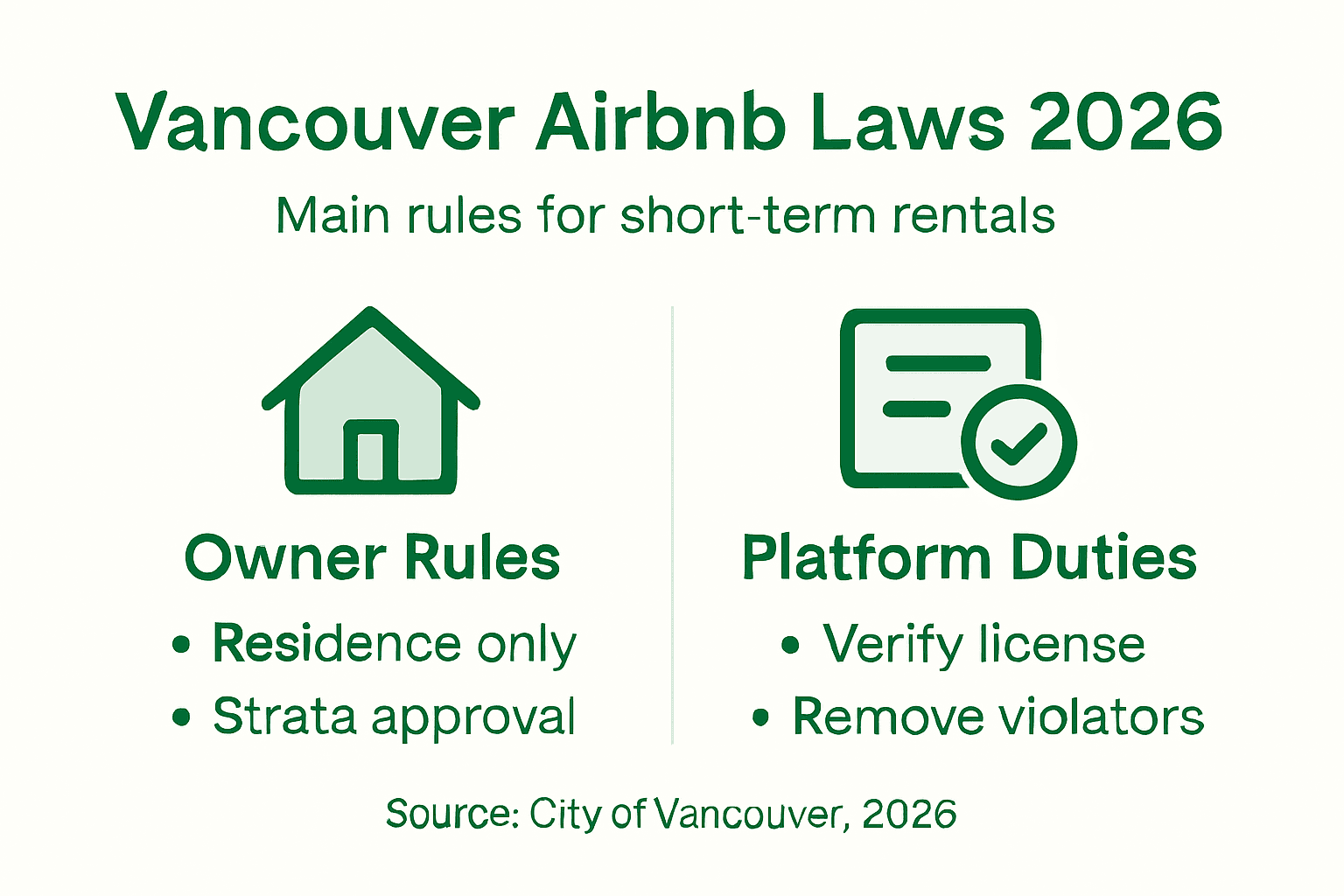
Rental Platform Responsibilities now include mandatory verification of host credentials, ensuring that all listings meet provincial and municipal regulatory standards. Online platforms like Airbnb must actively collaborate with local authorities to maintain accurate, compliant rental inventories.
Pro tip: Consult a local real estate lawyer specializing in short-term rental regulations to develop a comprehensive compliance strategy before investing in Vancouver rental properties.
Principal Residence Rule and Property Types
The principal residence requirement fundamentally transforms short-term rental strategies in Vancouver, creating a complex regulatory landscape for property investors. Provincial principal residence regulations establish strict guidelines that directly impact how owners can leverage their properties for short-term rentals.
Under these new regulations, property types are categorized into specific rental eligibility tiers:
Primary residential units
Secondary suites
Accessory dwelling units
Laneway homes
Strata-owned properties
The primary residence definition is critically precise. Owners must demonstrate that the property serves as their actual living space, substantiated through documentation like:
Utility bills in the owner’s name
Provincial health card registration
Income tax filing address
Voter registration records
Driver’s license address
Vancouver’s principal residence rules prioritize housing availability over short-term rental opportunities.
Strata properties introduce additional complexity, requiring explicit approval before short-term rental conversion. Many strata councils have implemented stringent bylaws that further restrict rental potential, making comprehensive due diligence essential for investors.
Property owners must navigate multiple regulatory layers, understanding that Vancouver’s short-term rental requirements extend beyond provincial baseline regulations. The city imposes additional restrictions, including:

Here is a summary of Vancouver short-term rental property types and their investment implications:
Property Type | Regulatory Challenge | Investment Potential |
Downtown condos | High compliance requirements | Strong year-round demand |
Laneway homes | Limited rental days allowed | Moderate, niche guest market |
Strata units | Strata approval often required | Variable, dependent on governance |
Secondary suites | Must meet principal residence rule | Lower vacancy, mid-tier returns |
One licence per individual
Maximum 90-day annual rental period
Mandatory landlord and strata approvals
Detailed record-keeping obligations
Compliance Verification demands meticulous documentation and proactive management. Investors must maintain comprehensive records demonstrating continuous adherence to principal residence requirements, or risk significant financial penalties.
Pro tip: Consult a local real estate professional specializing in short-term rental regulations to conduct a comprehensive property eligibility assessment before making any investment decisions.
Licensing, Taxes, and Ongoing Compliance
Navigating the complex landscape of short-term rental compliance requires meticulous attention to licensing, taxation, and regulatory requirements. Vancouver’s short-term rental licensing represents a comprehensive framework designed to ensure responsible property management and community integration.
The licensing process involves multiple critical components for prospective short-term rental operators:
Annual business licence application
Mandatory safety compliance documentation
Proof of primary residence
Landlord or strata corporation approval
Detailed record-keeping requirements
Financial obligations extend beyond the initial licensing fee, which currently stands at approximately $1,108 annually. Property owners must also consider:
Provincial sales tax registration
Income tax reporting for rental revenues
Potential additional municipal fees
Compliance monitoring expenses
Potential penalty mitigation costs
Short-term rental compliance is a dynamic process requiring continuous adaptation to evolving regulatory landscapes.
The Compliance and Enforcement Unit plays a critical role in monitoring and enforcing short-term rental regulations. Provincial compliance mechanisms include comprehensive investigative tools such as:
Administrative penalty assessments
Compliance order issuance
Potential legal injunctions
Systematic platform monitoring
Detailed violation tracking
Taxation Implications demand strategic financial planning. Rental income must be reported accurately, with operators required to maintain detailed financial records demonstrating transparent revenue reporting and tax compliance.
Non-compliance carries substantial risks, including:
Significant financial penalties
Potential licence suspension
Legal prosecution
Reputational damage
Potential property rental restrictions
Pro tip: Invest in professional accounting and legal consultation to develop a comprehensive compliance strategy that anticipates regulatory changes and minimizes financial risks.
Profit Potential, Luxury Upside, and Key Risks
Investing in Vancouver’s short-term rental market demands a nuanced understanding of potential returns and complex regulatory challenges. Short-term rental market dynamics reveal a landscape of substantial opportunities tempered by significant operational risks.
The profit potential varies across different property categories:
Luxury waterfront condos
Downtown high-rise units
Heritage neighborhood properties
Near-campus residential spaces
Olympic Village accommodations
Potential annual revenue streams demonstrate compelling investment attractiveness:
Premium properties: $60,000-$120,000 annually
Mid-tier units: $30,000-$75,000 annually
Standard residential spaces: $20,000-$50,000 annually
Niche market properties: $15,000-$40,000 annually
Vancouver’s short-term rental market rewards strategic, compliance-focused investors.
Understanding regulatory risks becomes paramount for sustainable investment. Evolving British Columbia rental regulations create substantial uncertainty for property investors, with potential consequences including:
Significant financial penalties
Potential listing removals
Restricted rental permissions
Complex compliance requirements
Reduced market flexibility
Luxury Market Advantages include premium pricing potential and higher-quality guest experiences. Investors focusing on exceptional properties can differentiate themselves through:
Curated interior design
Premium amenity packages
Exceptional customer service
Strategic location selection
Technology-enhanced guest interactions
Mitigating Investment Risks requires comprehensive due diligence, including:
Detailed market research
Robust legal consultation
Continuous regulatory monitoring
Flexible investment strategies
Comprehensive financial planning
Pro tip: Develop a diversified investment portfolio that balances short-term rental properties across different regulatory zones to minimize potential market disruption risks.
Alternatives to Airbnb in Vancouver
Beyond traditional Airbnb platforms, Vancouver offers a diverse ecosystem of short-term rental alternatives that provide strategic opportunities for property investors. Provincial short-term rental registry enables multiple platforms to operate legally within comprehensive regulatory frameworks.
Key alternative platforms include:
VRBO (Vacation Rentals by Owner)
HomeAway
FlipKey
Local boutique rental agencies
Corporate housing platforms
Each alternative platform presents unique advantages:
Below is a comparison of alternative short-term rental platforms for Vancouver investors:
Platform | Main Audience | Unique Benefit |
VRBO | Families, groups | Longer average stays |
Global travelers | Broad international reach | |
FlipKey | Vacation-oriented guests | User-friendly search experience |
Corporate Housing | Business professionals | Reliable occupancy, fewer issues |
VRBO: Strong family and group travel market
HomeAway: International traveler connections
Booking.com: Extensive global marketing reach
Local agencies: Personalized service networks
Corporate housing: Consistent, professional clientele
Alternative rental platforms offer diversified market access beyond traditional Airbnb strategies.
Regulatory Compliance Considerations demand careful platform selection:
Mandatory provincial registration requirements
Platform-specific licensing protocols
Verification of host credentials
Transparent reporting mechanisms
Consistent safety standard adherence
Strategic Platform Differentiation involves understanding unique market segments:
VRBO targets family and extended stay travelers
Booking.com attracts international visitors
Corporate platforms serve business professionals
Local agencies provide neighborhood-specific experiences
Risk Mitigation Strategies include:
Multi-platform listing approaches
Comprehensive insurance coverage
Diverse target market positioning
Regular regulatory compliance updates
Professional property management support
Pro tip: Develop a cross-platform rental strategy that maximizes exposure while maintaining strict regulatory compliance across different short-term rental platforms.
Navigate Vancouver’s Complex Airbnb Market with Expert Support
Facing the 2026 legal realities of buying an Airbnb in Vancouver means dealing with strict principal residence rules, licensing challenges, and evolving provincial regulations. These complexities can leave property owners uncertain about maximizing rental income while staying fully compliant. If you value peace of mind and want to unlock the profit potential of your investment without risking penalties or license suspensions, you need a partner who understands these nuances.
At Nestoria Estates, we specialize in managing luxury short-term rentals within Vancouver’s regulatory framework. Our platform provides tailored property management combined with curated travel experiences that elevate your guest offerings. From navigating registration requirements to ensuring your property meets all safety and strata approvals, we handle the heavy lifting so you can focus on maximizing returns.
Explore our premium properties and services and discover how we blend compliance with exceptional guest experiences.
Leverage our expertise today to confidently invest in Vancouver’s Airbnb market while protecting your financial future.
Partner with Nestoria Estates now and turn regulatory complexity into your competitive advantage.

Frequently Asked Questions
What are the principal residence requirements for buying an Airbnb in Vancouver?
The principal residence requirements mean that property owners must demonstrate that their property is their actual living space, supported by documentation like utility bills, health card registration, or tax records.
How long can I rent out my property on Airbnb each year?
Property owners can typically rent their primary residence for a maximum of 90 to 180 days per year, depending on specific municipal regulations.
What types of properties are eligible for short-term rentals in Vancouver?
Eligible properties for short-term rentals can be classified into primary residential units, secondary suites, accessory dwelling units, laneway homes, and strata-owned properties. Each category has different regulatory requirements.
What are the consequences of non-compliance with short-term rental regulations?
Non-compliance can lead to significant financial penalties, potential suspension of rental licenses, and legal action, making it essential for property owners to stay informed about regulations.
Recommended
Comments