

Short-Term Rental ROI: Maximizing Luxury Property Profits


Owning a luxury property in Vancouver presents both a unique opportunity and a real challenge: generating impressive returns while delivering the high-touch service affluent guests expect. The rules around short-term rental ROI go far beyond simple math, blending personalized hospitality with costs and market shifts that set this model apart from traditional leases. Understanding every piece of short-term rental ROI is crucial for property owners who want to balance profitability with standout guest reviews.
Table of Contents
Key Takeaways
Point | Details |
Short-Term Rental ROI Calculation | Unlike traditional rentals, ROI for short-term rentals considers variable income, higher operating costs, and active management needs. |
Premium Pricing Through Guest Experience | Properties offering curated services and experiences can charge higher rates, leading to increased profitability. |
Impact of Location and Seasonal Demand | The property’s location and seasonal fluctuations significantly influence rental success and income generation. |
Hidden Costs and Accurate Expense Tracking | Owners should account for hidden costs like repairs, permits, and the value of their time to avoid miscalculating their ROI. |
Defining Short-Term Rental ROI in Real Estate
Short-term rental ROI measures how much profit you generate from your luxury property relative to the money and time you invest. Unlike traditional long-term rentals, short-term rentals refer to properties rented for brief periods, often under seven days, which fundamentally changes how you calculate returns.
ROI in Vancouver’s luxury market isn’t just about gross revenue divided by property cost. You need to account for variable expenses, seasonal fluctuations, and the active management required to maintain high occupancy rates and guest satisfaction.
Here’s what separates short-term rental ROI from traditional metrics:
Rental income varies monthly based on seasonality, local events, and demand patterns
Operating costs are higher due to frequent turnover, cleaning, and guest communication
Tax treatment differs significantly from long-term rentals, offering unique advantages
Time investment is substantial if you manage the property yourself
Guest experience directly impacts earnings through reviews and repeat bookings
Vancouver’s luxury vacation rental market thrives on personalized experiences. Properties that offer curated add-ons like private chef services and city tours typically generate higher per-night rates and command premium pricing year-round.
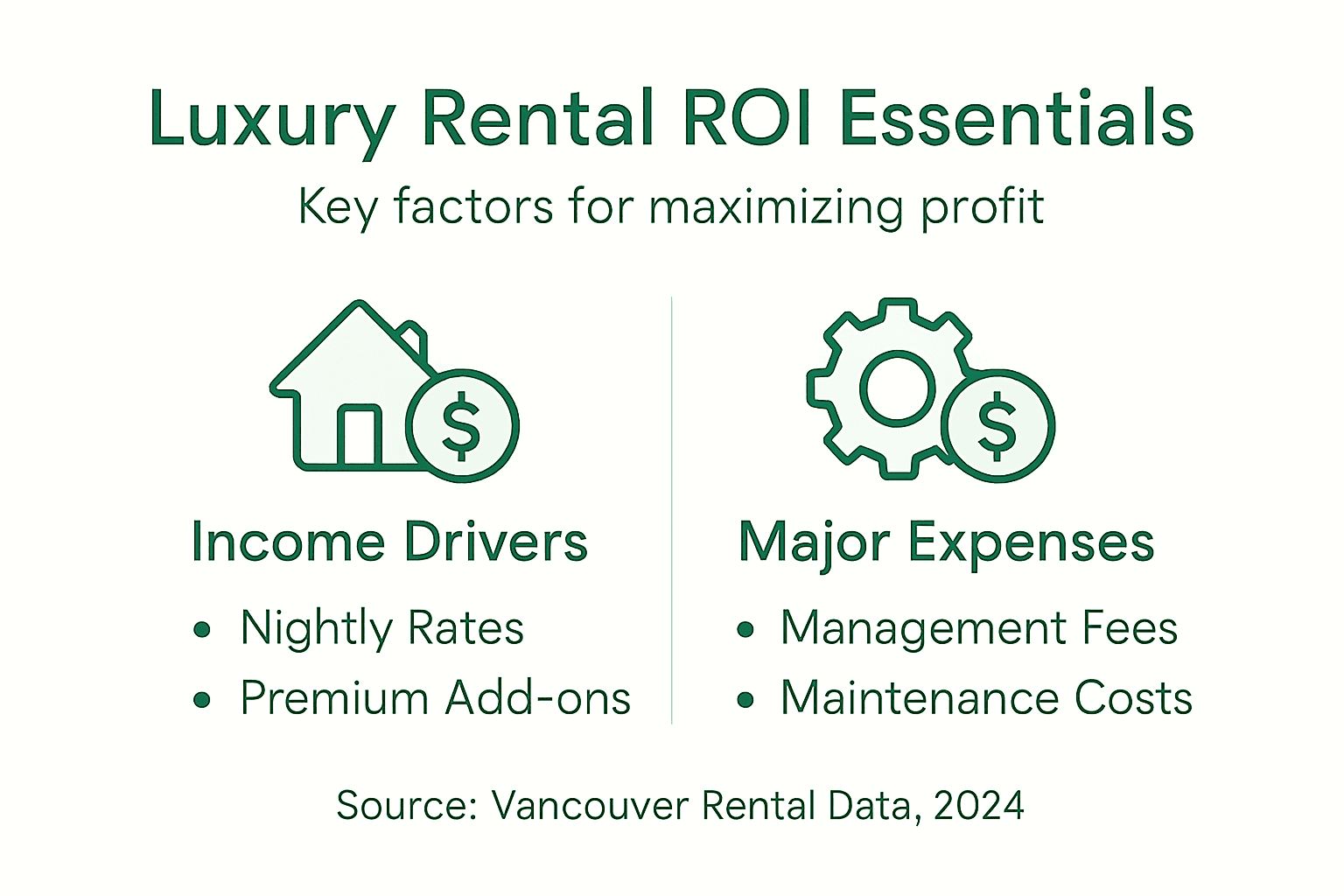
The Numbers Behind ROI
A typical luxury property in Vancouver might generate $8,000 to $15,000 monthly during peak season (summer), dropping to $3,000 to $6,000 during slower months. Your actual ROI depends on these core factors:
Purchase price or property value
Total annual rental income
Operating expenses (utilities, insurance, maintenance, cleaning)
Vacancy rates and seasonal gaps
Management fees or time invested
Capital improvements and upgrades
ROI reveals whether your property works as a vacation rental investment or whether you’d earn better returns through alternative strategies.
Many Vancouver luxury owners discover that high-end properties outperform long-term rentals when managed for the vacation market. The ability to charge premium nightly rates for homes with ocean views, private pools, or downtown locations makes short-term rentals financially attractive.
Calculating your actual ROI requires tracking both income and expenses meticulously. Properties earning $120,000 annually but spending $50,000 on operations, management, and maintenance deliver a very different return than properties with lower operational demands.

Pro tip: Separate your ROI calculations by season—track peak, shoulder, and off-season performance independently to identify which periods drive your profits and where you might optimize pricing or marketing.
Methods for Calculating Rental Return on Investment
Calculating ROI accurately is the foundation of smart investment decisions. There are several approaches, each revealing different aspects of your property’s financial performance.
The most straightforward method is gross rental yield, which divides your annual rental income by the property purchase price. A Vancouver luxury property purchased for $2 million generating $180,000 annually in rental income yields 9% gross return. However, this ignores all expenses, so it’s incomplete.
Net rental yield paints a more realistic picture. This calculation subtracts operating expenses from rental income, then divides by purchase price. Operating costs include utilities, insurance, maintenance, and property management fees, which can consume 30% to 50% of gross revenue in luxury properties.
Here’s the core difference between calculation methods:
Here’s how common ROI calculations compare for luxury short-term rentals:
Method | What It Measures | Pros | Cons |
Gross Yield | Income vs. purchase price | Simple, quick estimate | Ignores all expenses |
Net Yield | Profit after expenses vs. price | Reflects operational costs | Still misses loan impact |
Cash-on-Cash Return | Actual cash profit vs. invested sum | Captures real return | Excludes property appreciation |
Cap Rate | Net income vs. property value | Compares properties fairly | Can be skewed by market value |
Gross yield: Rental income ÷ Purchase price (ignores expenses)
Net yield: (Rental income − Operating costs) ÷ Purchase price (accounts for expenses)
Cash-on-cash return: Annual cash flow ÷ Total cash invested (measures actual money in your pocket)
Cap rate: Net operating income ÷ Property value (compares properties fairly)
The Complete ROI Formula
For Vancouver luxury owners, the most useful metric combines everything:
Calculate total annual rental income from all bookings
Subtract all operating expenses (cleaning, utilities, insurance, mortgage interest, maintenance)
Subtract property management fees or your time value
Subtract capital improvements and upgrades
Divide remaining profit by total cash invested
Multiply by 100 for percentage
If you invested $500,000 cash down payment and earned $25,000 net profit after all expenses, your cash-on-cash return is 5%. Net ROI accounts for all capital invested and provides the realistic measure of profitability that matters most.
Calculate both gross and net returns—the gap between them reveals how efficiently you’re operating your property.
Many luxury property owners overlook hidden costs: seasonal vacancy rates, emergency repairs, property taxes specific to short-term rentals in Vancouver, and the value of management time. These expenses directly impact your actual returns.
Compare multiple metrics simultaneously. One property might show 8% cap rate but only 2% cash-on-cash return due to high mortgage payments. Another might have lower cap rate but superior cash flow because it’s mortgage-free.
Pro tip: Create separate calculations for each quarter to catch seasonal patterns—summer months might yield 15% returns while winter drops to 2%, helping you identify when to adjust pricing or plan renovations.
Factors Impacting ROI in Luxury Rentals
Not all luxury properties perform equally. Your ROI depends on factors both within and beyond your control, and understanding them helps you optimize returns.
Location matters intensely. A waterfront penthouse in Vancouver’s Coal Harbour commands $800+ per night, while an equally luxurious property in less desirable neighborhoods struggles to reach $400. Proximity to attractions, water views, walkability, and neighborhood prestige directly influence what guests pay.
Seasonal demand creates dramatic fluctuations. Vancouver’s luxury rental market peaks in summer months (June through September) when occupancy rates hit 80% to 90%. Winter months drop significantly unless your property appeals to holiday travelers or ski enthusiasts. Understanding your property’s peak and off-peak seasons allows you to adjust pricing strategically.
Market location and seasonal fluctuations critically influence luxury rental returns, shaping when and how much revenue you generate throughout the year.
Operating costs in luxury properties exceed standard rentals substantially:
Premium furnishings and décor requiring regular updates and replacement
Concierge services for guest requests, restaurant reservations, and special arrangements
High-end cleaning standards using specialized services between each guest
Professional property management with 24/7 availability and responsiveness
Maintenance of luxury features like pools, hot tubs, home automation systems
Insurance premiums reflecting higher property values and liability exposure
Hidden Costs That Erode Profits
Furnishing, management fees, and concierge services elevate guest experience but add significant expenses that cut directly into your bottom line. Many luxury owners underestimate these costs when projecting returns.
Regulatory requirements in Vancouver impact profitability directly. Short-term rental regulations, business licensing fees, property taxes on rental income, and potential restrictions on rental days per year all reduce net returns. These rules vary by neighborhood and change frequently.
Property uniqueness drives pricing power. A luxury home with exceptional architecture, designer interiors, or one-of-a-kind features commands premium rates. Generic luxury properties with standard finishes struggle to differentiate and often compete primarily on price.
Guest experience quality directly affects your ROI through reviews and repeat bookings. Professional rental management maximizes luxury income by ensuring flawless guest experiences that generate five-star reviews, higher occupancy rates, and the ability to maintain premium pricing.
Vacancy rates vary seasonally but also depend on marketing effectiveness and pricing strategy. A property sitting empty one week monthly loses approximately 8% of annual revenue, regardless of nightly rate.
Optimize the factors you control—property condition, guest experience, and pricing strategy—while planning for those you cannot, like seasonal demand and regulatory changes.
Pro tip: Track your cost-per-booking by dividing total annual operating expenses by number of bookings to identify whether high-touch services like concierge deliver enough additional revenue to justify their cost.
Overlooked Costs and Common Pitfalls
Many Vancouver luxury property owners start with optimistic ROI projections that crumble when reality hits. The gap between expected and actual returns usually comes from costs they didn’t anticipate.
Vacancy rates destroy profitability silently. A property sitting empty costs nothing to operate but generates zero revenue. Most owners assume 85% to 90% occupancy, but luxury properties often experience 20% to 30% vacancy, especially during shoulder seasons. One empty week monthly cuts annual returns by 8% before any expenses are factored in.
Unexpected repairs blindside owners repeatedly. A luxury property’s hot tub malfunctions mid-winter, requiring $3,000 in repairs. The smart home system crashes, necessitating $2,500 in technician fees. These aren’t budgeted in monthly operating costs but arrive nonetheless. Unexpected repairs, insurance premiums, and management fees erode rental profits significantly over time.
Here’s what luxury owners commonly forget:
Turnover cleaning costs between every guest, not just weekly
Utilities for empty properties running continuously through vacant periods
Licensing and permit renewal fees that increase periodically
Short-term rental tax compliance requiring accountant expertise
HOA or condo fees with potential surcharges for rental activity
Capital replacements like HVAC systems or roofing (not optional)
The Hidden Time Cost
If you manage the property yourself, you’re working for free until ROI calculations account for your labor. Responding to guest inquiries, coordinating cleaners, handling complaints, and managing bookings requires 10 to 20 hours monthly for active properties. Valuing your time at $50 per hour adds $6,000 to $12,000 in annual costs that don’t appear on expense statements.
Variable costs like utilities, cleaning fees, and licensing expenses significantly reduce expected ROI, especially in Vancouver’s regulated short-term rental environment where compliance requirements increase annually.
Tax liability surprises many owners. Short-term rental income is fully taxable at marginal rates. A property generating $120,000 annually might owe $35,000 to $45,000 in taxes, depending on your income bracket. Owners who don’t set aside this money monthly face unexpected bills.
Property degradation happens faster in short-term rentals. Luxury finishes deteriorate through frequent guest use. That designer sofa needs reupholstering after three years instead of five. Premium linens wear out constantly. These replacement costs compound annually.
Below is a summary of hidden costs that can reduce actual ROI in Vancouver luxury rentals:
Cost Type | Typical Frequency | Financial Impact |
Emergency Repairs | Unpredictable, as needed | $2,000–$5,000 per incident |
Licensing & Permits | Annual or biannual | $500–$2,000 annually |
Tax Compliance | Annual | Up to 35% of gross income |
Capital Replacements | Every 3–8 years | $10,000+ for major systems |
Owner Time Value | Ongoing, monthly | $6,000–$12,000 per year |
Underestimating costs by 20% to 30% is standard among first-time luxury rental owners—plan conservatively and adjust upward if performance exceeds expectations.
Market volatility in Vancouver’s vacation rental sector creates income uncertainty. A major event (pandemic, recession, or regulatory restrictions) can devastate occupancy instantly. Properties without financial reserves fail when returns drop suddenly.
Pro tip: Create a detailed spreadsheet tracking every expense for the first year, then add 15% to 20% as a contingency buffer when projecting future ROI—this accounts for surprises and prevents disappointment when reality emerges.
Enhancing ROI Through Guest Experience Add-Ons
Guest experience add-ons transform ordinary luxury rentals into memorable stays that justify premium pricing and generate repeat bookings. These value-added services directly impact your bottom line through higher nightly rates and occupancy numbers.
Premium add-ons create pricing power. A standard luxury penthouse might rent for $600 per night, but one offering a private chef experience commands $900 to $1,200. That $300+ increase covers the service cost while delivering significant profit margins. Guests remember exceptional experiences and book again or recommend your property enthusiastically.
Guest experience add-ons like concierge services, tailored local experiences, and premium amenities increase perceived property value, justifying higher rental rates while driving positive guest reviews and occupancy.
Here’s what separates high-performing properties from average ones:
Private chef services for special dinners or multiple-day meal planning
Concierge arrangements handling reservations, tickets, and local logistics
Curated city tours with insider knowledge of Vancouver neighborhoods
Spa and wellness packages including massage therapists and yoga instructors
Adventure experiences like helicopter tours or yacht charters
Celebration packages for anniversaries, proposals, or milestone birthdays
Strategic Add-On Selection
Not every add-on makes financial sense. Calculate the cost versus the price increase it justifies. A private chef service costing $500 might enable you to charge $400 more per night—that’s only $100 additional profit if booked once monthly. Analyze demand carefully before investing.
Personalization drives booking decisions more than any single amenity. Vacation rental management services handle bespoke luxury stays by matching guest preferences with curated experiences, transforming casual bookings into premium reservations.
Review data reveals what guests value most. Properties offering genuine, thoughtfully selected experiences receive five-star ratings mentioning “unforgettable” or “exceeded expectations.” These glowing reviews convert browsers into bookers and justify price premiums.
Timing matters strategically. Romantic getaway packages sell well Valentine’s Day through March. Holiday celebration experiences peak November through December. Align seasonal add-ons to natural demand cycles.
Tech enhancements increase perceived luxury. Smart home systems controlling lighting, temperature, and entertainment create modern comfort. Premium streaming services, high-speed internet, and voice-activated controls appeal to affluent travelers expecting sophisticated amenities.
Guests booking luxury properties don’t just want accommodation—they want curated moments they couldn’t create themselves at home.
Transparency in add-on pricing prevents guest friction. Clearly present optional packages during booking with exact costs, building trust and reducing cancellations related to surprise fees.
Pro tip: Survey past guests asking which experience would have elevated their stay further, then introduce the top three suggestions at competitive pricing—this guarantees demand for your new add-ons.
Unlock the Full Potential of Your Luxury Short-Term Rental Investment
Maximizing short-term rental ROI in Vancouver requires more than just high nightly rates. The challenges of managing variable operating costs, seasonal vacancies, and delivering exceptional guest experiences demand expert support. If you want to overcome hidden expenses and boost your property returns through curated add-ons like private chef services and personalized city tours you need a partner who understands the luxury vacation rental market inside and out.

Partner with Nestoria Estates to elevate your property’s profitability. Our comprehensive vacation rental management platform combines expert listing services with bespoke experience packages crafted to increase your occupancy and justify premium pricing year-round. From 24/7 management that cuts your time investment to seamlessly integrating guest experience enhancements we help you unlock higher cash-on-cash returns and smooth operational efficiency. Start turning your luxury property into a standout income generating asset by visiting Nestoria Estates and explore how our tailored solutions bring lasting value to your short-term rental business. Discover more about maximizing luxury property profits with our curated travel experiences and professional rental management services today.
Frequently Asked Questions
What factors should I consider when calculating ROI for a short-term rental?
You should consider purchase price, total annual rental income, operating expenses, vacancy rates, management fees, and any capital improvements.
How do seasonal fluctuations impact my short-term rental ROI?
Seasonal fluctuations can significantly affect rental income, with peak seasons generating higher occupancy rates and revenue compared to slower months. Understanding these patterns helps optimize pricing strategies.
What are the hidden costs associated with luxury vacation rentals that could affect my ROI?
Hidden costs can include emergency repairs, licensing fees, property management expenses, and the depreciation of luxury furnishings. It’s essential to account for these when calculating your actual returns.
How can guest experience add-ons enhance my rental profits?
Offering personalized guest experiences, such as private chef services or curated city tours, can justify higher rental rates and improve guest satisfaction, resulting in repeat bookings and positive reviews.
Recommended
Comments