

Benefits of Professional Rental Management: Maximizing Luxury Income


Managing a luxury property in cities like London, Paris, or New York often means balancing high income expectations with the demand for personalized service. Every decision can impact guest satisfaction, long-term rental value, and the overall prestige of your investment. By understanding the advantages of professional rental management, you gain insight into how a strategic and technology-driven approach can transform your property into a truly profitable asset while delighting the most discerning guests.
Table of Contents
Key Takeaways
Point | Details |
Professional Rental Management | Offers a comprehensive operational approach, transforming properties from passive assets into actively managed, income-generating investments. |
Vacation Rental Models | Diverse management models exist, including owner-managed, third-party, hybrid, and platform-assisted, each with unique advantages and challenges. |
Luxury Property Management | Focuses on personalizing guest experiences while integrating advanced technologies and providing concierge-level services to elevate value. |
Legal Compliance Importance | Rigorous adherence to regulations is essential for property managers to mitigate risks related to tenancy agreements, safety standards, and financial reporting. |
Defining Professional Rental Management Services
Professional rental management represents a sophisticated approach to property oversight that transforms individual real estate assets into strategic income-generating investments. Unlike traditional rental methods, these services provide comprehensive operational support that goes far beyond simple property listing and maintenance. Professional property management has evolved into a consolidated industry characterized by corporate hosting and systematic management practices.
At its core, professional rental management encompasses several critical operational dimensions:
Technological Integration: Leveraging digital platforms for seamless booking, guest communication, and performance tracking
Portfolio Optimization: Managing multiple properties with standardized service models
Revenue Enhancement: Implementing dynamic pricing strategies and occupancy maximization techniques
Guest Experience Curation: Delivering consistent, high-quality hospitality experiences across different properties
The professional management landscape goes beyond simple property maintenance, representing a holistic approach to real estate monetization. Property agency standards established by global organizations like RICS outline sophisticated frameworks for conducting these services, which include detailed operational protocols and ethical guidelines.
Professional rental management transforms properties from passive assets into dynamic, revenue-generating investments through strategic, technology-enabled approaches.
Key differentiators of professional management include systematic risk mitigation, advanced financial reporting, and specialized expertise in local real estate markets. These services integrate comprehensive market analysis, legal compliance monitoring, and proactive maintenance strategies that individual property owners often cannot replicate independently.
Pro tip: Research and select a management company with proven expertise in your specific property type and local market to maximize your rental income potential.
Types of Vacation Rental Management Models
Vacation rental management has evolved into multiple sophisticated models, each designed to address different property owner needs and market dynamics. Accommodation business models range from hands-on owner management to comprehensive third-party professional services, representing a nuanced approach to real estate monetization.
The primary vacation rental management models include:
Owner-Managed Model: Direct property oversight by the owner
Third-Party Management Model: Full-service professional management
Hybrid Management Model: Collaborative approach between owner and management company
Platform-Assisted Management: Using digital platforms for partial management support
Third-party management represents the most sophisticated approach. Comparative research on management strategies reveals that professional managers leverage economies of scale, advanced marketing techniques, and operational expertise to optimize rental performance significantly.
Professional management transforms individual properties into strategically optimized income-generating assets through systematic, data-driven approaches.
Each management model offers distinct advantages and challenges. Owner-managed models provide maximum control but demand significant time investment, while third-party management delivers professional expertise at the cost of reduced direct involvement. Hybrid models increasingly represent a balanced approach, allowing owners to retain strategic input while benefiting from professional operational support.
Here’s a comparison of the main vacation rental management models and their strategic benefits:
Model Type | Owner Involvement | Revenue Potential | Operational Expertise |
Owner-Managed | Full control by owner | Varies, often inconsistent | Limited to owner’s knowledge |
Third-Party Managed | Minimal | Higher with expert pricing | High, professional systems |
Hybrid Model | Shared | Moderate, flexible options | Mixed, blends skills |
Platform-Assisted | Some | Moderate, boosted by tech | Dependent on platform tools |
Pro tip: Evaluate your personal time availability, technical expertise, and income goals to select the most appropriate vacation rental management model for your specific property.
Key Features of Luxury Property Management
Luxury property management transcends traditional rental services, representing a sophisticated approach to real estate that prioritizes exceptional guest experiences and strategic value creation. Strategic luxury management focuses on creating unique value propositions that distinguish high-end properties from standard rental offerings.
The core features of luxury property management include:
Personalized Guest Experience: Tailored services anticipating and exceeding guest expectations
Advanced Technology Integration: Cutting-edge digital platforms for seamless booking and communication
Comprehensive Property Maintenance: Meticulous upkeep and preservation of property aesthetic and functional value
Concierge-Level Services: Premium add-ons like private chefs, transportation, and exclusive local experiences
Discrete Security Protocols: Enhanced privacy and safety measures for high-net-worth clients
Professional standards are paramount in luxury property management. Real estate management guidance emphasizes the critical importance of maintaining stringent operational protocols, ensuring client confidentiality, and delivering consistently exceptional service.
Luxury property management transforms real estate from mere accommodations into curated, memorable experiences that reflect the highest standards of hospitality and personal service.
Successful luxury property management requires a delicate balance between creative guest experience design and rigorous operational excellence. Managers must possess deep understanding of high-end market dynamics, technological sophistication, and the nuanced expectations of discerning travelers seeking more than just a place to stay.
Pro tip: Invest in continuous staff training and cultivate a network of premium local service providers to elevate your luxury property management offerings.
Legal Compliance and Regulatory Responsibilities
Property management involves complex legal landscapes that demand rigorous adherence to multiple regulatory frameworks. Real estate management standards emphasize the critical importance of understanding and implementing comprehensive legal compliance protocols across different jurisdictional requirements.
Key legal compliance considerations include:
Tenancy Agreement Regulations: Ensuring contract terms meet local and national legal standards
Anti-Discrimination Laws: Maintaining fair and equitable tenant selection processes
Safety and Health Compliance: Meeting building codes, safety regulations, and maintenance requirements
Tax and Financial Reporting: Accurate documentation and transparent financial management
Licensing and Permit Requirements: Obtaining and maintaining necessary operational permits
Regulatory frameworks vary significantly across different regions and property types. Rental regulation systems demonstrate the complexity of navigating local and national legal requirements, which can differ dramatically based on property classification, location, and intended use.
Professional property management requires continuous legal education and proactive compliance strategies to mitigate potential risks and legal challenges.
Successful legal compliance demands a multifaceted approach that combines deep legal knowledge, meticulous documentation, and ongoing education. Property managers must stay current with evolving regulations, implement robust internal compliance protocols, and develop strategic relationships with legal professionals who specialize in real estate law.

Pro tip: Invest in comprehensive legal compliance training and develop a systematic approach to tracking and updating regulatory requirements for your properties.
Financial Impacts: Income, Costs, and Taxes
Professional rental management transforms property investments by strategically optimizing financial performance. Short-term rental management demonstrates significant potential for maximizing revenue through advanced operational strategies and technological integration.
Key financial considerations include:
Dynamic Pricing Strategies: Leveraging real-time market data to optimize rental rates
Cost Management: Identifying and minimizing operational expenses
Tax Optimization: Implementing efficient tax planning and reporting mechanisms
Revenue Diversification: Developing multiple income streams from property assets
Performance Tracking: Using advanced analytics for financial decision-making
Financial planning requires comprehensive understanding of complex revenue models. Rental business feasibility research highlights the critical importance of detailed accounting techniques, including precise tracking of maintenance costs, cleaning expenses, and commission structures.
Successful property financial management transforms real estate from a passive asset into a sophisticated, revenue-generating investment vehicle.
Professional management mitigates financial risks by implementing sophisticated financial protocols. This approach includes comprehensive market research, detailed cost analysis, and strategic pricing models that adapt to changing market conditions and maximize potential income streams.
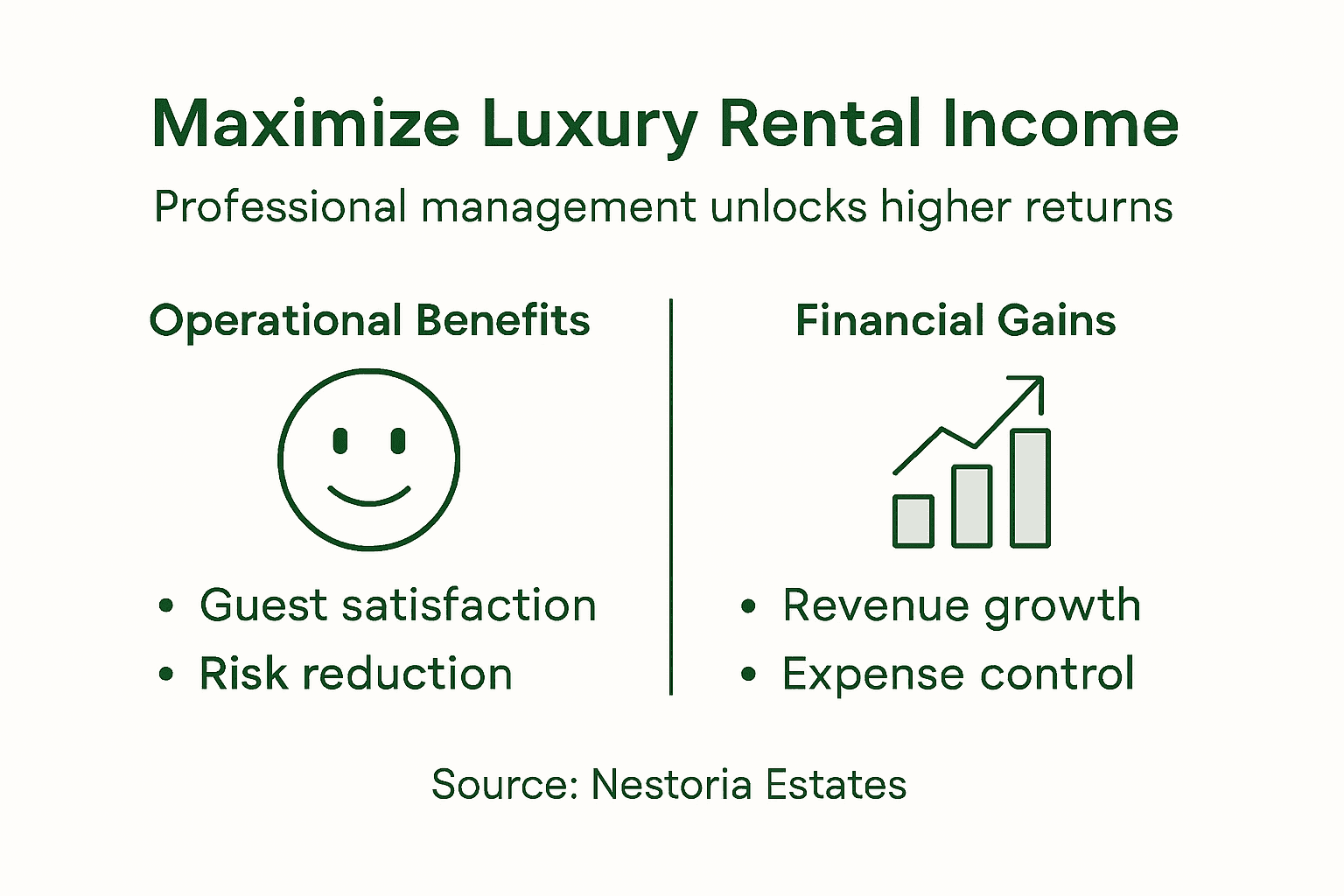
The table below summarizes key financial effects of professional rental management:
Financial Aspect | Strategic Value | Risk When Neglected |
Dynamic Pricing | Maximized nightly earnings | Underpricing or lost occupancy |
Cost Controls | Higher profit margins | Rising operational expenses |
Tax Optimization | Minimized tax liabilities | Fines or excessive tax payments |
Analytics Usage | Accurate forecasting | Poor planning, missed opportunities |
Pro tip: Develop a robust financial tracking system that integrates real-time market data, expense monitoring, and predictive analytics to optimize your property’s financial performance.
Risks, Liabilities, and Owner Protections
Property management involves navigating complex legal and financial risks that require strategic protection mechanisms. Legal liabilities of property managers encompass a wide range of potential exposure points that demand proactive risk management strategies.
Critical risk management considerations include:
Maintenance Liability: Preventing injuries through regular property inspections
Environmental Hazard Protection: Addressing potential health risks like mold or lead exposure
Insurance Coverage: Comprehensive policies protecting against unexpected incidents
Tenant Screening Protocols: Minimizing potential legal disputes through thorough tenant evaluation
Contract Clarity: Developing precise management agreements with clear liability boundaries
Professional risk mitigation requires comprehensive strategies. Real estate management standards emphasize the importance of thorough risk assessments and transparent communication with property owners about potential legal exposures.
Effective risk management transforms potential vulnerabilities into structured, predictable operational protocols that protect both property owners and managers.
Successful liability protection involves a multifaceted approach combining legal expertise, comprehensive insurance coverage, and proactive management techniques. Property managers must continuously update their risk management strategies to address evolving legal landscapes and emerging potential liability scenarios.
Pro tip: Conduct annual comprehensive risk assessments and maintain detailed documentation of all property management activities to minimize potential legal vulnerabilities.
Elevate Your Luxury Property Income with Expert Rental Management
The article highlights the challenges property owners face in maximizing revenue while delivering exceptional guest experiences through professional rental management. You may be seeking ways to enhance your luxury property’s performance by leveraging dynamic pricing, personalized guest services, and comprehensive operational expertise. Managing risks, legal compliance, and ensuring unforgettable stays demand a sophisticated approach that goes beyond traditional rental methods.
At Nestoria Estates, we specialize in connecting luxury property owners with travelers who value bespoke stays and curated experiences. Our platform offers expert short-term rental management, seamless booking tools, and tailored packages such as private chefs and exclusive city tours to help you fully capitalize on your investment. By integrating advanced technology with personalized hospitality, we help transform your property into a vibrant, income-generating asset while exceeding guest expectations.
Discover how our professional rental solutions can help you achieve greater revenue and guest satisfaction at Nestoria Estates. Learn more about maximizing your property earnings with expert support by visiting our vacation rental management platform.
Are you ready to elevate your luxury rental income and create memorable guest experiences today

Join Nestoria Estates now and start turning your property into a premier destination that guests love and owners trust. Visit us at https://nestoriaestates.com to get started.
Frequently Asked Questions
What are the main benefits of professional rental management for luxury properties?
Professional rental management for luxury properties offers personalized guest experiences, advanced technology integration, comprehensive property maintenance, concierge-level services, and enhanced security protocols, all of which contribute to maximizing rental income.
How does professional rental management help in optimizing rental income?
Professional rental management utilizes dynamic pricing strategies and comprehensive market analysis to adjust rental rates and increase occupancy, ultimately enhancing revenue potential for luxury properties.
What key features differentiate luxury property management from standard rental management?
Luxury property management focuses on personalized guest experiences, meticulous property maintenance, and high-end services, setting it apart from standard management that typically emphasizes basic property upkeep.
What legal compliance issues should property owners consider in professional rental management?
Property owners must ensure compliance with tenancy agreement regulations, anti-discrimination laws, safety and health requirements, tax obligations, and necessary licensing and permits to avoid legal complications.
Recommended
Comments