
How to Monetize Luxury Property in 2026: Vancouver Owner's Playbook
- info67421305
- 6 minutes ago
- 19 min read

For most Vancouver luxury owners in 2026, the fastest and lowest-risk route to meaningful income is a professionally managed short-term rental on your principal residence, listed across Airbnb, Vrbo, and Booking.com, with a revenue-share manager handling compliance, pricing, and guest operations.
Here is why that recommendation holds up. BC’s principal-residence rule, enacted in May 2024, removed most investor-owned short-term rentals from the market. Fewer legal listings means higher per-night prices for compliant hosts. Luxury properties in Vancouver typically command ADRs well above the city average, and a specialist manager can push occupancy into a moderately high range on a well-positioned listing. The City of Vancouver business licence costs $77 to apply and roughly $1,108 annually, and your listing must display both the provincial registry number and the City licence number before you go live.
Prioritized monetization routes for Vancouver luxury owners:
Luxury short-term rental (principal residence, managed): Highest ADR, fastest ramp-up, fully compliant when licensed. Best for owners who live in the property and want hands-off income.
Mid-term corporate leasing (30–90 days): Sidesteps the principal-residence rule, attracts relocating executives and film crews, lower operational intensity than nightly rentals.
High-end long-term tenancy: Steadiest cash flow, lowest operational burden, but subject to BC’s Residential Tenancy Act and rent-increase caps.
Film and location hire: High day rates, episodic revenue, requires strata approval and event insurance. Best layered on top of another primary strategy.
Secondary suite or laneway house conversion: Highest capex, longest payback, but adds a permanent yield-generating asset and increases estate value.
Pro Tip: Request a free revenue projection before committing to any route. Nestoriaestates provides owner-specific ADR and occupancy estimates based on your property’s size, location, and finish level, so you can model net income before spending a dollar on setup.
Key Takeaways
Professionally managed luxury short-term rentals on a principal residence are the fastest, highest-yield monetization route for most Vancouver owners in 2026, provided compliance with BC’s principal-residence rule and City of Vancouver licensing requirements is in place.
Point | Details |
Compliance is non-negotiable | You need a BC registry number and a City of Vancouver business licence ($77 application, $1,108 annual) before listing. |
ADR and occupancy drive net income | Target $450–$550 ADR and 60–75% occupancy for a well-positioned Vancouver luxury listing. |
Dynamic pricing beats static rates | Override algorithms for high-demand events (VIFF, Pride, cruise season) to capture premium nightly rates. |
Capex payback varies widely | Executive suite conversions cost $150k–$450k+ and typically pay back in five to ten years at conservative occupancy. |
Nestoriaestates manages the full operation | Revenue-share management typically improves net owner income by lifting ADR and occupancy above self-managed levels. |
Table of Contents
What compliance steps do Vancouver owners need before listing?
When does long-term or mid-term leasing beat short-term renting?
Which capex projects actually move the yield needle in Vancouver?
What non-guest revenue streams work for Vancouver luxury homes?
DIY vs. professional luxury property manager: what should you expect?
What taxes and fees do you need to model for luxury rental income in Canada?
How do you price and forecast revenue for a luxury Vancouver rental?
How Nestoriaestates helps Vancouver luxury owners: sample projection and case highlights
Nestoriaestates manages Vancouver luxury properties so you do not have to
Which monetization route fits your luxury property?
The right strategy depends on three variables: whether you live in the property, how much operational involvement you want, and your risk tolerance for regulatory exposure. The matrix below uses conservative estimates for Vancouver luxury properties.
Route | Typical ADR & Occupancy | Upfront Capex | Operational Intensity | Regulatory Risk | Payback Period | Best Use Cases |
Luxury short-term rental (managed) | typical ADR and occupancy above average | Low setup costs | Low (with manager) | Medium (principal-residence rule, licence required) | Moderate payback period | Principal-residence owners, families, couples, corporate guests |
Mid-term corporate leasing (30–90 days) | moderate nightly equivalent rate; relatively high occupancy | Low to medium | Low to medium | Low (avoids STR rules for 90+ day stays) | Moderate payback period | Relocating executives, film crews, extended-stay travelers |
High-end long-term tenancy | competitive monthly rents | Low | Low | Low (RTA applies; rent-increase rules) | Moderate to longer payback period | Owners prioritizing stability over yield |
Film and location hire | day rates higher than rental income | Low (insurance upgrade) | Medium to high | Medium (strata, permits, noise bylaws) | Episodic income | Luxury homes with distinctive architecture or interiors |
Secondary suite conversion | adds significant monthly net rental income | High upfront cost ($150k–$450k+) | Low (once built) | Medium (permits, zoning, strata) | Long payback period | Owners with underused lower levels or laneway potential |
A few clarifications worth making explicit:
The short-term rental route requires principal-residence status. If you do not live in the property, mid-term corporate leasing or long-term tenancy is the compliant path.
Film and location hire earns the highest per-day rate but is episodic. It works best as a revenue supplement, not a primary income strategy.
Long-term tenancy offers the most predictable cash flow but the lowest yield per square foot. For a $3M+ Vancouver home, the opportunity cost versus a managed short-term rental is substantial.
Luxury rental investment metrics for Vancouver show that owners who combine professional management with dynamic pricing consistently outperform self-managed listings on both ADR and occupancy.
How do you win a luxury short-term rental listing in 2026?
The three highest-ROI listing upgrades are professional media, concierge-style amenities, and a tailored guest experience that signals the property’s tier before a guest ever books. Everything else is secondary.
Professional photography and videography
Luxury guests make booking decisions based on visual quality. A standard real-estate shoot does not cut it. You need a photographer who understands hospitality staging: wide-angle interiors with natural light, detail shots of premium finishes (stone countertops, hardware, wine storage), and exterior shots that capture the neighborhood context. For video, a 90–120 second walkthrough with drone footage of the surrounding area converts browsers into bookers at a meaningfully higher rate than static images alone.

Shot list minimums: every bedroom, both bathrooms, kitchen, living areas, outdoor spaces, and at least one lifestyle shot (a set table, a lit fireplace, a morning coffee setup on the deck). Drone footage is worth the extra cost for properties with mountain views, water proximity, or significant outdoor space.
Listing copy for high-net-worth guests
Write to the guest’s experience, not the property’s specs. “Three bedrooms” is a spec. “Wakes up to unobstructed North Shore mountain views from the primary suite” is an experience. Lead with the neighborhood’s selling points (proximity to fine dining, cultural venues, film festival venues, Granville Island), then layer in amenities. Use specific brand names for appliances and finishes when they signal quality (Sub-Zero, Miele, Restoration Hardware). High-net-worth guests notice.
For event targeting, add language that signals the property’s suitability for specific occasions: corporate retreats, family reunions, film-industry accommodation, wedding-party overflow. These searches are less competitive and often command premium rates.
Operational policies that protect the asset
Minimum stay of three nights is the standard floor for luxury properties. It filters out single-night party bookings and improves the cleaning-fee economics. A simple illustration: a $350 cleaning fee spread across one night raises the effective nightly cost by $350. Spread across four nights, it adds $87.50. At a $500 ADR, that is the difference between a guest perceiving the listing as overpriced versus competitive. Vancouver Tourism data confirms the break-even versus hotels typically lands around three to four nights once cleaning fees and platform service fees are factored in.
Damage protection: require a security deposit or use a platform-provided damage protection program, and carry a dedicated short-term rental insurance endorsement on top of your homeowner’s policy. Standard homeowner’s insurance does not cover commercial rental activity.
A curated welcome package (how to enjoy self-catering stays: local restaurant guide, artisan coffee, branded toiletries) costs $80–$150 per stay and generates disproportionate five-star review mentions. Reviews drive ranking. Ranking drives occupancy.
Pro Tip: For luxury listing optimization, consider a virtual concierge preview: a short video walkthrough sent to inquiring guests before they book, narrated by the host or manager. It answers questions before they arise and converts tentative inquiries into confirmed bookings at a higher rate than text responses alone.
Airbtics data on Vancouver shows a clear summer ADR peak in July and August, with steady business-travel demand through the rest of the year. Pricing strategy should reflect both: premium rates during cruise season and summer, and corporate-friendly mid-week rates in shoulder months.
What compliance steps do Vancouver owners need before listing?
Before your first booking goes live, you need three things confirmed: a BC provincial registry number, a City of Vancouver short-term rental business licence, and a strata bylaw check if your property is in a strata building. Missing any one of these can result in listing removal or fines.
Step-by-step compliance checklist
**Confirm principal-residence eligibility. Under BC’s Short-Term Rental Accommodations Act, short-term rentals are generally limited to the operator’s principal residence. Confirm this applies to your property before proceeding.
Register with the BC Short-Term Rental Registry. Complete the provincial registration online. Platforms are required to validate your registration number and remove listings that cannot display one.
Apply for a City of Vancouver short-term rental business licence. The application fee is $77. The annual licence fee is approximately $1,108. Renewal deadline is December 31 each year. Both the provincial registration number and the City licence number must appear on your listing.
Check strata bylaws. Many Vancouver strata buildings prohibit short-term rentals outright or impose restrictions on minimum stay lengths. Confirm in writing before listing.
Upgrade your insurance. Add a short-term rental endorsement to your homeowner’s policy. Standard policies exclude commercial rental activity.
Safety compliance. Install or confirm working smoke detectors, carbon monoxide detectors, and a fire extinguisher. Some insurers require a safety inspection.
Display licence numbers on all listings. Airbnb, Vrbo, and Booking.com all require this for Vancouver properties. Non-compliant listings are removed.
Ongoing costs to build into your pricing
Annual City licence: $1,108
Provincial registry renewal: confirm current fee at time of application
Platform commission: typically 3% (Airbnb host fee) to 15%+ depending on platform and model
Professional cleaning per turnover: $200–$500 depending on property size
Insurance endorsement: varies by insurer and property value
Management fee (if using a revenue-share manager): typically 15–25% of gross revenue
Liv notes that owners who fail to build licence and registration costs into their nightly pricing routinely underestimate their true cost base and compress net margins unnecessarily.
Owners who cannot meet the principal-residence rule have two compliant alternatives: mid-term leasing (stays of 30 days or more, which fall outside the Short-Term Rental Accommodations Act’s scope) or long-term tenancy under the Residential Tenancy Act. Both are covered in the next section.
When does long-term or mid-term leasing beat short-term renting?
If you cannot satisfy the principal-residence requirement, or if you simply prefer predictable monthly income over nightly rate management, long-term or mid-term leasing is the smarter path. It carries lower regulatory exposure and, for the right property, can generate competitive net income with far less operational overhead.
Long-term tenancy (12+ months)
Under BC’s Residential Tenancy Act, any tenancy of 90 days or more is a fixed-term or month-to-month residential tenancy. That means rent-increase rules apply (currently capped at the annual allowable increase set by the province), and eviction requires specific grounds and notice periods. For a luxury property, this matters: you cannot simply end a tenancy because you want to switch to short-term rentals.
Pros: predictable monthly income, minimal operational involvement, no turnover costs, no platform fees. Cons: rent-increase caps limit upside, tenant screening is critical (damage to a luxury finish is expensive), and regaining possession takes time if a tenancy goes wrong.
Pro Tip: For long-term luxury tenancies, require professional tenant references, a credit check, and first and last month’s rent. A tenant who pays $8,000/month and treats the property well is worth more than a slightly higher rent from an unvetted tenant. Screening is the single highest-leverage action in long-term leasing.
Mid-term corporate leasing (30–90 days)
This is the sweet spot for owners who cannot do short-term rentals but want rates above long-term tenancy. Corporate relocations, film crews, extended-stay business travelers, and executive housing programs all seek furnished properties for 30–90 day periods. These stays fall outside the Short-Term Rental Accommodations Act’s scope, so the principal-residence rule does not apply.
Revenue predictability: Higher than short-term (fewer vacancies), lower than short-term peak ADR.
Tenant screening: Easier than long-term (corporate employer often guarantees the stay).
Wear and tear: Lower than nightly short-term, higher than long-term.
Legal exposure: Stays under 90 days are not covered by the Residential Tenancy Act; stays of 90+ days are. Structure your agreements carefully.
What wins corporate bookings: a fully furnished property with high-speed internet, a dedicated workspace, blackout blinds, a well-equipped kitchen, and parking. Corporate guests are less interested in the welcome package and more interested in reliability and proximity to business districts or film studios.
Which capex projects actually move the yield needle in Vancouver?
The two capex projects with the clearest yield uplift for Vancouver luxury homes are executive secondary suite conversions and high-end finish upgrades to the primary rental space. Both increase both nightly rate potential and overall estate value, but they operate on very different timelines and budgets.
Secondary suite conversions
Converting an underused lower level into a self-contained executive suite is no longer just a mortgage-helper strategy. Cloverleaf Builders’ 2026 West Side estate guide puts typical cost bands at roughly $150,000 for a standard executive conversion and $350,000–$450,000+ for a full structural dig-out. At those costs, the suite needs to generate $2,500–$6,000/month in net rent to produce a reasonable payback period.
A simple ROI example: a $200,000 executive suite conversion generating $3,500/month net rent pays back in roughly 57 months (just under five years), assuming stable occupancy and no major maintenance events. At $5,000/month net, payback drops to 40 months. These are conservative assumptions; a well-finished suite in a desirable West Side or North Shore location can command the higher end.
Before initiating any conversion:
Confirm zoning permits a secondary suite or laneway house (RS-1, RS-2, and most RS zones in Vancouver allow secondary suites; laneway houses have their own zoning requirements).
Check strata bylaws if applicable (most strata buildings prohibit secondary suites).
Pull a building permit. Unpermitted suites cannot be legally rented and reduce resale value.
Budget for a separate electrical panel, egress windows, and fire separation requirements.
High-end finish upgrades
A $30,000 kitchen and bathroom refresh on a property earning $400/night ADR can push ADR to $450–$480, paying back in one to two seasons.
Prioritize operational improvements (professional media, dynamic pricing, turnover standards) before committing to capex. A well-managed, well-photographed property at its current finish level will almost always outperform a poorly managed property with a recent renovation.
What non-guest revenue streams work for Vancouver luxury homes?
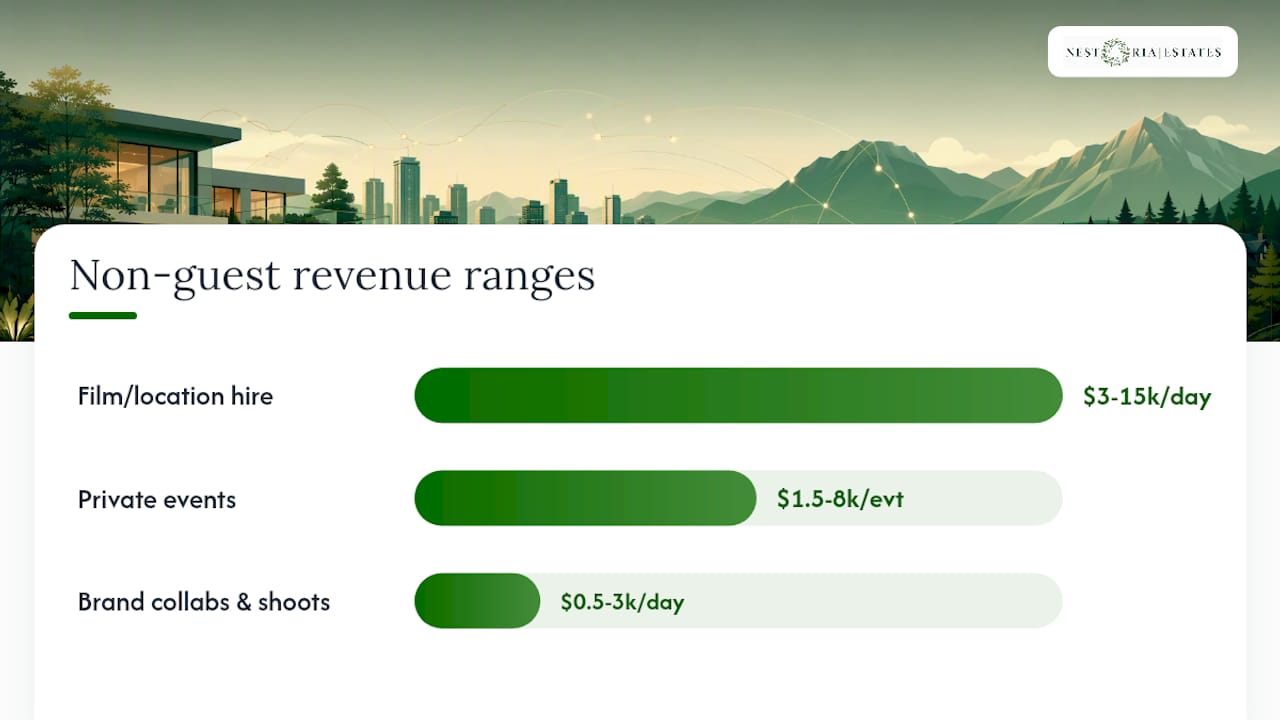
Film and location hire earns the highest per-day rate of any non-guest use, typically $3,000–$15,000 per day for a luxury Vancouver property with distinctive architecture or interiors. Private events and brand collaborations can also generate meaningful revenue, but both carry regulatory and insurance requirements that owners must resolve before marketing.
Non-guest revenue options and typical constraints:
Film and location hire: $3,000–$15,000/day. Requires strata approval (if applicable), a location permit from the City of Vancouver, event insurance, and a location agreement. Production companies handle most logistics but expect the property to be cleared and available on short notice.
Private events (dinners, corporate gatherings): $1,500–$8,000/event. Requires a special occasion licence if alcohol is served, noise bylaw compliance, parking management, and event liability insurance. Strata buildings almost universally prohibit this.
Brand collaborations and photo shoots: $500–$3,000/day. Lower disruption than film, shorter setup, but requires the same insurance and strata checks.
Membership or private club access: Emerging model for ultra-luxury properties; requires legal structuring and is not yet common in Vancouver.
To test-market film and location hire without committing to a full marketing push, list the property on one location-hire platform for six weekends and track inquiry volume, booking conversion, and marginal costs (cleaning, insurance, wear and tear). If the economics work, scale. If not, you have lost nothing but time.
Regulatory note: Any commercial use of a residential property in Vancouver requires checking both the zoning bylaw (commercial activity in residential zones is restricted) and your strata’s bylaws. Film shoots are generally permitted under a City location permit; private events are more legally ambiguous and carry higher neighbor-complaint risk.
The AirDNA Vancouver market data shows that luxury listings with distinctive design features and strong visual identity attract both short-term guests and location scouts. Investing in the property’s visual identity serves multiple revenue streams simultaneously.
DIY vs. professional luxury property manager: what should you expect?
A revenue-share professional manager is the faster, lower-risk route for most luxury property owners, specifically because luxury guests have higher expectations, higher complaint thresholds, and lower tolerance for slow responses than budget-segment guests. One bad review on a $600/night listing costs more in lost future revenue than a year of management fees.
What a specialist manager should deliver
Dynamic pricing calibrated to Vancouver’s event calendar, cruise season, and film-industry demand cycles
Guest screening and pre-arrival communication
White-glove turnovers with luxury-standard cleaning and restocking
24/7 guest support (not a chatbot, an actual person)
Maintenance coordination and emergency response
Insurance coordination and damage claim handling
Transparent monthly owner statements with gross revenue, all deductions, and net owner take
Market-based repricing on a defined cadence (weekly at minimum during peak season)
Professional short-term rental setup in Vancouver consistently shows that owners who hand off operations to a specialist see higher occupancy and ADR than self-managed equivalents, largely because response time and review scores improve immediately.
Vendor evaluation checklist
Ask for a sample owner P&L from a comparable property (same size, neighborhood, finish level).
Confirm the reporting cadence: monthly statements are the minimum; weekly during peak season is better.
Ask how damage claims are handled: who files, who pays the deductible, what the turnaround time is.
Confirm which platforms they list on and whether they use dynamic pricing tools.
Review the revenue-share terms: gross versus net basis matters. A 20% fee on gross revenue is very different from 20% on net after cleaning and platform fees.
Check contract exit terms. A good manager is confident enough to offer a 30–60 day exit clause.
Fee structures and net revenue expectations
In exchange, you get full operations handled, compliance managed, and typically a higher gross revenue than you would achieve self-managing, because professional managers optimize ADR and occupancy more aggressively than most owners do on their own.
Pro Tip: Insist on transparent monthly owner statements that show gross ADR, occupancy nights, platform fees, cleaning costs, and the management fee as separate line items. Any manager who bundles these into a single “net payment” without itemization is obscuring your true cost base. Transparency is non-negotiable.
Professional turnover standards are one of the most underrated revenue levers in luxury short-term rentals. A property that consistently photographs well between stays and receives five-star cleanliness reviews ranks higher on Airbnb’s algorithm, which directly increases organic booking volume.
What taxes and fees do you need to model for luxury rental income in Canada?
Short answer: rental income from short-term stays is taxable as business income in Canada, GST/HST registration is required once you exceed $30,000 in annual revenue, and the tax treatment differs meaningfully between short-term and long-term rental income. Consult a Canadian tax professional before structuring any rental arrangement, especially if you hold the property in a corporation, trust, or cross-border ownership structure.
Key taxable events for Vancouver luxury rental owners
Rental income reporting: All rental income must be reported on your T1 personal return (or T2 if held corporately). Short-term rental income is generally treated as business income, not passive rental income, which affects which deductions are available and how the income is taxed.
GST/HST: Short-term accommodation (stays under 30 days) is subject to GST. Once your annual revenue exceeds $30,000, GST/HST registration is mandatory. Long-term residential rentals (30+ days) are generally GST/HST exempt.
Platform service fees and cleaning: These are deductible business expenses when the property is operated as a short-term rental business.
Provincial accommodation tax: BC’s Municipal and Regional District Tax (MRDT) applies to short-term accommodation in Vancouver. Platforms like Airbnb collect and remit this on behalf of hosts in most cases, but confirm this with your platform and tax advisor.
Capital cost allowance (CCA): Furniture, appliances, and certain improvements may be depreciated over time.
Sample P&L template for a Vancouver luxury short-term rental
AirDNA’s Vancouver market data shows market tightening: fewer active listings year-over-year but higher ADR, which supports the conservative $550 ADR assumption for a well-positioned luxury property. Actual results will vary by property, season, and management quality.
Owners with complex ownership structures (corporations, family trusts, cross-border holdings) should engage a Canadian tax accountant before listing. The interaction between short-term rental income, principal-residence exemption, and corporate attribution rules is not straightforward.
How do you price and forecast revenue for a luxury Vancouver rental?
The two quickest levers to increase net revenue are ADR and occupancy, and dynamic pricing is the mechanism that moves both. A property priced statically at $500/night leaves money on the table during Pride Weekend, the Vancouver International Film Festival, and cruise season, and it loses bookings during shoulder months when a $380 rate would fill the calendar.
Simple forecasting model
KPIs to track monthly
ADR (Average Daily Rate): Your revenue per booked night. The primary lever for luxury properties.
Occupancy rate: Booked nights divided by available nights. Target 60–75% for luxury Vancouver listings.
RevPAR (Revenue per Available Room/Night): ADR × occupancy. The single number that captures both levers together.
Average length of stay: Longer stays reduce turnover costs and improve net margins.
Net owner take after all fees and taxes: The number that actually matters.
Airbtics’ Vancouver data confirms a July–August ADR peak and steady business-travel demand through fall and winter. Override dynamic pricing algorithms for known high-demand events: set floor prices for VIFF, Pride, cruise ship arrival weekends, and major conventions at least 90 days in advance. Algorithms trained on historical data often underprice these windows because they lack forward-looking event context.
Vacation rental success factors for Vancouver show that owners who track RevPAR monthly and adjust pricing weekly during peak season consistently outperform those who set rates quarterly and leave them.
Eight-week launch checklist: from decision to first booking
A realistic timeline from decision to first booking is eight weeks, with the critical dependency being compliance paperwork and professional media. Both take longer than most owners expect. Start the licence application in week one, not week five.
Week-by-week checklist
Week 1: Inspection and compliance. Confirm principal-residence eligibility. Begin BC provincial registry application. Apply for City of Vancouver short-term rental business licence ($77 application fee). Check strata bylaws. Contact your insurer about a short-term rental endorsement.
Week 2: Property preparation. Deep clean and declutter. Identify any repairs or finish upgrades needed before photography. Order welcome package supplies. Confirm smoke detectors, CO detectors, and fire extinguisher are in place.
Week 3: Professional media. Book a hospitality photographer and videographer. Brief them on the shot list (all rooms, detail shots, outdoor spaces, drone footage if applicable). Allow one week for editing and delivery.
Week 4: Listing creation. Write listing copy for Airbnb, Vrbo, and Booking.com. Set house rules, minimum stay (three nights recommended), and cancellation policy. Upload media. Add licence and registry numbers to all listings (required before going live).
Week 5: Pricing setup. Configure dynamic pricing. Set seasonal floor and ceiling rates. Mark high-demand event dates and set premium rates manually. Review competitor listings for calibration.
Week 6: Channel distribution. Activate listings on Airbnb, Vrbo, and Booking.com. Sync calendars to prevent double-bookings. Set up automated pre-arrival and check-in messaging.
Week 7: Cleaning and turnover setup. Hire and brief a professional cleaning team. Create a turnover checklist specific to your property. Do a test turnover before the first guest.
Week 8: Soft launch. Open the calendar for bookings. Monitor inquiry response time (under one hour is the target). Adjust pricing based on early booking pace. Request your first review after the first stay.
Licensing timing note: The City of Vancouver business licence typically takes two to four weeks to process. Do not schedule photography or list the property until you have the licence number in hand. Listing without it violates platform terms and City bylaws.
The step-by-step luxury rental booking guide from Nestoriaestates covers the guest-experience workflow in detail, including pre-arrival communication templates and check-in protocols that reduce guest questions and improve review scores.
How Nestoriaestates helps Vancouver luxury owners: sample projection and case highlights
A managed, revenue-share model typically improves net owner take in Vancouver luxury listings by combining higher ADR (through professional media and dynamic pricing), better occupancy (through multi-platform distribution and fast response times), and lower operational friction (through white-glove turnovers and 24/7 guest support).
Sample projection: 3BR luxury condo, West End Vancouver
Metric | Self-Managed (Estimated) | Managed by Nestoriaestates (Estimated) |
ADR | $420 | $510 |
Occupancy | 52% | 68% |
Annual gross revenue | $79,716 | $126,691 |
Platform fees (15%) | ($11,957) | ($19,004) |
Cleaning ($300/stay) | ($5,694) | ($7,434) |
Management fee (20%) | $0 | ($25,338) |
Licence and insurance | ($3,508) | ($3,508) |
Net owner income | $58,557 | $71,407 |
These are illustrative estimates based on Vancouver market benchmarks from AirDNA; actual results depend on property specifics.
What the management process looks like in practice
Media and listing: Professional photography, video, and listing copy written for high-net-worth guests across Airbnb, Vrbo, and Booking.com.
Pricing: Dynamic pricing calibrated weekly, with manual overrides for Vancouver’s event calendar.
Guest management: Pre-screening, pre-arrival communication, 24/7 support during stays, post-stay review management.
Turnovers: White-glove cleaning to luxury hospitality standards, restocking, and property inspection after each stay.
Compliance: Licence and registry number management, platform compliance monitoring, insurance coordination.
Reporting: Monthly owner statements with gross revenue, all deductions itemized, and net owner take.
Pro Tip: When requesting a free revenue projection from Nestoriaestates, prepare your property’s square footage, bedroom count, finish level (standard, premium, ultra-luxury), and any unique features (views, outdoor space, pool, distinctive architecture). The more specific your inputs, the more accurate the projection.
To request a free revenue projection and see how your property benchmarks against comparable Vancouver listings, contact Nestoriaestates directly through the services page.
The single change luxury owners should prioritize in 2026
The owners I see leaving the most money on the table in Vancouver are not the ones with the wrong strategy. They are the ones with the right strategy executed at the wrong quality level: a luxury property listed with real-estate photography, static pricing, and self-managed guest communication.
Vancouver’s supply contraction after the May 2024 principal-residence rule has increased per-night prices for compliant luxury hosts. Fewer legal listings, higher per-night demand, and guests who are actively willing to pay a premium for a well-presented, professionally managed property. That window will not stay open indefinitely as the market adjusts.
The single highest-leverage change for 2026 is upgrading the execution quality of whatever strategy you are already running: professional media if you do not have it, dynamic pricing if you are still pricing statically, and professional management if you are handling guest communication yourself. The strategy matters less than the execution tier. A mid-tier strategy executed at a professional level beats a premium strategy executed at an amateur level every time.
If you are evaluating whether a managed model makes sense for your property, Nestoriaestates offers a no-obligation revenue projection that shows you the realistic upside before you commit to anything.
Nestoriaestates manages Vancouver luxury properties so you do not have to
Owners who want the income without the operational load have a direct path: Nestoriaestates manages the full short-term rental operation on a revenue-share basis, so you earn from your property without managing a single guest interaction, cleaning schedule, or pricing decisions.

The model is straightforward. Nestoriaestates handles dynamic pricing calibrated to Vancouver’s event calendar, professional guest screening and communication, white-glove turnovers, maintenance coordination, compliance monitoring, and transparent monthly owner reporting. You receive a detailed statement every month showing gross revenue, every deduction itemized, and your net take. No guesswork, no surprises.
For Vancouver luxury owners, the combination of BC’s tighter supply environment and Nestoriaestates’ data-driven pricing approach means the managed route typically outperforms self-management on net income, not just convenience. The free revenue projection shows you the numbers for your specific property before you sign anything.
Request your free revenue projection and see what your property can realistically earn under professional management in 2026.
Sources
These are the primary sources Vancouver luxury owners should consult before listing, pricing, or converting a property.
This article is general information, not a substitute for advice from a qualified financial advisor. Consult a qualified financial professional about your own circumstances before acting on anything here.
FAQ
What is the 2% rule for rental properties?
For Vancouver luxury properties, this threshold is rarely achievable given high acquisition costs, so most owners evaluate yield on net cash flow and ADR/occupancy benchmarks instead.
Is 2026 a good year to monetize a luxury property in Vancouver?
Yes, for compliant principal-residence owners. BC’s May 2024 supply restrictions reduced the number of legal short-term rental listings, which has pushed per-night prices higher for compliant hosts. AirDNA’s Vancouver data shows fewer active listings year-over-year alongside higher ADR, a favorable combination for owners who meet the licensing requirements.
What is the hardest month to fill a luxury short-term rental in Vancouver?
January and February are typically the softest months for leisure bookings in Vancouver. Business travel and corporate relocations provide some floor demand, but owners should expect lower occupancy and should price competitively during these months rather than holding premium rates that leave the calendar empty.
Do Vancouver short-term rental hosts need to collect GST/HST?
Once annual short-term rental revenue exceeds $30,000, GST registration is mandatory in Canada. Short-term accommodation (stays under 30 days) is taxable for GST purposes, while long-term residential rentals of 30 days or more are generally exempt. Platforms like Airbnb collect and remit certain provincial taxes on hosts’ behalf, but GST obligations depend on your individual revenue threshold and ownership structure.
What does Nestoriaestates charge for luxury property management in Vancouver?
Nestoriaestates operates on a revenue-share model, typically charging a percentage of gross rental revenue in exchange for full-service management including pricing, guest communication, turnovers, compliance, and owner reporting. Request a free revenue projection to see specific terms and estimated net owner income for your property.
Recommended
Comments