

How to Create Celebration Packages for Your Vancouver Airbnb
- info67421305
- 3 days ago
- 11 min read

A Vancouver Airbnb host can design, price, and sell dependable celebration packages by following five clear steps: design your offer, source local supplies, set a profitable price, build a repeatable fulfillment process, and list the add-on with a secure payment flow. You can have a first package ready to test with your next booking in a single afternoon.
Start here, right now:
Pick one package type (a birthday setup or a romantic welcome kit works well for most Vancouver properties).
Cost it out using real local prices, then apply a markup that covers your time and any platform fees.
Confirm your BC short-term rental registration is active and your registration number is displayed on your listing.
Line up one local vendor — a bakery, florist, or gift shop — before you advertise the package.
Offer it to your next guest via Airbnb messaging and collect payment through the Resolution Centre.
Seasoned hosts on the Airbnb Community forum consistently report that upsells adding genuine, place-based value increase guest satisfaction and positive reviews, not just margins. That is the standard worth building toward from day one.
Key Takeaways
Designing and selling celebration packages is a five-step process: design, source, price, operate, and list with a documented payment flow. BC registration and local business licence compliance must come before you advertise any paid add-on.
Point | Details |
Five-step process | Design, source, price, operate, and list with a secure payment flow before your first booking. |
BC compliance first | Confirm active STR registration, display your number on listings, and check your municipality’s business licence rules. |
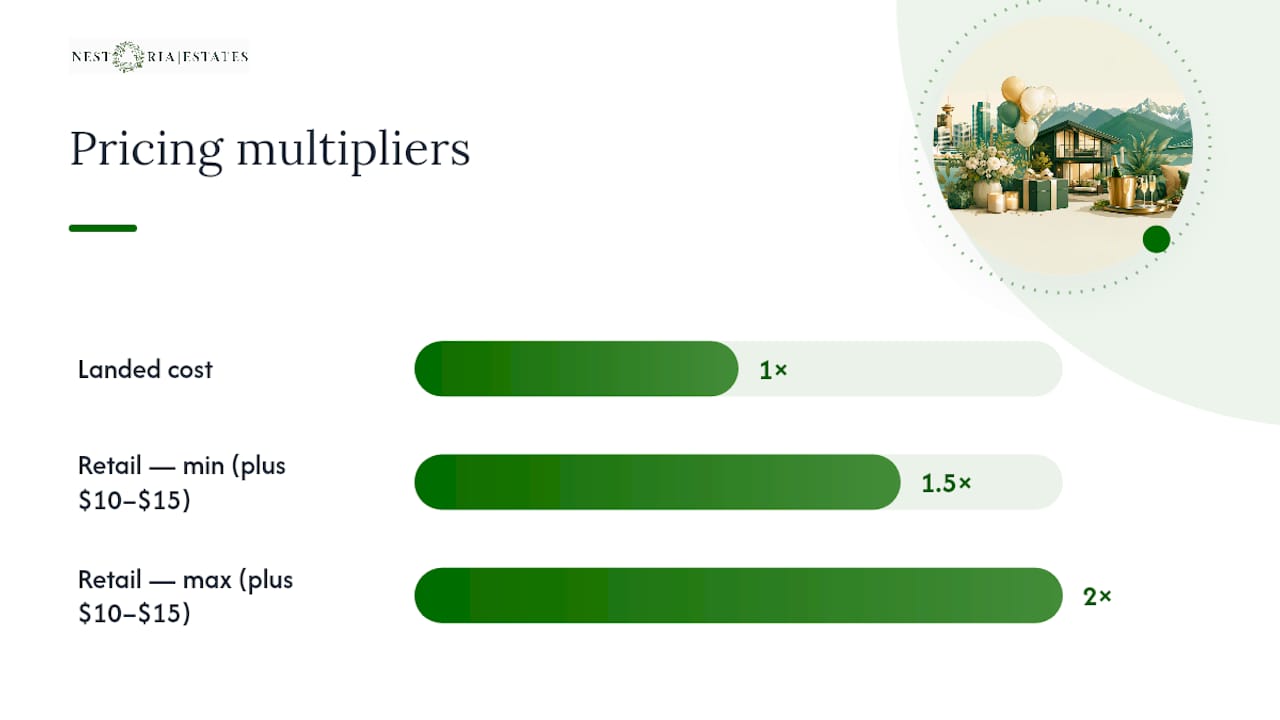
Pricing formula | Landed cost × 1.5–2× markup plus a $10–$15 handling fee gives a retail price that covers margins and platform fees. |
Payment via Resolution Centre | Use Airbnb messaging and the Resolution Centre to request payment; keep delivery photos and receipts as proof. |
Nestoriaestates option | Nestoriaestates designs, sources, and operates packages for Vancouver owners who prefer a fully managed approach. |
Table of Contents
Before you launch: a compliance and readiness checklist
Get these boxes checked before you advertise any paid add-on.
Registration and licensing:
Confirm your provincial STR registration is active. Per BC’s Short-Term Rental Accommodations Regulation, platforms must not provide services for unregistered offers after specified enforcement dates. Your registration number must appear on every listing.
Registrations renew annually; you can start the renewal process 40 days before expiry. Keep supporting documents — including any required business licence — current.
Check your municipality’s business licence rules. Vancouver and several Metro Vancouver cities require a licence to sell goods or services alongside accommodation. See Nestoriaestates’ Vancouver STR regulations guide for city-specific details.
Operational readiness:
Decide whether you will fulfill packages yourself or use a local vendor. Outsourcing perishables to a bakery or florist removes the storage problem immediately.
Confirm you have a place to store non-perishables between bookings and a plan for fresh goods (same-day delivery from a vendor is the cleanest solution).
Draft a guest communication template that discloses allergens, confirms the package is optional, and states your cancellation policy for the add-on.
Pro Tip: Before you go live, do a soft launch with a trusted repeat guest or a friend’s booking. Document every step — vendor order, delivery time, setup photos, guest reaction. That record is your operations manual for every booking that follows.
How to create celebration packages: choosing what to offer
The best packages for STRs are simple, repeatable, and matched to your guest profile. Five archetypes cover most Vancouver bookings:
Welcome kit — locally sourced snacks, a handwritten note, a small candle, and a map of the neighborhood. Low cost, high perceived value.
Romantic/anniversary setup — rose petals, candles, a bottle of BC wine or sparkling cider, and a charcuterie board from a local deli.
Birthday setup — balloons, a small custom cake from a local bakery, a banner, and a birthday card.
Family celebration box — kid-friendly snacks, a board game, and a welcome activity kit.
Local artisanal gift box — curated BC-made products: jam, chocolate, coffee, and a small piece of local art or craft.
High-impact, low-effort items are balloons, printed banners, candles, and pre-ordered cakes. High-effort items — private chef dinners, elaborate floral installations — are worth outsourcing entirely or skipping until you have volume.
Build a core package at a fixed price, then offer one or two premium upgrades (a larger cake, a bottle of Champagne instead of cider, a spa kit). That structure keeps your operations simple while giving guests a reason to spend more.
Vancouver guests skew toward weekend couples and local staycationers, so the romantic and birthday packages tend to get the most uptake. Family boxes perform well in summer when out-of-town visitors are common.
How to source supplies and local partners in Vancouver
Partnering with local BC businesses creates a three-way value exchange: you get a differentiated product, the vendor gets exposure, and your guest gets something authentically local. That is a harder pitch for a generic Amazon basket to beat.

Where to find vendors: local farmers’ markets, the Vancouver Farmers Market vendor directory, neighbourhood Facebook groups, and referrals from other hosts. For experience-based add-ons, a venue like Origins Ranch is the kind of local partner worth approaching for group or outdoor packages.
Vendor vetting checklist:
Request sample photos of past orders.
Confirm they carry food-safe handling certification if they supply edibles.
Ask about delivery windows and minimum order quantities.
Verify they have their own business insurance.
Initial outreach email — key questions to include: Can you deliver to [address] by [time]? What is your minimum order? Do you offer a standing account for repeat orders? What is your cancellation window?
For small-volume hosts, pay-per-order is the simplest model. Once you hit five or more packages a month, a credit-on-account arrangement with a preferred bakery or florist saves time and often unlocks a small discount.
How to price packages: formula, examples, and Canadian tax notes
The formula:
A markup of 1.5×–2× on landed cost is typical for STR add-ons. Add a flat $10–$15 handling fee to cover your coordination time on smaller packages.
Package | Landed cost (CAD) | Markup | Handling fee | Suggested retail (CAD) |
Welcome kit | base cost calculated | markup applied | handling fee applied | retail price calculated |
Birthday setup | base cost calculated | markup applied | handling fee applied | retail price calculated |
Platform fees: Airbnb does not have a dedicated packages checkout. The recommended method is to request payment through Airbnb messaging and the Resolution Centre before arrival. This keeps the transaction documented and within platform rules. Factor in any Resolution Centre service fee when setting your retail price.
GST/HST: Once your total annual revenue from all commercial activity exceeds CAD $30,000, you are required to register for and collect GST/HST in Canada. Package sales count toward that threshold. Consult an accountant for your specific situation, particularly if you are selling alcohol-adjacent items or working with multiple vendors.
Operations and logistics: fulfillment, timing, and guest safety
A repeatable setup process is what separates a one-time experiment from a reliable revenue stream. Follow this sequence for every order:
Confirm the package order and payment at least 48 hours before check-in.
Place the vendor order with confirmed delivery time (target: 2 hours before guest arrival).
Brief your cleaner or co-host on the setup checklist: item placement, balloon inflation, candle positioning, allergen card placement.
Photograph the completed setup before the guest arrives. Store the photo with the booking record.
Send the guest a pre-arrival message confirming the package is ready and noting any allergens or items requiring refrigeration.
If a vendor cancels, activate your backup plan: a secondary vendor on standby, or a pre-agreed partial refund policy.
For perishables, same-day vendor delivery is the cleanest approach. Avoid storing fresh cakes or cut flowers overnight. For non-perishables, a dedicated storage bin in a utility closet keeps items organized across bookings.
Allergen disclosure is non-negotiable. Include a printed card with every food item listing the top allergens (gluten, dairy, nuts, sulphites for wine). Require any food vendor you use to provide ingredient lists in writing.
How to present the add-on, sell it, and collect payment
List the package in three places: your Airbnb listing description (one short sentence), your digital guidebook (a dedicated section with a photo and price), and your pre-arrival message (sent 5–7 days before check-in).
Keep the offer short, price-first, and clearly optional. Guests who feel pressured do not buy and sometimes leave a note in their review.
Payment flow: Send a payment request through the Airbnb Resolution Centre once the guest confirms. Never request payment outside the platform without explicit written consent from the guest and a clear paper trail. Provide a written receipt after payment, note any taxable items, and keep delivery photos as proof of fulfillment.
Pro Tip: Add a photo of a past setup to your guidebook. A real image of a decorated space converts far better than a text description alone.
Legal, safety, and insurance considerations for BC hosts
Selling paid add-ons adds a layer of liability that your standard homeowner or STR policy may not cover automatically.
STR registration: You must be registered with the provincial registry and display your registration number. Platforms are required to validate registration status before providing services.
Business licence: Check with your municipality. Vancouver, Burnaby, and Richmond each have their own rules about selling goods or services from a residential property.
Insurance: Contact your insurer and confirm coverage extends to third-party vendor services, food service, and any alcohol you supply. Many standard STR policies exclude food liability. A supplemental general liability policy is worth the cost once you are running packages regularly.
Food safety: Require any food vendor to provide proof of a valid food-safe handling certificate. Keep that documentation on file.
Recordkeeping: BC regulations require hosts and platforms to retain records of reservations and disclosures. Keep package orders, receipts, and delivery photos for at least two years.
For a detailed look at Vancouver’s current STR rules, the Nestoriaestates guide for Vancouver owners covers the municipal and provincial layers in one place.
Five ready-to-use package templates for Vancouver hosts
1. Welcome Kit — priced to provide good value Local snacks (chips, chocolate, dried fruit), a small candle, a handwritten welcome card, and a neighborhood map. No allergen risk if you choose nut-free items. Shelf-stable; prepare up to 24 hours ahead.
2. Romantic Evening — priced to provide good value BC sparkling wine or cider, a charcuterie board (ordered same-day from a local deli), rose petals, two candles, and a playlist card with a QR code. Sulphite disclosure required for wine. Charcuterie must be same-day delivery.
3. Birthday Setup — priced to provide good value Custom cake (local bakery, ordered 48 hours ahead), balloons, a banner, and a birthday card. Confirm cake allergens in writing from the bakery. Balloons: inflate day-of.
4. Family Celebration Box — priced to provide good value Kid-friendly snacks (nut-free), a board game, a colouring kit, and a welcome activity sheet for Vancouver attractions. Fully shelf-stable. Prepare up to 48 hours ahead.
5. Local Artisanal Gift Box — priced to provide good value BC-made jam, local chocolate, a small bag of Vancouver-roasted coffee, and one artisan craft item (pottery, print, or candle). Fully shelf-stable. Source from local markets or a curated BC gift supplier.
For inspiration on building modular, flexible package structures that guests can customize, the event-planning sector has developed useful frameworks that translate well to STR add-ons.
Example walk-through of cost-to-retail pricing: Birthday Setup
Component | Cost (CAD) |
Custom cake (local bakery) | cost estimated |
Balloons + banner | cost estimated |
Card + ribbon | cost estimated |
Host coordination time (estimated duration) | estimated cost |
Total landed cost | calculated total |
Markup applied | calculated retail |
Handling fee applied | estimated fee |
Suggested retail | final price suggested |
How to measure uptake, revenue impact, and guest feedback
Track key performance indicators from your first package onward:
Uptake rate: proportion of packages sold relative to total bookings. Higher rates suggest good positioning.
Average revenue per booking: total package revenue divided by total bookings. Small increases can add meaningful incremental revenue.
Incremental revenue per booked night: valuable metric for multi-night stays where a package covers the whole visit.
Review sentiment: monitor guest mentions of the package in reviews. Positive feedback validates the offering; lack thereof may indicate presentation issues.
Simple tests to run after your first three packages:
Swap the price point up or down by $10 and measure conversion over the next five bookings.
Add a photo to your guidebook entry and compare uptake before and after.
Include a small free item (a chocolate bar, a local postcard) and note whether it changes the review tone.
After each stay, send a one-question follow-up: “Did the [package name] meet your expectations? Any suggestions?” Two sentences of honest feedback from a guest are worth more than any spreadsheet.
Why Nestoriaestates supports curated celebration add-ons
The case for celebration packages is not complicated: guests who feel genuinely welcomed spend more, review better, and rebook. That aligns directly with what Nestoriaestates works toward for every property under management.
The honest caveat is that operations are where most hosts stall. Sourcing vendors, coordinating same-day deliveries, briefing cleaners, and managing payment requests takes real time. For a host managing one property on the side, that overhead is manageable. For a host with two or more properties, or anyone who wants consistent premium delivery without personally coordinating every order, outsourcing the whole system makes more sense than building it from scratch.
Nestoriaestates handles the design, sourcing, operations, and reporting layers that make packages work reliably at scale. Free revenue projections, transparent owner reporting, and hands-off management are the practical reasons Vancouver owners choose to work with a professional manager rather than figure it out alone.
Nestoriaestates can build and run your packages for you
Running celebration packages well means vendor relationships, allergen documentation, cleaner briefings, payment tracking, and guest messaging — all coordinated around a tight check-in window. Nestoriaestates handles every layer of that for Vancouver property owners who want the revenue without the operational lift.
The service covers package design, local sourcing, fulfillment coordination, and performance reporting, so you see the revenue impact without managing the moving parts yourself. Owners get transparent reporting and continuous pricing adjustments that factor in add-on revenue alongside base rental income.
If you want to see what celebration packages could add to your property’s annual revenue, request a free revenue projection from Nestoriaestates. A short discovery call is all it takes to get a clear picture of what your specific property can earn.
Sources
Bookmark these official pages and check them whenever you renew or expand your add-on offering:
Consult a licensed accountant for GST/HST registration and an insurance broker to confirm your policy covers food service and third-party vendor liability before you sell your first package.
FAQ
Do I need a business licence to sell celebration packages in Vancouver?
Possibly. Vancouver and several Metro Vancouver municipalities require a business licence when you sell goods or services alongside accommodation. Check your city’s requirements before advertising any paid add-on.
How do I collect payment for packages on Airbnb?
Use Airbnb messaging to confirm the order, then send a payment request through the Resolution Centre before the guest arrives. This keeps the transaction documented and within platform rules.
What is the safest way to handle food allergens in a package?
Require your food vendor to provide a written ingredient list, and include a printed allergen card with every food item in the package. Disclose allergens in your pre-arrival message as well.
How do I know if my celebration packages are working?
Track uptake rate (packages sold divided by total bookings), average revenue per booking, and how often guests mention the package in reviews.
Can Nestoriaestates manage celebration packages for my property?
Yes. Nestoriaestates offers full-service management that includes package design, local sourcing, fulfillment coordination, and performance reporting for Vancouver property owners.
Recommended
Comments