
Montreal Airbnb Rules: Comply With June 10 to September 10 in 5 Steps
Yes, short-term rentals of a Montreal principal residence are allowed, but only from June 10 through September 10, and only with a valid municipal permit plus provincial registration through CITQ. Secondary residences run as year-round investment Airbnbs are effectively blocked in most zones. Skip either approval and you risk platform delisting, daily municipal fines, and provincial penalties that stack fast.
TL;DR:
Short-term rentals of principal residences are only legal from June 10 to September 10 and require a municipal permit plus CITQ registration, with approval sequences critical for success.
Failure to obtain proper permits can lead to platform delisting, municipal fines, and escalating provincial penalties, especially if violations are repeated.
Secondary residences and commercial tourist homes face strict zoning, approval, or declaration bans that often make their rental infeasible or illegal in Montreal.
Hosts must handle taxes and insurance carefully, including registering for accommodation taxes, reporting income, and maintaining liability coverage of at least two million dollars.
Managing compliance involves ongoing renewal paperwork, proper documentation, and strategic planning, often best supported by professional management services.
Table of Contents
Airbnb Rules Montreal: The Seasonal Window Explained
The seasonal rule is the single biggest change hosts need to understand. Montreal now restricts most short-term rentals of a principal residence to the period between June 10 and September 10, a shift CBC reported was designed to ease housing pressure and make enforcement simpler for the city. Outside that window, you cannot legally list your home on Airbnb, Vrbo, or Booking.com as a short-term stay.
“Principal residence” has a specific meaning under municipal policy: it’s the home where you actually live most of the year, not a property you own but rent out full time. A few things to keep straight:
The June 10–September 10 window applies to principal-residence rentals only, not to every property you own.
Some boroughs layer on additional restrictions or documentation requirements, so check your specific borough’s rules before listing.
A property you don’t live in and rent out commercially falls into a different, much stricter category: the “commercial tourist home.”
That last distinction matters more than most new hosts realize. A commercial tourist home requires a separate occupancy permit and borough approval process that most secondary-residence investors will never clear.
Getting Legal: Municipal Permits and CITQ Registration
Two approvals sit between you and a legal listing, and the order you pursue them in matters. First comes the municipal Notice of Compliance, sometimes called a host permit, which you apply for through your borough. Municipal fees generally land in the $300 range, though the exact figure and process vary by borough.
Only after that municipal step is documented can you move to CITQ, the provincial tourist accommodation regulator. CITQ explicitly requires a completed municipal Notice of Compliance before it will even process a provincial application. Apply to CITQ first, and you’ll likely get bounced back to square one.
Here’s the sequence that actually works:
Confirm your borough’s specific requirements and submit for the municipal Notice of Compliance.
Wait for municipal approval and keep the documentation on file.
Submit your CITQ registration application with that municipal proof attached.
Once issued, display your CITQ registration number on every listing across every platform.
Pro Tip: Practitioners consistently advise applying for the municipal Notice of Compliance before touching CITQ — attempting it in reverse order is one of the most common causes of outright rejection.
Common rejection triggers include missing proof of principal residence, no condo authorization letter where applicable, and insufficient liability insurance documentation. Gather your tax bill, government ID, condo board consent, and insurance certificate before you start either application.
Zoning and Condo Rules That Can Block a Listing Entirely
Zoning maps quietly decide a huge amount of what’s actually possible for investors. Commercial tourist homes, the category covering secondary-residence rentals, are largely confined to designated commercial and tourist corridors, and operating one requires a commercial occupancy permit plus conditional-use approval from the borough council, along with minimum separation distances from other tourist homes. These approvals are rare and can take months with no guarantee of success.
Condo declarations add a second layer of risk that catches buyers off guard. Many co-ownership associations have amended their declarations to ban short-term rentals outright, and changing that declaration typically requires a supermajority vote of owners, something a single unit owner can’t force through alone.
Before buying anything with Airbnb income in mind:
Request the full declaration of co-ownership and recent meeting minutes, not just a summary.
Confirm the property’s zoning designation directly with the borough, not through a listing agent’s assurance.
Ask whether any neighboring units already hold tourist home approval, since separation-distance rules can disqualify a property outright.
Taxes and Insurance Every Host Needs to Handle
Running a compliant listing means more than permits. Quebec’s lodging tax gets collected and remitted on short-term stays, and Canada Revenue Agency and Revenu Québec both hold hosts responsible for reporting accommodation income under rules specific to shared and short-term accommodation.
Insurance is not optional paperwork, either. CITQ’s application process asks for proof of liability coverage, and hosts commonly carry minimums around $2 million to satisfy registration requirements, since a standard homeowner’s policy typically won’t cover paying guests. Keep in mind:
Report all short-term rental income to CRA and Revenu Québec; unreported income is one of the more common enforcement triggers.
Register for accommodation tax remittance before your first booking, not after.
Renew your liability insurance certificate on the same schedule as your CITQ registration to avoid a lapse.
What Happens If You Skip a Permit or Registration
Enforcement has gotten sharper alongside the seasonal rule, not looser. Municipal daily fines for unregistered listings can accumulate quickly, and repeat provincial violations under the Tourist Accommodation Act carry their own escalating penalties. This isn’t a one-time slap on the wrist.
Platforms have become active enforcement partners rather than passive listing sites. Airbnb’s own help center confirms that Montreal hosts must be registered with both the city and the province, and that a registration number has to be visible on the listing itself. Platforms retain copies of registration certificates and cross-check them, meaning a missing or invalid number can trigger delisting with little warning.
A few habits protect you if a notice does arrive:
Keep every permit, certificate, and renewal confirmation in one folder, digital and physical.
Respond to any municipal or platform compliance notice within the stated deadline, not after your next booking.
If a listing gets flagged, don’t relist until the underlying registration issue is actually fixed.
Your Compliance Checklist: Documents, Order, and Timeline
Getting this right comes down to sequence and paperwork, not luck. Follow the steps in order and you avoid the rejection loop that traps a lot of first-time hosts.
Confirm your property qualifies as a principal residence and check your borough’s specific rules.
Apply for the municipal Notice of Compliance, submitting proof of residence, ID, and condo authorization if applicable.
Once municipal approval is granted, submit your CITQ registration with that proof attached, along with your liability insurance certificate.
Add your CITQ registration number to every platform listing.
Register with Revenu Québec for accommodation tax remittance before accepting bookings.
Recent updates now require two separate proofs of principal residence and, in many cases, a fresh written condo or landlord consent at every renewal, which makes this a recurring task rather than a one-time application.
Step | Typical timeline | Estimated cost |
Municipal Notice of Compliance | A few weeks depending on borough | Around $300 |
CITQ registration | Weeks after municipal approval | Provincial registration fee applies |
Insurance certificate | Ongoing, renew annually | Varies by provider |
Tax registration | Before first booking | No fee to register |
Why Full-Time Investor Airbnb Rarely Works in Montreal Anymore
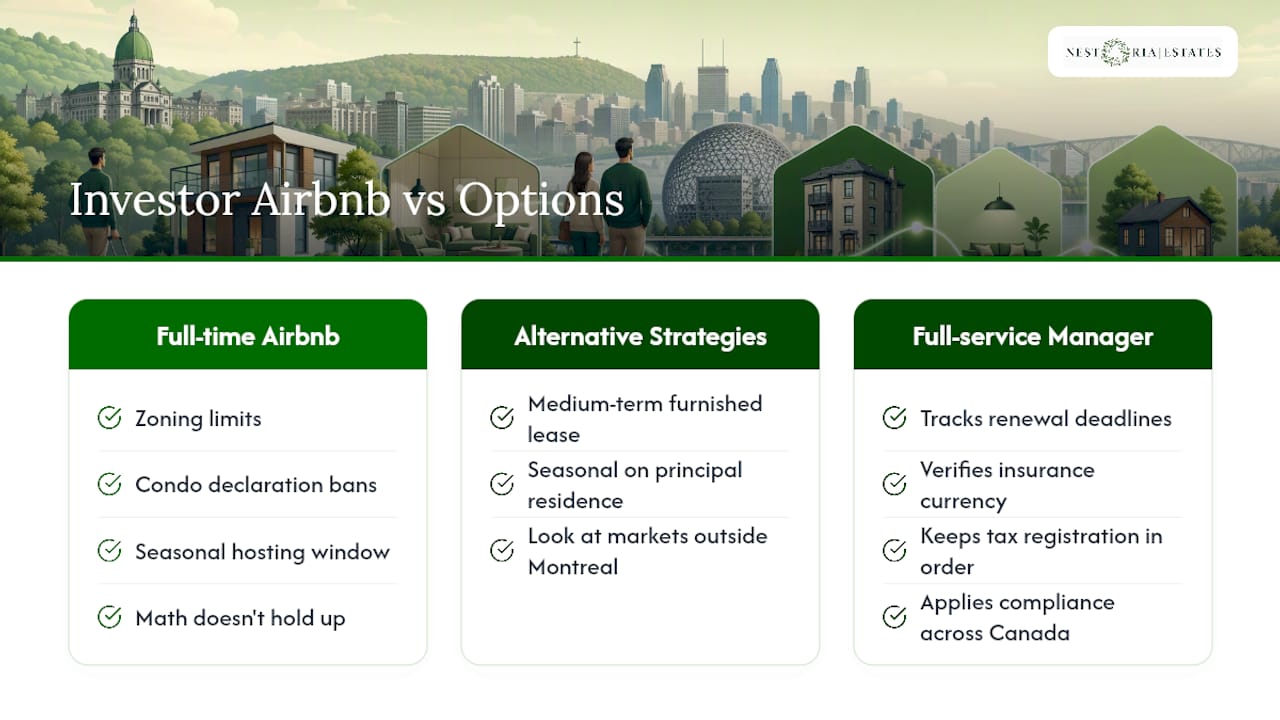
The math on buying a Montreal condo purely to run a year-round Airbnb doesn’t hold up under current rules. Between zoning limits, condo declaration bans, and the seasonal window, most secondary-residence investors are better served by a medium-term furnished lease strategy, seasonal hosting on a principal residence, or looking at markets outside Montreal entirely.
A full-service manager handles the pieces that trip up self-managed hosts: tracking renewal deadlines, verifying insurance stays current, and keeping tax registration in order. Nestoria Estates applies this same compliance discipline to owners across Canada, including Vancouver hosts navigating their own provincial short-term rental rules.
An Investor’s Take vs. a Homeowner’s Take
Investors: don’t buy a Montreal condo for year-round Airbnb income without confirming zoning and condo declaration status first. Homeowners: seasonal hosting works, but only with active, ongoing compliance. Either way, treat renewal paperwork as a recurring job, not a one-time task.
— Kamran
How Nestoria Estates Keeps Montreal Hosts Compliant and Profitable
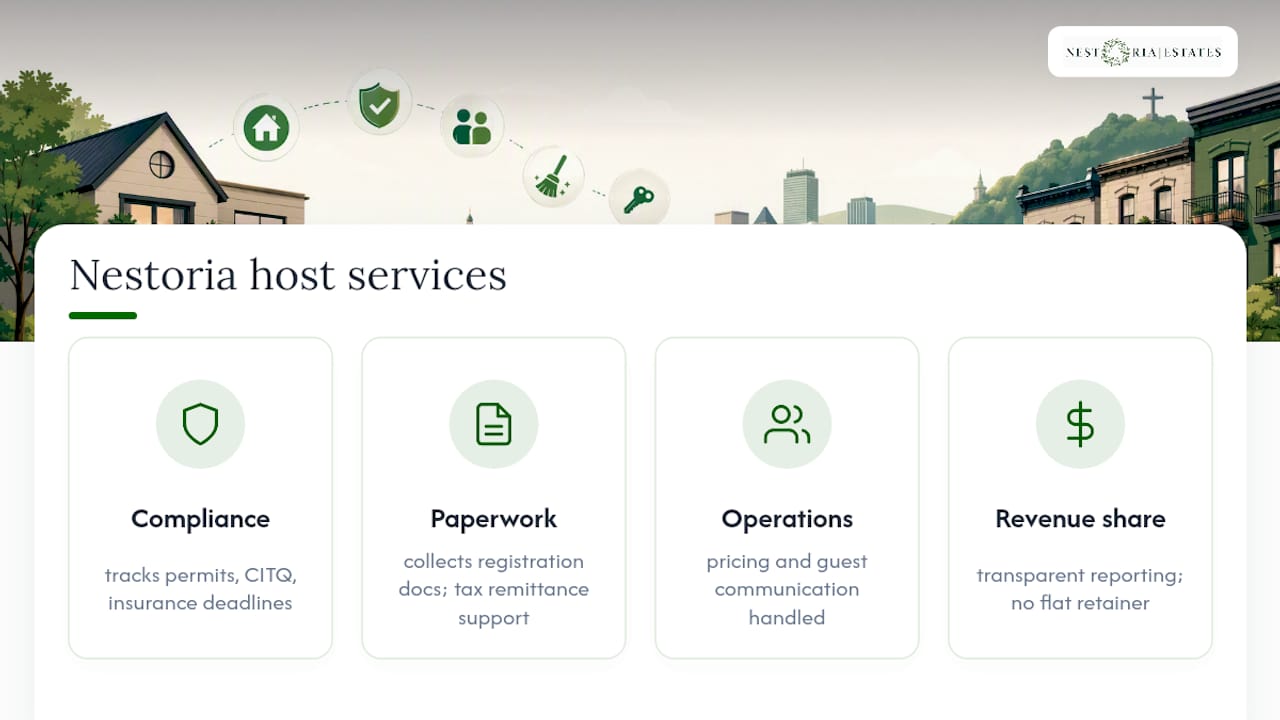
Between the seasonal window, the two-tier permit process, and annual renewal paperwork, staying compliant in Montreal has become a part-time job on top of actually hosting. There are professional management teams that track municipal permit renewals, CITQ registration deadlines, and insurance certificate expirations to help ensure nothing lapses mid-season.

Professional management services often handle the paperwork side of compliance, including document collection for registration, tax remittance support, and platform registration number updates, alongside pricing and guest communication. Vancouver property owners already rely on us for professional short-term rental setup that removes the daily hassle, and the same revenue-share model applies here: transparent owner reporting, a live owner portal, and no flat retainer regardless of how your bookings perform.
If you’re weighing whether seasonal hosting or a different rental strategy fits your Montreal property, request a free revenue projection through our services page and get a clear next step before your next booking window opens.
This article is general information, not a substitute for advice from a qualified lawyer. Consult a qualified legal professional about your own circumstances before acting on anything here.
Sources
FAQ
What Is the 80/20 Rule for Airbnb in Montreal?
There’s no official rule in Montreal’s short-term rental bylaws based on usage proportions; the actual governing rule is the seasonal window limiting most principal-residence rentals to June 10 through September 10 each year.
Is Airbnb Legal in Quebec?
Airbnb is legal in Quebec, but every host must hold a valid CITQ registration and display that registration number on their listing, alongside any municipal permit their city requires.
What Are Montreal Airbnb Hosts Not Allowed to Do?
Hosts cannot rent a principal residence short-term outside the June 10–September 10 window, cannot operate an unregistered listing, and cannot run a full-time commercial tourist home without borough approval and a commercial occupancy permit.
Where Are the Actual Laws on Montreal Short-Term Rentals?
The governing framework is the provincial Tourist Accommodation Act, enforced alongside City of Montreal municipal permit rules and borough-specific bylaws, all of which apply on top of standard CITQ registration requirements.
Can Nestoria Estates Help With Montreal Compliance Specifically?
Nestoria Estates manages the recurring compliance tasks, permit renewals, insurance verification, and tax registration support, that Montreal’s two-tier system requires, in addition to standard pricing and guest management services.
Recommended
Comments