
Canada: Lift RevPAR 25.1% and Boost Airbnb Occupancy With Guardrails
The fastest way to raise occupancy is market-informed dynamic pricing paired with tight guardrails, followed immediately by fixing listing conversion (photos, headline, amenities) and speeding up guest responses. Get those three right before touching anything else. Then track occupancy rate and RevPAR weekly to confirm the changes are actually working, not just filling nights at a loss.
TL;DR:
Running a price check against competitors and swapping out images can increase bookings within days, especially when focusing on value-based adjustments.
Setting strict pricing guardrails with dynamic rates prevents revenue loss from demand surges and underpricing, ensuring better overall payout even if occupancy fluctuates.
Improving listing conversion through high-quality photos, benefit-focused headlines, and essential amenities significantly boosts visibility and reservation rates.
Regularly updating responses, optimizing guest communication, and managing calendars across channels help maintain occupancy and avoid dead nights.
Full-service property management simplifies occupancy growth by continuously adjusting prices, coordinating turnovers, and providing detailed performance reports.
Table of Contents
Increase Airbnb Occupancy: Quick Wins You Can Make This Week
Before you rebuild your pricing model or hire a photographer, run through the fixes that cost little and pay off fast. These are the moves that move the needle within days, not months.
Run a price check against your comp set. Pull up five similar listings within a half-mile radius and see where your nightly rate sits. If you’re 15% above the pack with no extra amenities to justify it, you have your answer.
Replace your hero photo. Airbnb’s search results live or die on that first thumbnail. A bright, wide-angle shot of your best room, taken midday with natural light, beats a dim evening photo every time.
Turn on Instant Book with basic guest screening. Require a verified ID and no history of cancellations. This alone often lifts visibility in search.
Set minimum stays that match your market rhythm. A two-night minimum on weekends in a leisure market; one night midweek if you’re near business travel.
Standardize your cleaning fee and turnover window. Guests compare total trip cost, not just nightly rate. A cleaning fee that looks disproportionate to a short stay kills conversion.
Update your amenities list completely. Fast Wi-Fi, workspace, and parking are the three most-filtered amenities on the platform. Missing them means you drop out of relevant searches entirely.
Build three response templates. Pre-arrival, mid-stay, and checkout messages, written once, sent in seconds. Guests booking last-minute favor hosts who answer within the hour.
Test your Wi-Fi speed and post it. A number on the listing (“150 Mbps fiber”) removes a guest’s biggest unspoken hesitation.
Rank these by impact versus effort: pricing checks and photo swaps take an afternoon and move bookings within a week. Amenities and cleaning-fee resets take longer to show results but cost nothing. Anything requiring capital, like a new mattress or a bathroom refresh, goes on a separate, slower list.
Pro Tip: Change one variable at a time. If you swap the hero photo and drop the price in the same week, you won’t know which move actually drove the bump in bookings.
Pricing Strategy: Dynamic Rates, Guardrails, and Length-of-Stay Tactics
A full calendar isn’t the goal. A calendar full of nights booked below their real value is a worse outcome than a few empty nights at the right price. The metric that matters is RevPAR (revenue per available night), not occupancy in isolation, because occupancy without payout discipline just means you’re working harder for less.
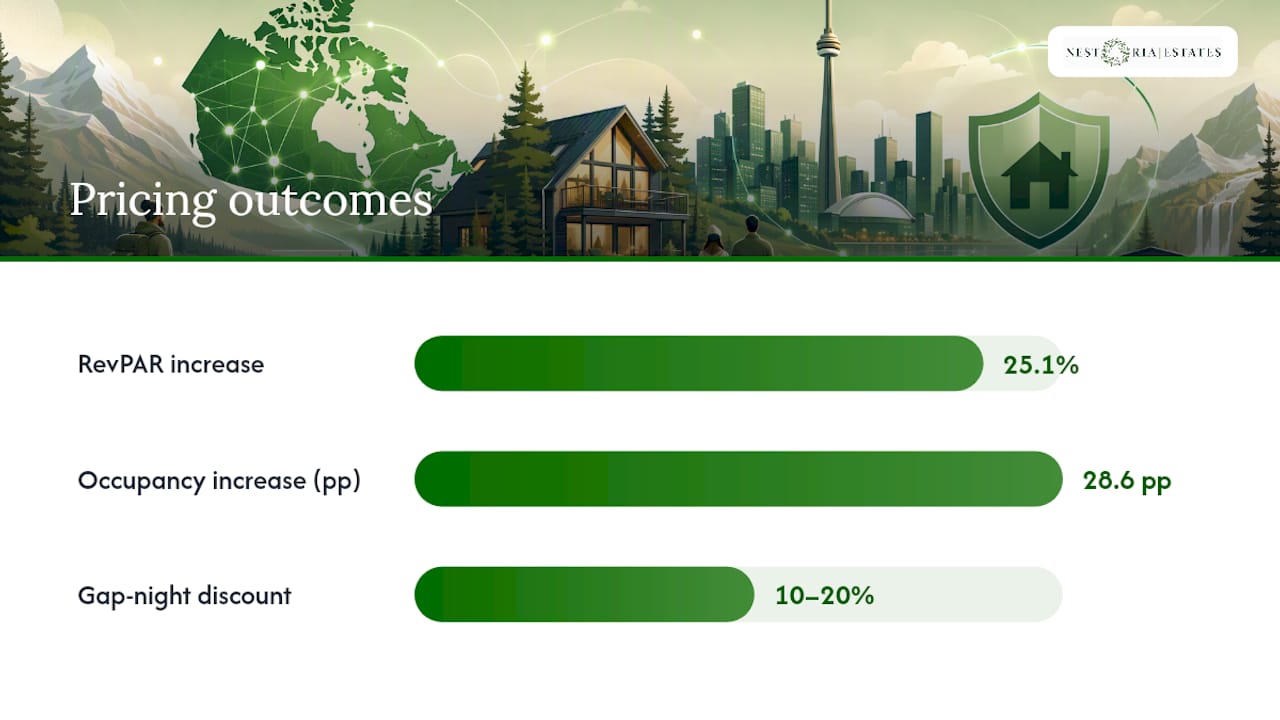
Dynamic pricing tools adjust your nightly rate based on lead time, competitor pacing, local event calendars, and historical demand curves for your specific market. Done well, the results are substantial: a study of a major dynamic pricing provider found users saw a 25.1% increase in RevPAR and a 28.6 percentage-point jump in occupancy compared to a control group running static rates. That’s not a marginal edge. It’s the difference between a side hustle and a real income stream.
But automation without limits can backfire. Academic research on Airbnb pricing found that price surges close to the stay date actually reduce revenue on average, because guests who are price-sensitive book early and shop elsewhere when they see a spike. The fix is guardrails, not blind trust in an algorithm:
Set a base price reflecting your true cost-plus-margin floor.
Set a minimum acceptable nightly rate the tool can never drop below, even during slow stretches.
Set a ceiling so demand spikes don’t push you into “why would anyone book this” territory.
Build event overrides for known local demand spikes (concerts, conferences, holidays) rather than letting the algorithm guess.
For length-of-stay tactics, gap-night discounts (10 to 20% off a single orphan night between two bookings) fill nights that would otherwise sit empty. Weekly and monthly discounts attract remote workers and extended-stay guests who lower your turnover costs. Reserve targeted promo codes for repeat guests or slow-season pushes rather than blanket discounting, which trains your audience to wait for a deal.
Listing Conversion: Photos, Headline, and Amenities That Book
A pricing engine can only work with the traffic your listing earns. If guests click through and bounce, no rate adjustment fixes that.
Your photo sequence should open with your strongest room, followed by a wide-angle living space shot, the primary bedroom, kitchen, and any standout outdoor feature (balcony, mountain view, patio). Order matters because Airbnb’s gallery loads in sequence, and most guests stop scrolling after five images.
Hero shot: bright, wide-angle, taken during the day.
Living space: show scale, not clutter.
Bedroom: made bed, natural light, no personal items visible.
Kitchen: clean counters, visible appliances.
Outdoor or view shot: this is often the emotional close for leisure travelers.
Your headline and opening sentence do the selling before a guest ever opens a photo. Lead with the guest benefit, not a feature list: “Steps from Stanley Park, fast Wi-Fi for remote work” outperforms “2BR condo downtown Vancouver” because it answers the guest’s actual question, which is “what does staying here get me?”
On amenities, prioritize what guests filter by, not what feels impressive to list. Fast Wi-Fi, dedicated workspace, in-unit laundry, and parking consistently drive more filtered searches than a hot tub or a game room. Updating outdated photos and copy is one of the most consistently cited levers for conversion across host resources, and it costs nothing but time.
To test changes, swap one variable, wait two full weeks, and compare your view-to-booking ratio in Airbnb’s own insights dashboard before touching anything else.
How Do You Improve Guest Experience to Boost Bookings?
Review scores and response speed compound over time. A listing sitting at 4.7 stars with slow replies loses search placement to a 4.9-star listing that answers in minutes, even at a similar price.
Send a pre-arrival message 24 to 48 hours out with check-in instructions, parking notes, and two or three local recommendations that feel personal, not copy-pasted.
Run a consistent cleaning checklist covering the details guests photograph and complain about most: bathroom grout, kitchen appliances, and fresh linens.
Respond to in-stay issues within the hour. A guest who reports a broken thermostat and gets same-day resolution often still leaves five stars; one who’s ignored for a day almost never does.
Ask for reviews within the first 24 hours after checkout, when the trip is still fresh, using Airbnb’s built-in review request rather than off-platform pressure, which violates platform terms.
Reward repeat guests with a small discount code or a handwritten welcome-back note. It costs a few dollars and often converts a one-time guest into a recurring booking.
Distribution and Calendar Management That Prevent Dark Nights
Listing on Airbnb alone caps your visibility to one audience. Adding VRBO, Booking.com, or a direct booking page reaches guest segments who never touch Airbnb at all, and a channel manager keeps your calendar synced so you never double-book.
Enable Instant Book once you have basic screening in place; it materially increases search visibility for last-minute searchers.
Use minimum-stay rules that flex by day of week rather than a flat rule year-round, which creates orphan single nights nobody books.
Offer gap-night discounts specifically for the single nights stranded between two reservations.
Sync your calendar across every channel at least daily; a missed sync is how double bookings happen.
Seasonality and Event-Aware Promotions
Map your market’s actual demand curve before you set a single rate. Pull twelve months of your own booking history, or your competitors’ visible calendars, and mark the weekends that consistently sell out first.
Identify your top three to five recurring local events and set manual overrides that price above your dynamic tool’s default.
Require longer minimum stays on high-demand weekends to prevent one-night bookings from blocking a lucrative three-night stretch.
Build shoulder-season packages: a weekly discount bundled with a late checkout or a welcome basket extends stays when demand is naturally softer.
Avoid stacking aggressive price hikes on top of an already-strong event weekend. Test any promotion on a short window first and measure the booking response before rolling it out further.
How Do You Measure Whether Occupancy Gains Are Real?
Occupancy rate is nights booked divided by nights available. Average daily rate (ADR) is your total revenue divided by nights sold. RevPAR, the number that actually tells you if you’re winning, is ADR multiplied by occupancy rate. None of these mean much without net payout: subtract cleaning costs, platform fees, and management fees from RevPAR to see what you actually keep.
Metric | Formula | What it tells you |
Occupancy rate | Nights booked ÷ nights available | How full your calendar is |
ADR | Total room revenue ÷ nights sold | Your average price per booked night |
RevPAR | ADR × occupancy rate | Revenue efficiency per available night |
Net payout | RevPAR minus fees and costs | What you actually keep |
Canadian short-term rentals in strong markets typically run 60 to 80% occupancy, with many successful properties landing in the 60 to 75% range annually, depending heavily on season and local zoning constraints. If your occupancy climbs but net payout falls, you’ve likely discounted too aggressively or absorbed a fee increase you didn’t notice. Track occupancy, ADR, and net payout weekly, and run any price or photo change as a two-week test rather than a permanent shift.
When Does Hiring a Property Manager Make Sense?
Once pricing, photos, and response speed are dialed in, the remaining occupancy gains often come from consistency: adjusting rates daily instead of monthly, turning over cleanings on tight timelines, and answering guest messages at 11 p.m. That’s where full-service management earns its fee.
Continuous, market-based pricing adjustments rather than a rate set once and forgotten.
Professional photography and listing copy maintained over time, not just at launch.
24/7 guest communication and faster turnover coordination between bookings.
Transparent owner reporting so you can see exactly what’s driving occupancy changes.
When evaluating a manager, ask about their reporting cadence, their fee structure (typically a revenue-share model), and whether they offer a free revenue projection before you sign anything. Nestoria Estates provides free revenue projections and ongoing market-based pricing adjustments as part of its standard offering.
Pro Tip: If you’re already spending more than a few hours a week on guest messages and turnover logistics, that’s usually the signal to price out a manager rather than keep DIY-ing it.
A Vancouver Host’s Priority List
For Vancouver owners, I’d rank the levers in this order: pricing guardrails first, since local demand swings hard between summer tourism and slow winter stretches; photo quality second, because the market is visually competitive; guest communication speed third. Hand your cleaner or manager a simple checklist: turnover time, amenity restock, and photo refresh dates.
— Kamran
Let Nestoria Estates Handle the Occupancy Work for You
Everything in this playbook, dynamic pricing, photo refreshes, response templates, calendar hygiene, takes real weekly time to execute well. Full-service property management companies run all of it for you: pricing optimization that adjusts to your specific market instead of a generic algorithm default, guest communication around the clock, cleaning coordination timed to your actual turnover windows, and owner reporting that shows exactly what’s driving your numbers month to month.

Many property managers offer a free revenue projection, so you can see realistic occupancy and income estimates for your property before committing to anything. If you’d rather spend your evenings doing anything other than answering a 2 a.m. guest message about the Wi-Fi password, check Nestoria Estates’ services and request your projection today.
Sources
FAQ
What Is the 80/20 Rule in Airbnb?
It generally refers to the idea that roughly 80% of your bookings and revenue come from a small set of high-leverage factors, usually pricing accuracy and listing conversion, rather than dozens of minor tweaks. Focus your effort on pricing guardrails and photo quality before chasing smaller optimizations.
Will Airbnb Increase My Price if I Add More Guests?
Airbnb allows you to set a per-guest fee above a base occupancy, so your total price can rise automatically when a booking includes additional guests beyond your included count. The base nightly rate itself doesn’t change; only the extra-guest fee you configure does.
Is Airbnb Still Profitable in 2026?
It can be, particularly in markets with strong seasonal or event-driven demand where dynamic pricing captures real upside. Profitability now depends more on disciplined pricing and cost control than it did in the platform’s early years, since competition and operating costs have both risen.
Are Airbnbs Struggling?
Some individual listings underperform, usually due to static pricing, weak photos, or slow guest response rather than the platform itself failing hosts broadly. Markets with strong occupancy fundamentals, in the 60 to 80% range for well-run Canadian properties, continue to perform when hosts actively manage pricing and guest experience rather than setting a rate once and walking away.
Recommended
Comments