

Premium Add-Ons for Vancouver Airbnb Owners That Boost Revenue
- info67421305
- 3 days ago
- 9 min read

The highest-impact premium add-ons for Vancouver short-term rentals are linen and turnover upgrades, guest concierge packages, enhanced cleaning, welcome hampers with local products, early check-in and late check-out, airport transfers, and pet-friendly services. Each one either lifts your average daily rate, extends stays, or pulls five-star reviews that compound into more bookings.
Start with two or three before adding more:
Linen and turnover upgrade — hotel-quality bedding drives review scores faster than almost any other single change.
Early check-in / late check-out — low fulfillment cost, high perceived value; guests pay $25–$50 for flexibility you already have.
Welcome hamper with local Vancouver products — Granville Island goods or BC wine signal quality from the moment guests walk in.
Airport transfer — high-margin, easy to outsource, and guests arriving at YVR appreciate the certainty.
Pro Tip: Package add-ons around Vancouver’s event calendar. A “Seafair Weekend” bundle (late check-out + welcome hamper + a printed local guide) or a “Whistler Day Trip” kit (packed snacks, trail map, early check-in) converts well because it solves a specific guest problem rather than offering a generic upgrade.
Key Takeaways
The highest-ROI premium add-ons for Vancouver Airbnb owners are low-overhead services priced with clear flat fees, tested over 90 days, and measured by take rate and incremental margin before scaling.
Point | Details |
Start with two add-ons | Choose low-overhead options like early check-in and a welcome hamper before expanding. |
Price with flat fees first | Flat-fee pricing is easiest to communicate and track for new add-on programs. |
Track three metrics | Monitor take rate, incremental margin, and guest review score change every 30 days. |
Market at the right moment | Logistics add-ons convert at booking; food and experience add-ons convert best 72 hours pre-arrival. |
Nestoriaestates manages it all | Nestoriaestates handles vendor sourcing, pricing, fulfillment, and transparent monthly reporting for Vancouver owners. |
Table of Contents
What types of premium add-ons can you offer at your Vancouver rental?
Setting up add-on fulfillment without it becoming a second job
Canadian and Vancouver legal and tax points to check before charging for add-ons
How Nestoriaestates implements premium add-ons for Vancouver owners
Why starting small is the right move, even when the opportunity looks obvious
Nestoriaestates makes add-on implementation hands-off for Vancouver owners
What types of premium add-ons can you offer at your Vancouver rental?
The table below maps each category to a typical service, suggested Canadian price bands, and the main cost drivers. Prices reflect the Vancouver market.
Luxury amenity categories and their cost profiles vary significantly; high-end spa treatments and private dining carry the widest margin spread, so price them carefully.
Bundling logic: Linen upgrades pair naturally with welcome hampers because both land at check-in and reinforce a single “premium arrival” impression. Concierge packages bundle well with airport transfers for guests who want full-trip handling. Pet add-ons stand alone — they serve a specific guest segment and rarely need pairing.

Margin note: Early check-in/late check-out and damage waivers are the highest-margin options because variable costs are near zero. Concierge experiences and airport transfers are moderate-margin but drive the strongest reviews. Grocery pre-stocks are low-margin unless you mark up meaningfully.
Pro Tip: Add-ons presented at booking convert at a higher rate for logistics items (transfers, early check-in) because guests are already in planning mode. Food and experience add-ons convert better in a pre-arrival email sent 72 hours before check-in, when guests are thinking about what to do.
Matching add-ons to what guests actually want matters as much as the add-on itself. Amenities guests actually use tend to be practical, locally specific, and easy to understand at a glance.
How to price add-ons and forecast the revenue they generate
Three pricing models cover most situations:
Flat fee per stay — best for fixed-cost add-ons like welcome hampers or damage waivers. Simple to communicate and easy to track.
Per-guest or per-night — works for airport transfers, pet fees, and mid-stay cleaning. Scales naturally with party size or length of stay.
Percentage uplift on nightly rate — less common for individual add-ons but useful when bundling into a “premium tier” listing.
Sample Vancouver calculation (conservative assumptions):
Assume a one-bedroom listing averaging 20 booked nights per month. You add an airport transfer at $90 flat fee. At $90 gross and a $55 driver cost, monthly incremental margin is roughly $210. Payback on any setup cost (booking integration, vendor onboarding) is typically under 60 days at that take rate.
Run the same math for a welcome hamper at $75 with a $40 product and delivery cost: With a good take rate over a typical month, welcome hampers can generate notable monthly margin. Lower per-unit margin, but higher take rate because more guests opt in.
Quick A/B test ideas:
Offer early check-in at $35 for one month, then $50 the next. Track take rate at each price point.
Send a pre-arrival upsell email at 72 hours vs. 24 hours before arrival. Measure which timing produces more add-on purchases.
Add one add-on to your booking flow and one only to the pre-arrival message. Compare conversion.
Success metrics to watch: take rate (percentage of stays that purchase), ADR lift (average nightly rate including add-on revenue), and review score change over 90 days. Add-ons that pay off share a common pattern: clear pricing, reliable fulfillment, and tracked performance from day one.
Setting up add-on fulfillment without it becoming a second job
Every add-on needs six operational pieces before you go live: a vetted supplier, a confirmed margin, a scheduling trigger, a guest communication template, a quality check, and a refund policy.
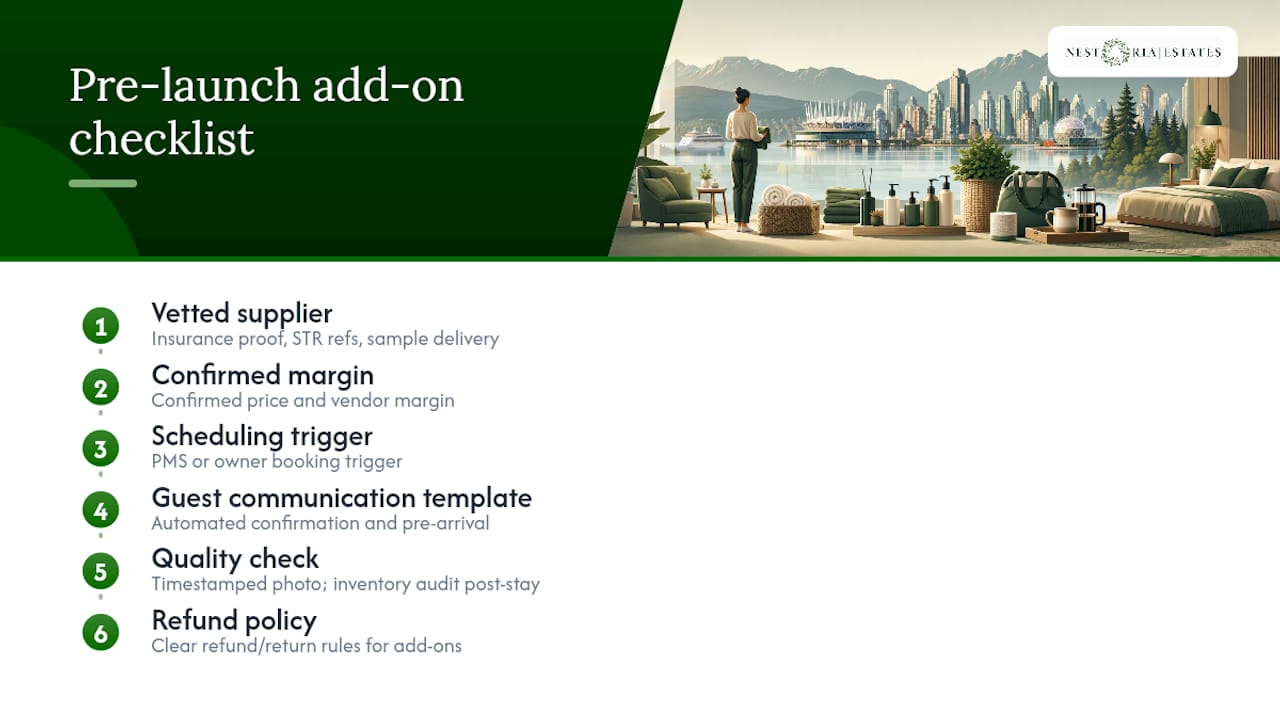
Vendor sourcing in Vancouver: Ask any supplier for proof of liability insurance, references from other STR operators, and a sample delivery or service. For local food vendors, confirm they can handle weekend surges during events like the Vancouver Folk Music Festival or Dine Out Vancouver. Bilingual capacity (English and Mandarin or Cantonese) is a practical advantage given Vancouver’s guest mix.
Workflow by role:
Booking confirmed (owner or PMS trigger) → automated message sent to guest confirming available add-ons → guest selects → vendor notified with check-in date and unit address → fulfillment completed before or at arrival → post-stay: owner or manager audits inventory and reconciles vendor invoice.
For high-season weekends, outsourcing fulfillment to a coordinator or property manager is almost always worth the cost. Managing three concurrent turnovers with add-ons in-house on a July Saturday is where quality slips and reviews suffer. Consistent execution is what converts a good add-on into a reliable revenue line.
Automation checklist: Set PMS message triggers for booking confirmation, 72-hour pre-arrival, and post-checkout. Use a shared vendor calendar or a simple spreadsheet to track fulfillment status per booking. Confirm every add-on delivery with a timestamped photo before guest arrival.
Pro Tip: Keep a par-stock level for consumables (toiletries, hamper items) equal to three stays’ worth. Running out mid-month because of an unexpected booking surge is the most common operational failure for new add-on programs.
Canadian and Vancouver legal and tax points to check before charging for add-ons
Add-on revenue is taxable income in Canada. Before you charge guests for any service, check these items:
Vancouver short-term rental license: The City of Vancouver requires STR operators to hold a valid business license. Adding paid services does not require a separate license, but the base STR license must be current.
GST/HST registration: If your total annual revenue from rental and add-on income exceeds $30,000, GST/HST registration is required. Add-on fees count toward that threshold.
CRA reporting: Report add-on income as business income on your T1 or T2, separate from rental income if the add-ons constitute a commercial service. Consult a Canadian tax professional to confirm the correct treatment for your structure.
Municipal accommodation tax: Vancouver’s Municipal and Regional District Tax (MRDT) applies to short-term accommodation. Confirm with the City whether add-on fees bundled into the nightly rate are subject to MRDT.
Pro Tip: Track four fields for every add-on transaction: gross revenue, vendor cost, platform fee (if any), and net payout. A simple spreadsheet with these columns makes quarterly GST/HST remittance and CRA reporting straightforward and audit-ready.
How to market add-ons so guests actually buy them
The highest-converting placements are the booking flow, a pre-arrival email at 72 hours, and featured listing photos with short descriptive captions.
Copy and timing by channel:
Booking flow: “Add an airport transfer from YVR — $90, confirmed instantly.” One line, one price, one action.
Pre-arrival email (72 hours out): “Your stay starts in three days. Want us to stock your fridge with BC favorites or arrange a late check-out? Reply here or click below.” Conversational, low pressure.
On-property welcome card: “Scan the QR code to add a mid-stay clean or extend your check-out by two hours.”
Photo guidance: One hero shot of the add-on (a styled welcome hamper, a made bed with premium linens) and two detail shots (close-up of local products, folded towels). Guests buy what they can picture.
Bundling suggestions:
Welcome hamper + linen upgrade = “Premium Arrival” bundle at a 10% discount.
Airport transfer + early check-in = “Stress-Free Travel” bundle.
Pet kit + late check-out = “Pet-Friendly Stay” bundle.
Curated local experiences and culinary add-ons generate the most detailed positive reviews, which in turn improve search ranking on Airbnb. Positive reviews driven by add-on experiences also increase price tolerance for future guests.
Conversion test plan:
Establish a baseline take rate for one add-on over 30 days.
Change one variable (price, timing, or copy) and run for another 30 days.
Measure take rate and ADR lift.
Keep the winning version and test the next variable.
For listing presentation, attracting premium guests depends on photo quality and specific, benefit-led copy rather than generic “luxury” claims.
How Nestoriaestates implements premium add-ons for Vancouver owners
Nestoriaestates handles the full add-on lifecycle for Vancouver owners: vendor sourcing, pricing, booking-flow integration, fulfillment coordination, and monthly reporting. Owners do not manage vendor relationships or chase down invoices.
What owners receive: a free revenue projection before signing, transparent monthly reporting that shows add-on take rate, incremental revenue, and vendor costs, plus continuous market-based pricing adjustments as Vancouver demand shifts seasonally.
Owner benefits at a glance:
Free revenue projection that includes estimated incremental income from recommended add-ons.
Transparent owner reporting with add-on performance broken out by category.
Vendor network already vetted for Vancouver’s STR market.
Seasonal pricing updates so add-on fees stay competitive year-round.
Nestoriaestates’s managed services cover the full stack, from dynamic pricing to add-on implementation, so owners receive a single dashboard view of total rental performance. The concierge and guest-experience layer is one of the higher-ROI components Nestoriaestates deploys for Vancouver properties.
Why starting small is the right move, even when the opportunity looks obvious
Most owners who struggle with add-ons do not pick the wrong services. They launch too many at once, fulfillment gets inconsistent, and a few bad reviews erase the revenue gain.
Pick one or two add-ons with minimal operational overhead, run them for 90 days, and track take rate and margin before adding anything else. A welcome hamper and early check-in are the right starting pair for most Vancouver listings: low variable cost, easy to automate, and fast feedback.
The owners who build durable add-on revenue treat it like a product line, not a side feature. They measure, adjust pricing, and retire underperformers. The ones who add six services at launch and never check the numbers usually end up with one or two that quietly drain margin.
Nestoriaestates makes add-on implementation hands-off for Vancouver owners
Running premium add-ons well takes vendor relationships, booking automation, and consistent fulfillment — the exact operational load most owners want to avoid. Nestoriaestates removes that friction entirely. Vancouver owners get a managed add-on program built into their property management agreement: vetted vendors, integrated booking flows, and monthly reporting that shows exactly what each add-on earned and cost.

The free revenue projection includes estimated incremental income from recommended add-ons, suggested pricing for your specific listing, and a shortlist of the services most likely to convert for your guest profile. No commitment required to see the numbers.
Request your free revenue projection and find out which add-ons make sense for your Vancouver property.
Useful resources for Vancouver STR owners
The Role of Add-Ons in Vacation Rentals That Pay Off — which add-ons generate the strongest ROI and how to measure them.
Offer Amenities Guests Actually Use — matching amenity choices to guest preferences and review impact.
Types of Luxury Property Amenities: 2026 Investor Guide — cost and margin profiles for high-end add-on categories.
How to List Luxury Rentals for Premium Guests Online — listing copy and photo strategy for premium offerings.
Consistent Guest Experiences — why operational consistency determines whether add-ons help or hurt your reviews.
For tax and licensing questions, contact the City of Vancouver’s licensing office directly or consult a Canadian tax professional. CRA guidance on rental income and GST/HST registration is available at canada.ca.
Sources
What Is Guest Experience? A Guide for Hospitality Pros – Wild Foodz by Hotel Entree Brugge
FAQ
What are the best premium add-ons for a Vancouver Airbnb?
Early check-in, late check-out, a local welcome hamper, and airport transfers from YVR are the highest-converting starting points for most Vancouver listings because they are low-cost to fulfill and easy for guests to understand at booking.
How do premium add-ons affect my Airbnb revenue?
Add-ons increase total revenue per stay by adding flat fees or per-guest charges on top of the nightly rate.
Do I need to charge GST/HST on add-on services in Canada?
If your combined rental and add-on revenue exceeds $30,000 annually, GST/HST registration is required. Add-on fees count toward that threshold, so track them separately from the start.
How does Nestoriaestates handle add-ons for owners?
Nestoriaestates sources vendors, sets pricing, integrates add-ons into the booking flow, and provides transparent monthly reporting showing take rate, incremental revenue, and vendor costs for each service.
When should I offer add-ons to guests?
Logistics add-ons like transfers and early check-in convert best at booking. Food, experience, and concierge add-ons convert better in a pre-arrival email sent 72 hours before check-in.
Recommended
Comments