

Can I Airbnb my condo in Vancouver? Rules, bylaws & revenue
TL;DR:
Vancouver’s short-term rental regulations require owners to meet multiple provincial, city, and strata rules to operate legally. Ensuring principal residence status, obtaining necessary licenses, and securing strata approval are essential for sustainable Airbnb income. Building good relationships with strata councils and maintaining compliance help owners avoid fines, listing removal, and legal issues.
Vancouver’s short-term rental market is genuinely attractive. Median annual Airbnb revenue in Vancouver sits at CA$63,000, driven by a 78% occupancy rate and an average daily rate of $216 as of 2026. Those numbers turn heads fast. But for condo owners, the path from “I want to list on Airbnb” to “I’m legally earning income” is far more complicated than setting up a profile and posting photos. Three overlapping layers of regulation, plus your own building’s rules, all have to align before you can legally host a single guest. This guide breaks down exactly what is allowed, what you need to do to comply, and how to position your condo for maximum returns.
Table of Contents
Understanding Vancouver’s short-term rental rules for condos
What you need to comply: Licenses, registration, and strata approval
Strata bylaws: The building factor that can make or break your Airbnb
What you can earn (and lose): Airbnb revenue potential and risks
Regulatory shifts and event-driven changes: What to watch for in 2026
Our take: Why mastering strata details and compliance beats chasing loopholes
How Nestoria Estates can help you Airbnb your Vancouver condo legally and profitably
Key Takeaways
Point | Details |
Principal residence required | You can only Airbnb your Vancouver condo legally if it is your main home. |
Strata rules can override | Even with city permits, your building’s strata may completely ban or restrict Airbnbs. |
Proper licenses are mandatory | City and provincial registrations are required and must be displayed on listings to avoid removal and fines. |
Professional management boosts income | Expert management often raises Airbnb earnings 20–40% and ensures compliance with complex rules. |
Regulations may change | Big events like the World Cup could lead to evolving rules, so owners need to monitor updates. |
Understanding Vancouver’s short-term rental rules for condos
With the revenue potential in mind, it’s essential to understand the rules that determine who can actually list a condo on Airbnb.
Vancouver’s short-term rental framework is not a single rulebook. It’s a stack of three separate authorities, each with its own requirements, and you need to satisfy all three simultaneously. Missing even one layer puts your income and your unit at serious risk.
The three layers are:
City of Vancouver: Requires a short-term rental business license and mandates that the unit be your principal residence
Province of British Columbia: Requires provincial short-term rental registration under the Short-Term Rental Accommodations Act
Strata corporation (your building’s association): Can permit, restrict, or outright ban short-term rentals through its bylaws, regardless of what the city or province allow
The most important rule across all three layers is the principal residence requirement. Short-term rentals under 90 days are only permitted in Vancouver condos if the unit is the owner’s primary home, with required provincial registration, a City of Vancouver short-term rental business license, and strata council approval where applicable. You cannot legally Airbnb a second property, an investment condo you don’t live in, or a unit you rent out long-term while you live elsewhere.
Key fact: Many condo owners assume that getting a city business license is enough. It isn’t. Your strata corporation has independent authority to ban short-term rentals entirely, and that ban holds even if you have every city and provincial document in order.
Strata corporations can prohibit or restrict short-term rentals through their bylaws, with fines reaching up to $1,000 per day for violations. Many Vancouver condos ban Airbnb outright. A smaller number explicitly allow it, sometimes with conditions like guest registration requirements or noise rules. Understanding short-term rental regulations at every level before you list is not optional. It is the foundation of a sustainable Airbnb operation.
If you’re considering buying a property specifically to Airbnb, the legal realities of buying an Airbnb in Vancouver are worth reviewing before you sign anything.
What you need to comply: Licenses, registration, and strata approval
Once you understand if your building allows it, here’s exactly what you need to do to operate legally.
Compliance is not a one-time checkbox. It requires gathering multiple documents from different authorities, keeping them current, and displaying them correctly on your listing. Here is the full sequence:
Confirm your unit is your principal residence. This is the legal foundation. You must be registered to vote, pay taxes, and receive government correspondence at this address.
Review your strata bylaws. Request the most current version from your strata council or property manager. Look specifically for language about “short-term rentals,” “vacation rentals,” or rentals under 30 days.
Get written confirmation from your strata. A verbal “yes” is not enough. Request written approval or a formal strata resolution that permits short-term rentals in your unit.
Register with the Province of BC. Apply for your provincial short-term rental registration number through the provincial portal.
Apply for a City of Vancouver short-term rental business license. This is separate from provincial registration and must be renewed annually.
Display both numbers on your listing. Hosts must display their provincial registration number and city business license number on every listing. Platforms actively remove listings that lack these numbers.
Requirement | Issued by | Renewal | Consequence of non-compliance |
Provincial registration | BC Government | Annual | Listing removed from platforms |
City business license | City of Vancouver | Annual | Fines, listing removal |
Strata approval | Your strata council | Varies | Daily fines up to $1,000, eviction risk |
Principal residence proof | Self-documented | Ongoing | Loss of all permits, fines |
Short-term rentals are only allowed in principal residences, with required provincial and municipal licensing. Both levels of government have enforcement mechanisms, and platforms cooperate with removal requests.
Pro Tip: Set calendar reminders for your license renewal dates at least 60 days in advance. A lapsed business license can trigger automatic listing removal, costing you bookings during peak season. Pair this with a folder that stores all your compliance documents digitally so you can respond quickly to any strata or city inquiry.
For more on staying compliant while running a profitable operation, our Airbnb management tips and compliance for short-term rentals resources walk through the operational side in detail.
Strata bylaws: The building factor that can make or break your Airbnb
After covering required licenses and city rules, we need to focus on the local building-level regulations that often determine eligibility.
Your strata corporation is arguably the most powerful regulator you will face. The city can grant you a license, and the province can register you, but if your building’s bylaws say no short-term rentals, you have no legal path to listing.

Strata corporations can prohibit or restrict short-term rentals through bylaws, with fines up to $1,000 per day for violations. Enforcement is real. Strata councils receive complaints from neighbors, review security footage, and issue formal violation notices. Some buildings have permanently banned owners from listing after repeated violations.
Here is a general picture of how Vancouver condo buildings break down:
Building type | Short-term rental policy | Typical conditions | Penalty for violation |
Newer luxury towers (post-2015) | Often banned | None, ban is absolute | $500 to $1,000/day |
Mid-rise buildings with hotel-style amenities | Sometimes permitted | Guest registration, noise rules | $200 to $1,000/day |
Older concrete buildings (pre-2000) | Varies widely | May require strata vote to change | $200 to $500/day |
Purpose-built short-term rental buildings | Permitted | Managed by building operator | Handled by management |
Key things to look for when reviewing your strata bylaws:
Any language defining “residential use” narrowly (this often excludes short-term guests)
Specific clauses mentioning platforms by name or rentals under 30 days
Rules about guest registration, key fob access, or amenity use by non-residents
Recent bylaw amendments, since many buildings tightened rules after 2022
Pro Tip: Before purchasing a condo with Airbnb income in mind, request the last three years of strata meeting minutes. Bylaws can be amended at any general meeting, and minutes will reveal whether short-term rentals have been debated or restricted recently. This single step can save you from buying into a building that bans Airbnb six months after you move in.
If you want to explore condos that permit Airbnbs in Vancouver, there are specific buildings and neighborhoods worth targeting.
What you can earn (and lose): Airbnb revenue potential and risks
Now that you know what’s required to operate and where, let’s see what the numbers look like and what happens if you get it wrong.
The income potential is real and significant. Vancouver’s combination of tourism, business travel, and chronic hotel shortages creates strong, year-round demand for well-managed short-term rentals.
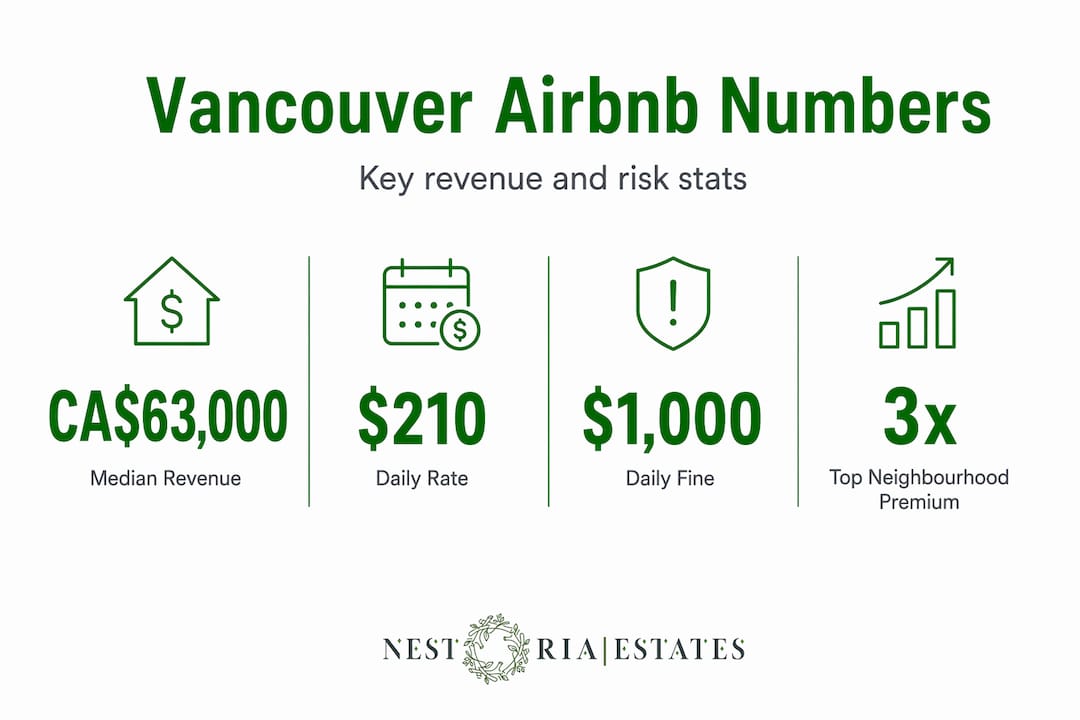
Metric | 2026 Vancouver data |
Median annual Airbnb revenue | CA$63,000 |
Average daily rate (ADR) | $216 |
Typical occupancy rate | 78% |
Estimated monthly revenue (median) | ~CA$5,250 |
These are median figures for Vancouver as of 2026. Top-performing units in prime neighborhoods like Yaletown, Coal Harbour, and the West End can exceed these numbers significantly. A well-located one-bedroom with professional photography, optimized pricing, and responsive guest communication can outperform the median by 30% or more.
Professional management firms increase revenue through several concrete mechanisms. Dynamic pricing tools adjust nightly rates in real time based on local demand, competitor availability, and seasonal patterns. Optimized listing copy and photography improve click-through rates. Faster response times improve search ranking on the platform. Many owners see 20 to 40% more revenue with expert optimization compared to self-managing with static pricing.
The risks of getting it wrong are equally concrete:
Daily fines up to $1,000 from your strata for bylaw violations
Listing removal by Airbnb for missing registration or license numbers
Loss of your business license if the city finds you are not operating from your principal residence
Strata-initiated legal action in serious or repeated violation cases
Reputational damage that can affect your ability to re-list even after compliance is restored
Enforcement applies to all non-compliant operators, including those in buildings that ban short-term rentals and those renting non-principal residences. The risk is not hypothetical.
For owners who want to maximize returns without the operational complexity, strategies to boost short-term rental income through professional management are worth exploring in detail.
Regulatory shifts and event-driven changes: What to watch for in 2026
Finally, Vancouver’s rental landscape is always in motion. Here’s what you should know about evolving regulations and market trends.
Vancouver is set to host major international events in the coming years, including matches tied to the 2026 FIFA World Cup. These events create enormous accommodation demand that Vancouver’s existing hotel inventory may not be able to meet. That pressure is fueling a real debate about whether the city should temporarily or permanently relax its short-term rental rules.
“There are growing calls from tourism and hospitality stakeholders to revisit short-term rental restrictions ahead of major events, but no confirmed regulatory changes have been announced as of 2026.”
The debate is genuine. Some city councilors and tourism advocates argue that loosening rules during peak events would benefit local property owners and reduce pressure on hotel rates. Others argue that relaxing rules, even temporarily, would undermine housing availability and set a difficult precedent.
For condo owners, here is how to stay positioned for any changes that do come:
Monitor the City of Vancouver’s short-term rental news page for bylaw amendments and new license categories
Watch for strata bylaw amendment meetings at your building, since some stratas may update policies if city rules change
Keep your compliance documents current so you can activate or scale up quickly if restrictions ease
Build a relationship with your strata council now, so you are not starting from zero if you need to request approval under new rules
Work with a management partner who tracks regulatory changes as part of their service, rather than relying on you to monitor everything yourself
Owners who are already compliant and well-positioned will be first to benefit from any regulatory relaxation. Those scrambling to get licensed at the last minute will miss the window. For forward-thinking owners, short-term rental solutions for 2026 are worth planning now rather than later.
Our take: Why mastering strata details and compliance beats chasing loopholes
With all this context, here’s our real-world view on the smartest way to approach Airbnb-ing your Vancouver condo.
We see a consistent pattern among owners who come to us after things have gone wrong. They found a gray zone. Maybe their strata bylaws were ambiguous, or the city’s enforcement seemed slow. They listed anyway, earned some income, and then received a violation notice, had their listing pulled, or faced a strata fine that wiped out months of revenue. The short-term gain was real. The long-term cost was worse.
The owners who build genuinely sustainable Airbnb income in Vancouver share one trait: they treat compliance as a competitive advantage, not a burden. When you are fully licensed, strata-approved, and operating transparently, you can invest in your listing without fear. You can respond to reviews, build your reputation, and scale your pricing strategy. The owners hiding in gray zones are always one complaint away from losing everything they built.
Our experience also shows that building relationships with your strata council and property manager is one of the most underrated moves a condo owner can make. Strata councils are made up of your neighbors. When they know you, trust you, and see that you are managing guests responsibly, they are far less likely to push for a bylaw change that bans short-term rentals entirely. One bad actor in a building often triggers restrictions that affect every owner.
The impact of rental policies on long-term income is significant. Regulatory gray zones rarely pay off. The buildings and owners who thrive are the ones who chose the right property, did the compliance work upfront, and manage their operation professionally.
How Nestoria Estates can help you Airbnb your Vancouver condo legally and profitably
If you’re ready to move forward, here’s how we can partner to maximize your results with less stress.
Vancouver’s Airbnb opportunity is real, but the compliance requirements, strata dynamics, and pricing strategy all demand consistent attention. Most condo owners have full-time lives that don’t leave room for managing guest inquiries at midnight, tracking license renewals, or monitoring dynamic pricing tools daily.

At Nestoria Estates, we handle the full picture. Our Airbnb and short-term rental management services cover everything from licensing guidance and strata communication to dynamic pricing, guest screening, cleaning coordination, and detailed owner reporting. We work specifically with Vancouver condo owners who want to earn strong, compliant income without the operational weight. Whether you are just starting out or looking to optimize an existing listing, our homeowner Airbnb services are built around your goals. Explore our full property services to see how we can make your condo work harder for you.
Frequently asked questions
Can I Airbnb my Vancouver condo if it’s not my principal residence?
No. Vancouver short-term rental rules require your condo to be your principal residence for legal Airbnb operation. Investment properties and secondary homes do not qualify.
Do all condo buildings in Vancouver allow Airbnb?
No. Many strata corporations ban short-term rentals through their bylaws, and those bans hold even if you have city and provincial permits. Always confirm your building’s specific bylaws before listing.
What happens if I list my condo without proper registration or a license?
You risk daily fines up to $1,000 from your strata and removal of your listing from Airbnb and other platforms for missing registration or license numbers.
Will Vancouver loosen Airbnb regulations for events like the World Cup?
There are active calls for event-driven rule changes, but no confirmed regulatory shifts have been announced as of 2026. Owners should monitor city announcements and keep their compliance current to benefit quickly if rules do change.
Recommended
Comments