

The Role of Testimonials in Rentals: 2026 Guide
- info67421305
- 2 hours ago
- 9 min read

TL;DR:
Guest testimonials are the most powerful tool for Vancouver Airbnb owners to increase bookings and revenue.
Authentic, specific, and recent reviews build trust, boost search rankings, and justify higher rates.
Guest testimonials are the single most powerful booking tool available to Vancouver Airbnb owners. The role of testimonials in rentals goes far beyond simple feedback: they function as social proof that directly converts browsers into paying guests. 91% of Canadians read at least one review before making a purchase decision. That number tells you exactly where your guests’ trust is built before they ever message you. In the short-term rental market, where guests cannot physically inspect a property before booking, testimonials fill that trust gap completely.
How do testimonials influence guest trust and booking decisions in rentals?
Testimonials work through a well-documented psychological mechanism called social proof. When a potential guest sees that dozens of previous guests had a positive experience, they lower their personal risk assessment and book with confidence. This effect is especially strong in short-term rentals, where guests are essentially trusting a stranger with their vacation or work trip.
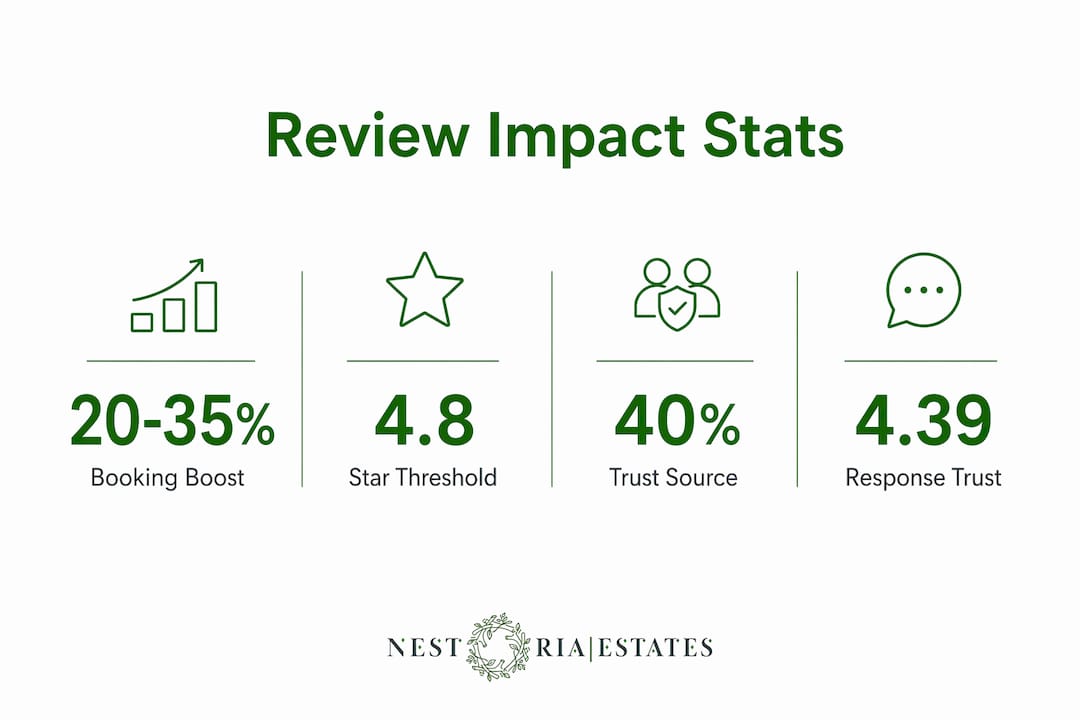
The numbers behind this are hard to ignore. Reviews influence booking rates by 20–35% in competitive short-term rental markets. That is not a marginal gain. A 20% booking rate increase on a Vancouver property listing can represent thousands of dollars in additional annual revenue.
Platform algorithms amplify this effect further. Airbnb’s search ranking system rewards listings with high review volume, strong star scores, and recent feedback. A listing with 30 reviews rated at 4.9 stars will consistently outrank a newer listing with 5 reviews rated at 5.0 stars. Volume and recency both matter to the algorithm, not just the score itself.
Three specific review signals drive the most impact:
Volume: Listings with fewer than 10 reviews convert at roughly half the rate of those with 10–20 reviews. Building your review count fast is the priority for new listings.
Recency: 73% of Canadian consumers prioritize reviews written within the last month. A listing with 50 old reviews and no recent ones signals neglect.
Star score: 48% of Canadians refuse to use businesses rated below 4 stars. On Airbnb, a 4.8 or higher is the practical threshold for staying competitive in Vancouver’s market.
Pro Tip: Set a calendar reminder to check your review recency every 30 days. If your most recent review is older than three weeks, it is time to actively prompt your next guest.
What makes testimonials effective in the rental market?
Not all testimonials carry equal weight. The most effective guest reviews share three qualities: they are specific, they are recent, and they feel authentic. A review that says “Great place, would stay again” does almost nothing for a prospective guest. A review that says “The check-in instructions were clear, the kitchen was fully stocked, and the host responded within 10 minutes when I had a question” tells a story that converts.
40% of Canadians consider authentic user experiences their most trusted source when making decisions. They trust real guest accounts more than polished marketing copy. This means your listing description matters less than your review section to most guests who are close to booking.
Operational transparency is a surprisingly strong trust signal. Guests rely on what researchers call “receipts”: verifiable details like documented check-in processes, low cancellation rates, and consistent cleanliness scores. A review that mentions documented procedures and accountability builds more trust than one that simply praises the host’s personality. This mirrors what the wedding and hospitality industry has learned about venue reviews in event planning: specific, process-oriented feedback consistently outperforms generic praise.
With AI-generated fake reviews rising across platforms, authenticity markers matter more than ever. Use these signals to make your real reviews stand out:
Guest photos attached to reviews signal genuine stays and add visual credibility.
Verified stay badges on platforms confirm the reviewer actually booked and stayed.
Specific details like room names, neighborhood references, or local restaurant mentions confirm the review is real.
Non-templated host responses show a human is actively managing the property.
Pro Tip: When guests check out, send a brief thank-you message that references one specific detail from their stay, such as the neighborhood they explored or the event they attended. This personal touch increases the likelihood they will write a specific, detailed review.
How can Vancouver rental owners collect more and better testimonials?
The timing and method of your review request matters as much as the request itself. Personalized thank-you messages sent within 24 hours of checkout increase review submission rates by 35%. The guest’s experience is freshest in that window, and a warm, specific message prompts them to reciprocate with their own feedback.

The guest experience that generates great reviews actually starts before arrival. A welcome message sent 48 hours before arrival increases average guest ratings by 0.4 stars. That single touchpoint sets expectations, reduces anxiety, and signals that the host is attentive. A 0.4-star improvement on a listing already at 4.5 stars can push it into the 4.9 territory that unlocks higher average daily rates.
A practical collection system for Vancouver Airbnb owners looks like this:
Send a pre-arrival welcome message 48 hours before check-in. Include local tips specific to the Vancouver neighborhood, parking details, and a direct contact method.
Send a mid-stay check-in message on day two. Ask if everything is comfortable and address any issues immediately. Resolving problems during the stay prevents negative reviews after checkout.
Send a personalized thank-you within 24 hours of checkout. Reference something specific about their trip and mention that reviews help other travelers find the property.
Follow up once more at the 48-hour mark if no review has been submitted. Keep the tone warm and brief.
Automate the timing, but personalize the content. Use guest management tools to trigger messages at the right intervals, but customize each one with the guest’s name and trip details.
The guest experience in rentals is the foundation of every great testimonial. Owners who treat review collection as a separate task from guest management miss the point. The review is the natural output of a well-managed stay.
Pro Tip: For Vancouver properties near major attractions like Stanley Park or Granville Island, include a short list of local recommendations in your welcome message. Guests who discover a great local spot because of your tip are far more likely to mention it in their review.
How should rental managers respond to testimonials to enhance reputation?
Responding to reviews is not optional for serious Vancouver rental owners. Public responses signal to future guests that the host is engaged, professional, and accountable. They also give you a second chance to shape the narrative around any review, positive or negative.
Personalized review responses score 4.39 out of 5 in consumer trust, compared to 2.2–2.52 for AI-generated or templated responses. Future guests read your responses just as carefully as the reviews themselves. A generic “Thanks for staying!” response tells them nothing. A response that references the guest’s specific comments and adds a personal note demonstrates real engagement.
For negative reviews, the response strategy is even more critical. Responding professionally to critical feedback reduces its impact on future bookings and demonstrates commitment to guest satisfaction. A negative review with a thoughtful, solution-focused response often builds more trust than a listing with only five-star reviews and no responses at all.
Best practices for responding to testimonials:
Respond to every review within 48 hours. Speed signals attentiveness.
Reference a specific detail from the review to prove you read it carefully.
For negative reviews, acknowledge the issue first before explaining what you have changed or improved.
Never argue or get defensive in a public response. Future guests are watching how you handle conflict.
Use responses to highlight property features that the reviewer mentioned, reinforcing those selling points for future guests.
What impact do testimonials have on rental pricing and revenue?
Testimonials are a direct revenue driver, not just a reputation metric. The correlation between review quality and income is measurable and significant. Listings rated 4.9 stars or higher command 18–23% higher average daily rates than comparable listings with lower scores. In Vancouver’s competitive short-term rental market, that premium can represent a substantial income difference across a full year.
Review volume compounds this effect. Higher review counts reduce guest hesitation at the booking stage, which translates directly into higher occupancy rates. A listing that converts at a higher rate can maintain strong revenue even during slower seasons, because it captures a larger share of the available demand.
Review score | Booking rate impact | ADR premium |
Below 4.0 stars | Significant drop in conversions | Negative pricing power |
4.0–4.7 stars | Baseline conversion rate | Standard market rate |
4.8–4.9 stars | Above-average conversion | Up to 23% ADR increase |
10+ reviews | Roughly double the conversion vs. under 10 | Stronger pricing position |
The hospitality practices in vacation rentals that generate strong reviews are the same ones that justify premium pricing. Guests who pay more expect more, and owners who deliver on that expectation receive the reviews that sustain those rates.
Key Takeaways
Testimonials in short-term rentals are a measurable revenue asset: owners who build review volume, maintain high scores, and respond personally to every guest will consistently outperform those who treat reviews as an afterthought.
Point | Details |
Reviews drive bookings | Reviews influence booking rates by 20–35% in competitive short-term rental markets. |
Volume beats perfection early | Listings with fewer than 10 reviews convert at roughly half the rate of those with 10–20 reviews. |
Timing increases submissions | Personalized thank-you messages within 24 hours of checkout raise review rates by 35%. |
Authentic responses build trust | Personalized responses score 4.39/5 in consumer trust versus 2.2–2.52 for templated replies. |
High scores unlock higher rates | Listings rated 4.9+ earn 18–23% higher average daily rates than lower-rated competitors. |
Why I think most Vancouver hosts are leaving review revenue on the table
I have worked with enough short-term rental owners to see the same pattern repeat itself. Owners spend significant money on photography, furnishings, and listing copy, then do almost nothing systematic to collect or respond to reviews. They treat testimonials as something that happens to them rather than something they actively build.
The shift I have seen make the biggest difference is treating the guest experience as a marketing system. The booking workflow does not end at check-in. It runs through the stay, through checkout, and through the review window. Every touchpoint is an opportunity to generate the kind of specific, authentic feedback that future guests trust.
What I find most interesting is that operational transparency outperforms charm every time. Guests do not need you to be their best friend. They need to know that check-in will work, that the place will be clean, and that someone will respond if something goes wrong. Reviews that confirm those basics convert better than reviews that rave about the host’s personality.
In 2026, with AI-generated content flooding every platform, authentic and specific guest feedback is more valuable than it has ever been. Owners who build systems to generate and respond to that feedback will hold a real competitive advantage in Vancouver’s market.
— Kamran
How Nestoriaestates helps Vancouver owners build a review-driven rental business
Managing guest communications, review timing, and response quality across multiple stays is a full-time job on its own. Nestoriaestates handles all of it for Vancouver property owners who want strong testimonials without the daily workload.

Nestoriaestates builds personalized guest communication plans that cover every touchpoint from pre-arrival to post-checkout, timed to maximize review submission rates. The team manages public responses to every review with the kind of specific, personal tone that scores highest in guest trust. Owners get the benefit of a professional rental management service that treats testimonial strategy as a core part of property performance, not an afterthought. If you want to see what your Vancouver property could earn with a stronger review profile, Nestoriaestates offers a free revenue projection to get you started.
FAQ
How much do testimonials affect rental booking rates?
Reviews influence booking rates by 20–35% in competitive short-term rental markets. Listings with strong review volume and high scores consistently outperform those with few or outdated reviews.
What star rating do Vancouver Airbnb owners need to stay competitive?
A rating of 4.8 or higher is the practical threshold for staying visible in Vancouver’s short-term rental market. Listings rated 4.9 or above earn 18–23% higher average daily rates than lower-rated properties.
How do I get more guests to leave reviews?
Send a personalized thank-you message within 24 hours of checkout. This single step increases review submission rates by 35%, and referencing a specific detail from the guest’s stay makes the message far more effective than a generic note.
Should I respond to negative reviews on my rental listing?
Responding professionally to negative reviews reduces their impact on future bookings. A solution-focused public response demonstrates accountability and often builds more trust than a listing with only five-star reviews and no host engagement.
Does a pre-arrival message really improve review scores?
A welcome message sent 48 hours before arrival increases average guest ratings by 0.4 stars. That improvement can move a listing from a 4.5 to a 4.9 rating, which directly affects both search ranking and pricing power.
Recommended