

Trends in Luxury Rentals 2026: What Vancouver Owners Must Know
- info67421305
- 8 hours ago
- 10 min read

TL;DR:
Luxury short-term rental owners in Canada must operate like hospitality businesses to succeed in 2026, focusing on hotel-grade standards and compliance. Market trends favor location-mature, amenity-rich, and data-driven listings that adapt pricing and meet higher guest expectations. Engaging a full-service manager like Nestoriaestates helps owners capitalize on these trends through integrated operations, compliance, and revenue management.
In 2026, luxury short-term rentals in Canada reward owners who run their listings like hospitality businesses, not passive income side projects. The RE/MAX Canada 2026 Recreational Property Report confirms the shift: buyers and renters are chasing turnkey, location-driven assets, and casual operators are getting squeezed out by tightening municipal rules. Your immediate action: audit your listing against hotel-grade cleanliness and response standards this week, or request a market-based price review from your manager before the summer booking window closes.
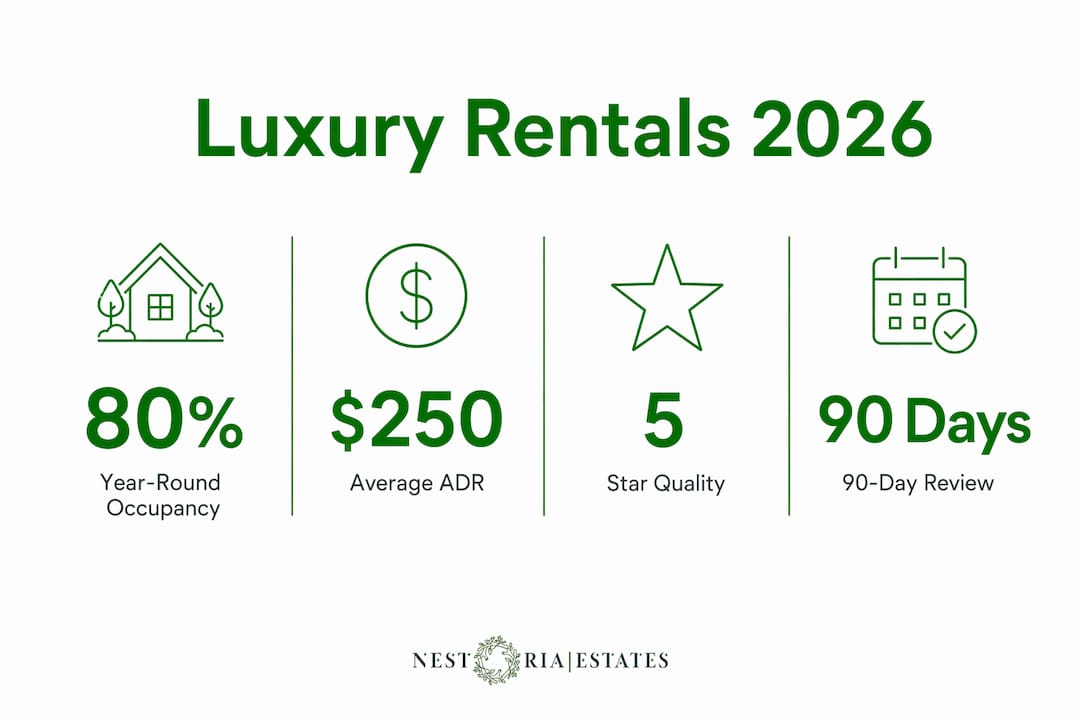
Vancouver sits at the center of this story. With an 80% year-round occupancy rate, the city is among the highest-performing markets in Canada, but that performance only holds for listings that meet rising guest and regulatory expectations.

Table of Contents
Hotel-grade operational standards every luxury host should deliver in 2026
Canadian compliance essentials in 2026: what Vancouver owners must verify
Pricing, distribution, and revenue operations that outperform in 2026
KPIs, benchmarking, and a 90-day plan to measure performance
What the 2026 market actually feels like on the ground in Vancouver
Nestoriaestates helps Vancouver owners capture every 2026 opportunity
What are the biggest trends in luxury rentals 2026?
Six forces are reshaping the Canadian luxury short-term rental market right now.
Location-driven maturity. The pandemic speculation era is over. RE/MAX Canada’s findings show buyers and guests gravitating toward proven resort corridors and supply-constrained tourism pockets. Whistler, for example, posted supply growth of just 12.1% against revenue growth of 31.8% in 2025, a gap that favors well-positioned luxury listings.
Market polarization. Urban centers like Toronto and Montreal are seeing supply outpace revenue, while constrained resort markets tighten. Luxury listings in the right locations gain pricing power; generic urban listings lose it.
Hotel-grade guest expectations. Cleanliness, sub-one-hour inquiry responses, and professional check-in procedures are no longer differentiators. They are the baseline. Guests booking at luxury price points compare their experience directly to boutique hotels.
Regulatory tightening. Municipal licensing pressure is intensifying across Canadian cities. Compliant operators benefit as non-compliant listings disappear from platforms.
Continuous dynamic pricing. Static seasonal rates leave money on the table. Top performers update pricing in response to real-time occupancy signals, local events, and competitor availability.
Tech and sustainability. Smart locks, AI-assisted guest messaging, and eco-friendly amenities are moving from nice-to-have to expected at the luxury tier. Guests increasingly filter for properties that reflect their values.
Stat to know: Canada’s short-term vacation rental market generated USD $5,334.6 million in revenue in 2025 and is projected to reach USD $13,719.7 million by 2033, a 12.6% CAGR.
What do these trends mean for your Vancouver property?
Translate the macro signals into a three-horizon action plan.
Immediate (this week):
Audit listing photos, description accuracy, and house rules against hotel-grade standards
Confirm your short-term rental business license is current with the City of Vancouver
Ask your manager for last month’s ADR, occupancy, and RevPAR figures
Near-term (30–90 days):
Commission professional photography if your current images are more than 18 months old
Install a smart lock and automate check-in instructions
Review your minimum-stay rules for peak and shoulder seasons
Medium-term (6–18 months):
Upgrade linens, towels, and bathroom amenities to hotel-grade specifications
Add at least one sustainability feature (e.g., energy-efficient appliances, recycling program, EV charging)
Build a preventative maintenance schedule for HVAC, hot tubs, and appliances
On the cost-versus-return question: professional photography typically recovers its cost within one or two bookings at luxury ADR levels. Smart locks reduce guest-communication friction and lower the risk of bad reviews tied to access issues. High-end linens are one of the most-cited factors in five-star cleanliness reviews. Carrying costs matter too. Interest-rate conditions in 2026 continue to affect how owners weigh capital upgrades against holding costs, so prioritize upgrades with the fastest payback first.
Hotel-grade operational standards every luxury host should deliver in 2026
Operational rigor is now a revenue differentiator, not just a guest-satisfaction metric. Here is the playbook.
Service level agreements your manager must meet:
Respond to all guest inquiries within 60 minutes during waking hours
Complete check-in confirmation messages at least 48 hours before arrival
Finish housekeeping turnover within 3 hours of checkout for same-day bookings
Escalate maintenance issues to a licensed contractor within 24 hours of identification
Cleaning and turnover checklist (minimum standard):
Full linen change and hotel-fold presentation on all beds
Bathroom deep clean including grout, fixtures, and mirrors
Kitchen appliance wipe-down inside and out
Restock of toiletries, coffee, and welcome consumables to stated inventory levels
Final walkthrough with photo documentation before guest arrival
Preventative maintenance cadence:
HVAC filter replacement every 90 days
Hot tub water chemistry check weekly during active rental periods
Appliance inspection every six months
Exterior and common-area inspection after every major weather event
Pro Tip: Design your turnover checklist as a photo-verified task list in a tool like Breezeway or Properly. Cleaners submit timestamped photos for each item, which protects you in disputes and gives your manager accountability data without micromanagement.
Canadian compliance essentials in 2026: what Vancouver owners must verify
Regulatory pressure is the single biggest threat to casual operators and the single biggest opportunity for compliant luxury listings.
Compliance checklist:
City of Vancouver short-term rental business license (renewed annually)
Provincial registration if required under British Columbia’s Short-Term Rental Accommodations Act
Platform-level registration number displayed on all listings
Commercial general liability insurance of at least CAD $2 million per occurrence
Confirmation that your property qualifies as a principal residence under Vancouver’s STR rules, or that you hold the correct non-principal-residence permit
Risk callout: Vancouver’s STR regulations restrict most short-term rentals to principal residences. Operating without the correct license can result in fines and platform delisting, both of which eliminate revenue immediately. Municipal licensing tightening is concentrating demand into compliant inventory, so getting this right is also a competitive advantage.
Tax considerations: Short-term rental income in Canada is generally reported as business income on your T1 personal return or through a corporate structure. GST/HST registration is required once annual revenue crosses the $30,000 threshold. Consult a Canadian tax professional for your specific situation, as treatment varies by structure and province.
Pricing, distribution, and revenue operations that outperform in 2026
Owners who track the right metrics and demand continuous pricing adjustments from their managers capture the most upside. Market-specific benchmarks beat national averages every time.
Essential KPIs and what they tell you:
KPI | Definition | Why it matters for luxury |
ADR (Average Daily Rate) | Total revenue ÷ nights booked | Measures your pricing power vs. comp set |
Occupancy rate | Nights booked ÷ nights available | Signals demand health and pricing calibration |
RevPAR | ADR × occupancy rate | Single number for overall revenue performance |
NOI (Net Operating Income) | Gross revenue minus operating costs | The number that actually hits your bank account |
Pricing tactics that work at the luxury tier:
Set a dynamic pricing floor that protects your brand (never discount below a rate that attracts the wrong guest profile)
Apply minimum-stay rules of 3–5 nights during peak periods to reduce turnover costs
Distribute across Airbnb, Vrbo, and a direct booking channel to reduce platform dependency
Review competitor availability and pricing weekly, not monthly
A basic forecast template your manager should provide monthly: projected occupancy by week, expected ADR by segment, estimated gross revenue, estimated NOI after management fees and operating costs, and variance against the prior period.
Where to invest capital for luxury STRs in 2026
Rank your spending by payback speed and guest-perception impact.
Professional photography and listing copy — fastest payback, highest click-through impact
Smart home access (locks, thermostats, noise monitors) — reduces operational friction and guest complaints
Hotel-grade linens and bathroom amenities — directly cited in five-star reviews; cost per stay is low
HVAC and hot tub maintenance — prevents the single-incident bad review that tanks a season
EV charging station — growing demand signal among luxury travelers; adds a filterable amenity
Branded welcome experience — local snacks, curated guidebook, personalized note — high perceived value at low cost
Luxury vacation rental demand continues to grow for amenity-rich stays, supporting premium ADRs in supply-constrained markets. Turnkey readiness at launch also compresses the time to first booking and improves early review velocity, which compounds into better search ranking on Airbnb.
KPIs, benchmarking, and a 90-day plan to measure performance
Milestone | Action | Measurable checkpoint |
Week 1–2 | Pull current ADR, occupancy, RevPAR from manager | Baseline figures documented |
Week 3–4 | Benchmark against Vancouver market data | Gap vs. market identified |
Month 2 | Implement pricing and listing upgrades | ADR change vs. baseline |
Month 3 | Review NOI and guest review scores | RevPAR trend and review average |
Vancouver’s 80% occupancy rate is a strong benchmark for well-managed luxury listings. If your property is running below 65% occupancy in peak season, pricing calibration or listing quality is likely the cause. For resort-destination comparisons, Canmore also posts 80% occupancy, while Whistler’s revenue growth of 31.8% in 2025 signals strong ADR upside in constrained supply environments.
How a full-service manager helps you capture 2026 trends
Full-service management quality is the primary determinant of whether a luxury listing outperforms in a polarized market. Operations, compliance, and pricing must work as one system, not three separate tasks.
What a capable manager must deliver:
Dynamic pricing updates at least weekly, tied to real market signals
Guest communication coverage from inquiry through post-stay review
Cleaning coordination with photo-verified checklists
Compliance monitoring: license renewals, platform registration, insurance verification
Monthly owner reporting with ADR, occupancy, RevPAR, and NOI
Questions to ask any prospective manager:
What pricing tool do you use, and how often are rates updated?
How do you handle a maintenance emergency at 2 AM?
Can you show me a sample owner report from a current client?
What is your average inquiry response time across your portfolio?
Pro Tip: Ask for a 90-day performance review clause in your management agreement. Any manager confident in their results will agree to it, and it gives you a clean exit if the numbers do not move.
For a deeper look at management best practices for luxury listings, the operational standards that separate top performers are well-documented.
Key Takeaways
In 2026, compliant, data-driven luxury listings in supply-constrained Canadian markets outperform because they combine hotel-grade operations with continuous pricing discipline and full regulatory standing.
Point | Details |
Market maturity favors operators | RE/MAX Canada confirms location-driven demand; turnkey, compliant listings capture the most bookings. |
Vancouver occupancy benchmark | Vancouver posts 80% year-round occupancy, one of the highest rates in Canada. |
Compliance is a competitive edge | Vancouver’s STR rules concentrate demand into licensed listings; non-compliant operators face fines and delisting. |
Track four KPIs monthly | ADR, occupancy, RevPAR, and NOI together tell the full performance story. |
Nestoriaestates delivers the full system | Nestoriaestates provides dynamic pricing, compliance monitoring, guest comms, and monthly owner reporting for Vancouver owners. |
What the 2026 market actually feels like on the ground in Vancouver
The national data tells one story. The street-level reality in Vancouver adds texture that no report fully captures.
Guests booking luxury short-term rentals here in 2026 are not comparing your property to the Airbnb down the block. They are comparing it to the Four Seasons. That is not an exaggeration. The guests who can afford CAD $400–$600 per night in a Vancouver luxury listing have stayed in five-star hotels, and they notice when the shower pressure is weak, the welcome note is generic, or the check-in instructions arrive the morning of arrival instead of 48 hours before.
The regulatory environment has also shifted the competitive field in a way that benefits serious operators. Vancouver’s principal-residence rules have removed a large chunk of investor-owned listings from the market. What remains is a smaller, higher-quality pool, and guests are booking from that pool with higher expectations and less price sensitivity than two years ago.
The owners who are winning right now are not necessarily the ones with the most expensive properties. They are the ones who treat every booking as a hospitality event, not a transaction.
Nestoriaestates helps Vancouver owners capture every 2026 opportunity
Vancouver luxury owners who want the performance gains described in this article without managing the complexity themselves have a direct path forward with Nestoriaestates.

Nestoriaestates handles dynamic pricing, guest communication, cleaning coordination, compliance tracking, and monthly owner reporting as a single integrated service, not a patchwork of tools. The firm is headquartered in Vancouver and built specifically for the Canadian short-term rental market, which means your pricing benchmarks, compliance checks, and guest communication standards are calibrated to local conditions, not national averages. Owners get transparent reporting with ADR, occupancy, RevPAR, and NOI every month, plus a free revenue projection before signing anything. If you want to see what your property could realistically earn under professional management, request a free projection and get a Vancouver-specific number within 48 hours.
Useful sources and recommended reading
RE/MAX Canada 2026 Recreational Property Report — Start here for market maturity signals and turnkey demand trends across Canadian recreational and resort markets.
Airbtics Canada STR Market Report 2025 — Best source for Vancouver occupancy benchmarks, supply vs. revenue growth by market, and identifying under-the-radar opportunities like Whistler.
AirROI Canada 2026 STR Data — Use for ADR and occupancy benchmarking by market; essential for building a realistic forecast.
Grand View Research: Canada Short-Term Vacation Rental Market Outlook — Long-range revenue and CAGR projections through 2033; useful for investment-horizon planning.
Canadian Mortgage Professional: STR Gold Rush Is Over — Covers regulatory pressure and the shift toward strategic, compliant operators; read before any compliance conversation.
Nestoriaestates: Luxury Property Management Guide — Operational standards and management service components for luxury short-term rentals in Canada.
FAQ
What are the top luxury rental market trends for 2026 in Canada?
Location-driven maturity, hotel-grade guest expectations, regulatory tightening, and continuous dynamic pricing are the four forces shaping high-end rental performance in 2026. Compliant, amenity-rich listings in supply-constrained markets hold the strongest pricing power.
What occupancy rate should Vancouver luxury owners target?
Vancouver posts a high year-round occupancy rate, among the highest in Canada. A well-managed luxury listing running below 65% in peak season likely has a pricing or listing-quality issue worth addressing immediately.
Which KPIs matter most for luxury short-term rentals?
Track ADR, occupancy rate, RevPAR, and NOI monthly. RevPAR combines pricing and occupancy into one number, while NOI shows what actually reaches you after costs.
Do Vancouver short-term rental owners need a business license?
Yes. The City of Vancouver requires a short-term rental business license, and British Columbia’s Short-Term Rental Accommodations Act adds a provincial registration layer. Operating without both risks fines and platform delisting. This article is general information; confirm current requirements with the City of Vancouver or a qualified legal professional.
How does Nestoriaestates help owners capture 2026 luxury rental trends?
Nestoriaestates provides integrated dynamic pricing, compliance monitoring, guest communication, and monthly KPI reporting for Vancouver owners, covering every operational standard the 2026 market demands. Owners can request a free revenue projection before committing to a management agreement.
Recommended



Comments