
The Advantages of Curated Travel Experiences for Airbnb Hosts
- info67421305
- 4 minutes ago
- 8 min read

Curated guest experiences raise the perceived value of a stay, which lets Vancouver hosts command higher nightly rates, fill more calendar nights, and keep guests booking longer. This is the core mechanism behind every experience-driven Airbnb strategy: you stop competing on price and start competing on memory.
Hosts who add a curated layer to their listing typically see:
Higher occupancy from listings that stand out in search results
Higher ADR because guests pay more for a stay that feels designed, not generic
Longer average stays, since guests extend trips built around planned activities
Better reviews, which feed directly into Airbnb’s ranking algorithm
Higher repeat-booking rates from guests who felt genuinely hosted, not just housed
Ancillary revenue from paid add-ons like local tours or premium check-in windows
The evidence backs this up. Airbnb’s own research found that 64% of guests said their rental stay helped them feel more connected to local culture than a hotel stay would. Themed, experience-driven listings can command 30 to 50% higher nightly rates than comparable standard listings. Nestoria Estates builds this kind of experience layer into its full-service management for Vancouver property owners, pairing it with dynamic pricing and transparent reporting so the upside actually shows up in your payout.
Start small. Pick one experience, like a curated local welcome pack, test it for 30 days, and watch what happens to your booking rate.
Key Takeaways
Curated guest experiences work because they shift competition from nightly price to perceived value, and that shift shows up directly in ADR, occupancy, and repeat bookings.
Point | Details |
Local connection drives value | 64% of guests feel more connected to local culture through rental stays than hotels, which supports higher perceived value. |
Start with one low-friction offer | A welcome pack, digital guidebook, and one paid local upsell requires minimal setup and gives a fast read on guest demand. |
Price with a tested model | Use an add-on fee, bundled premium, or partner commission, and launch at a modest price before raising it. |
Track the right numbers | Watch occupancy, ADR, RevPAR, ancillary revenue, and repeat-guest rate for at least one full month before scaling. |
Professional management fills the gap | Nestoria Estates handles partner vetting, dynamic pricing, and owner reporting so Vancouver hosts can run experience bundles without doing it all themselves. |
Table of Contents
Why Do Curated Experiences Increase Airbnb Revenue?
Curated experiences change what a guest is actually buying. A generic listing sells square footage and a bed. A curated one sells a story the guest wants to be part of, and guests pay a premium for that story before they even arrive.
The mechanism is partly psychological and partly algorithmic. On the psychology side, 64% of Airbnb guests report feeling more connected to local culture through their rental stay than through a hotel visit. That connection is not incidental. It is exactly what curated recommendations, local partnerships, and thoughtful welcome touches are designed to produce.
On the algorithmic side, better guest communication and smoother check-ins drive review scores up, and Airbnb’s search ranking rewards higher review scores with more visibility. Concierge-style coordination alone can lift communication scores by roughly 0.2 to 0.4 stars while adding meaningful ancillary income per booking. A hospitality guest-experience framework built around pre-arrival messaging and curated local tips produces fewer complaints and stronger word-of-mouth, which shows up as repeat bookings months later.
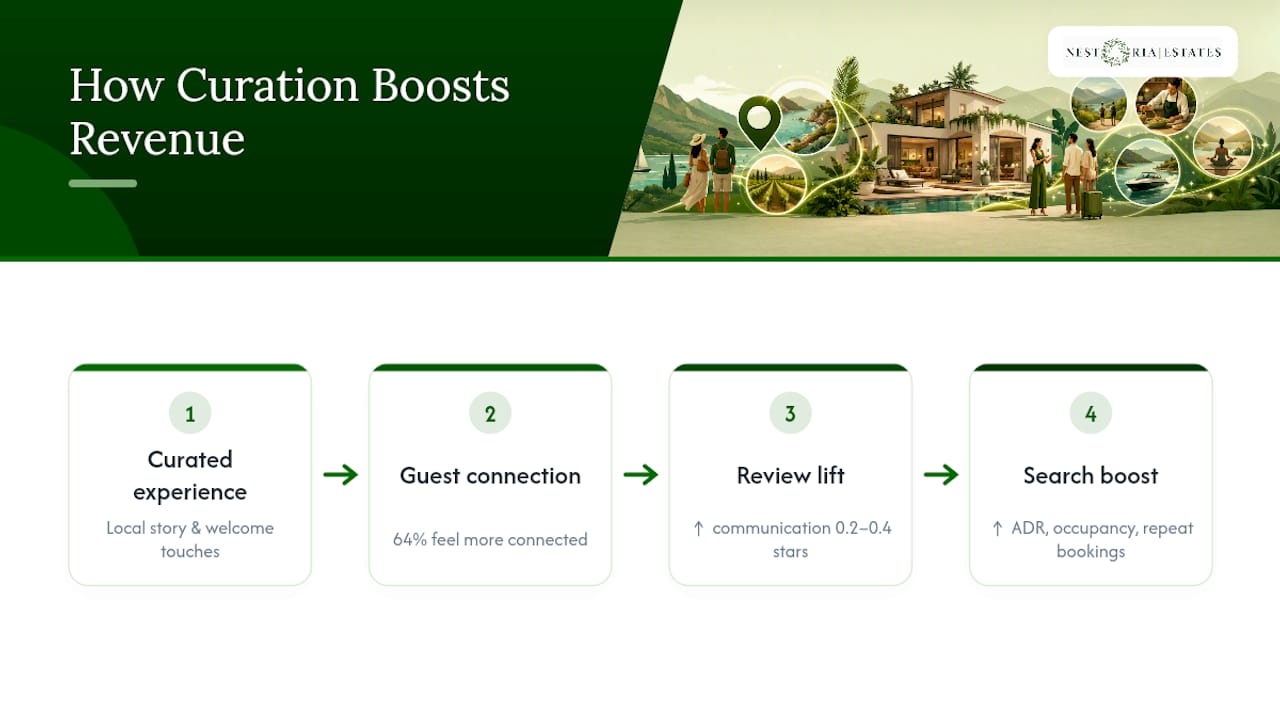
For Vancouver hosts, this matters more than in slower markets. The city has a dense cluster of well-managed, professionally photographed listings competing for the same guest pool. A generic listing gets lost in that scroll. A curated one, with a distinct local hook, does not.
What Types of Curated Experiences Can You Offer Guests?
The highest-impact experiences fall into three categories, and none of them require a large property or a big budget to start.
On-property touches are the fastest to launch. A welcome pack stocked with local coffee or a small-batch product from a nearby maker, a themed room concept, a consistent scent and playlist, or a short in-house class like guided yoga all create photogenic, shareable moments guests remember. These details also read as intentional in listing photos, which itself supports higher rates.

Local partnerships add the “connected to place” element that guests explicitly say they want. Think private walking tours, a chef-led dinner, a guided hike, or a cultural experience run by a vetted local operator. You are not building these from scratch. You are curating access to people who already do it well.

Concierge add-ons and digital experiences scale without extra labor. A digital guidebook that answers arrival questions before they get asked, paid early check-in or late checkout, and pre-arrival restaurant or activity bookings all fall here. A well-built welcome book reduces repetitive guest inquiries and prevents the small first-impression failures that trigger a mediocre review.
Pro Tip: Pick partners and design touches with the listing photo in mind. An experience that photographs well spreads on its own, through your listing gallery and through guests’ own social posts, at zero extra marketing cost.
How Should You Price and Package a Curated Experience?
Three pricing models cover almost every situation a Vancouver host will run into: the add-on fee, the bundled premium, and the commissioned partner booking.
Add-on fee. Offer early check-in, a welcome basket, or a guided activity as an optional paid extra, shown at booking or in pre-arrival messaging. A $25 to $75 add-on on a $200 nightly listing adds real margin without touching your base rate.
Bundled premium. Fold the experience into the nightly rate itself and raise ADR accordingly. This works best for themed or highly differentiated properties, where the whole stay is the product, not a checkbox extra.
Commissioned partner booking. Route guests to a local tour operator, chef, or guide and take a referral commission, typically 10 to 20% of the booking value. You add zero fulfillment work and guests get a vetted local option instead of a random online search.
Present the fee plainly. State it in the listing description and reinforce it in a pre-arrival message, since ambiguity around pricing is one of the fastest ways to generate a defensive review. Some hosts also use a flat service fee to cover concierge coordination generally, separate from any specific activity.
Pro Tip: Do not price your first experience high. Launch it at a modest rate, watch uptake for a month, then raise the price once you know guests actually want it. Dynamic, market-based pricing applies to experiences too, not just your nightly rate.
What Does It Take to Launch a Curated Experience Program?
Most hosts can go from idea to a live, bookable experience in two to six weeks using a straightforward rollout checklist.
Define the scope of the offer: one experience, clearly bounded, not five half-built ideas.
Write guest-facing copy and set your price using one of the three models above.
Lock in local partner agreements, including basic liability terms and proof of insurance where activities are involved.
Set a fulfillment schedule so partners and cleaners know exactly when a booking triggers action.
Add the offer to your guest messaging sequence and digital guidebook.
Refresh listing photos and description to reflect the new offer.
Brief cleaning and turnover staff on any physical setup the experience requires.
One compliance reminder worth repeating: confirm local permit requirements and liability coverage before promoting any off-property activity, since insurance gaps are the most common rollout mistake.
A single-property host can usually manage this alone in a few hours a week. Owners with five or more units tend to hit a wall here, which is exactly the operational gap a manager like Nestoria Estates is built to close.
How Do You Measure ROI on Guest Experiences?
Track occupancy, ADR, RevPAR, average length of stay, ancillary revenue per booking, review score movement, and repeat-guest rate. Most of this lives in your platform analytics or owner dashboard already.
Occupancy and ADR show whether the experience is pulling more bookings, commanding a higher rate, or both.
RevPAR blends the two into one number worth watching month over month.
Ancillary revenue per booking tells you if the add-on itself is profitable.
Review score and repeat-guest rate are the lagging indicators that confirm the experience is actually landing with guests.
A simple ROI formula: (incremental ADR or add-on revenue minus partner cost and fulfillment time) divided by upfront setup cost equals your payback period. Professional guest management and dynamic pricing have been linked to 8 to 12% higher average nightly revenue in competitive markets. Test any new experience for one full month or season before scaling it across your portfolio.
How Does a Full-Service Manager Package Guest Experiences?
A property manager bundling concierge coordination with a local partnership tends to see both a higher ADR and a stronger repeat-booking rate, because the guest experience becomes consistent instead of dependent on the host’s personal bandwidth.
The pattern usually looks like this: a portfolio owner struggles with inconsistent reviews and flat occupancy. The manager introduces a launch bundle, a digital guidebook, a curated local partner tour, and paid early check-in, then handles fulfillment scheduling, partner vetting, and guest messaging end to end. The result, tracked over a season, is a measurable lift in review scores and repeat bookings.
Consistency is what turns a one-off nice touch into a repeatable revenue line. The properties that see the biggest gains are the ones where guest messaging, pricing, and partner fulfillment run on the same system every single booking, not just when the host remembers.
Nestoria Estates runs this model for Vancouver owners: free revenue projections before you commit to anything, ongoing market-based dynamic pricing, and transparent owner reporting so you can see exactly what an experience bundle is contributing to your bottom line. Consistent guest experiences are the throughline connecting every one of these outcomes.
Which Experience Should You Test First?
If you manage one or two Vancouver units, start with a curated welcome pack paired with a digital guidebook and a single paid local experience upsell. It requires almost no operational overhead, touches every guest automatically, and gives you a clean signal on whether guests will pay for more. Watch your review language and repeat-booking rate over the first 30 to 90 days before adding a second offer.
How Nestoria Estates Helps You Launch These Experiences
Professional management closes the gap between having a good idea for a guest experience and actually running one profitably every week without your direct involvement. The hard part was never coming up with a welcome pack idea. It’s vetting reliable local partners, scheduling fulfillment around every check-in, and pricing the whole thing so it pays back.
Nestoria Estates handles that operational layer directly for Vancouver property owners: partner vetting so you are not personally responsible for a tour guide’s reliability, concierge fulfillment so guests get a consistent experience regardless of who is on shift, market-based dynamic pricing so your nightly rate and any bundled experience stay competitive, and detailed owner reporting so you can see the actual revenue impact rather than guessing at it. A typical launch package might bundle a digital guidebook, concierge onboarding, and one vetted local partner integration, rolled out under a single service agreement instead of five separate vendor relationships.
If you want to see what this could look like on your own property, request a free revenue projection through Nestoria Estates’ services page and get a clear number before you change anything.
Sources
Changing travel trends help Indigenous communities benefit from tourism – Airbnb Newsroom
Airbnb Concierge Services: What Every STR Investor Should Know | BNBCalc
How to create the best short-term rental welcome book | Guesty
Experience-Based Hosting: How to Create a Themed Airbnb That Commands Premium Rates — StayStrat
FAQ
What Are the Main Advantages of Curated Travel Experiences for Hosts?
The main advantages are higher occupancy, the ability to raise ADR, longer average stays, better reviews, and higher repeat-booking rates, all driven by guests placing more value on a personalized stay.
Do Curated Experiences Actually Increase Nightly Rates?
Yes. Themed and experience-driven listings can command 30 to 50% higher nightly rates than comparable standard listings when the experience fits the property and market.
How Much Should I Charge for a Guest Experience Add-on?
How Long Does It Take to Launch a Curated Experience Program?
Most single or small-portfolio hosts can plan, contract partners, and go live within two to six weeks using a structured checklist.
Can a Property Manager Handle Curated Experiences for Me?
Yes. Nestoria Estates manages partner vetting, concierge fulfillment, dynamic pricing, and owner reporting for Vancouver hosts, so experience bundles run consistently without added workload for the owner.
Recommended
Comments