

Should You Allow Pets? An Airbnb Pet Policy Strategy That Pays
- info67421305
- 1 day ago
- 9 min read

Allow pets if your property has durable flooring and some outdoor access. Decline for now if you have delicate furnishings, restrictive HOA rules, or zero buffer time between guests. Either way, you can implement a working airbnb pet policy strategy in the next 72 hours.
Three moves, in order: toggle “pets allowed” in your listing settings, set a per-stay pet fee in the platform’s fee field, and rewrite your house rules into four short lines instead of a wall of text. That’s the whole setup. The refinement comes later.
Watch two numbers for the first 60 days:
Average daily rate (ADR) uplift on pet-inclusive nights versus your prior baseline
Net pet-fee revenue after subtracting extra cleaning cost, not gross fee collected
Pet-friendly listings in studied markets show a 14 to 40 percent higher annual revenue, driven mostly by ADR gains and more search impressions. That’s the number that should decide this for most owners sitting on the fence.
Key Takeaways
A disciplined pet fee, tested and adjusted over 60 days, matters more to net revenue than any amenity purchase or flooring upgrade.
Point | Details |
Test your fee, don’t guess it | Start with a conservative per-stay fee, track net revenue for 60 days, then raise it 10 to 15 percent. |
Match property to policy | Durable flooring and outdoor access justify pets allowed; fragile furnishings or HOA bans mean wait. |
Budget the cleaning buffer | Add 20 to 30 minutes and $15 to $30 per turnover for pet stays, and label them in your scheduling system. |
Document damage immediately | Photograph within 24 hours and file through the Resolution Center, not a direct guest message. |
Hand off operations to Nestoria Estates | Nestoria Estates runs fee testing, cleaning SOPs, and damage claims for Vancouver owners who want the revenue without the labor. |
Table of Contents
How Do You Decide If Your Listing Should Be Pet-Friendly?
Run this checklist before you touch your listing settings:
Market type. Drive-to and vacation markets tend to see the strongest premium because pet owners often avoid boarding costs altogether. Dense urban condos see a smaller lift but still benefit from expanded search visibility.
Property features. Luxury vinyl plank or tile beats carpet. A fenced yard or nearby off-leash park beats a fourth-floor walkup. Fragile furniture or light-colored upholstery raises your risk without raising your fee ceiling.
Building rules. Check your strata bylaws or HOA restrictions before you advertise anything. A Vancouver condo board that bans pets outright makes this whole exercise moot.
Then do the math: multiply your expected ADR uplift by projected additional nights booked, then subtract incremental cleaning cost and a reasonable depreciation allowance for wear on soft goods. If that number is positive, allow pets. If it’s marginal, test it for one quarter before committing further.
Pro Tip: Pull your last 12 months of inquiry messages and count how many asked about pets, even if you don’t allow them. That’s your suppressed demand, sitting there for free.
What Property Changes Reduce Pet-Related Risk?
You don’t need a renovation. You need a short list of durable swaps and a few cheap items that double as marketing photos.
Flooring first. LVP handles claws and accidents far better than carpet, and it’s the single highest-leverage change if you’re renovating anyway.
Washable furniture covers on sofas and armchairs protect upholstery without making the space look like a kennel.
Area rugs over hard floors in high-traffic zones catch mud and reduce slip risk for older dogs.
A pet welcome kit: a bowl set, a mat, a few waste bags, and a treat. StayStrat’s operator guide puts total setup cost for these basics around $43 to $80, and it pays back fast in reviews.
A designated “pet zone.” A crate corner or mudroom nook near the entry keeps muddy paws contained and gives you a clean staging spot for listing photos.
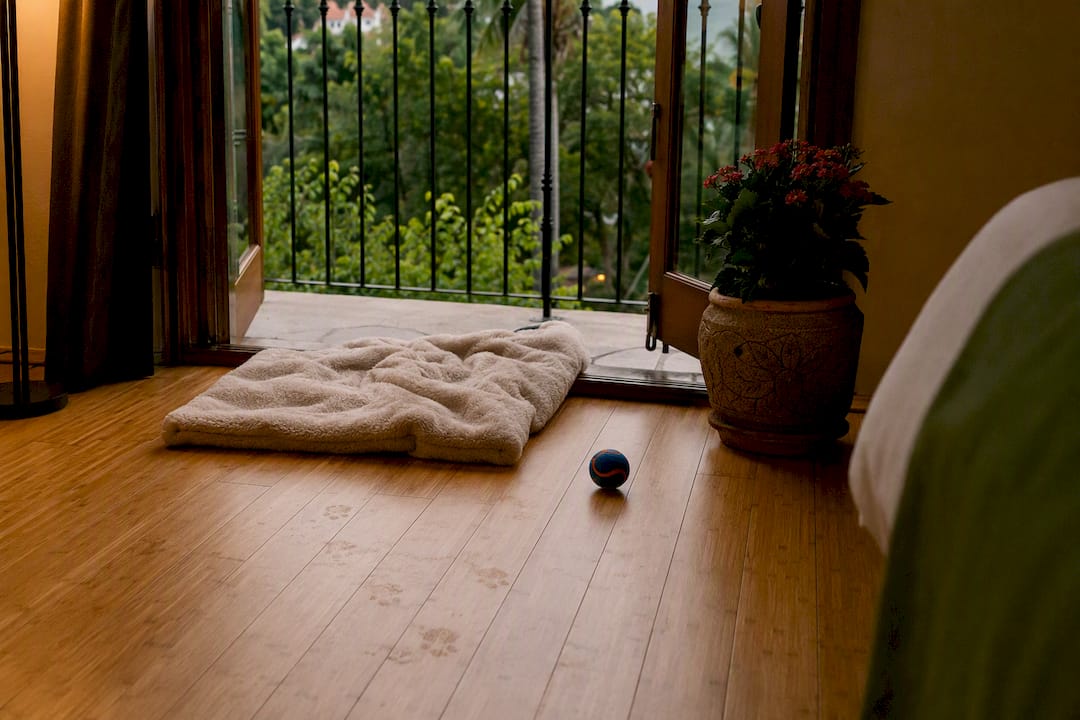
None of this needs to look institutional. A tidy pet bed in a sunny corner photographs better than an empty room, and it signals to responsible pet owners that you’ve actually thought this through. Small, visible amenities like these carry outsized weight relative to their cost when guests are deciding between two similar listings.
What Should You Charge for a Pet Fee?
You have four real options, and they behave differently:
Per-stay flat fee. Simplest for guests to evaluate, and it doesn’t punish longer bookings the way a nightly charge does.
Per-night fee. Scales with length of stay but can spook a two-week booker doing math at checkout.
Built into the base rate. Useful in markets where service-animal exemptions are common enough that a visible fee becomes hard to enforce consistently.
Refundable damage deposit. Adds friction at booking but gives you leverage if something goes wrong.
Operator data points to a flat per-stay fee, or a $20 to $35 per-night charge, as the range most hosts actually use without denting conversion. A per-stay flat fee tends to preserve booking rates better on week-plus stays because guests aren’t watching a number climb.
Here’s the mistake worth naming directly: hosts who set their fee too low often blame the pet, not the price, when a stay turns unprofitable. RentTools’ fee-math breakdown shows several hosts who raised fees to a realistic level and saw occupancy hold steady while net profit improved. Run a 60-day test at a conservative fee, track net revenue (not just bookings), then raise it 10 to 15 percent and compare.
How Should You Structure Cleaning and Damage Documentation?
Pet stays need a slightly different turnover routine, and skipping it is how small issues become disputed claims three weeks later.
Vacuum twice, once on arrival prep and once mid-clean, focusing on corners and under furniture where fur collects.
Use enzyme cleaner on any visible stain or odor source immediately, not a generic all-purpose spray.
Wash all removable covers and rugs on a hot cycle after every pet stay, even if they look clean.
Lint-roll upholstery as a final pass before the next guest arrives.
Check the yard or balcony for anything left behind before your next check-in.
Label pet stays in your property management or cleaning software so your team knows to add 20 to 30 minutes and budget the extra $15 to $30 cleaning premium operator guides recommend. Build that buffer into your turnover schedule rather than hoping the cleaner finishes early.
If damage happens, document it immediately: photos within 24 hours, timestamped, from multiple angles. File through Airbnb’s Resolution Center rather than messaging the guest directly first, and keep receipts for any replacement or repair. AirCover for Hosts can reimburse legitimate damage, but only if your documentation trail is clean.
Pro Tip: Take a 30-second video walkthrough of the unit before every pet stay, not just photos. It’s faster than staging individual shots and gives you full-room context if a dispute arises later.
What Should Your Listing and House Rules Say?
Enable the “Pets allowed” amenity toggle, and mention it in your title or opening line of the description. Pet owners often filter searches by this exact setting, so burying it on line four of your description costs you visibility.
Keep house rules short and specific:
Maximum number of pets (most owners cap at two)
Size or weight limit, or a simple “house-trained dogs and cats only”
Whether pets can be left unattended in the unit
Furniture rules (on the bed, on the sofa, crate required or not)
Add a short guidebook section with the nearest off-leash park, a 24-hour vet clinic, and a doggy daycare option, supported by the hotel check-in process workflow that helps organize guest information and pet arrival instructions. That single addition resolves the three questions every pet-owning guest messages you about anyway, cutting down on back-and-forth before check-in.
What Are the Rules Around Service Animals and Insurance?
Service animals are not pets under Airbnb’s policy, and hosts generally cannot charge a pet fee or refuse them in most jurisdictions, regardless of your “no pets” setting. Airbnb’s own verification is limited, so build this into your expectations rather than fighting it guest by guest.
Emotional support animals sit in a grayer zone. Platform rules and local tenancy law don’t always agree, so check your provincial regulations rather than assuming Airbnb’s policy is the final word.
Before flipping the pets-allowed switch:
Confirm your short-term rental insurance rider actually covers pet-related damage, not just general liability
Read your condo bylaws or lease agreement in full, not just the pet-restriction clause
Ask your insurer directly whether a claim history involving pets affects your renewal rate
How Does Nestoria Estates Handle Pet Policy for Vancouver Owners?
Nestoria Estates runs this entire playbook for owners who’d rather collect the revenue than manage the logistics. That means dynamic pricing that adjusts for pet-friendly demand, guest communication that answers the “is my dog allowed” question before it’s asked, cleaning coordination with pet-specific SOPs already built in, and damage handling through proper documentation and Resolution Center filings when needed.
Owners who hand off pet-policy operations skip the part where you’re the one lint-rolling a couch at 11 PM before a same-day turnover.
The process typically looks like:
Nestoria reviews your unit’s layout, flooring, and building rules for pet suitability
A conservative fee gets tested for the first cycle, then adjusted based on net revenue data
Cleaning teams get a standing pet checklist attached to every applicable turnover
Owner reporting shows the ADR uplift and fee revenue separately, so you see what’s actually working
If you’re a Vancouver owner weighing whether the pet-friendly premium is worth the operational lift, request a free revenue projection through Nestoria Estates’ services page and let the numbers make the call.
Editorial Perspective: What Actually Moves the Needle
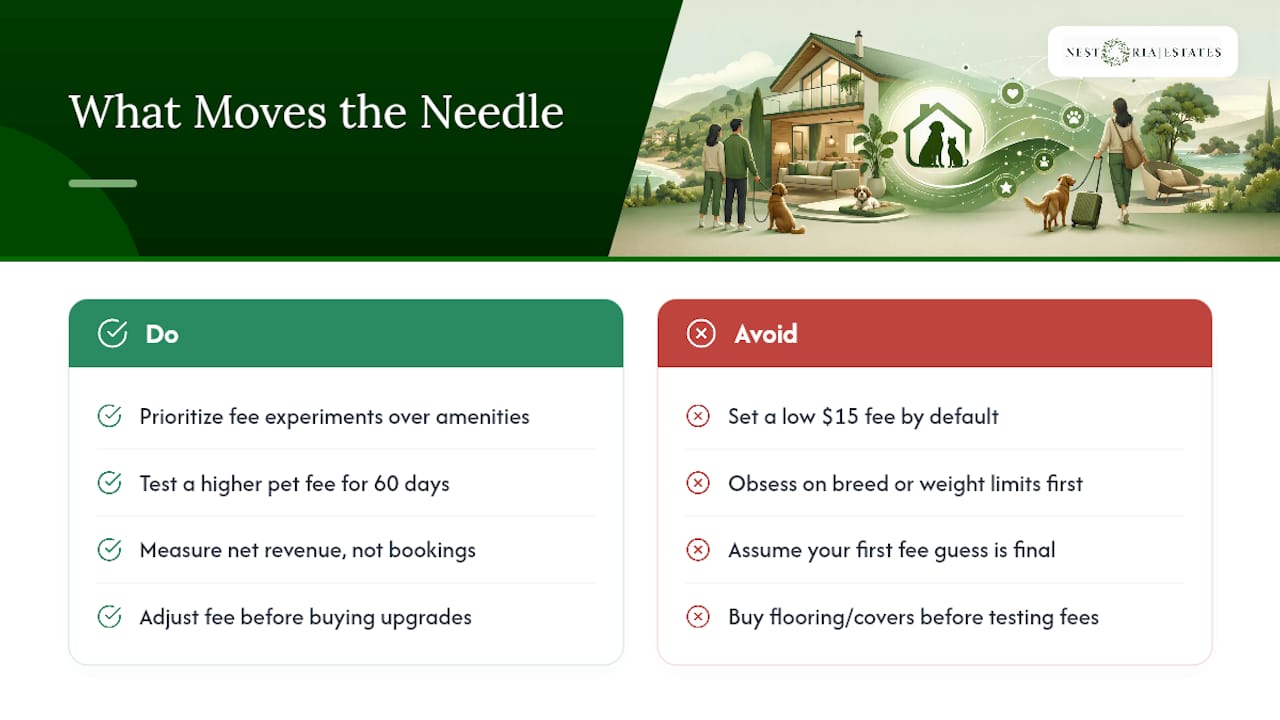
Most pet-policy advice online obsesses over the wrong variable. Owners agonize over breed restrictions and weight limits when the real lever is fee discipline. A $15 pet fee on a $200-a-night listing isn’t a policy, it’s a rounding error that guarantees you lose money on the first accident.
The conventional wisdom says “start friendly, keep it simple.” Fine advice, incomplete math. Simple and underpriced are not the same thing. The hosts who complain that “pets don’t pay” are almost always the ones who never tested a higher fee band, they just assumed their first guess was correct and stopped looking.
If you take one thing from this, prioritize the fee experiment over the amenity spending. A pet bed and a bowl set are nice touches, but they don’t fix a fee that’s $15 too low. Test the number for 60 days, watch net revenue rather than booking count, and adjust before you spend another dollar on flooring or covers you may not need yet.
The property features matter, but they’re the second decision, not the first.
Get a Free Revenue Projection From Nestoria Estates
If everything above sounds right but you don’t want to be the one running fee experiments and checking cleaning checklists between guest messages, that’s exactly the gap Nestoria Estates fills.

Nestoria Estates manages the full pet-policy cycle for Vancouver property owners: dynamic pricing tuned to pet-friendly demand, guest messaging that heads off pet questions before check-in, cleaning coordination with SOPs already in place, and damage claims filed correctly the first time. You get the comprehensive management services without touching a single Resolution Center form yourself. Request a free revenue projection through the Nestoria Estates services page to see what a pet-friendly policy could add to your specific listing.
Sources
What you need to know about hosting pets - Resource Center - Airbnb
The Complete Guide to Making Your Airbnb Pet-Friendly (and Charging Premium Rates) — StayStrat
Airbnb Pet-Friendly Revenue Premium: AirROI Data Shows 14-40% More Across 6 Markets | AirROI
Pet fee math for short-term rental hosts: when allowing dogs actually pays · RentTools
FAQ
Can I charge a pet fee for a service animal on Airbnb?
No. Airbnb classifies service animals separately from pets, and hosts generally cannot charge a fee or deny the booking on that basis in most jurisdictions.
What’s a reasonable pet fee for an Airbnb listing?
Most operators use a flat per-stay fee or a $20 to $35 per-night charge, based on typical ranges reported across operator fee guides.
Does allowing pets actually increase Airbnb revenue?
Yes, in most studied markets. Pet-friendly listings show a 14 to 40 percent higher annual revenue, largely from ADR gains and increased search visibility.
Should I set a refundable damage deposit instead of a pet fee?
A deposit adds booking friction and isn’t necessary for most owners; a well-tested per-stay fee combined with AirCover documentation typically covers the same risk with less guest hesitation.
Can Nestoria Estates manage pet policy for my Vancouver property?
Yes. Nestoria Estates handles fee testing, pet-specific cleaning coordination, and damage claim documentation as part of its full-service management for Vancouver owners.
Recommended
Comments