

Best Travel Experience Packages 2026: Vancouver Owner's Guide
- info67421305
- 1 hour ago
- 9 min read

For Vancouver Airbnb owners, the highest-performing packages in 2026 share four themes: wellness and reading escapes (“Readaways”), farm charm and slow travel, nature and outdoor immersion, and remote-work retreats. Bundle each with vetted local partners, clear logistics, and a fixed price. Launch checklist: pick one theme, contract one partner, run a test stay, add the package to your listing, and review KPIs at 90 days.
Wellness/Readaway: spa partner + curated book kit + blackout curtains
Farm Charm: farm tour + seasonal produce box + guided foraging
Nature Immersion: guided hike or kayak + packed trail lunch + gear rental
Remote-Work Retreat: high-speed Wi-Fi guarantee + ergonomic setup + co-working day pass
Tourism spending in Canada is forecast to grow by 6.0% in 2026, with long-term revenue projected to reach $216.3 billion by 2035. Guests are already searching for these bundles. The owners who productize now capture the yield; those who list only a space compete on price alone.
Table of Contents
Why do experience-first packages matter for Canadian hosts in 2026?
What are the top experience themes that convert for Canadian short-term rentals?
What exactly should you include in a guest-ready experience package?
How do you reliably deliver packages without service failures?
How do you promote packages on listings and distribution channels?
What are the practical next steps for Vancouver owners launching in 2026?
Why experience packages are the right call for Vancouver owners right now
Nestoriaestates handles the hard parts of package delivery for you
Why do experience-first packages matter for Canadian hosts in 2026?
The demand signal is unusually clear this year. Canada’s tourism outlook points to reshoring of domestic travel dollars alongside faster growth from higher-yield, fly-in international visitors. Both groups want more than a bed. They want a reason to choose your property over the one two blocks away.
Expedia Group’s Unpack '26 identifies Readaways, Farm Charm, Set-Jetting, and Hotel Hop as the defining 2026 trends. These are not niche preferences. They reflect a broad shift: Canadian travelers now start trip planning with a desired experience, then find the accommodation that delivers it. For vacation rental management in Canada, that shift is an opening. A well-packaged property ranks higher in guest searches, commands a premium nightly rate, and attracts guests who leave detailed, positive reviews.
What are the top experience themes that convert for Canadian short-term rentals?
Five themes have the clearest demand and the most practical delivery paths for Vancouver owners.
Wellness and Readaways: Partner with a local massage therapist or spa, add a curated book selection, and market the stay as a digital-detox retreat. Works in any apartment with blackout curtains and a quiet setup.
Farm Charm and Slow Travel: Coordinate a day trip to a Fraser Valley farm, include a seasonal produce box, and frame the stay as an antidote to city pace. Best for properties with easy highway access.
Nature and Outdoor Immersion: Pair with a Sea-to-Sky guide for kayaking, hiking, or snowshoeing. Urban Vancouver properties can offer a Grouse Mountain or Lynn Canyon day package.
Remote-Work Retreats: Guarantee verified Wi-Fi speeds, add an ergonomic chair and monitor, and include a co-working day pass. High attach rate with extended-stay guests.
Cultural and Set-Jetting Micro-Experiences: Curate a neighborhood food tour, an Indigenous-led storytelling walk, or a film-location visit tied to a popular series. Low cost, high perceived value.
Urban apartments suit wellness, remote-work, and cultural themes. Sea-to-Sky or rural cottages are natural fits for farm charm and nature immersion.
Pro Tip: Before committing to a full package rollout, test one add-on for a single night. Offer a $40 welcome kit with a local book and a bath soak. Track how many guests select it. If attach rate exceeds 30% in the first month, build the full package around that theme.

What exactly should you include in a guest-ready experience package?
The deliverables that matter most to guests are the ones that remove friction. A curated, personalized experience increases perceived value and willingness to pay far more than a generic amenity upgrade.
Core checklist for every package:
Branded welcome kit (local snack, printed itinerary, handwritten note)
Pre-booked partner activity with confirmed time slot and meeting point
Transport or meet-and-greet logistics documented in the guest app
Clear refund and cancellation policy stated at booking
One-page safety brief covering activity risks and emergency contacts
Digital itinerary sent 48 hours before check-in
Sample 48-hour wellness package itinerary:
Day 1, 4 PM: Check-in, welcome kit waiting, blackout curtains drawn
Day 1, 6 PM: In-suite massage with pre-vetted therapist (90 min)
Day 2, 9 AM: Guided forest walk, Stanley Park or Lynn Canyon
Day 2, 12 PM: Packed lunch from local deli included in package
Day 2, 3 PM: Free afternoon, curated reading list on the nightstand
Day 2, 11 PM: Late checkout option (confirm at booking)
Before every package check-in, verify the partner has confirmed the time slot, the welcome kit is assembled, and the digital itinerary has been sent. Permits, liability waivers, and activity insurance should be confirmed with each partner before the first guest arrives.
How should you price and sell packages in 2026?
The core formula is straightforward: base nightly rate + fixed partner cost + 20–30% markup + platform fee + applicable taxes. Keep the math visible so you can adjust when partner costs change.
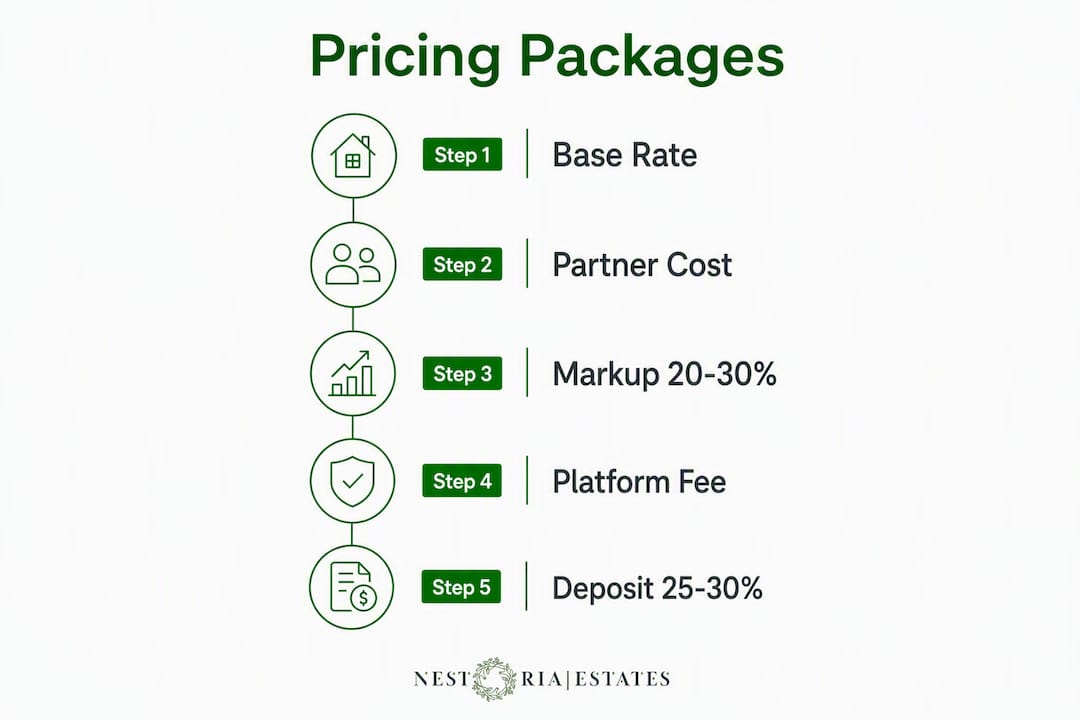
Collect a non-refundable deposit of 25–30% at booking to cover partner costs. List the package as a separate line item or upsell in your booking platform’s add-ons section, not buried in the description. For luxury accommodation positioning, price anchoring works: show the itemized value of each component so guests see they are paying less than booking each piece separately.
How do you reliably deliver packages without service failures?
Operations is where most packages fail. A guest who books a massage and arrives to find the therapist double-booked will not leave a five-star review.
Weeks 1–2: Draft partner agreements with confirmed SLAs, cancellation terms, and backup contacts.
Week 3: Run a full test stay. Owner or manager checks in as a guest and walks every step.
Week 4: Train cleaning and coordination staff on the package sequence and escalation path.
Days 30–90: Review every guest review mentioning the package. Flag any partner failure within 24 hours.
Preventative cleaning protocols protect package revenue by catching maintenance issues before a guest arrives. A broken blackout curtain or a faulty Wi-Fi router discovered during a remote-work retreat can tank an otherwise perfect stay. Document a pre-arrival inspection checklist specific to each package type.
Maintenance is the top stressor for 46% of rental owners, and surprise costs are a leading reason owners switch managers. Set approval thresholds in writing: any repair under $200 proceeds without owner sign-off; anything above triggers a same-day notification with photo evidence.
Pro Tip: Ask any property manager you consider to walk you through their maintenance ticketing system before you sign. The ones who can show you a live dashboard with contractor response times and cost history are the ones who will not surprise you with a $900 emergency invoice.
How do you promote packages on listings and distribution channels?
Your listing title does the heaviest lifting. Lead with the experience, not the space.
Weak: “2BR apartment near Stanley Park”
Strong: “Wellness Retreat + Spa | Stanley Park | Blackout Escape”
Match your copy to the language Expedia Unpack '26 travelers are already using: “Readaway,” “slow travel,” “digital detox,” “set-jetting.” These phrases appear in guest search queries.
“Canadian travellers entering 2026 are prioritizing meaningful, curated experiences over quantity. Clients no longer want activities that feel generic or overcrowded. They want experiences that align with personal values — quality, transparency, safety, and local connection.” — globalagents.ca
Surface packages in three places: the listing headline, the photo captions (show the welcome kit, the activity, the view), and the “add-ons” or “experiences” section of your booking platform. Personalized travel services consistently increase guest satisfaction and repeat bookings when the offer feels specific rather than generic.
How do you measure whether packages are actually working?
Track five metrics from day one. Without them, you cannot tell whether a package is profitable or just busy.
KPI | Target by Day 90 |
Incremental revenue per booking | +15–25% vs. baseline nightly rate |
Package attach rate | >25% of eligible bookings |
Guest review score (package mentions) | high guest rating |
Repeat booking lift | Measurable uptick vs. pre-package period |
Maintenance cost delta | No increase vs. baseline |
Check at 30 days (is the attach rate above 10%?), 60 days (are reviews mentioning the package positively?), and 90 days (is incremental revenue covering partner costs with margin left over?). If attach rate stays below 15% at 60 days, change the price point or the theme before investing further.
What are the practical next steps for Vancouver owners launching in 2026?
Choose one theme that fits your property type (urban: wellness or remote-work; Sea-to-Sky: nature or farm charm).
Identify and contact two local partners. Get written confirmation of availability, pricing, and cancellation terms.
Build the welcome kit and digital itinerary. Keep the first version simple.
Run a test stay with a trusted guest or yourself before opening bookings.
Add the package to your listing headline and add-ons section.
Confirm your Vancouver short-term rental license is current and that partner activities carry their own liability coverage.
Run a 90-day performance review against the KPIs above.
Peak shoulder seasons in Vancouver (May–June and September–October) are the best windows for a trial run. Demand is strong, but operational pressure is lower than July–August, giving you room to fix problems without losing peak revenue.
Key Takeaways
Experience-first packages that bundle vetted local partners, clear logistics, and a fixed price outperform bare-bones listings in 2026 because Canadian travelers now choose a destination based on the experience it delivers, not the address.
Point | Details |
2026 market growth | Canadian tourism spending is forecast to grow 6.0% in 2026, with long-term revenue projected to reach $216.3 billion by 2035. |
Top themes | Wellness/Readaways, Farm Charm, Nature Immersion, and Remote-Work Retreats have the clearest demand for Vancouver owners. |
Pricing formula | Base rate + partner cost + 20–30% markup + platform fee; collect a 25–30% non-refundable deposit at booking. |
90-day KPI targets | Aim for a meaningful package attach rate and incremental revenue above baseline by day 90. |
Nestoriaestates | Nestoriaestates offers full-service package design, partner coordination, dynamic pricing, and transparent 90-day onboarding for Vancouver owners. |
Why experience packages are the right call for Vancouver owners right now
The conventional wisdom says list your property, set a competitive price, and let the platform algorithm do the work. That worked in 2019. In 2026, the algorithm rewards properties with strong review velocity, high average booking value, and repeat guest signals. Experience packages drive all three.
What most owners underestimate is how little the package itself has to cost to move the needle. A welcome kit and a pre-booked massage appointment can justify a significant premium on a two-night stay. The math is not complicated. The execution is. Partners cancel, kits arrive late, and guests ask questions the listing did not answer. The owners who succeed are the ones who treat the package as a product with an SLA, not a nice gesture.
Transparency in the first 90 days is not a soft value. It is the mechanism that keeps owners from abandoning a package strategy the moment one partner fails. A dashboard showing real-time revenue, maintenance costs, and guest review scores turns a single bad week into a data point rather than a reason to quit.
Nestoriaestates handles the hard parts of package delivery for you
Running a curated experience package on top of a short-term rental is genuinely more complex than a standard listing. Partner coordination, preventative maintenance, dynamic pricing, and guest communication all have to work together, or the guest experience falls apart and the reviews reflect it.
Nestoriaestates manages every layer of that operation for Vancouver owners. The full-service management offering covers package design, partner contracting, pricing optimization, cleaning coordination, and a 90-day onboarding plan with dashboard reporting from day one. Owners get a free revenue projection before signing anything, and the revenue-share model means Nestoriaestates only earns when your property does. No surprise fees, no opaque maintenance invoices. To get your free revenue projection and 90-day onboarding plan, book a consultation with the Nestoriaestates team today.
Useful sources and further reading
For market data and trend verification, start with the primary industry reports. For operational guidance, the property management and hospitality resources below are the most directly applicable.
Expedia Group Unpack '26 Canada — trend language and guest demand signals
Expedia Unpack '26 Summer Travel Trends — seasonality and domestic demand data
Nestoria Estates Services — full-service management and onboarding details for Vancouver owners
FAQ
What are the best travel experience packages for Vancouver Airbnb owners in 2026?
Wellness and Readaway bundles, Farm Charm slow-travel packages, nature immersion stays, and remote-work retreats are the top-performing options. Each pairs a vetted local partner with clear logistics and a fixed guest-facing price.
How much of a premium can a package command over a standard nightly rate?
A well-structured package typically generates 15–25% more incremental revenue per booking than a baseline listing, based on the pricing formula of base rate plus partner costs plus a 25% owner markup.
How long does it take to see results from an experience package?
Most owners see meaningful attach-rate and revenue data within 60–90 days. Use 30/60/90-day checkpoints to decide whether to scale, adjust the price, or switch themes.
Can Nestoriaestates design and manage experience packages on my behalf?
Yes. Nestoriaestates handles package design, partner contracting, dynamic pricing, and 90-day onboarding with dashboard reporting for Vancouver owners, operating on a revenue-share model with no hidden fees.
Do I need a special license to offer experience packages in Vancouver?
Your existing short-term rental license covers the accommodation. Each partner activity (guided tours, massage, etc.) must carry its own liability coverage and any required municipal permits. Confirm both before your first guest arrives.
Recommended