

Calgary Short Term Rental Rules: What Hosts Must Know Now

Yes, you can legally run a short-term rental in Calgary, but only with a valid business licence covering stays up to 180 consecutive days. That’s the new definition as of April 1, 2025, and it changes which properties fall under the bylaw. Before you list a single night, you need three things locked down.
A business licence in the correct category (Primary or Non-Primary Residence)
A passed fire inspection from the Calgary Fire Department for any new licence
Your licence number visible on every online listing and advertisement
Start by confirming your property qualifies, then set up a myID Citizen account, and budget time for the fire inspection before you book your first guest.
Key Takeaways
Calgary permits short-term rentals under a licensing system that now covers stays up to 180 days, splits primary and non-primary properties into separate categories, and ties future non-primary approvals to rental vacancy conditions.
Point | Details |
180-day definition | Stays of up to 180 consecutive days now require a short-term rental business licence. |
Two licence categories | Primary Residence licences require proof of residency; Non-Primary licences face higher fees and moratorium risk. |
Fire inspection is mandatory | New licences require a Calgary Fire Department inspection; renewals use risk-based scheduling. |
Fees vary by category | Non-Primary and Short-Term Rental Company licences ($3,000/year) cost more than Primary Residence fees. |
Compliance is continuous | Licence numbers, guest records, and emergency contacts must be maintained every day the listing is active. |
Table of Contents
Calgary Short Term Rental Rules: The 180-Day Shift
The biggest change to Calgary’s short-term rental rules isn’t a new fee or a stricter inspection but aligns with common considerations in medium-term and corporate housing contracts, as explained in this complete guide to rental agreements in Sweden. It’s a wider net. Calgary now defines a short-term rental as any accommodation offered for compensation for up to 180 consecutive days, nearly double what most hosts assumed the rule covered. That pulls furnished monthly rentals and corporate housing stays into the same licensing regime as weekend Airbnb bookings.
Two licence categories now split the market:
Primary Residence licence: for owners renting out the home they actually live in, with proof of residency required and only one active booking at a time.
Non-Primary Residence licence: for investment properties or secondary units, subject to a higher fee tier and closer scrutiny.
The city has also built in a moratorium trigger. If the Canada Mortgage and Housing Corporation’s purpose-built rental vacancy rate drops below 2.5%, council can pause new Non-Primary licences to protect long-term rental supply. That’s a real possibility given how tight Calgary’s rental market has been, so investors should treat non-primary status as conditional, not guaranteed.
How To Apply For A Short-Term Rental Licence
Getting licensed comes down to using the right account and having your paperwork ready before you start the clock. Here’s the sequence that avoids the most common delays.
Create a myID Citizen account. Business accounts are for corporate filings, not individual STR licences. Applying under the wrong account type is one of the most frequent snags hosts run into, according to the city’s own guidance.
Gather your documents. For Primary Residence applications, that means proof you actually live at the address. For any property, you’ll need site details for a fire safety plan, and if you’re in a condo, a copy of your bylaws or written authorization from the board.
Complete permits and safety upgrades first. Don’t book your fire inspection until smoke alarms, egress windows, and any required electrical work are already done.
Submit and wait for review. Processing times vary, but incomplete applications and unprepared inspections are what stretch this out.
Renew early. The city allows renewal applications up to 30 days before expiry, which gives you a buffer if anything needs fixing.
Pro Tip: Book your fire inspection only after a final walkthrough of your own. A second inspection visit costs you time and, in some cases, an additional fee.
Calgary Short-Term Rental Licence Fees And Costs
Budgeting for a Calgary STR licence means accounting for more than one line item. The 2026 Business Licence Fee Schedule sets separate rates for new applications and renewals, and the category you fall into changes the total significantly.
Primary Residence licences carry the lowest fees of the two categories, plus a separate fire inspection fee where one applies.
Non-Primary Residence licences sit at a higher tier, reflecting the commercial nature of investment-property rentals.
Short-Term Rental Company licences, aimed at platforms and larger operators rather than individual hosts, run $3,000 per year.
All licence fees are non-refundable once submitted, and none of them include the cost of permits or safety upgrades you might need before your inspection. Factor that into your first-year math, not just the sticker price on the fee schedule.
Passing The Calgary Fire Department Inspection
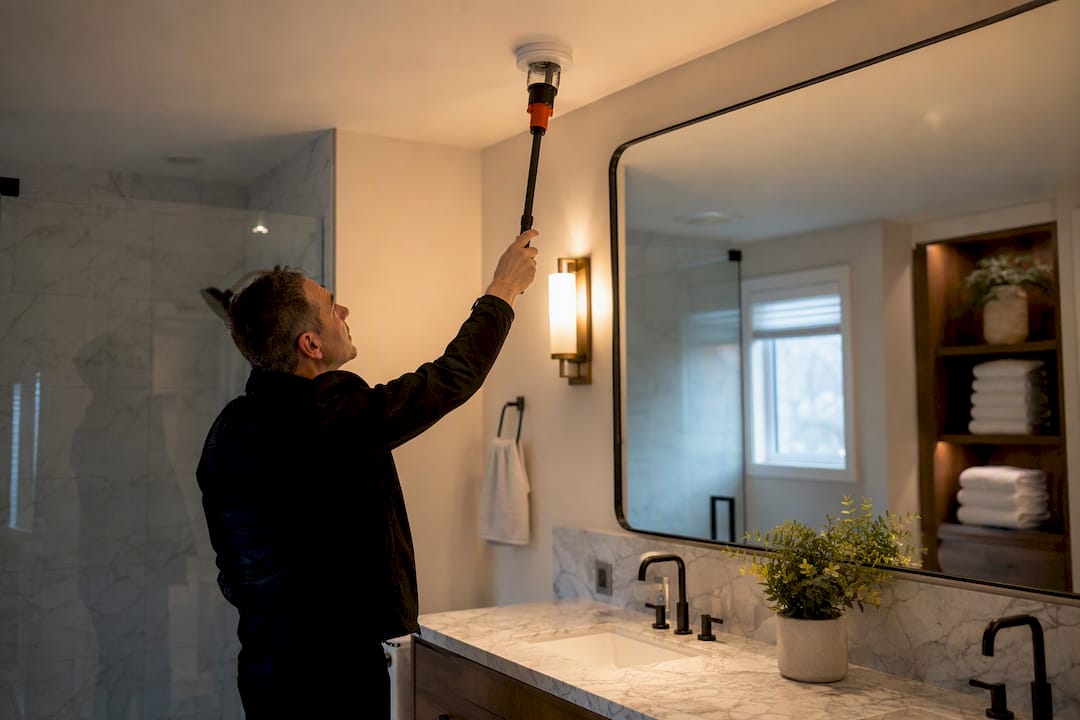
Every new short-term rental licence requires a Calgary Fire Department inspection before it’s issued. Renewals work differently. The CFD uses a risk-based prioritization model rather than inspecting every renewal in person, but that doesn’t mean compliance is optional between visits. You’re expected to maintain the same safety standard year-round.
Inspectors typically check for:
Working smoke and carbon monoxide alarms in every required location
Proper egress, including windows large enough to exit through in bedrooms below grade
A posted fire safety plan showing exit routes
Accessible emergency contact information for guests
Most failed inspections come down to the same handful of issues: a missing CO detector, a blocked or undersized egress window, or no posted safety plan. Fix those before you call for an inspection, not after.
Pro Tip: Take photos of every smoke alarm and egress point before your inspection date. If a fix gets flagged, you’ll have a paper trail showing what was already in place.
Day-To-Day Rules Once You’re Licensed
A licence isn’t a one-time hurdle. Calgary expects ongoing compliance with a set of operating rules that apply every single day your listing is live.
Display your business licence number on every online listing and any advertisement, print or digital.
Never overlap bookings. You can’t rent separate rooms in the same home to different parties at the same time.
Respect occupancy limits set for each room or unit at licensing.
Keep electronic guest records on file and available whenever the Chief Licence Inspector requests them.
Post a 24-hour emergency contact on-site so guests and inspectors can reach someone immediately.
These aren’t suggestions buried in fine print. Bylaw officers can and do check listings against the licence registry, and a missing licence number is one of the easiest violations to spot from a browser.
Restrictions, Enforcement, And Special Cases
Not every Calgary property qualifies for a short-term rental licence, and the exclusions matter more than most hosts expect. The city will not issue licences to homes designated as affordable or non-market housing, a deliberate move to keep that stock available for long-term tenants.

Condo ownership adds another layer entirely. A city licence says nothing about what your condo board allows. Strata bylaws can prohibit short-term rentals outright, and a municipal licence does not override a private bylaw. Check your condo documents before you apply, not after you’ve paid the fee.
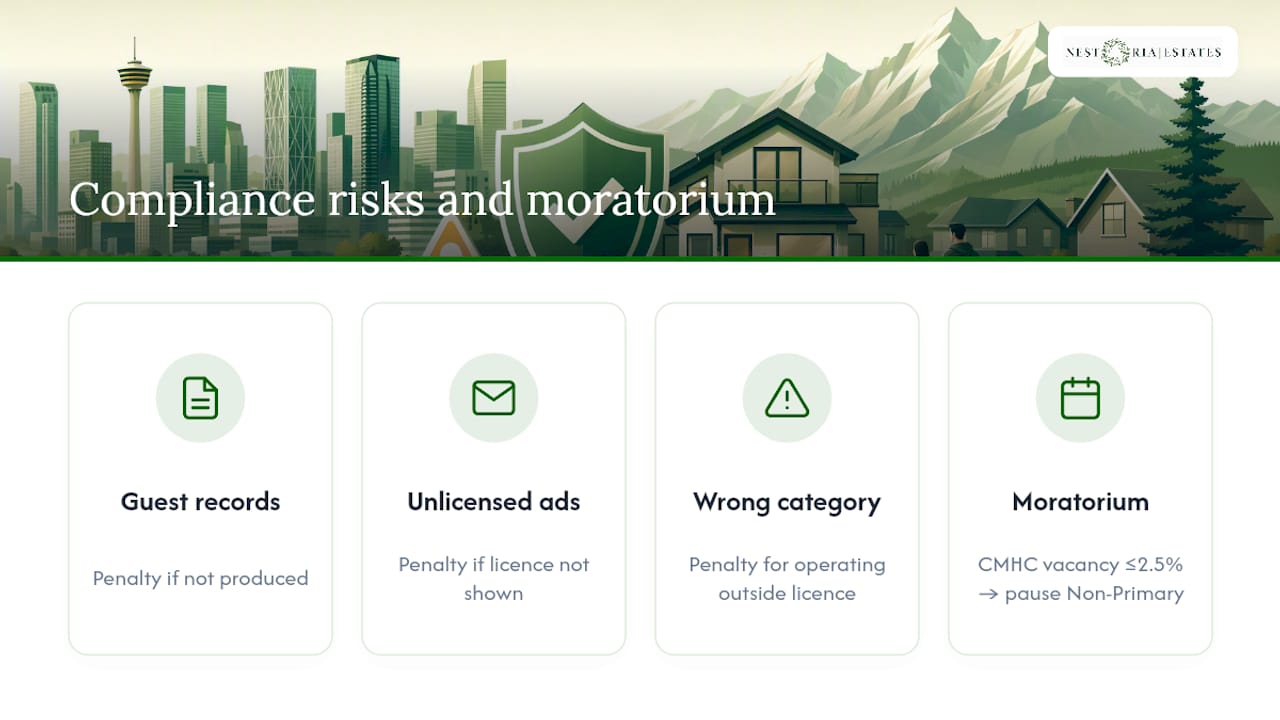
Penalties apply for failing to produce guest records on request, advertising without a visible licence number, or operating outside your licence category. And remember the moratorium mechanism tied to the 2.5% CMHC vacancy threshold: if that number dips, new Non-Primary licences can be paused entirely.
A Practical Checklist Before You List
Whether you’re launching your first Calgary listing or bringing an existing property into compliance, the sequence matters. Skip a step and you’ll likely pay for it in inspection delays or licence rejections.
Check your condo bylaws (if applicable) before you spend a dollar on permits
Complete required permits and safety upgrades first
Test every smoke and CO alarm and confirm egress windows meet code
Fix any known safety issues before booking your fire inspection
Set up digital, searchable guest records from day one
Post a 24/7 emergency contact number inside the unit
Display your licence number on every listing platform you use
Pro Tip: Property-management software that automates guest-record storage and syncs your licence number across listings cuts down on the manual work that trips up self-managed hosts during a compliance check.
If you’re weighing whether to handle all of this yourself or hand it off, this is usually where the math shifts. Owners managing rentals long-distance, or juggling multiple properties, tend to see more inspection failures and slower renewals simply from bandwidth, not intent. That’s the gap professional management closes: fewer failed inspections, continuous compliance between renewal cycles, and pricing that adjusts to Calgary’s market instead of sitting static. Nestoria Estates handles exactly this kind of operational load for owners who’d rather not track fire code updates on top of everything else, and its approach to professional short-term rental setup reflects lessons learned managing rentals across multiple Canadian regulatory environments, not just one city’s bylaw.
What Nestoria Estates Sees Hosts Get Wrong
Calgary’s bylaw overhaul reads like a compliance checklist, but the real risk isn’t the paperwork. It’s assuming last year’s rules still apply. The 180-day definition alone catches a lot of hosts off guard because it reclassifies furnished monthly rentals that used to sit outside STR licensing entirely. If you’re renting anything under six months for compensation, you’re now in scope.
The primary versus non-primary split gets treated as a technicality, but it’s actually the more consequential distinction. Non-primary owners are the ones exposed to the moratorium risk, and that’s a policy lever the city has already built and can pull without much warning. Anyone buying a Calgary property specifically for short-term rental income should model what happens if new non-primary licences freeze for a stretch.
Most hosts also underestimate how much inspection failures cost in lost booking time, not just repair costs. A property sitting unlicensed for three extra weeks while you source an egress window is real revenue gone. Fix the physical building before you touch the application.
— Kamran
Sources
FAQ
Is Short-Term Rental Allowed In Calgary?
Yes. Calgary permits short-term rentals with a valid business licence, either Primary or Non-Primary Residence, and compliance with fire safety and operational rules.
What Is The 90-Day Rule For Short-Term Rentals?
Calgary’s current definition covers stays of up to 180 consecutive days as of April 1, 2025, which is wider than some other cities’ rules.
What Does The 80/20 Rule Mean For Airbnb?
The 80/20 rule isn’t part of Calgary’s bylaw. It’s a general revenue-management concept where roughly 80% of bookings or income often come from around 20% of listings or peak dates, useful for pricing strategy but not a compliance requirement.
What Is The New Tax Rule For Airbnb?
Calgary’s 2025 bylaw changes address licensing and safety, not federal or provincial tax treatment. Hosts should still track rental income separately and consult a tax professional for reporting obligations tied to short-term rental earnings.
Does A City Licence Override My Condo’s Rental Rules?
No. A Calgary business licence does not override a condo corporation’s bylaws, so check your strata documents before applying if you own a condo unit.
Recommended
Comments