

Exclusive Stay Options for Vancouver Airbnb Owners
- info67421305
- 2 hours ago
- 10 min read

TL;DR:
An exclusive stay on Airbnb refers to a rental where guests have sole access to the entire unit without shared spaces. In Vancouver, short-term rentals under 30 days require specific licensing, insurance, and compliance measures to avoid legal risks. Professional management ensures consistent operations, optimized pricing, and proper adherence to regulations, maximizing revenue and minimizing headaches.
An exclusive stay is a short-term rental where guests get sole access to an entire residential unit — no shared hallways, no common bathrooms, no host on the premises. On Airbnb, this maps directly to the “Entire place” listing type, where guests have exclusive use of every room: kitchen, living areas, bedrooms, and bathrooms. For Vancouver property owners, defining exclusive stay options this way matters immediately because it determines your host settings, your guest expectations, and which municipal licensing rules apply to your property.
Table of Contents
What counts as a short-term rental in Canada?
Short-term rentals are generally defined as stays under 30 days, and that threshold is what separates them from residential tenancies under provincial law. Cross that line and you’re in a different legal category entirely — one with its own bylaws, tax obligations, and insurance requirements.
In British Columbia, the distinction carries real weight. A residential tenancy triggers the Residential Tenancy Act, giving tenants significant protections. A short-term exclusive stay does not. That’s why Vancouver’s municipal rules treat them separately, and why getting the classification right before you list matters so much.
Key regulatory touchpoints for Vancouver owners:
Duration threshold: Under 30 days = short-term rental in most Canadian municipalities
Municipal licensing: Vancouver requires STR operators to hold a valid business license and, in most cases, list only a principal residence
GST/HST: Short-term rentals under 30 days are taxable supplies; you may need to register and remit GST/HST
Provincial tenancy law: Stays under 30 days fall outside the Residential Tenancy Act — but misclassifying a long-term guest as a short-term one creates legal exposure
Insurance: Standard homeowner policies rarely cover commercial STR activity; a commercial endorsement or dedicated STR policy is needed
PIPEDA: Collecting guest data (names, payment info, ID) triggers obligations under Canada’s federal privacy law
Pro Tip: Before signing any exclusive management contract in Vancouver, check the City of Vancouver’s short-term rental registry and confirm your property qualifies. Principal-residence restrictions have caught many owners off guard.
How do you set up an “entire place” listing correctly?
The Entire place classification on Airbnb signals to guests that no spaces are shared — and that expectation must be accurate. Mismatches between listing settings and reality are the single biggest driver of bad reviews for exclusive stays.
Walk through these fields when building your listing:
Property type: Select the accurate category (apartment, house, condo, etc.)
Guest access: Choose “Entire place” — not “Private room” or “Shared room”
Self check-in: Enable it and specify the method (smart lock or lockbox); automated check-in reduces friction and aligns with guest privacy expectations
Guest access notes: Confirm no shared spaces in the listing description — be explicit
Photos: Show every room guests will use: kitchen, living room, all bedrooms, bathrooms. Guests booking an entire-place listing want visual confirmation of what they’re getting
Pro Tip: Automate your check-in instructions through Airbnb’s scheduled messaging feature and include emergency contact details in a printed house manual left at the property. Guests who can self-serve from arrival are happier guests.
Who books exclusive stays and what do they expect?
Families, business travelers, remote workers on extended workations, and groups booking for events — these are the core guest profiles for entire-place listings. Each has a slightly different priority, but they share one: they paid for privacy and they expect it to be real, enjoying curated premium services featured in luxury Arizona experiences.
What premium guests expect from an exclusive stay:
Fully equipped kitchen with basic pantry staples, quality cookware, and a coffee setup
Reliable, fast Wi-Fi with the password visible on arrival (not buried in a message thread)
Dedicated workspace for business travelers and remote workers
Clean, hotel-quality linens with clear instructions for extras
Clear house rules covering noise, parking, and check-out procedures
The revenue case for owners is straightforward. Entire-place listings typically command a rate premium over private-room listings and attract longer average stays, which cuts turnover costs. For unique lodging experiences like heritage homes or waterfront condos in Vancouver, that premium can be substantial.
Pro Tip: Lead your listing description with space, not amenities. “Three-bedroom home with full kitchen and private backyard” outperforms “Netflix, Nespresso, and fast Wi-Fi” for guests choosing an entire place.

Which pricing model works best for exclusive stays?
Pricing Model | Best For | Key Advantage |
Nightly rate | Standard apartments, condos | Familiar to guests; easy to compare |
Minimum-stay pricing | Weekend demand, event periods | Reduces low-value one-night bookings |
Per-accommodation/per-stay | Luxury villas, unique properties, event rentals | Emphasizes experience over headcount |
Dynamic (market-based) | All exclusive stays | Adjusts to demand in real time |
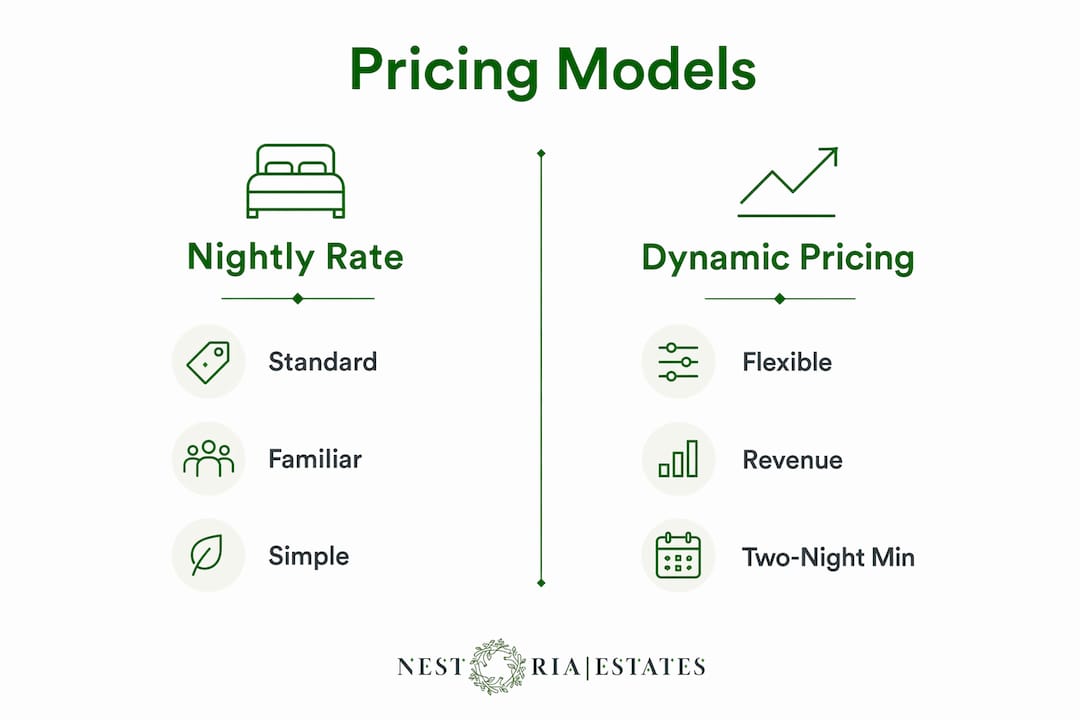
For most Vancouver condos and houses, a dynamic nightly rate with a two-night minimum on weekends is the practical starting point. Luxury or highly unique properties — a waterfront home, a heritage character house — sometimes benefit from per-stay pricing, where guests pay for the experience rather than a per-night calculation. This approach works especially well for premium stay selections marketed to groups or event-based bookings.
A simple example: a property with a base nightly rate, a cleaning fee, and a two-night minimum generates a substantial booking amount before taxes. Dynamic pricing that increases the nightly rate during a Vancouver festival weekend adds extra revenue to that booking with no additional effort.
Revenue levers worth setting from day one: seasonal rate adjustments, weekly and monthly discounts for longer stays, and a cleaning fee that reflects actual costs rather than acting as a hidden markup.
Pro Tip: Free revenue projections from a professional manager give you a realistic income benchmark before you commit to a management agreement. Use them as a negotiating tool, not just a sales pitch.
What does the operations playbook look like?
Consistent exclusive-stay experiences don’t happen by accident. They come from a documented workflow that runs the same way every turnover.
Cleaning schedule: Tied directly to the booking calendar, with a minimum two-hour buffer between checkout and next check-in
Inspection checklist: Post-cleaning walkthrough covering every room, appliances, linens, and consumables
Inventory restocking: Set par levels for toiletries, paper goods, and kitchen basics; replenish after every stay
Linen management: Rotate two full sets per bed; track replacement cycles for wear
Self check-in instructions: Send 24 hours before arrival with photos of the lockbox or smart lock
Digital house manual: Cover Wi-Fi, appliances, parking, garbage, and emergency contacts
24/7 guest messaging: Response within one hour for any issue during a stay
Vendor SLAs: Prequalify cleaners and maintenance contacts with written response-time expectations
Pro Tip: Capture photos of smoke detectors, CO detectors, and fire extinguishers during each inspection. You’ll need them for permit renewals and they protect you if a guest ever raises a safety complaint.
Canadian legal, tax, and insurance considerations
The regulatory picture for exclusive short-term stays in Canada involves several overlapping frameworks, and Vancouver adds its own layer on top.
Management agreements for exclusive STR services intersect with municipal STR bylaws, provincial tenancy laws, PIPEDA for guest data, and tax obligations under the Income Tax Act. A credible management agreement covers all of them. Key clauses to look for in any STR management agreement: service scope, fee structure, insurance responsibilities, data protection terms, spending authorization limits, and termination conditions.
Insurance is the most commonly overlooked gap. Standard condo or homeowner policies exclude commercial rental activity. You need either a commercial STR endorsement or a standalone short-term rental policy that covers host liability and guest damage.
On tax: short-term rentals under 30 days are taxable supplies for GST/HST purposes. If your annual rental revenue exceeds the small-supplier threshold, registration and remittance are required. All rental income must also be reported under the Income Tax Act.
Pro Tip: Consult a Vancouver-based accountant and a real estate lawyer before signing an exclusive management agreement. The cost of an hour’s advice is a fraction of what a compliance gap can cost later.
How professional managers handle exclusive stays
What a credible short-term rental manager actually does for Vancouver owners:
Dynamic pricing: Daily rate adjustments based on local demand, events, and competitor data
Free revenue projections: Modeled estimates before you sign, so you know what to expect
Listing optimization: Professional photos, keyword-rich descriptions, and accurate field settings
24/7 guest communication: Every inquiry and issue handled without owner involvement
Cleaning coordination: Scheduled turnover teams tied to the booking calendar
Transparent owner reporting: Regular statements showing bookings, revenue, and expenses
Compliance support: Licensing, safety checks, and bylaw monitoring
Nestoriaestates handles all of this for Vancouver owners under a revenue-share model, meaning the company’s income is tied directly to yours. Onboarding typically includes a property audit, safety compliance check, listing build-out, and market-based pricing setup before the first booking goes live.
Pro Tip: Ask any prospective manager for a sample owner report before you sign. Transparent reporting is the clearest signal that a manager treats your property like a business, not a side project.
Are you ready to list? A Vancouver pre-launch checklist
[ ] Valid STR business license from the City of Vancouver (or confirmation your property qualifies)
[ ] Proof of STR-specific insurance (commercial endorsement or standalone policy)
[ ] Working smoke detectors and CO detectors on every level (photographed)
[ ] Fire extinguisher accessible and in date
[ ] Professional photos covering every room guests will use
[ ] Printed house manual at the property (Wi-Fi, appliances, parking, emergency contacts)
[ ] Self check-in method installed and tested (smart lock or lockbox)
[ ] Airbnb listing set to “Entire place” with accurate guest-access notes
[ ] Cleaning and turnover workflow documented and vendor confirmed
[ ] GST/HST registration reviewed with an accountant
Pro Tip: Photograph your safety devices and save copies in a dedicated folder. Vancouver’s STR permit renewal process may request evidence of compliance, and having it ready saves time.
Key Takeaways
Exclusive stays on Airbnb are “Entire place” listings where guests have sole access to the full unit — and in Vancouver, getting the platform settings, pricing, operations, and compliance right from day one determines whether the property performs or creates headaches.
Point | Details |
Definition and platform mapping | An exclusive stay = Airbnb “Entire place”; guests get sole access to all rooms with no shared spaces. |
Duration and compliance | Stays under 30 days are short-term rentals in Canada; Vancouver requires a business license and principal-residence compliance. |
Pricing approach | Dynamic nightly pricing with minimum-stay rules drives occupancy; per-stay pricing suits luxury or event-focused properties. |
Operations discipline | A documented turnover checklist, two-hour booking buffers, and prequalified vendors are non-negotiable for consistent guest experience. |
Nestoriaestates | Offers Vancouver owners dynamic pricing, free revenue projections, transparent reporting, and full-service management under a revenue-share model. |
Why exclusive stays in Vancouver are worth doing right
Vancouver’s short-term rental market rewards owners who treat their property like a hospitality product, not a passive income side hustle. The city draws business travelers, film industry workers, international tourists, and remote workers year-round, and demand shifts sharply by neighborhood. A Coal Harbour condo performs differently from a Kitsilano house, and both perform differently from a Mount Pleasant suite during festival season.
What most owners underestimate is how much the “entire place” framing itself drives booking decisions. Guests aren’t just choosing a property; they’re choosing the absence of strangers. That’s a distinct value proposition, and it commands a price premium when the listing communicates it clearly. Properties that blur the line — shared laundry, a landlord who stops by, unclear access notes — lose that premium fast.
Professional management raises returns here not because managers are magic, but because they apply consistent systems to a market that punishes inconsistency. Dynamic pricing, fast guest response, and clean turnovers compound over dozens of bookings into meaningfully better annual revenue. The owners who treat this as a business from day one, with the right manager and the right compliance setup, are the ones still operating profitably when Vancouver tightens its STR rules further.
Nestoriaestates can handle your Vancouver exclusive stay
Vancouver owners who want the revenue of an exclusive short-term rental without the daily management work have a direct path: hand it to a team that already knows the market.
Nestoriaestates manages Vancouver exclusive stays end to end, covering dynamic pricing, listing setup, guest communication, cleaning coordination, compliance monitoring, and monthly owner reporting. Every new property starts with a free revenue projection so you know what your unit can realistically earn before committing to anything. The revenue-share model means the company’s incentives align with yours: higher occupancy and better rates benefit both sides.
If you’re ready to see what your Vancouver property could generate as an exclusive short-term rental, get your free revenue projection and speak with the Nestoriaestates team about next steps.
Useful sources
AirDNA: What Is Considered a Short-Term Rental? — Defines the under-30-day threshold and how STRs differ from residential tenancies; practical reference for Canadian owners.
Airbnb Community: Entire Place vs. Entire Guest Suite — Platform-level clarification on how Airbnb defines and distinguishes “Entire place” listings.
Lodgify Encyclopedia: Entire Place — Explains the Entire place classification, self check-in workflows, and guest expectations.
Office of the Privacy Commissioner of Canada: PIPEDA Brief — Regulatory reference for guest data collection and privacy obligations under Canadian federal law.
GenieAI: Short-Term Rental Management Agreement Template (Canada) — Template covering service scope, fees, insurance, and data protection clauses; useful starting point before engaging a lawyer.
GenieAI: Exclusive Property Management Agreement Template (Canada) — Covers exclusivity clauses, compensation structures, spending limits, and termination terms.
iGMS: Per Accommodation Per Stay Pricing Explained — Explains when per-stay pricing outperforms nightly rates for luxury and event-based exclusive rentals.
This article is general information for property owners and does not constitute legal, tax, or financial advice. Confirm current municipal rules, tax obligations, and contract terms with a qualified Vancouver lawyer or accountant before listing your property.
FAQ
What is an exclusive stay on Airbnb?
An exclusive stay is an “Entire place” listing where guests have sole access to the full unit, including all bedrooms, bathrooms, kitchen, and living areas, with no shared spaces.
How long can a short-term rental stay be in Canada?
Short-term rentals are typically defined as stays under 30 days. Stays of 30 days or more may fall under provincial residential tenancy law.
Do Vancouver Airbnb owners need a business license?
Yes. Vancouver requires short-term rental operators to hold a valid municipal business license and, in most cases, list only their principal residence as an STR.
Does GST/HST apply to exclusive short-term rentals?
Short-term rentals under 30 days are taxable supplies in Canada. If your annual rental revenue exceeds the small-supplier threshold, GST/HST registration and remittance are required.
What does Nestoriaestates offer Vancouver exclusive-stay owners?
Nestoriaestates provides full-service management including dynamic pricing, free revenue projections, listing setup, guest communication, cleaning coordination, and transparent owner reporting under a revenue-share model.
Recommended