

Hotel vs Vacation Rental: Key Differences for Travelers

Hotels are commercial operations built to serve strangers at scale. Vacation rentals are someone’s home, rented out. That single distinction drives almost every difference you’ll notice as a traveler, from the towels on the rack to the license number posted in the listing.
Here’s the short version of what separates them:
Nature of property: Hotels are purpose-built commercial facilities; vacation rentals are residential properties rented by their owners.
Service level: Hotels offer 24/7 front desks, daily housekeeping, and on-site staff; vacation rentals depend entirely on the host.
Space and privacy: Vacation rentals typically give you more square footage, a full kitchen, and no shared lobbies.
Pricing: Hotels charge per room per night with predictable fees; vacation rentals add cleaning fees and service charges that can shift the math significantly.
Booking and cancellation: Hotels often allow free cancellation up to 24–48 hours out; vacation rental policies vary widely by host.
Vancouver regulations: In Vancouver, vacation rentals must be the host’s principal residence and require a city business license. Hotels face no such residency requirement.
Table of Contents
What actually separates a hotel from a vacation rental?
The operational gap is wider than most travelers expect. A hotel is a commercial entity, staffed and licensed as such, with uniform standards applied across every room. A vacation rental is a residential property whose owner has decided to rent it out, usually through a platform like Airbnb, and whose quality depends almost entirely on that individual owner’s effort and investment.

Dimension | Hotel | Vacation Rental |
Nature of accommodation | Commercial facility, purpose-built | Residential property, owner-operated |
Service and amenities | 24/7 front desk, daily housekeeping, gym, restaurant | Host-dependent; varies from bare-minimum to hotel-like |
Privacy and space | Shared corridors, lobbies, pools | Private entrance, full home, often a kitchen and yard |
Pricing structure | Nightly rate, taxes, resort fees | Nightly rate, cleaning fee, service fee, taxes |
Booking and cancellation | Standardized policies, often flexible | Host-set policies; can be strict or non-refundable |
Vancouver regulatory status | Exempt from principal residence rules | Must be host’s primary home; license required |
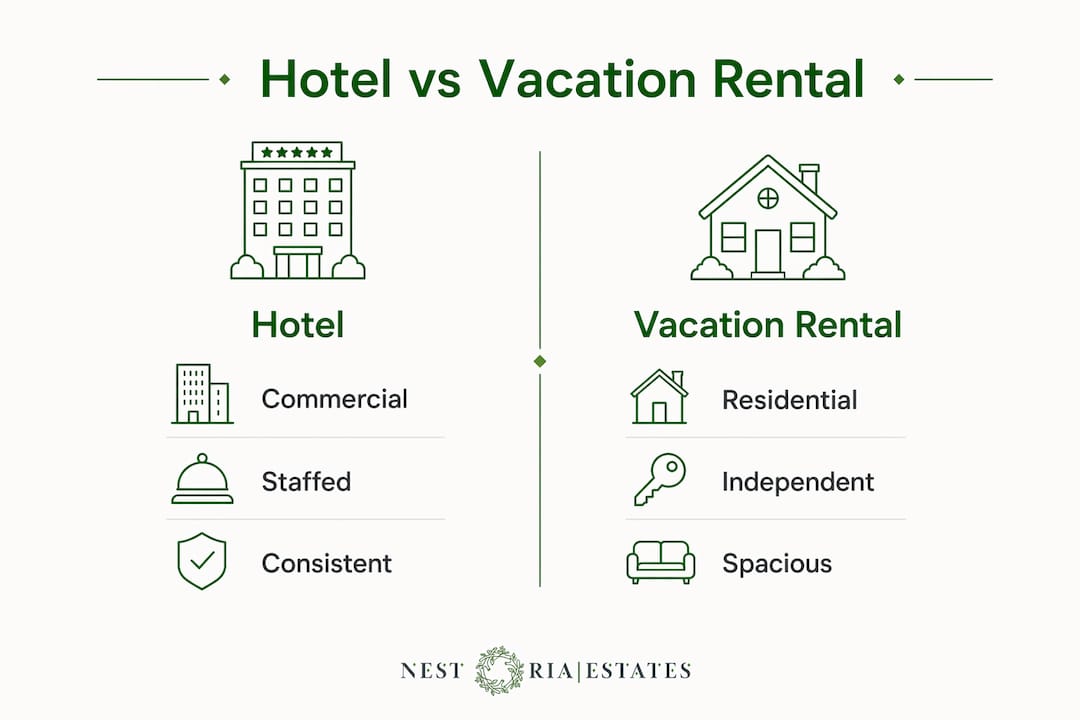
Hotels provide standardized amenities: a staffed front desk around the clock, daily housekeeping, and facilities like gyms and restaurants. Vacation rentals vary widely and depend on the host. A well-managed rental in Kitsilano might rival a boutique hotel in comfort. A poorly managed one might leave you hunting for extra toilet paper on a Sunday night.
Key feature differences worth knowing before you book:
Hotels guarantee a consistent baseline experience across chains and locations.
Vacation rentals offer full kitchens, laundry, and living rooms that hotels rarely match.
Hotels carry commercial liability insurance and meet building code standards for commercial use.
Vacation rentals in Vancouver must meet fire and building safety standards, but compliance varies.
Strata hotels, a category specific to British Columbia, operate under unified management with hotel-like services and are classified as commercial or mixed-use properties, making them exempt from principal residence requirements unlike standard vacation rentals.
Pros, cons, and which traveler each option actually suits
Hotels: who they work for
Hotels win on predictability. You know what you’re getting before you arrive, and if something goes wrong, there’s a person at the desk to fix it. For solo business travelers, short stays, or anyone who values not having to think about logistics, a hotel is hard to beat.
Pros of hotels:
Consistent service and quality standards
On-site security, often with key card access and cameras
Daily housekeeping included in the rate
Concierge, room service, and amenity access
Flexible cancellation on most bookings
Cons of hotels:
A single room for a family of four gets expensive fast
No kitchen means every meal is a restaurant or takeout decision
Less local character, especially with large chains
Resort fees and parking charges can add up quietly
Vacation rentals: who they work for
Families, groups, and longer stays are where vacation rentals pull ahead. Splitting a three-bedroom house in East Vancouver among six people costs far less per head than booking three hotel rooms, and you get a kitchen, a living room, and the ability to actually spread out.
Pros of vacation rentals:
More space per dollar for groups and families
Full kitchen cuts food costs on longer trips
Local neighborhood feel that no hotel lobby replicates
Pet-friendly options are far more common
Cons of vacation rentals:
No guaranteed daily cleaning or on-site support
Cleaning fees can erase the cost advantage on short stays
Cancellation policies are often stricter and host-specific
Quality is unpredictable without careful review reading
Pro Tip: On a two-night stay, always add the cleaning fee to the nightly rate before comparing to a hotel. A $60-per-night rental with a $150 cleaning fee often costs more than a $100 hotel room for the same nights.
For business travelers on short trips, hotels almost always win. For families staying five or more nights, vacation rentals usually do. Solo travelers and couples land somewhere in the middle, and the decision often comes down to whether you want a kitchen or a concierge.

Vancouver’s regulations and what they mean for your booking
Vancouver’s rules around short-term rentals are among the strictest in Canada, and they directly shape what you can book, where, and at what price. Understanding them helps you avoid surprises.
Vancouver defines short-term rentals as stays of fewer than 90 consecutive days, permitted only in the operator’s principal residence. That means the person listing the property must actually live there. Hotels and strata hotels are explicitly exempt from this requirement.
Key regulatory points for Vancouver:
A valid short-term rental business licence from the City of Vancouver is required before any listing goes live.
Only a host’s primary home can be rented. Separate basement suites or laneway houses qualify only if the host lives in that specific unit.
Both homeowners and renters can apply, but renters need written landlord permission, and strata residents need strata council approval.
Hotels, motels, and strata hotels are not subject to the principal residence requirement anywhere in British Columbia under provincial short-term rental legislation.
Strata hotels must provide hotel-like services under unified management, including a staffed front desk, housekeeping, and a centralized booking platform, to qualify for the commercial exemption.
Regulatory note: Vancouver’s April 2025 hotel development policy actively promotes new hotel construction, particularly in the Broadway Corridor, to address accommodation shortages that vacation rental restrictions have made more acute.
The city’s approach is deliberate. Vacation rentals are treated as a way for residents to earn supplemental income, not as a substitute for commercial hotel supply. That policy intent affects availability: fewer vacation rentals are legally operating in Vancouver than in cities with looser rules, which pushes some demand back toward hotels and drives up nightly rates on both sides.
For travelers, this means a Vancouver vacation rental listing without a visible license number is a red flag. The city actively monitors compliance and can fine unlicensed operators. Booking an unlicensed rental puts your stay at risk if the city intervenes.
Safety compliance also differs. Hotels meet commercial building codes by definition. Vacation rentals in Vancouver must meet fire and safety standards, including fire resistance ratings, but enforcement depends on inspections and complaints rather than automatic certification. Professional property management, like the services Nestoriaestates provides to Vancouver owners, helps close that gap by handling licensing, safety checks, and guest communication from the start. Owners who want to understand the full regulatory picture can find detailed guidance on short-term rental regulations specific to Vancouver’s 2026 rules.
For travelers who want the space and feel of a vacation rental with more confidence in the setup, properties managed by professional operators tend to meet a higher and more consistent standard. Nestoriaestates works with Vancouver owners to handle exactly this, from professional Airbnb setup to ongoing compliance, so guests get a reliable experience and owners stay on the right side of city rules.
Is your vacation rental managed the way a hotel would be?

Most travelers don’t think about who’s managing their rental until something goes wrong, which is why professional property management Gulf Shores AL services can make a significant difference. Nestoriaestates offers full-service short-term rental management in Vancouver, covering pricing, guest communication, cleaning coordination, and regulatory compliance so that every stay runs the way it should. If you’re a property owner looking to earn rental income without the operational headaches, explore Nestoriaestates’ management services and see what professional management actually looks like in practice.
Key Takeaways
Vacation rentals offer more space and local character, but hotels deliver consistency and service that residential rentals rarely match, especially for short stays in a regulated market like Vancouver.
Point | Details |
Commercial vs residential | Hotels are purpose-built commercial facilities; vacation rentals are residential properties rented by their owners. |
Service gap | Hotels provide 24/7 staffing and daily housekeeping; vacation rental service quality depends entirely on the individual host. |
Vancouver licensing | Vacation rentals in Vancouver require a city business license and must be the host’s principal residence; hotels are exempt. |
Cost calculation | Always add cleaning and service fees to the nightly rate before comparing vacation rental costs to hotel pricing. |
Strata hotel distinction | Strata hotels in British Columbia operate under unified management and are exempt from principal residence rules, unlike standard vacation rentals. |
FAQ
Why are vacation rentals better than hotels for families?
Vacation rentals give families more space, a full kitchen, and a private entrance, which cuts both costs and friction on longer trips. For groups of four or more staying five or more nights, the per-person cost is usually lower than booking multiple hotel rooms.
Do vacation rentals in Vancouver need a license?
Yes. Vancouver requires all short-term rental operators to hold a valid city business license before listing or hosting. The license number must appear in all listings, and only the host’s principal residence qualifies.
What is a strata hotel, and how does it differ from a vacation rental?
A strata hotel is a property where different owners hold individual strata lots, but the building operates under unified management with hotel-like services, including a staffed front desk and housekeeping. Unlike standard vacation rentals, strata hotels are exempt from British Columbia’s principal residence requirement.
Are hotels safer than vacation rentals?
Hotels meet commercial building codes by design and carry commercial liability coverage. Vacation rentals in Vancouver must comply with fire and safety standards, but verification is less automatic. Professionally managed rentals close much of that gap through regular inspections and compliance oversight.
Is a hotel or vacation rental cheaper in Vancouver?
It depends on group size and length of stay. For one or two nights, hotels often cost less once vacation rental cleaning fees are factored in. For groups or stays of five or more nights, vacation rentals typically offer better value per person, assuming the listing is properly licensed and managed.
Recommended
Comments