

Guest Personalization in Travel: A Vancouver STR Guide
- info67421305
- a few seconds ago
- 16 min read

Guest personalization in travel means tailoring every message, offer, and in-stay touchpoint to a specific guest’s preferences, booking context, and behavior — and for Vancouver Airbnb owners, it’s the most direct path to higher review scores, repeat direct bookings, and ancillary revenue that doesn’t require adding a single unit to your portfolio.
According to Hostfully, automated pre-arrival messages, tailored upsells, and timed mid-stay check-ins measurably improve both review rates and guest satisfaction. BeyondBooking frames the guest experience itself as a marketing strategy — one that drives 5-star reviews, referrals, and direct repeat bookings more reliably than any ad spend.
Three things you can do in the next 24–72 hours:
Send a personalized pre-arrival message that references the guest’s specific trip purpose (anniversary, ski trip, business travel) and includes one local recommendation relevant to it.
Add a single custom field to your booking intake form asking about dietary restrictions or accessibility needs, then act on it before check-in.
Set up a timed mid-stay check-in message (triggered at the 36-hour mark) that asks one specific question rather than a generic “How’s everything going?”
Key Takeaways
Guest personalization in travel is the single highest-ROI operational investment available to Vancouver short-term rental operators managing 10–20 units, with industry data showing revenue uplifts from effective programs.
Point | Details |
Start with data hygiene | Clean your PMS guest records before automating — bad data amplifies errors, not personalization. |
Prioritize message timing | Pre-arrival at 48 hours and review requests within 2 hours of checkout are the highest-leverage quick wins. |
Track five KPIs | Review score lift, repeat direct booking rate, ancillary revenue per stay, offer conversion rate, and response time. |
Stay PIPEDA-compliant | Disclose data collection at intake, provide opt-out options, and limit retention to 24 months for guest preference data. |
Nestoriaestates as your operator | Nestoriaestates manages the full personalization stack for Vancouver owners — data, communication, reporting, and revenue optimization. |
Table of Contents
Why personalization is now a strategic necessity for short-term rentals
How to benchmark where your personalization stands right now
Personalization across the guest journey: where it actually happens
Privacy, consent, and PIPEDA: what Canadian operators must know
How Nestoriaestates applies personalization for Vancouver property owners
Getting your team ready: change management and staff training
How to choose the right technology for your short-term rental portfolio
Guest communication practices that make personalization land
Nestoriaestates handles personalization so Vancouver owners don’t have to
Why personalization is now a strategic necessity for short-term rentals
Travel demand has normalized. The post-pandemic surge that filled calendars regardless of experience quality is over, and Skift’s 2025 market analysis confirms that operators competing in this environment need differentiation beyond price and location. Personalization is that differentiator.
The ROI case is concrete. Jurny’s industry analysis cites operator reports and McKinsey summaries showing revenue uplifts from effective personalization programs — driven by higher ancillary spend, better review scores that lift search ranking, and repeat guests who book direct rather than through Airbnb on their next trip.
Guests now expect recognition. Forrester’s research on loyalty programs shows that consumers want meaningful, personalized benefits and recognition — not just discounts. A guest who felt seen during their first stay is far more likely to reach out directly for their next Vancouver visit. That’s a booking fee you keep entirely.
EHL’s hospitality research frames guest experience as central to hospitality value creation, not a nice-to-have layer on top of operations. For a 10–20 unit portfolio in Vancouver, where each unit competes against hundreds of similar listings on Airbnb and Marriott-affiliated properties, the guest experience is the product.
How to benchmark where your personalization stands right now
AltexSoft’s stage-based model offers the clearest framework for mapping where you are and what to build next. Here’s how it maps to a short-term rental context:
Basic personalization: You use the guest’s first name in messages and confirm their check-in time. No data is stored beyond what the platform captures. Most Airbnb hosts operate here by default.
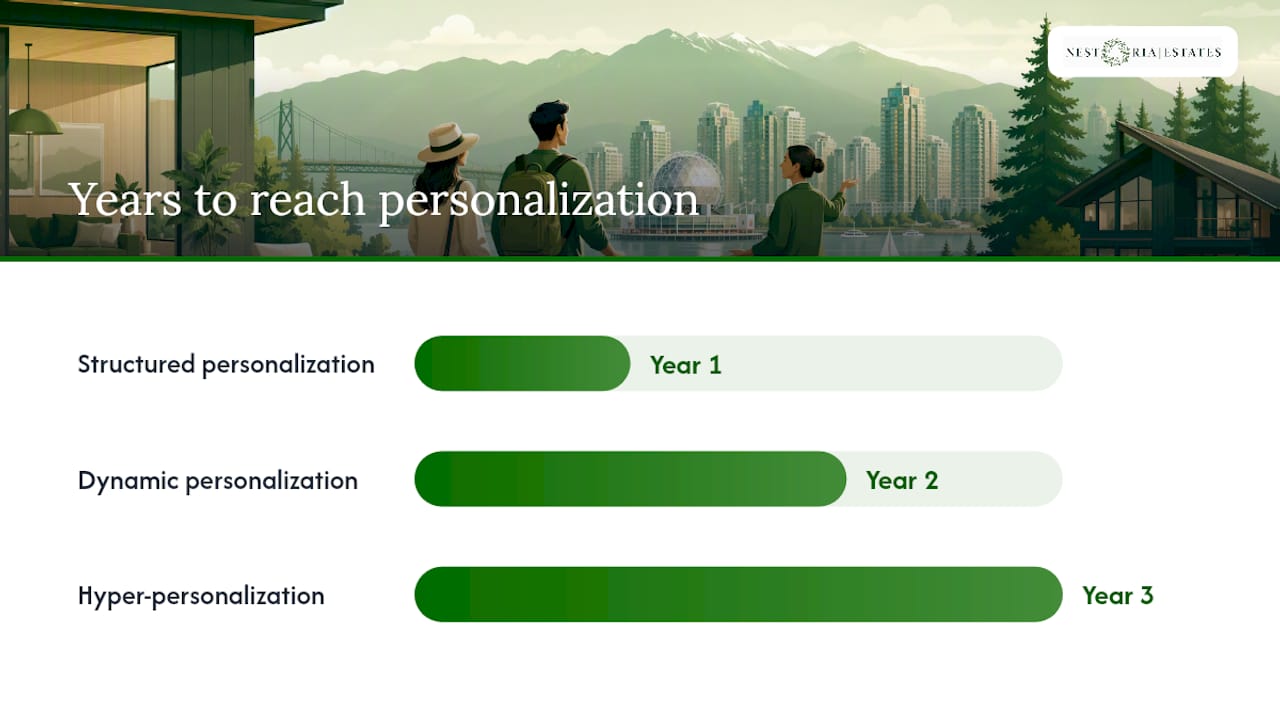
Structured personalization: You maintain a simple guest profile (trip purpose, group size, preferences from past stays or intake forms) and use it to send relevant pre-arrival content and one or two targeted upsells. You have templates, but a human reviews and adjusts them.
Dynamic personalization: Your PMS or CRM triggers messages and offers automatically based on booking signals (lead time, group composition, repeat guest flag). You track which offers convert and refine them quarterly.
Hyper-personalization: Real-time behavioral data, in-stay signals (smart lock entry times, concierge requests), and AI-driven timing combine to deliver offers and service adjustments the guest didn’t know they needed. Otelciro describes this shift as moving from static profiles to dynamic guest identity — converging PMS data, website behavior, and contextual signals in real time.
For most Vancouver operators managing 10–20 units, the target in year one is moving from Basic to Structured. Dynamic personalization becomes achievable in year two once your data foundation is clean. Hyper-personalization is a year-three conversation, and only if the unit economics justify the tooling investment.
The signal to move up a level: when your current touchpoints feel templated even to you, and you’re leaving the same upsell offer for a solo business traveler as for a family of five.
The core building blocks: data, systems, and processes
Personalization runs on data, and most short-term rental operators already have more of it than they use. The gap is usually structure, not volume.
Essential data sources to capture:
System Category | What It Contributes | Minimum Fields to Capture |
Booking engine / OTA | Booking context, lead time, group size | Trip purpose, group composition, special requests |
PMS | Reservation history, stay patterns, revenue per stay | Repeat guest flag, average stay length, unit preference |
CRM / messaging tool | Communication history, response sentiment, preferences stated | Dietary needs, accessibility requirements, local interests |
Channel manager | Cross-platform booking source | Source channel, discount sensitivity |
Upsell / RMS engine | Offer conversion rates, ancillary revenue per stay | Which offer types convert by guest segment |
Mews emphasizes that centralizing guest data in a modern PMS or CRM is the prerequisite for any meaningful personalization — without a single source of truth, automations amplify inconsistencies rather than fix them.
For a small portfolio, the integration priority is straightforward: connect your booking engine to your messaging tool first, so pre-arrival sequences fire automatically with the right guest data populated. Everything else — upsell engines, dynamic pricing integrations, review request timing — layers on top of that foundation.
Pro Tip: Before investing in any new tool, audit what your current PMS already captures and isn’t being used. Most operators discover they have 60–70% of the data they need sitting unused in their existing system.
Personalization across the guest journey: where it actually happens
The guest journey has five distinct touchpoints, and each one has a different leverage ratio between effort and impact.
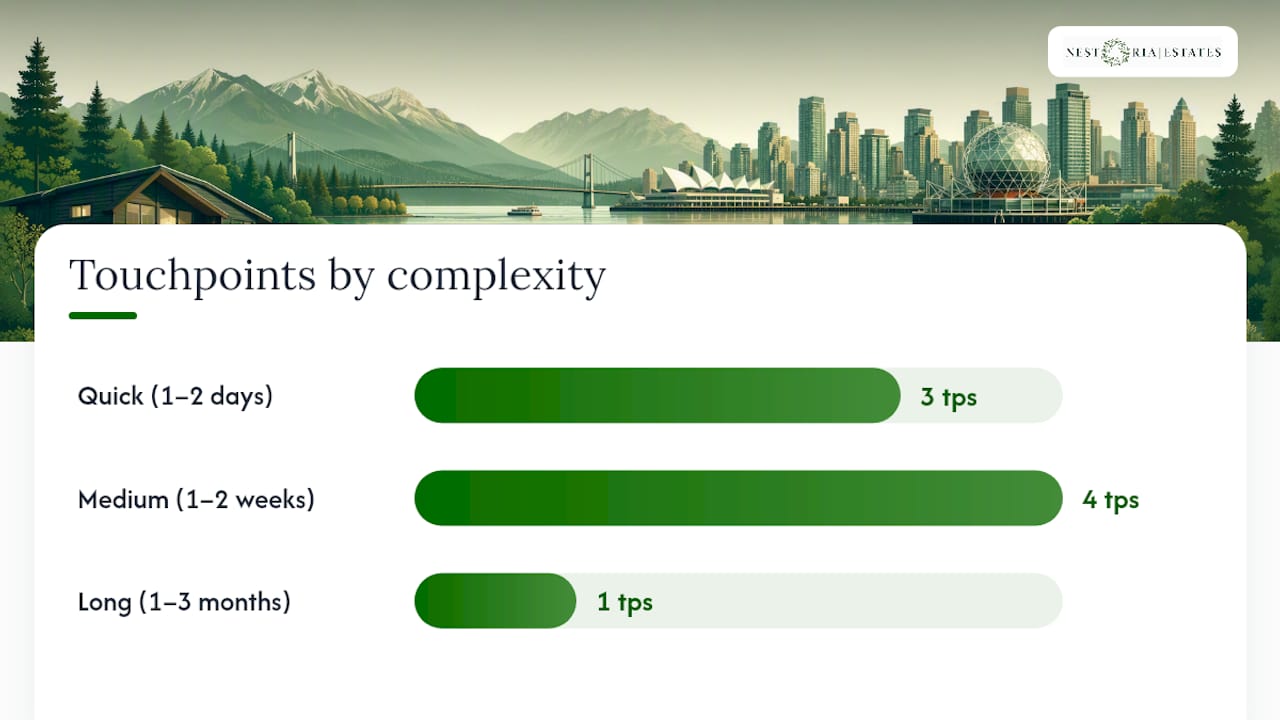
Touchpoint | Personalization Action | Data Trigger | Complexity |
Pre-arrival | Custom welcome message + local tips by trip type | Trip purpose field, group size | Quick (1–2 days) |
Pre-arrival | Targeted upsell offer (early check-in, parking, grocery delivery) | Lead time, booking value | Quick (1–2 days) |
Arrival | Personalized welcome note referencing booking detail | Repeat guest flag, occasion | Quick (1 hour) |
In-stay | Mid-stay check-in with specific question | Stay length, day 2 trigger | Medium (1–2 weeks) |
In-stay | Concierge-style local recommendation by interest | Stated interests from intake | Medium (1–2 weeks) |
Departure | Personalized thank-you with direct booking incentive | Repeat guest flag, stay rating | Medium (1–2 weeks) |
Post-stay | Timed review request at optimal window | Checkout timestamp, sentiment | Medium (1–2 weeks) |
Post-stay | Seasonal re-engagement offer for past guests | Past stay date, booking source | Long (1–3 months) |
Jurny’s analysis identifies message timing as the highest-leverage operational change available to most operators — getting the pre-arrival message to land 48 hours before check-in (not 7 days, not 2 hours) and the review request to arrive within 2 hours of checkout consistently outperforms generic timing.
For a memorable stay that generates reviews and referrals, the in-stay touchpoint is where most operators underinvest. A single well-timed mid-stay message asking “Is there anything we can arrange for the rest of your trip?” does more for review scores than a premium welcome basket.
A practical 90-day roadmap for 10–20 unit operators
This sequence is designed to build the data foundation first, then layer personalization on top of it — rather than automating before you have clean inputs.
Week 1–2: Data inventory (Low cost, 4–6 hours). Audit what your PMS captures today. Identify the three guest fields you’re missing most often: trip purpose, group composition, and repeat guest status. Add a simple intake question to your booking confirmation or pre-arrival form.
Week 2–3: Template library (Low cost, 3–4 hours). Write five message templates: pre-arrival (business traveler), pre-arrival (leisure/family), arrival (repeat guest), mid-stay check-in, and post-stay thank-you. Keep each under 150 words. Personalization tokens (first name, unit name, check-in date) should be auto-populated.
Week 3–4: Quick-win automation (Low-to-medium cost, 1–2 days setup). Connect your booking engine to your messaging tool and activate the pre-arrival and post-stay sequences. Test with one unit before rolling out across the portfolio.
Month 2: Upsell layer (Medium cost, 1–2 weeks). Identify two or three upsell offers that fit your Vancouver market (early check-in, late checkout, curated local experience packages). Build offer triggers based on booking value and lead time. Track conversion weekly.
Month 2–3: Review optimization (Low cost, ongoing). Set your post-stay review request to fire within 2 hours of checkout. Monitor review volume and score weekly for 30 days. Adjust timing if response rate is below 20%.
Month 3: Cohort analysis (Low cost, 2–3 hours). Pull a simple before/after comparison: review scores, ancillary revenue per stay, and repeat booking rate for the 90 days before and after your personalization rollout. This becomes your owner report data.
Month 3+: Dynamic offers (Medium-to-high cost, ongoing). Once your data is clean and your templates are converting, introduce dynamic offer logic — different upsells for different guest segments, triggered by booking signals rather than manual selection.
Staffing note: for a 10–20 unit portfolio, one part-time operations coordinator can manage this entire roadmap if the automations are set up correctly. The goal is to optimize your workflow so personalization runs on systems, not on individual memory.
How to measure whether personalization is actually working
Personalization without measurement is just hospitality theater. These are the five KPIs that matter for a Vancouver short-term rental portfolio:
Review score lift is the most immediate signal. Track your average rating monthly, segmented by unit. A well-timed pre-arrival sequence and mid-stay check-in typically show results within 60 days.
Repeat direct booking rate measures how many returning guests bypass Airbnb on their second stay. This is the metric that directly reduces your platform fee exposure. Track it quarterly.
Ancillary revenue per stay captures upsell conversion. If you’re offering early check-in, late checkout, or experience packages, this number tells you which offers are landing and which aren’t.
Offer conversion rate is the micro-metric behind ancillary revenue. A 10–30% uplift from personalized offers is the range Jurny’s industry summaries cite as achievable with effective personalization.
Response time matters because fast, relevant responses correlate with higher review scores on Airbnb. Track average first-response time and aim for under 1 hour during business hours.
For owner reporting, include these five fields in a simple monthly dashboard: average review score (vs. prior period), total ancillary revenue, repeat guest count, offer conversion rate, and average response time. Owners who see these numbers understand the value of personalization without needing a lecture on the theory.
Privacy, consent, and PIPEDA: what Canadian operators must know
Canada’s federal privacy law, PIPEDA (Personal Information Protection and Electronic Documents Act), governs how you collect, use, and store guest data for commercial purposes. British Columbia operators should also note that BC’s Personal Information Protection Act (PIPA) applies provincially and is substantially similar to PIPEDA, though it covers provincially regulated organizations.
Practical consent checklist for Vancouver STR operators:
Disclose what data you collect and why at the point of collection (booking confirmation or pre-arrival form). A single plain-language sentence is sufficient: “We collect your preferences to personalize your stay and may use your contact information to send you relevant offers.”
Provide a clear opt-out option for marketing communications. A one-click unsubscribe in every post-stay email satisfies this requirement.
Limit data retention. Guest preference data should not be kept indefinitely — a 24-month retention window is a reasonable default for repeat-booking purposes. Delete or anonymize records beyond that window.
Restrict access. Only staff who need guest data to perform their role should have access. Document who has access and review it annually.
Store data securely. Use platforms with encryption at rest and in transit. Avoid storing sensitive guest data in unprotected spreadsheets or shared email inboxes.
The personalization tactics described in this article — intake forms, preference capture, timed messaging — are all permissible under PIPEDA when disclosed at collection. The risk area is using data for purposes the guest didn’t anticipate (selling it, sharing it with third parties, or using it for unrelated marketing). Stay within the stated purpose and you’re on solid ground.
This is general information, not legal advice. Confirm your specific data practices with a qualified Canadian privacy lawyer or the Office of the Privacy Commissioner of Canada.
How Nestoriaestates applies personalization for Vancouver property owners
Nestoriaestates manages short-term rental portfolios across Vancouver with a personalization model built around three operational pillars: data centralization, sequenced guest communication, and owner-facing reporting that makes the ROI visible.
On the data side, every guest interaction — booking source, trip purpose, stated preferences, in-stay requests, and post-stay feedback — flows into a centralized record. That record drives the pre-arrival sequence: a message timed 48 hours before check-in that references the specific booking context, includes a curated local recommendation relevant to the guest’s trip type, and surfaces one relevant upsell offer.
During the stay, a timed mid-stay check-in goes out at the 36-hour mark. It’s short, specific, and designed to surface any friction before it becomes a review. Post-checkout, a review request fires within 2 hours, followed by a direct-booking incentive for guests who indicate they’d return to Vancouver.
Property owners see the results in a monthly dashboard that tracks review score trends, ancillary revenue per stay, and repeat guest rate. The goal isn’t just a better guest experience — it’s a portfolio that performs better on every metric an owner cares about, with less hands-on involvement from the owner.
For guest success stories and outcome data from the Nestoriaestates portfolio, the pattern is consistent: operators who implement even the Basic-to-Structured personalization steps described in this article see measurable review score improvement within 60–90 days.
Getting your team ready: change management and staff training
Personalization fails most often not because of bad technology, but because the people delivering it don’t understand why it matters or how to execute it consistently. Consistency in tone and service delivery is what turns a good personalization system into a great guest experience.
For small teams managing 10–20 units, the change management challenge is usually one of two things: staff who skip the intake form step because it feels like extra work, or staff who override automated messages with generic responses because they don’t trust the system.
Address both with a short onboarding session (30–45 minutes) that covers three things: why personalization affects review scores and revenue (show the before/after data once you have it), how the messaging system works and what triggers each touchpoint, and what a staff member should do when a guest’s situation falls outside the template. The last point matters most — give your team a clear escalation path and permission to deviate from the template when the situation calls for it.
Review the system monthly for the first quarter. Look at which templates are being skipped, which upsells aren’t converting, and where guests are responding with friction. Treat those signals as training data, not failures.
Common pitfalls that derail personalization programs
The most expensive mistake is automating before your data is clean. If your PMS has duplicate guest records, inconsistent trip-purpose fields, or missing repeat-guest flags, your automated messages will fire with wrong names, irrelevant offers, or no personalization at all. That’s worse than a generic message — it signals to the guest that you’re pretending to know them.
The second pitfall is over-messaging. Three to five touchpoints across a stay is the right range for most guests. More than that, and even well-personalized messages start to feel intrusive. The mid-stay check-in is the most commonly over-triggered touchpoint — once is enough.
A third failure mode is personalizing the wrong things. Knowing a guest’s name and check-in date is not personalization — it’s basic data hygiene. Real personalization means using the trip purpose, group composition, or stated preference to change what you offer or recommend. If your “personalized” message would read identically for 90% of your guests, it isn’t personalized.
Finally, don’t skip the post-stay sequence. Most operators invest in pre-arrival and in-stay touchpoints, then drop the ball at checkout. The post-stay window — specifically the 2 hours after checkout — is where review volume and direct rebooking rates are most influenced. A timed, specific thank-you message with a direct booking incentive is one of the highest-ROI touchpoints in the entire journey.
How to choose the right technology for your short-term rental portfolio
Technology selection for a 10–20 unit portfolio comes down to four criteria, in this order:
Integration with your existing booking channels is non-negotiable. Any tool that doesn’t connect cleanly to Airbnb and your other active channels will create more manual work than it saves. Verify the integration before signing any contract.
Ease of template management matters because your messaging library will evolve. You need to be able to update a template in under 5 minutes without developer help. If the tool requires a support ticket to change a message, it will slow your personalization program to a crawl.
Guest data portability protects you if you switch tools. Confirm that you can export your full guest record — including preference fields and communication history — in a standard format (CSV or JSON). Platforms that lock your data in proprietary formats create switching costs that compound over time.
Pricing model fit for small portfolios is the practical constraint. Per-unit pricing models work well for portfolios under 20 units; flat-rate or percentage-of-revenue models can become expensive as you scale. Run the math at your current unit count and at 2x your current count before committing.
For amenity selection that complements your personalization program, the same principle applies: choose what your specific guest segments actually use, not what looks good in listing photos.
Guest communication practices that make personalization land
Personalization is only as effective as the communication that delivers it. A well-timed, relevant message sent in a tone that feels robotic or corporate will underperform a simpler message that sounds like a person wrote it.
Three practices that consistently improve personalization effect:
Write at a conversational reading level. Short sentences, plain words, and a direct ask outperform formal hospitality language in every guest segment. “Is there anything we can arrange before you arrive?” lands better than “Please do not hesitate to contact us should you require any pre-arrival assistance.”
Reference one specific detail from the booking. Mentioning the guest’s check-in date, their unit name, or a detail from their special requests field is the minimum bar for a message to feel personal rather than automated. One specific detail is enough — listing everything you know about them reads as surveillance, not service.
Match the channel to the message type. Pre-arrival sequences work well via email because guests can reference them later. In-stay check-ins work better via SMS or the platform’s messaging system because they’re time-sensitive. Post-stay review requests should go through the platform first (Airbnb’s review system) and then via email for direct-booking guests.
For a deeper look at guest experience strategy across your rental portfolio, the principle is the same at every scale: consistency and relevance matter more than sophistication.
The part of personalization most operators get wrong
Most property managers approach personalization as a guest-satisfaction project. That’s the wrong frame. The operators who get the most out of it treat it as a revenue and retention system — one where every touchpoint is designed to either increase the value of the current stay or increase the probability of a future direct booking.
That reframe changes what you prioritize. A welcome basket is a guest-satisfaction project. A pre-arrival message that surfaces a $40 early check-in offer and converts at 25% is a revenue system. Both feel personal to the guest. Only one shows up in your monthly P&L.
The second thing operators consistently underestimate is the compounding effect of review scores. A 0.1-point improvement in your Airbnb rating — from 4.7 to 4.8 — can meaningfully shift your search ranking and booking conversion rate. Personalization is one of the most reliable levers for moving that number, because guests who feel recognized are more likely to leave a review and more likely to leave a positive one.
The operators I’ve seen get this right share one habit: they treat their guest data as a business asset, not an administrative byproduct. They clean it, structure it, and use it to make decisions — about which upsells to offer, which touchpoints to add, and which guests to re-engage. That discipline, more than any specific tool or tactic, is what separates a personalization program that compounds over time from one that plateaus after the first 90 days.
Nestoriaestates handles personalization so Vancouver owners don’t have to
Running a personalized guest experience across 10–20 Vancouver units takes systems, data discipline, and consistent execution — and most property owners didn’t sign up to manage all three.
Nestoriaestates delivers full-service Airbnb management for Vancouver property owners: dynamic pricing, sequenced guest communication, cleaning coordination, and monthly owner reporting that shows exactly how personalization is moving your review scores and revenue. You get the guest experience outcomes without the operational overhead. Property owners who work with Nestoriaestates skip the 90-day setup curve entirely — the data infrastructure, messaging templates, and upsell sequences are already built and running.
If you want to see what a personalized, professionally managed rental looks like for your Vancouver property, review the full service offering and request a free revenue projection.
Sources
The sources below informed this guide and represent the strongest available research on guest personalization for short-term rental operators.
Hostfully’s practical guide covers automation templates, pre-arrival sequences, and upsell tactics specifically for short-term rental operators — the most operationally useful source in this list for managers starting from scratch.
Jurny’s hyper-personalization analysis provides the ROI framing (10–30% revenue uplift ranges) and the case for AI-driven timing — useful for operators ready to move beyond Basic personalization.
Otelciro’s 2026 hotel personalization report explains the shift from static guest profiles to dynamic, real-time identity — the conceptual foundation for understanding where personalization technology is heading.
BeyondBooking’s guest experience piece makes the clearest case for treating guest experience as a marketing strategy with measurable ROI — useful for presenting the business case to property owners.
EHL’s hospitality insights provide academic and industry grounding for why guest experience sits at the center of hospitality value creation.
Mews’s personalization guide covers technology and process-level guidance for centralizing guest data — the most useful source for the building-blocks section.
Forrester’s loyalty research supports the argument that guests want recognition and meaningful benefits, not just price discounts.
Skift’s 2025 travel trends analysis provides the market context for why personalization investment is strategically timely as demand normalizes.
FAQ
What is personalization in tourism?
Personalization in tourism means tailoring services, messages, and offers to individual guests based on their preferences, booking context, and behavior. AltexSoft defines it as matching content and services to a guest’s lifestyle, preferences, and requirements across every touchpoint.
What are examples of personalized travel experiences?
Common examples include a pre-arrival message referencing a guest’s trip purpose (anniversary, business travel), a targeted early check-in offer based on booking lead time, a curated local restaurant list matched to stated dietary preferences, and a timed post-stay review request. Hostfully’s guide covers these tactics in detail for short-term rental operators.
What does guest personalization mean for Airbnb hosts specifically?
For Airbnb hosts, guest personalization means using the data available at booking — group size, trip purpose, repeat guest status — to send relevant messages, surface appropriate upsells, and time touchpoints correctly. The goal is a guest experience that feels attentive without requiring manual effort for every stay.
What do guests actually want from personalization?
Forrester’s research shows guests want meaningful recognition and relevant benefits — not just discounts. Being acknowledged as a repeat visitor, receiving a recommendation that fits their actual interests, and having friction resolved before they have to ask for it are the experiences that drive 5-star reviews and direct rebookings.
How much revenue uplift can personalization generate for a short-term rental?
Industry summaries cited by Jurny point to a revenue uplift from effective personalization programs, driven by higher ancillary spend, improved review scores, and increased direct repeat bookings. Results at the lower end of that range are achievable for most 10–20 unit operators within the first 90 days of a structured program.
Recommended