

How to List Property for Airbnb in Vancouver: 2026 Guide
- info67421305
- 1 day ago
- 5 min read
Who can actually list a short-term rental in Vancouver?
Only your principal residence qualifies. Vancouver’s rules are strict: you cannot list an investment condo, a second home, or any property where you don’t actually live. The City of Vancouver limits each operator to one license, and that license applies only to the home where you pay taxes, receive mail, and conduct your daily life.
The British Columbia Short-Term Rental Accommodations Act reinforces this at the provincial level. Skip registration and your listings get pulled, your existing bookings get canceled, and you’re barred from accepting new ones.
A few other hard limits to know before you apply:
Corporations and societies cannot operate as short-term rental operators. The license must be held by an individual.
Strata owners need written authorization from their strata council before applying for any city license.
Tenants need written approval from their landlord.
Both your provincial registration number and your Vancouver city business license number must appear on every listing, every advertisement, every time.
Any service that promises to help you list a property that isn’t your principal residence is offering something illegal. The listing will be removed and legal consequences follow.
Table of Contents
How to list your Vancouver property on Airbnb, step by step
Getting your property listed legally takes preparation before you ever open the Airbnb app. Here’s the full sequence.
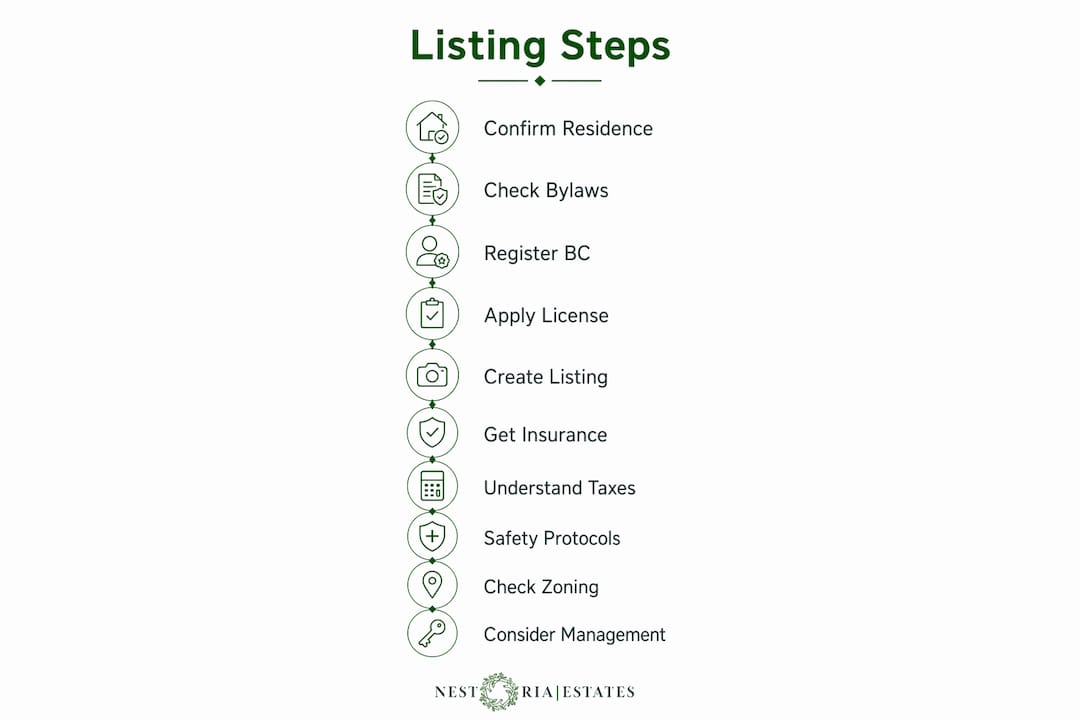
1. Confirm your principal residence status
Gather documents that prove you live there: a recent utility bill, your BC driver’s license, a property tax notice, or a government letter addressed to you at that address. The name and address on your documents must match your registration application exactly.

2. Check your strata bylaws or lease
Strata bylaws frequently impose additional STR restrictions that go beyond city rules. Get written authorization from your strata council or landlord before you spend time on anything else. No approval, no license.
3. Register with the provincial short-term rental registry
Visit the BC STR registry and create a BC Registries account using your BC Services Card. You’ll submit your property address, parcel identifier, number of bedrooms, your Social Insurance Number, and proof of principal residence. Pay the registration fee by credit card. Once approved, you receive a unique provincial registration number.
Pro Tip: Set a calendar reminder for your annual renewal. Letting your registration lapse means your listings come down automatically, even if you have active bookings.
4. Apply for a Vancouver city business license
With your provincial registration number in hand, apply for a short-term rental business license through the City of Vancouver. Upload your government-issued ID, proof of principal residence, and your strata or landlord authorization letter if applicable.
5. Create your Airbnb listing with both license numbers displayed
Both your provincial registration number and your city business license number must appear prominently on your listing. Platforms are required by provincial law to remove listings that don’t show valid numbers. Update these numbers every year when you renew.
6. Get short-term rental insurance
Standard homeowner or tenant insurance does not cover commercial short-term rental activity. You need a policy specifically written for STR use, covering guest liability and property damage. Talk to your broker before your first booking.
7. Understand your tax obligations
Income from short-term rentals is taxable under Canadian tax law. Keep records of all rental income and expenses. Depending on your annual revenue, you may also need to register for and collect GST/HST. A tax professional familiar with Canadian rental income rules will save you headaches at filing time.
8. Set up guest screening and safety protocols
Vancouver and BC standards require that your rental meets basic safety requirements: working smoke detectors, carbon monoxide detectors, a fire extinguisher, and clearly posted emergency contact information. Screen guests through Airbnb’s built-in verification tools and set clear house rules in your listing.
9. Check local zoning restrictions
Not every Vancouver neighborhood treats short-term rentals identically. Confirm your property’s zoning classification allows residential short-term rental use. The City of Vancouver’s property listing guide for owners covers zoning nuances worth reviewing before you go live.
10. Consider professional property management
Professional property managers can handle pricing, guest communication, cleaning coordination, and compliance reminders, but they cannot hold the license on your behalf or bypass the principal residence requirement. The legal responsibility stays with you. What they can do is make the operational side far less time-consuming, while keeping your listing competitive year-round. For a detailed look at getting your space guest-ready, the Airbnb preparation guide from Nestoriaestates walks through the practical setup steps.
Nestoriaestates makes compliant Vancouver Airbnb hosting genuinely hands-off
Running a legal, profitable Airbnb in Vancouver takes more than a good listing. Pricing shifts with demand, guests need fast responses, and your license numbers need updating every year. Most owners find the operational load adds up fast.

Nestoriaestates handles the full picture for Vancouver property owners: dynamic pricing based on real market data, professional guest communication, cleaning coordination, and transparent monthly reporting so you always know what your property earned. The team stays current on Vancouver and BC regulatory requirements, so your listing stays compliant without you tracking every policy update. You keep ownership and the license. Nestoriaestates handles operational tasks and compliance reminders.
If you want to see what your property could realistically earn, view the full services and request a free revenue projection.
Key Takeaways
Listing a short-term rental in Vancouver legally requires your principal residence, a provincial registration number, and a Vancouver city business license before accepting any bookings.
Point | Details |
Principal residence only | You can only list the home where you actually live; investment properties are ineligible. |
Two licenses required | Both a BC provincial registration number and a Vancouver city business license are mandatory before listing. |
Display both numbers | Every listing and advertisement must show your provincial registration number and city business license number. |
Non-compliance consequences | Failure to register results in listing removal, booking cancellations, and a ban on new bookings. |
Nestoriaestates | Handles pricing, compliance reminders, guest communication, and cleaning for Vancouver owners who want passive income without the operational load. |
FAQ
Can I list a rental property I don’t live in on Airbnb in Vancouver?
No. Vancouver’s rules restrict short-term rentals to your principal residence only. Investment properties and secondary homes are not eligible for a short-term rental license.
What happens if I list without a valid license?
Your listing will be removed by the platform, existing bookings will be canceled, and you cannot accept new reservations, as enforced under the BC Short-Term Rental Accommodations Act.
Do I need both a provincial registration and a city license?
Yes. You need a provincial registration number from the BC government and a Vancouver city business license. Both numbers must appear on every listing before you accept any bookings.
Can a property manager hold the license for me?
No. The license must be held by the individual operator, and that person must live in the property as their principal residence. A property manager like Nestoriaestates can run operations, but the legal compliance responsibility stays with the homeowner.
How often do I need to renew my registration?
Provincial registration and your city business license both require annual renewal. Your listing must display updated numbers each year, or platforms will remove it.
Recommended

Comments