
Kelowna Airbnb Rules: What Hosts Must Know in 2026

Kelowna hosts got a major regulatory shift on June 1, 2026, when the province let the city opt out of the principal-residence requirement for approved short-term rental subzones. Outside those subzones, the 240-day principal-residence rule still applies, and every operator, regardless of zone, needs a City of Kelowna short-term rental business licence plus provincial registration.
TL;DR:
Properties inside designated short-term rental subzones can now be rented without owner occupancy, regardless of the 240-day principal residence rule.
Outside subzones, owners must still occupy their property for at least 240 days annually to list it for short-term rentals.
All hosts must obtain a City of Kelowna business license and register with the province, with applications costing a $50 fee plus $345 annual renewal.
Strict safety requirements include 2A10BC fire extinguishers, regular alarm testing, posted evacuation plans, and a responsible contact available 24/7.
Strata bylaws can prohibit short-term rentals even if properties are in approved zones, making strata confirmation essential before listing.
Table of Contents
What Changed on June 1, 2026: The Kelowna Opt-Out Explained
The Short-Term Rental Accommodations Act lets municipalities apply for an exemption from the province’s principal-residence requirement once their long-term rental vacancy rate clears a 3% threshold. Kelowna’s rate had climbed to roughly 6.4% in 2025 according to CMHC data cited in local reporting, well past that bar.
Normally, municipalities requesting this change apply by February 28 for a standard June 1 effective date starting in 2027. Kelowna got something rarer: a one-time accelerated approval that moved its effective date to June 1, 2026, a full year ahead of the usual cycle, through a special regulatory amendment from the province. The Executive Council order formally added Kelowna to the regulation’s exemption schedule.
Here’s what this actually means for hosts on the ground:
Properties inside a designated STR subzone no longer need to be the owner’s principal residence.
Properties outside those subzones still fall under the 240-day rule.
Provincial registration and a City business licence remain mandatory everywhere in Kelowna, opt-out or not.
The City of Kelowna’s short-term rental page frames this as a targeted fix, not a citywide free-for-all. Kelowna kept principal-residence protection in most neighborhoods specifically to preserve long-term rental stock while giving investment properties in tourism-heavy zones more flexibility.
Who Can Operate STRs in Kelowna Now?
Two separate tracks now govern Kelowna short-term rental rules, and mixing them up is the single most common mistake new hosts make.
Major (Principal use) properties sit inside an approved STR subzone, and the owner doesn’t need to live there. These are typically concentrated near the airport, downtown core, and select tourism corridors identified by the city’s zoning maps.
Minor (Secondary use) properties are everywhere else, and here the 240-day principal residence test still governs. The owner must occupy the home as their primary residence for at least 240 days per year, and only then can they rent out a portion (a basement suite, a spare bedroom) short-term.
What this looks like in practice:
A condo in a downtown STR subzone building can be rented full-time, even if the owner lives in Vancouver.
A single-family home in a standard residential zone can only be listed short-term if the owner lives there most of the year.
A secondary suite or laneway home attached to a principal residence follows the same 240-day rule as the main house.
An investment property outside a subzone that the owner never occupies is not eligible under either track.
Confirming subzone status before you list is not optional. It determines your entire compliance path.
Licensing and Application Checklist
Every Kelowna short-term rental, subzone or not, needs a City business licence. The Short-Term Rental Accommodation Bylaw No. 11720 sets the fees at a $50 application fee plus a $345 annual licence fee, renewed yearly.
Here’s the application sequence:
Confirm your property’s zoning status (STR subzone or standard residential) through the city’s zoning lookup.
Gather photo ID and proof of ownership or tenancy authorization.
Provide evidence of principal residence (utility bills, a driver’s license address) if you’re outside a subzone, or subzone confirmation if you’re inside one.
Submit a floor plan showing bedroom count and egress routes.
Obtain written strata council consent if the property is a strata lot.
Sign a good-neighbour agreement acknowledging noise, parking, and nuisance rules.
Complete a self-evaluation safety form covering smoke alarms, carbon monoxide detectors, and fire extinguishers.
Register the property with the province’s short-term rental registry, listing your City business licence number as part of that registration.
Pro Tip: Apply for your City licence before you register provincially. The provincial registry requires a valid municipal licence number, and applying in the wrong order usually means resubmitting.
Operational Rules and Safety Requirements
Once licensed, Kelowna hosts operate under a fairly tight rulebook. Only one booking is permitted per dwelling at a time, no simultaneous reservations in separate rooms of the same unit. A maximum of three bedrooms can be used for short-term rental purposes, and occupancy is capped at two adults per sleeping unit. Accessory structures like sheds or detached garages can’t be converted into sleeping units for guests.
Fire safety carries specific, checkable requirements:
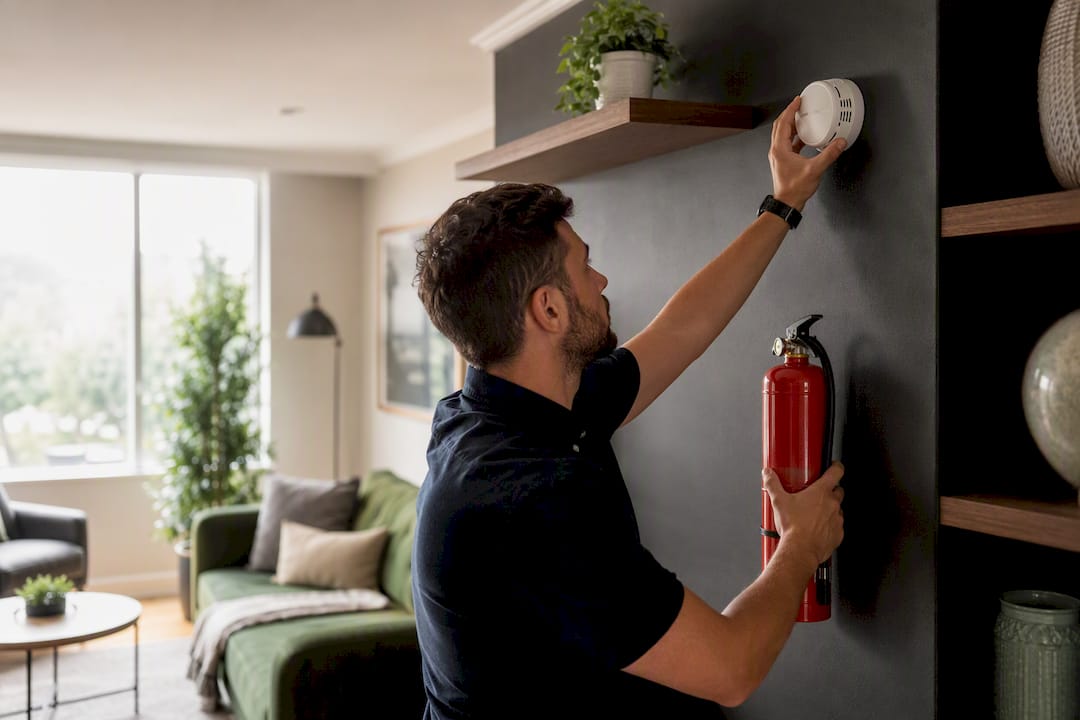
A 2A10BC-rated fire extinguisher on every floor of the rental.
Smoke and carbon monoxide alarms tested regularly, with dated logs kept on file.
A posted evacuation plan visible to guests.
The active licence number displayed on every listing, along with clear parking disclosure.
Hosts also need a responsible person available 24/7 and must respond to nuisance complaints within two hours. That two-hour window is one of the more overlooked details in the bylaw, and it’s exactly the kind of thing that trips up out-of-town owners without local support.
Strata, Zoning and Eligibility Pitfalls
A City licence doesn’t override strata bylaws. If you own a condo or townhouse, the strata council can prohibit short-term rentals outright, regardless of whether your building sits inside an STR subzone, and legal analysis of the exemption confirms strata rules take precedence where they conflict with the city’s permissions.
Before listing, check these four things:
Written strata council confirmation permitting short-term rental use, not just a verbal assurance.
Current zoning designation, since subzone boundaries can shift as council reviews tourism corridors.
Agricultural Land Reserve (ALR) status, which carries its own restrictions separate from municipal zoning.
Carriage houses and fractionally owned units, both of which often require additional documentation proving which portion of the property qualifies.
Skipping the strata check is the fastest way to get a licence approved and still face a cease-and-desist letter two months later.
Enforcement, Penalties and the Records You Must Keep
The city doesn’t rely on complaints alone. Bylaw officers can audit licence files directly, and penalties escalate quickly for noncompliance. Fines run up to $500 per day per offense, and the city can suspend or cancel a licence outright for repeated violations. Provincial enforcement under the Short-Term Rental Accommodations Act can add separate penalties on top of municipal fines.
Keep these records on hand at all times:
A guest registry logging every booking and check-in date.
Your annual self-evaluation safety attestation.
Fire extinguisher and smoke/CO alarm inspection logs.
Proof of principal residence for any period the city requests it, if you operate outside a subzone.
Unlicensed operation, misrepresented subzone status, and repeated nuisance complaints are the three most common triggers for an inspection.
A Property Manager’s Pre-Listing Checklist for Kelowna Hosts
Getting a Kelowna listing compliant from day one comes down to sequencing. Skip a step and you’ll be reapplying, which costs weeks during peak booking season.
Pull your zoning confirmation and, if applicable, get strata consent in writing before spending money on furnishing or photography.
Complete the fire-safety kit: extinguishers, alarms, a posted evacuation map.
Draft a floor plan and finalize your good-neighbour agreement language.
Set up a 24/7 responsible-contact system, whether that’s a phone tree, an answering service, or professional short-term rental setup.
Build automated guest messaging that covers parking rules, quiet hours, and occupancy limits before check-in.
Start your guest registry and safety-log spreadsheet on day one, not after your first inspection notice.
Pro Tip: If you live outside Kelowna, especially in Vancouver, a licensed local contact isn’t just convenient. It’s often the difference between a two-hour complaint response and a $500 fine.
Hiring a manager makes the most sense when you’re out of area, your strata has layered restrictions, or you’d simply rather not be the 2 AM phone call for a guest locked out of a rental two hours from home.
Is Kelowna an Opportunity for Vancouver Owners?
More eligible units in STR subzones will likely soften peak summer pricing somewhat as supply grows, though tourism demand in Kelowna has historically absorbed new inventory fast. The bigger caveat: this opt-out is narrow. Strata bylaws and zoning boundaries still block a lot of properties Vancouver investors might assume qualify.
Anyone weighing a Kelowna purchase against staying in the Lower Mainland should model cash flow carefully before assuming subzone eligibility, and line up local management rather than betting on remote self-management working out.
— Kamran
How Nestoria Estates Handles Kelowna Compliance for You
Nestoria Estates is the alternative to juggling Kelowna’s licensing paperwork yourself from Vancouver: we handle the City licence application, safety audits, and strata liaison so an out-of-area owner never has to drive to Kelowna to fix a compliance gap.

For Vancouver-based owners weighing a Kelowna property, the real cost isn’t the $345 licence fee. It’s the 24/7 responsible-contact requirement and the two-hour nuisance response window, both of which are hard to meet from three hours away. Our team manages guest communication, dynamic pricing, cleaning coordination, and incident response on the ground, plus the strata and zoning verification that trips up so many new hosts before their first booking. If you’re weighing whether a Kelowna property fits your portfolio, get a free revenue projection through our services page and see exactly what compliant, hands-off management looks like for your specific property.
Sources
FAQ
Can You Run an Airbnb in Kelowna?
Yes, if the property sits in an approved STR subzone or the owner meets the 240-day principal-residence rule elsewhere in the city, and you hold a valid City business licence plus provincial registration.
What Is the 80/20 Rule for Airbnb?
This isn’t a formal Kelowna regulation.
What Are the New Rules in BC for Airbnb?
BC’s Short-Term Rental Accommodations Act generally requires short-term rentals to be in an operator’s principal residence, but municipalities with vacancy rates above 3% can apply to opt out, which is exactly what allowed Kelowna’s June 1, 2026 exemption.
What Is the Latest News on Airbnbs in Kelowna?
Kelowna received a one-time accelerated provincial exemption effective June 1, 2026, letting properties in designated STR subzones skip the principal-residence requirement after the city’s rental vacancy rate rose above 6%, while a City licence stays mandatory citywide.
Recommended
Comments