

Property Marketing Guide 2026: Win More Renters Fast
- info67421305
- 1 day ago
- 8 min read

TL;DR:
Effective property marketing in 2026 relies on AI-powered listings, immersive 3D tours, authentic short videos, and localized content. Owners should allocate a structured budget across search, social media, retargeting, and SEO while tracking property KPIs like days-to-lease and occupancy rates for best results. Authentic storytelling combined with disciplined performance tracking helps Vancouver owners outperform competitors and maximize rental income.
Effective property marketing in 2026 is defined by one principle: data-driven digital tools combined with authentic multimedia content produce measurably better rental outcomes. For Vancouver Airbnb owners and real estate investors, this property marketing guide 2026 is the difference between a calendar full of bookings and a listing that sits idle. The market has shifted. Guests and investors now expect 3D virtual tours, short-form video, and AI-powered listing copy before they even consider reaching out. The owners who master these tools first will capture the highest occupancy rates and the strongest returns.
What are the essential tools for property marketing success in 2026?
The foundation of any effective real estate marketing strategy in 2026 is a short stack of high-impact tools. Each one solves a specific problem in the buyer or renter journey.

AI-powered listing creation is the starting point. AI-driven listing promotion boosts visibility on AI-powered search surfaces by 35% and raises click-through rates by 28%. Schema markup is the mechanism behind this. It tells search engines and AI assistants exactly what your property is, where it is, and what it offers, so your listing surfaces in the right results at the right moment.
3D virtual tours are no longer optional. Listings with 3D tours receive 87% more views and close up to 31% faster. Buyers and renters spend up to 10 times longer on listings that include immersive tours. Platforms like Matterport and iGUIDE are the two dominant tools in this space for Canadian properties. That extra time on listing translates directly into higher intent and faster decisions.
Short-form video is the trust engine. Authentic walkthrough videos under 90 seconds, shot on an iPhone, outperform cinematic drone productions for building renter trust. Guests want to see the real space, not a polished advertisement. Keep videos brief, personal, and honest.
CRM and marketing automation close the loop. Automated follow-ups via email and WhatsApp keep warm leads engaged without manual effort. For Vancouver Airbnb owners managing multiple units, this is the tool that prevents leads from going cold between inquiry and booking.
Google Ads and Meta Platforms drive paid traffic. Google captures high-intent search demand. Meta targets renters and investors by interest, behavior, and geography. Together, they cover the full funnel from awareness to conversion.
AI listing tools: schema markup, dynamic copy generation
3D tour platforms: Matterport, iGUIDE
Video: iPhone-shot walkthroughs under 90 seconds
CRM automation: email sequences, WhatsApp follow-ups
Paid channels: Google Ads, Meta Platforms (Facebook and Instagram)
Pro Tip: Set up your Google Business Profile before running any paid ads. A complete profile improves your Quality Score, which lowers your cost per click on Google Ads campaigns.
How should you allocate your marketing budget in 2026?
Budget allocation is where most property owners make their first mistake. They spend without a structure and then cannot tell which channel produced a booking.
Top-performing marketers allocate 3%–8% of projected revenue to marketing, split across four channels. This structure is not arbitrary. Each channel serves a different stage of the renter journey, and the split reflects where attention and intent actually live.
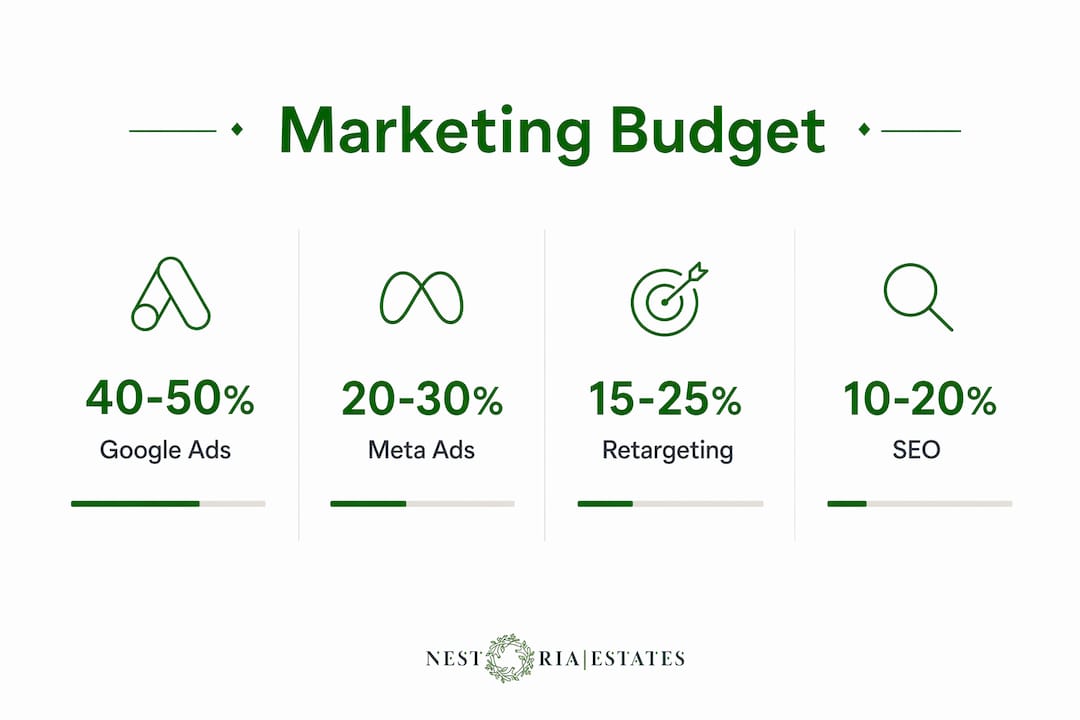
Channel | Budget share | Primary purpose |
Google Ads | 40%–50% | Capture high-intent search traffic |
Meta Ads | 25%–35% | Build awareness and retarget warm audiences |
Retargeting | 10%–15% | Re-engage visitors who did not convert |
SEO and content | 10%–15% | Build long-term organic visibility |
The performance benchmarks are equally specific. Top real estate marketers achieve a cost per lead between $18 and $65, recovering 2–4 times their ad spend within 90 days. Residential developers typically land in the $22–$38 CPL range. If your blended CPL climbs above $65 without a corresponding improvement in booking quality, reallocate spend from the underperforming channel toward retargeting.
The KPIs that matter are property-level outcomes, not platform metrics. Days-to-lease, occupancy rate, and net operating income (NOI) are the numbers that tell you whether your marketing is working. Tying marketing spend to these KPIs reduces cost per signed lease by 15%–25%. Vanity metrics like impressions and follower counts do not pay mortgages.
Pro Tip: Review your blended CPL every two weeks, not monthly. A two-week review cycle lets you catch underperforming campaigns before they drain a full month’s budget.
What content strategies convert Vancouver rental investors and tenants?
Vancouver’s rental market is one of the most competitive in North America. Generic listing copy does not work here. Content must be specific, localized, and distributed across multiple formats.
Most agents use one generic property description. That is the single most common and costly content mistake. The fix is to generate multiple AI-powered variations: one optimized for MLS, one for Instagram captions, one for email campaigns, and one for Google Ads copy. Each platform has a different character limit, tone expectation, and audience intent. One description cannot serve all four.
For video, the rule is authenticity over production value. Video is the fastest trust-builder for converting cold leads into long-term clients. A 60-second iPhone walkthrough that shows the morning light in the kitchen and the view from the balcony does more for a Vancouver Airbnb listing than a $2,000 drone reel. For YouTube, longer videos of 3–5 minutes work well. For Instagram Reels and TikTok, keep it under 90 seconds.
Localization is the factor most Vancouver owners overlook. Successful property marketing requires content tailored to different investor motivations. Middle Eastern investors prioritize rapid appreciation. European investors focus on yield and legal transparency. Domestic Canadian investors want cash flow clarity and tax efficiency. One listing description cannot speak to all three groups. Nestoriaestates helps owners build localized content variations that address each investor profile directly. For deeper context on the Vancouver rental market, the Vancouver rental revenue tips from Nestoriaestates are worth reviewing.
Here is a practical content distribution framework for Vancouver Airbnb owners:
Shoot a 60-second iPhone walkthrough on a clear day with natural light
Generate three listing copy variations using an AI tool: one for Airbnb, one for Instagram, one for email
Embed your Matterport or iGUIDE 3D tour link in every email and listing
Add a neighborhood guide section to your listing covering transit, restaurants, and local attractions
Repurpose your professional photos across MLS, social media posts, email headers, and printed flyers
Professional media assets work best when treated as modular blocks. One photo shoot produces content for six different channels. That approach reduces production costs and keeps your brand consistent across every touchpoint.
How do you fix common property marketing mistakes in 2026?
The most expensive marketing mistakes are not the ones that cost money upfront. They are the ones that quietly drain your occupancy rate over weeks.
Single generic listing copy. Use AI to create platform-specific variations. One description for Airbnb, a shorter punchy version for Instagram, and a benefit-focused version for email.
Skipping short-form video. Video builds trust faster than any other format. Owners who skip it are invisible to the largest segment of renters under 40.
Ignoring lead quality signals. Time-on-tour in your 3D walkthrough and ad attribution data tell you which channels produce serious renters versus browsers. Track both.
Not adjusting channel spend. If your Meta CPL climbs above $65 for two consecutive weeks, shift that budget to retargeting. Static budgets produce static results.
No CRM follow-up sequence. A lead that does not hear from you within four hours is likely booking somewhere else. Automated CRM sequences solve this without adding to your workload.
Pro Tip: Connect your Matterport or iGUIDE tour analytics to your CRM. Leads who spend more than three minutes in a 3D tour are your highest-intent prospects. Flag them for immediate follow-up.
For a broader view of how data shapes property decisions, the role of data in property management is a useful reference for understanding how KPI tracking connects to marketing performance.
Key Takeaways
Effective property marketing in 2026 requires AI-powered listings, authentic short-form video, structured budget allocation, and localized content to maximize Vancouver rental occupancy and returns.
Point | Details |
Use 3D tours and AI listings | Listings with 3D tours get 87% more views and close up to 31% faster. |
Allocate budget by channel | Split spend: 40%–50% Google Ads, 25%–35% Meta, 10%–15% retargeting, 10%–15% SEO. |
Track property-level KPIs | Measure days-to-lease, occupancy, and NOI, not impressions or follower counts. |
Create platform-specific content | Generate separate AI copy for Airbnb, Instagram, email, and MLS listings. |
Automate lead follow-up | CRM sequences prevent warm leads from going cold between inquiry and booking. |
What I have learned about property marketing in Vancouver
The biggest shift I have seen in Vancouver’s rental market is not the technology. It is the mindset. Owners who treat marketing as a cost center consistently underperform. Owners who treat it as a performance system consistently outperform, even with smaller budgets.
The authenticity trend in video is real, and it runs deeper than most people realize. I have watched beautifully produced drone videos generate fewer bookings than a simple iPhone tour that showed the actual morning light and the real size of the kitchen. Guests are not buying a fantasy. They are buying a specific experience in a specific space. Show them the truth, and they book faster.
The localization piece is where I see the most untapped opportunity in Vancouver. The city draws investors from dozens of countries, each with different priorities. A listing description that speaks to a European investor’s concern about yield and legal clarity will not resonate with a domestic buyer focused on cash flow. Most owners use one description for everyone. That is a missed conversion every time.
The vacation rental marketing strategies that work in 2026 are not complicated. They are consistent. Show up with the right content, on the right channels, with the right message for the right audience. Measure what matters. Adjust every two weeks. That is the whole system.
The owners who will win Vancouver’s rental market in 2026 are not the ones with the biggest budgets. They are the ones who combine genuine storytelling with disciplined performance tracking. That combination is available to any owner willing to build it.
— Kamran
How Nestoriaestates helps you market smarter in 2026
Vancouver Airbnb owners who want results without managing every detail have a direct path forward with Nestoriaestates.
Nestoriaestates handles the full marketing and management stack: AI-powered listing creation, professional media coordination, dynamic pricing, and guest communication. The team uses real market data to adjust your pricing continuously and produces the localized content variations that convert different investor and renter profiles. Every owner gets transparent reporting tied to the KPIs that actually matter, including occupancy rate, revenue per available night, and days-to-lease. If you are ready to put a proven system behind your property, explore the full range of Nestoriaestates services and request a free revenue projection for your Vancouver property.
FAQ
What is the most effective property marketing tool in 2026?
3D virtual tours are the single highest-impact tool. Listings with 3D tours receive 87% more views and close up to 31% faster than listings without them.
How much should I spend on property marketing in 2026?
Allocate 3%–8% of projected revenue, split across Google Ads, Meta Ads, retargeting, and SEO. Top performers recover 2–4 times their ad spend within 90 days.
Does short-form video really work for Airbnb listings?
Yes. Authentic iPhone-shot walkthroughs under 90 seconds build renter trust faster than polished cinematic productions. Video is the fastest format for converting cold leads into bookings.
How do I know if my marketing campaigns are working?
Track days-to-lease, occupancy rate, and NOI. Tying marketing spend to these property-level KPIs reduces cost per signed lease by 15%–25% compared to tracking vanity metrics.
How should Vancouver owners localize their listing content?
Create separate content variations for different investor profiles. Address yield and legal transparency for European investors, rapid appreciation for Middle Eastern investors, and cash flow clarity for domestic Canadian buyers.
Recommended
Comments