

Property Owner Benefits Explained for Vancouver Investors
- info67421305
- 2 days ago
- 9 min read

TL;DR:
Property ownership is the most reliable way to build long-term wealth, especially for Vancouver short-term rental investors. Holding properties for five to ten years allows appreciation, mortgage paydown, and tax strategies to maximize wealth accumulation.
Property ownership is the single most reliable path to long-term wealth accumulation, and for Vancouver short-term rental investors, the financial and operational advantages are even sharper. Property owner benefits explained in full include equity growth, depreciation deductions, cash flow from Airbnb guests, and the compounding gains that professional management unlocks. Homeowners accumulated 38 times more wealth than renters between 2019 and 2022. That gap is not a coincidence. It is the direct result of equity appreciation, mortgage paydown, and tax strategies that renters simply cannot access.
How does owning property build wealth compared to renting?
The wealth gap between owners and renters is not a myth. Homeownership in 199 out of 250 U.S. cities outperformed renting over a 10-year period, with markets like Miami projecting over $1 million in equity gains. That finding matters for Vancouver investors because it confirms that the advantages of property ownership are structural, not just the result of a hot market.
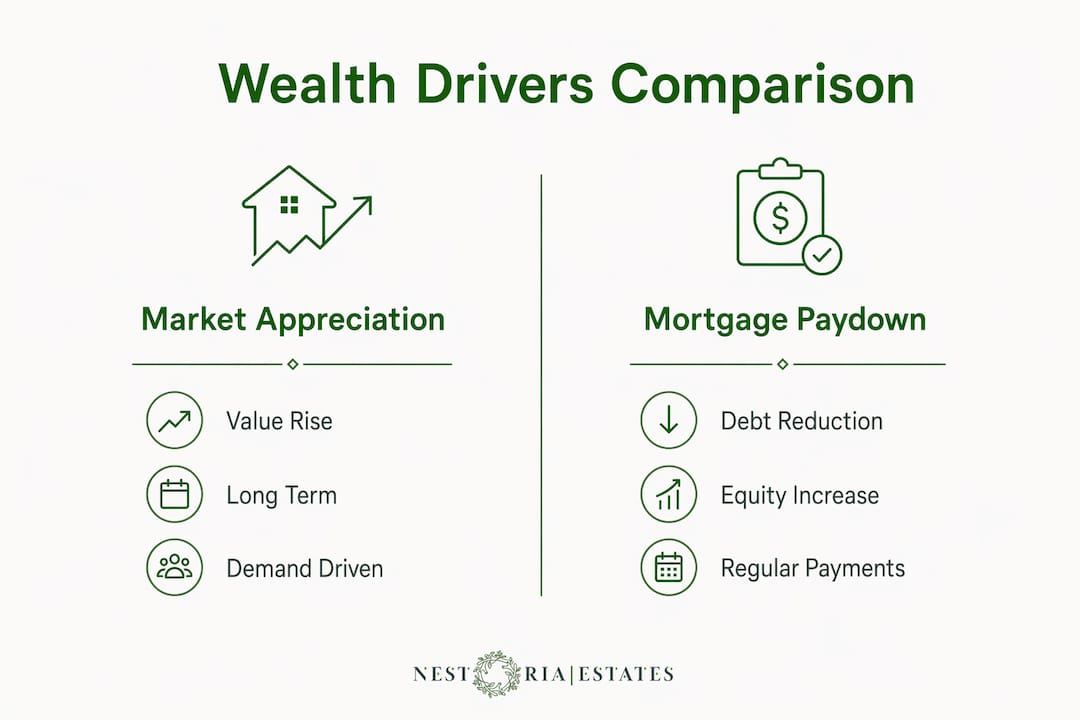
Equity builds through two separate engines running at the same time. First, your property appreciates in value as the market grows. Second, every mortgage payment reduces your principal balance, increasing your ownership stake regardless of what the market does. Vancouver’s real estate market has historically rewarded long-term holders, and that dynamic applies directly to short-term rental properties listed on Airbnb.
“Holding periods of 5 to 10+ years maximize the equity advantage; local market factors highly influence the buy vs. rent decision.” — Zillow Research, 2026
The table below shows how the two primary wealth-building mechanisms compare for a Vancouver property owner over time.
Wealth driver | How it works | Timeline |
Market appreciation | Property value rises with demand and inflation | Long term (5–10+ years) |
Principal paydown | Each mortgage payment reduces the loan balance | Monthly, from day one |
Short-term rental income | Airbnb guests generate cash flow above carrying costs | Immediate |
Tax savings | Depreciation and deductions reduce taxable income annually | Annual |

The key lesson here is patience. Investors who exit within two or three years rarely capture the full advantages of property ownership. Those who hold through market cycles and reinvest their rental income consistently build the most wealth.
Pro Tip: If you are evaluating a Vancouver property, calculate your projected equity position at year 5, year 7, and year 10 before making a purchase decision. Short-term cash flow matters, but the long-term equity picture is where real wealth is built.
What tax advantages do property owners receive for short-term rentals?
Tax strategy is where many Vancouver property owners leave significant money on the table. Residential rental properties depreciate over 27.5 years for federal tax purposes, creating a non-cash deduction that reduces your taxable income every single year. On a $500,000 building value (excluding land), that is roughly $18,182 in annual depreciation you can write off without spending a dollar.
The list of deductible expenses for short-term rental owners is extensive. Each deduction directly reduces the income the IRS or CRA taxes, improving your real after-tax return.
Mortgage interest: The interest portion of your monthly payment is fully deductible as a rental expense.
Property management fees: Fees paid to a management company are a legitimate business expense and reduce your net cost of professional help.
Cleaning and maintenance: Every cleaning service, repair, and maintenance call tied to your rental is deductible.
Depreciation: The 27.5-year schedule creates a paper loss each year that offsets real rental income.
Insurance premiums: Landlord or short-term rental insurance policies are deductible.
Advertising and platform fees: Airbnb service fees and any paid marketing costs qualify as deductions.
Section 199A pass-through deduction: Qualifying rental income may be eligible for a 20% deduction under Section 199A, depending on your income level and how the rental activity is structured.
The most powerful long-term tax tool for U.S.-based investors is the 1031 exchange. It allows you to defer capital gains taxes when you sell one investment property and roll the proceeds into a new one. Over multiple transactions, this deferral compounds into a significant tax advantage that renters and stock investors cannot replicate.
For Vancouver investors operating on both sides of the border, understanding which rules apply to your specific structure is critical. Working with a tax professional who specializes in cross-border real estate will protect your returns and keep you compliant.
Why is professional property management a smart investment for owners?
Most Vancouver Airbnb owners underestimate the true cost of self-managing a short-term rental. Guest communication alone can consume 10–15 hours per week during peak season. Add pricing adjustments, cleaning coordination, maintenance calls, and regulatory compliance, and self-management becomes a part-time job with unpredictable hours.
Professional property management fees average 8–12% of gross monthly rent and cover far more than basic administration. Here is what that fee typically includes for a Vancouver short-term rental owner:
Dynamic pricing: Managers use data tools to adjust nightly rates based on demand, local events, and competitor pricing, maximizing revenue per available night.
Guest screening and communication: Professional managers handle all guest inquiries, vetting, and post-stay reviews, protecting your property and your reputation.
Cleaning coordination: Turnover cleaning is scheduled automatically between bookings, maintaining the quality standards that drive five-star reviews.
Maintenance oversight: Routine inspections and rapid response to repairs prevent small issues from becoming expensive problems.
Regulatory compliance: Vancouver has specific short-term rental regulations, including licensing requirements. A local manager tracks these rules and keeps your listing compliant.
Pro Tip: Property management fees are fully tax-deductible as a business expense. The real net cost of management is lower than the headline percentage once you account for the tax write-off.
The deeper advantage is scalability. Professional management shifts owners from hands-on operators to portfolio builders. Once your first property runs on a managed system, adding a second or third becomes a financial decision rather than a workload question. That is the difference between owning a rental and building a rental business. Explore how professional management increases profits through lower vacancies and better guest retention.
How do cash flow, appreciation, paydown, and tax benefits drive total returns?
Experienced investors measure rental property performance across four distinct return drivers, not just monthly cash flow. Focusing only on cash flow causes investors to undervalue their properties and make poor buy or sell decisions.
The four engines work together, and their interaction is what makes real estate uniquely powerful as an asset class.
Return driver | What it delivers | Frequency |
Cash flow | Net income after all expenses | Monthly |
Principal paydown | Equity growth through loan reduction | Monthly |
Appreciation | Asset value increase over time | Annual/long-term |
Tax benefits | Reduced taxable income via deductions | Annual |
A Vancouver property generating modest monthly cash flow may still deliver a 12–15% total annual return when you factor in appreciation, principal paydown, and the depreciation deduction. Investors who ignore the non-cash components routinely underestimate their actual returns and sometimes sell properties that are quietly building significant wealth.
Short-term rental income amplifies the cash flow component specifically. Airbnb nightly rates in Vancouver’s peak summer and winter seasons consistently exceed what a long-term tenant would pay monthly. That premium, combined with the other three return drivers, creates a compounding effect that long-term rentals rarely match. For a deeper look at how these drivers interact, the short-term rental ROI breakdown at Nestoriaestates covers the math in detail.
Pro Tip: Build a simple annual return spreadsheet that tracks all four drivers separately. Most owners are surprised to find that appreciation and principal paydown together often exceed their cash flow in total dollar value.
What steps can Vancouver owners take to maximize rental income?
Maximizing rental income in Vancouver requires more than listing a property on Airbnb and waiting for bookings. The owners who consistently outperform the market follow a specific set of practices.
Use data-driven pricing: Static nightly rates leave money on the table. Tools like PriceLabs and Wheelhouse adjust rates dynamically based on local demand signals, competitor occupancy, and seasonal patterns. A professional manager typically handles this automatically.
Maintain the property proactively: Properties with recent updates and well-maintained interiors earn higher nightly rates and better reviews. Budget 1–2% of the property value annually for upkeep and improvements.
Understand Vancouver’s short-term rental rules: The City of Vancouver requires short-term rental operators to hold a valid business license and, in most cases, to rent only their principal residence. Violations can result in fines and listing removal. Staying compliant protects your income stream.
Optimize your listing quality: Professional photography, detailed descriptions, and a high review score directly affect your search ranking on Airbnb. Higher rankings mean more bookings at better rates.
Review performance monthly: Track occupancy rate, average daily rate, and revenue per available night each month. Comparing these metrics against local benchmarks reveals where you are leaving money behind.
The benefits of short-term rentals for Vancouver property owners extend well beyond the nightly rate. When managed correctly, a short-term rental generates more income per square foot than almost any other residential use of the same property.
Key takeaways
Property ownership builds wealth through four compounding drivers: cash flow, principal paydown, appreciation, and tax benefits, and professional management amplifies all four simultaneously.
Point | Details |
Wealth gap is structural | Homeowners accumulate 38 times more wealth than renters through equity and appreciation. |
Depreciation reduces tax burden | A 27.5-year depreciation schedule creates annual non-cash deductions that lower taxable income. |
Management fees pay for themselves | At 8–12% of rent, professional management reduces vacancies, improves compliance, and is tax-deductible. |
Four return drivers compound together | Cash flow, paydown, appreciation, and tax savings must all be tracked to measure true property ROI. |
Vancouver rules require active compliance | Short-term rental licensing in Vancouver is mandatory and must be maintained to protect income. |
Why I think most Vancouver owners undervalue what they actually own
I have worked with enough property owners to recognize a consistent pattern. Owners who self-manage focus almost entirely on cash flow. They look at the monthly rent, subtract the mortgage and expenses, and judge the investment on that number alone. That approach misses the majority of the return.
The depreciation deduction alone on a typical Vancouver property can offset tens of thousands of dollars in taxable income each year. Most owners either do not know this or have not set up their tax structure to capture it. That is not a small oversight. Over a 10-year hold, the cumulative tax savings from depreciation, deductible expenses, and strategic timing can rival the cash flow the property generated.
The management fee question is where I see the most resistance. Owners balk at paying 10% of gross rent to a management company. What they do not calculate is the cost of their own time, the revenue lost to pricing errors, and the risk exposure from non-compliance with Vancouver’s short-term rental regulations. A single bylaw violation can result in a fine that exceeds an entire year of management fees.
The Vancouver market has specific nuances that generic real estate advice does not address. Principal residence requirements, licensing rules, and seasonal demand patterns all affect how you should structure and operate your rental. Local expertise is not a luxury here. It is a competitive advantage. The owners who treat professional management as a strategic investment, rather than a cost to minimize, consistently outperform those who try to run everything themselves.
— Kamran
How Nestoriaestates helps Vancouver owners earn more with less effort
Nestoriaestates specializes in full-service short-term rental management for Vancouver property owners who want to maximize income without managing day-to-day operations themselves.

The team at Nestoriaestates handles dynamic pricing, guest communication, cleaning coordination, maintenance, and regulatory compliance, so you collect revenue without the operational load. Every owner receives transparent monthly reporting and data-backed pricing adjustments that respond to Vancouver’s seasonal demand patterns. Whether you own one property or several, the property management services at Nestoriaestates are built to grow with your portfolio. If you are ready to see what your property could realistically earn, reach out to the team for a free revenue projection.
FAQ
What are the main financial benefits of owning a rental property?
The primary financial benefits are cash flow from rental income, equity growth through appreciation and mortgage paydown, and annual tax deductions including depreciation. Together, these four drivers deliver total returns that typically exceed what cash flow alone suggests.
How much do property management fees cost in Vancouver?
Professional property management fees average 8–12% of gross monthly rent and cover pricing, guest management, cleaning, maintenance, and compliance. These fees are fully tax-deductible, reducing the real net cost to owners.
Is owning a short-term rental in Vancouver worth it?
Yes, for owners who hold long enough and manage compliance correctly. Vancouver’s demand for short-term accommodations supports premium nightly rates, and the four compounding return drivers make ownership significantly more profitable than renting out the same property long-term.
What tax deductions can Vancouver Airbnb owners claim?
Owners can deduct mortgage interest, management fees, cleaning costs, repairs, insurance, depreciation over 27.5 years, and platform fees. U.S.-based investors may also qualify for the Section 199A pass-through deduction and capital gains deferral through a 1031 exchange.
How long should I hold a Vancouver rental property to maximize returns?
Holding for 5–10+ years maximizes the equity advantage by allowing appreciation and principal paydown to compound. Short holding periods rarely capture the full financial benefits of ownership, particularly in a market like Vancouver where appreciation trends reward patience.
Recommended
Comments