

Property Owner Tax Tips for Vancouver Airbnb Hosts

Report every dollar of gross rental income and file Form T776 with your return. That’s the baseline. If your short-term rental activity crosses into business territory under CRA rules, you’ll use Form T2125 instead. Either way, the income gets reported.
Two things to do right now:
Reconcile your platform payouts to total gross receipts. Airbnb’s year-end statement shows what they paid you, not necessarily what guests paid in full. Add cleaning fees, damage deposits kept, and any off-platform income.
Check your GST/HST status. If your taxable short-term rental revenue exceeded $30,000 in any rolling 12-month period, registration is mandatory, not optional.
If your records are messy or your service levels are high (think daily cleaning, concierge, or meal service), talk to an accountant or a property manager like Nestoriaestates before you file.
Pro Tip: Save your Airbnb annual earnings summary the moment it’s available in January. Cross-reference it against your bank deposits before you do anything else.
Key Takeaways
Vancouver Airbnb owners must report total gross rental income on Form T776 and check their GST/HST registration status if revenue exceeded $30,000 in any rolling 12-month period.
Point | Details |
Report gross income | Enter total guest payments on line 8141 of T776, not the net payout Airbnb deposits. |
Choose the right form | Use T776 for rental income; switch to T2125 only if CRA classifies your activity as a business. |
Check GST/HST threshold | Registration is mandatory once taxable short-term rental revenue exceeds $30,000 in any 12-month period. |
Keep six years of records | Retain platform statements, invoices, and bank records for at least six years from the relevant tax year. |
Nestoriaestates | Monthly owner statements from Nestoriaestates map directly to T776 lines, reducing audit risk and filing time. |
Table of Contents
What counts as rental income and when does the CRA treat your Airbnb as a business?
How to report short-term rental income in Canada: forms, lines, and timing
Which expenses can you deduct, and how do you handle personal use and CCA?
GST/HST for short-term rentals: when you must register and what platforms don’t cover
Renting to family, below-market rates, and the reasonable expectation of profit rule
What Vancouver property managers see owners get wrong every year
Nestoriaestates helps Vancouver owners stay tax-compliant and audit-ready
Official CRA pages and forms Vancouver owners should consult
What counts as rental income and when does the CRA treat your Airbnb as a business?
Most Vancouver Airbnb hosts report rental income, not business income. The distinction turns on how many services you provide. CRA guidance is clear: basic services like heat, parking, and internet keep you in rental territory. Add meals, guided tours, daily linen changes, or anything resembling a hotel experience, and the CRA may reclassify your activity as a business.
Why does this matter? Rental income goes on Form T776 and flows to lines 12599/12600 on your T1. Business income goes on Form T2125 and flows to lines 13499/13500. The tax rate is similar, but the filing forms, expense rules, and GST/HST treatment differ.
Self-assessment checklist:
Do you provide meals or daily cleaning? (Business signal)
Do you offer transportation, tours, or concierge services? (Business signal)
Is the property rented to the same guest for more than 30 consecutive days? (May shift to long-term rental rules)
Do you only provide heat, light, parking, and Wi-Fi? (Rental income)
For mixed-use properties shared with co-owners, each owner reports their proportionate share of income and expenses on a separate T776. Setting up your rental correctly from the start reduces the risk of misclassification later.
Pro Tip: Document your service level in writing at the start of each year. A one-page “services offered” summary protects you if the CRA ever questions your T776 vs T2125 choice.
How to report short-term rental income in Canada: forms, lines, and timing
Guide T4036 is the CRA’s primary rental income reference. Read it before you file. Here’s the step-by-step process for most Vancouver Airbnb owners:
Gather all platform statements for the calendar year (January 1 through December 31). Include Airbnb, VRBO, or any other platform.
Total your gross rents. Enter this on line 8141 of Form T776. This is your gross rental income before any expenses.
Add other income (cleaning fees, pet fees, any income not captured in the base nightly rate).
Transfer the gross total to line 12599 on your T1 return.
Complete Part 4 of T776 (expenses), then transfer the net rental income or loss to line 12600.
If CRA treats your activity as a business, report on Form T2125 instead. Gross income goes to line 13499; net income to line 13500.
Statistic callout: CRA’s platform economy guidance confirms that platform-collected taxes do not remove your obligation to report total gross income. You report what guests paid, not just what the platform deposited in your account.
Co-owners each file their own T776 showing their ownership percentage.
Which expenses can you deduct, and how do you handle personal use and CCA?
The CRA allows deductions for reasonable expenses incurred to earn rental income. Common deductible current expenses include:
Advertising and platform fees
Cleaning and maintenance costs
Property management fees (Nestoriaestates invoices qualify here)
Insurance premiums
Mortgage interest (not principal)
Utilities paid by the owner
Repairs (not replacements)
Current vs. capital vs. non-deductible:
Category | Example | Treatment |
Fixing a leaky faucet | Deduct in full in the year incurred | |
Capital expense | Replacing the entire HVAC system | Claim via CCA over multiple years |
Non-deductible | Mortgage principal repayment | Never deductible |
Capital Cost Allowance (CCA) lets you deduct a portion of capital expenditures each year. The relevant T776 lines are 9936 (CCA claimed) and 9946 (undepreciated capital cost). One caution: claiming CCA on a principal residence used partly for rental can trigger recapture when you sell, meaning the CRA claws back the deductions as income. Many Vancouver owners skip CCA on their primary home for exactly this reason.
For mixed personal/rental use, allocate expenses by square footage or by the number of nights the unit was available for rent versus personal use. Be consistent year over year.
Section 67.7 of the Income Tax Act denies deductions for expenses tied to short-term rentals that are non-compliant with local licensing. Vancouver requires a short-term rental business license. If yours has lapsed, expenses cannot be deducted for the non-compliant period. Chart A and Chart B on T776 calculate these non-compliant amounts.
Pro Tip: Label every invoice with the property address and the tax year before filing it. A folder per property, per year, cuts audit response time from days to hours.
GST/HST for short-term rentals: when you must register and what platforms don’t cover
Short-term accommodation under one month is taxable unless the nightly rate is $20 or less.
Key rules:
$30,000 threshold: Once your taxable short-term rental revenue exceeds $30,000 in any rolling 12-month period, you must register for GST/HST.
Place of supply: Tax is charged based on where the property sits, not where the guest lives. A Vancouver condo is always subject to BC/federal rules.
Platform collection: Airbnb may collect and remit GST/HST on your behalf for some transactions, but this does not eliminate your obligation to register once you cross the threshold, nor does it replace your income reporting duty.
Voluntary registration: Even below $30,000, registering voluntarily lets you claim Input Tax Credits (ITCs) on cleaning, management, and maintenance expenses, which can meaningfully reduce your net tax cost.
Municipal levies: Vancouver’s Empty Homes Tax and the provincial Speculation and Vacancy Tax are separate obligations. Confirm your property’s status annually.
Statistic callout: The $30,000 GST/HST registration threshold applies over any 12-month period, not just the calendar year. A host who earns $28,000 from January through December but $32,000 from July to the following June crossed the threshold mid-year and should have registered at that point.
What records to keep and how to prepare for a CRA review
The CRA’s audit focus for short-term rentals has sharpened around three areas: service-level classification (rental vs. business), undisclosed gross income, and non-compliant expense claims. Good records are your first line of defense.
Keep these documents for a minimum of six years from the end of the tax year they relate to:
Annual platform earnings statements and monthly payout summaries
Bank statements showing deposits reconciled to platform reports
All cleaning, repair, and maintenance invoices (with dates and property address)
Insurance certificates and renewal notices
Mortgage statements showing interest vs. principal breakdown
Guest communications that demonstrate service levels (or the absence of hotel-style services)
Your Vancouver short-term rental business license
Professional management through a firm like Nestoriaestates produces monthly owner statements that already separate income, platform fees, cleaning costs, and maintenance charges. Those reports map directly to T776 expense lines and make a CRA review far less disruptive.
Pro Tip: Keep a pricing history export and your occupancy metrics. These two documents demonstrate reasonable expectation of profit, which is the standard the CRA applies when deciding whether to allow rental losses.
Renting to family, below-market rates, and the reasonable expectation of profit rule
The CRA disallows rental losses when a property is rented to a non-arm’s-length party (a family member, close friend, or related corporation) at below fair market value. The rule is straightforward: if you charge your sibling $800/month for a unit that rents on Airbnb for $3,000/month, you cannot deduct expenses beyond the $800 you collected.
Practical examples:
Roommate at market rate: Arm’s-length, full deductions apply.
Family member at market rate: Technically arm’s-length pricing, but document it carefully.
Family member below market rate: Losses are denied; income is still reportable.
Occasional personal use weeks: Allocate and exclude those periods from expense claims.
To demonstrate reasonable expectation of profit, keep records of your market-based pricing history, booking platform listings, occupancy targets, and any owner-prepared business plan. The benefits of short-term rentals are well documented, but the CRA expects you to show you’re actually pursuing them.
Pro Tip: If you rent to a family member even once at a discount, note it in your records and exclude that period from expense claims. A single undocumented below-market stay can invite scrutiny of the entire year.
Year-end checklist for Vancouver Airbnb owners
Run through this before you file:
Income reconciliation:
Export your Airbnb annual earnings summary
Match platform payouts to bank deposits, line by line
Add cleaning fees, damage deposits retained, and any off-platform income
Total gross rents for line 8141 of T776
Expense documentation:
Collect all cleaning, repair, and management invoices
Separate current expenses from capital expenditures
Calculate personal-use allocation (square footage or nights method)
Complete Chart A/Chart B on T776 if any non-compliant periods apply
GST/HST:
Confirm whether your 12-month rolling revenue crossed $30,000.
If registered, gather your GST/HST remittance records.
Confirm your Vancouver short-term rental license was valid for the full year.
Final steps:
If allocations are complex or your service level is high, engage an accountant or request an owner-report review from Nestoriaestates before filing.
Save the completed T776 and all supporting documents for six years.
A Vancouver Airbnb owner checklist can help you track these steps across the full operating year, not just at tax time.
What Vancouver property managers see owners get wrong every year
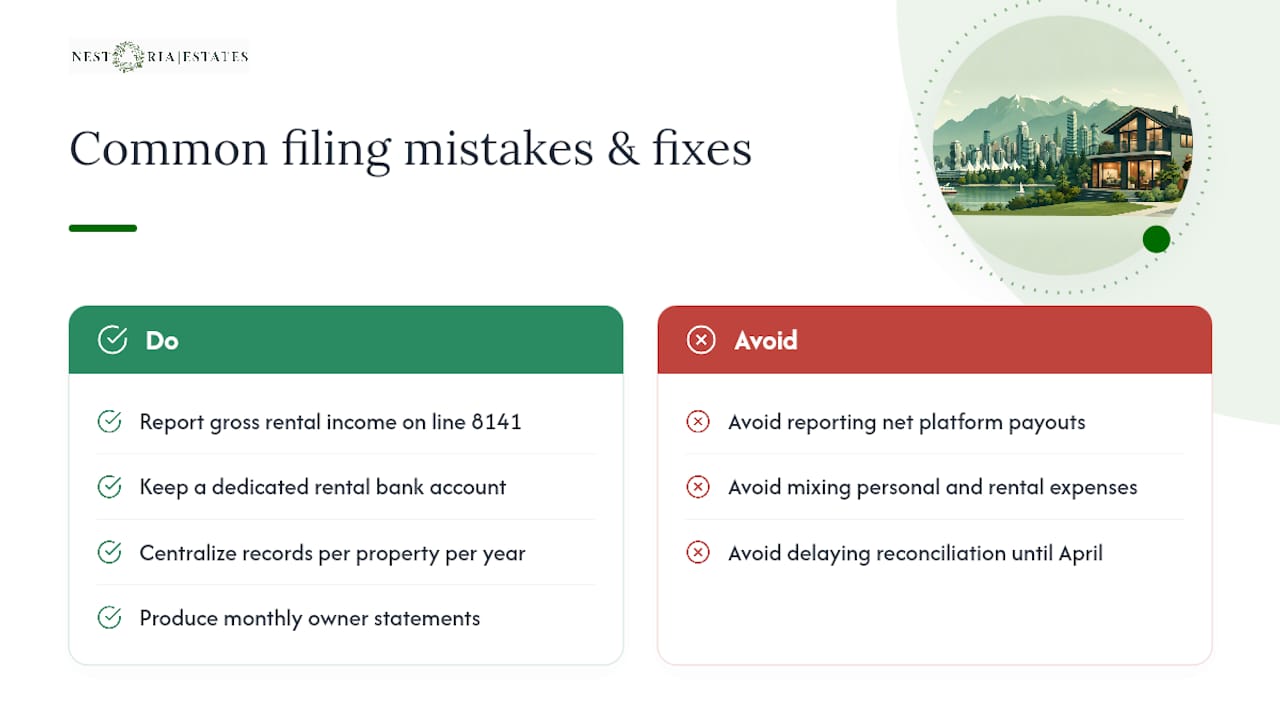
The most common filing error I see among Vancouver Airbnb owners is reporting net platform payouts instead of gross rental income. Airbnb deducts its service fee before it deposits money into your account. That deduction is a deductible expense on your T776, but the gross amount guests paid is what goes on line 8141. Reporting the net figure understates income and creates a mismatch with what Airbnb reports to the CRA.
The second most common mistake is mixing personal and rental expenses in one bank account. When a CRA auditor asks for records, a single account with grocery runs, Netflix charges, and cleaning invoices all mixed together is a red flag. A dedicated account for rental income and expenses takes 20 minutes to open and saves hours of explanation later.
The fix Nestoriaestates recommends to every owner: standardize your service level, centralize your records in one folder per property per year, and run a monthly reconciliation rather than scrambling in April. Voluntary GST/HST registration is worth considering even below the $30,000 threshold if your cleaning and management costs are significant, because the ITCs you recover can offset a meaningful portion of those expenses.
Pro Tip: A professional manager’s monthly owner statement is already audit-ready. If you self-manage, build the same habit: one statement per month, income minus expenses, filed digitally.
Nestoriaestates helps Vancouver owners stay tax-compliant and audit-ready
Tax season is easier when your records are already organized. Nestoriaestates provides Vancouver Airbnb owners with detailed monthly owner statements that separate gross income, platform fees, cleaning costs, and maintenance charges, mapped to the exact expense lines on Form T776. Every invoice is tracked, every payout is reconciled, and every owner portal entry is audit-ready before you even open TurboTax.

Owners who work with Nestoriaestates spend less time reconstructing records and more time deciding what to do with their returns. The full-service management offering includes GST/HST advisory, license compliance tracking, and bookkeeping-ready reports that your accountant can use directly. Request a free owner-portal walkthrough and see exactly what your reporting would look like under professional management.
Official CRA pages and forms Vancouver owners should consult
Bookmark these before you file. Each one is a primary source, not a summary:
Rental Income (Guide T4036) — The complete CRA guide for rental income, expenses, and Form T776 completion.
Completing Form T776 — Line-by-line instructions including Chart A/Chart B for short-term rentals.
Rental expenses you can deduct — Full list of deductible expense categories with T776 line references.
Rental expenses you cannot deduct — Non-deductible items and non-compliant short-term rental expense rules.
Sharing economy and platform taxes — CRA’s guidance on section 67.7, platform-collected taxes, and owner reporting obligations.
GST/HST for platform-based accommodation — Registration threshold, place-of-supply rules, and ITC eligibility.
Earning from online platforms — CRA’s plain-language overview of T776 vs T2125 and GST/HST registration for platform participants.
Residential real property rentals — GST/HST rules for short-term accommodation, including the $20/day exemption.
Print or save these pages. If the CRA ever questions a deduction, citing the exact guidance page that authorized it is the fastest way to close the matter.
This article provides general information about Canadian tax rules for short-term rental owners. It is not a substitute for professional tax or legal advice. Confirm current rules with the CRA or a qualified tax professional before filing.
Sources
FAQ
Do I report what Airbnb pays me or what guests pay in total?
Report the total amount guests paid, which is your gross rental income. Enter it on line 8141 of Form T776 and line 12599 of your T1 return. Airbnb’s service fee is a deductible expense, not a reduction of your reportable income.
What happens if Airbnb already collected GST/HST from my guests?
Platform collection does not remove your obligation to register once you exceed the $30,000 threshold, nor does it replace your duty to report gross income. You still file and, if registered, reconcile what the platform remitted against what you owe.
Can I deduct the full cost of a new appliance in the year I buy it?
No. A replacement appliance is a capital expense and must be claimed through Capital Cost Allowance over multiple years, not deducted in full in the year of purchase. A repair to an existing appliance is a current expense and is fully deductible in the year incurred.
What is the risk of not having a Vancouver short-term rental license?
Under section 67.7 of the Income Tax Act, expenses related to a non-compliant short-term rental are not deductible. Operating without a valid Vancouver business license means the CRA can deny your expense claims for the non-compliant period.
Should I register for GST/HST voluntarily if I earn less than $30,000?
Voluntary registration can make financial sense if your cleaning, management, and maintenance costs are significant, because registration lets you claim Input Tax Credits on those expenses. Weigh the administrative cost of filing GST/HST returns against the ITCs you would recover.
Recommended
Comments