

Rental Yield for Vancouver Airbnb Owners: 2026 Guide
- info67421305
- Jun 30
- 9 min read

TL;DR:
Rental yield measures a property’s annual income relative to its value, with net yield accounting for expenses. For Vancouver Airbnb owners, understanding the difference between gross and net yield is essential for accurate profitability assessment. Most short-term rentals see operating costs reduce net yield significantly below initial gross estimates.
Rental yield is defined as the annual income a property generates relative to its purchase price or market value, expressed as a percentage. The formula is straightforward: (Annual Rental Income ÷ Property Value) × 100 = Gross Rental Yield. For Vancouver Airbnb owners, this metric is the starting point for every serious profitability conversation. It tells you, at a glance, whether a property earns its keep. But gross yield is only the surface. Net yield, which accounts for real operating expenses, is what separates profitable short-term rentals from ones that quietly bleed cash.
What is rental yield and how does it work?
Rental yield is a primary benchmark for comparing income potential across different real estate investments. Investment professionals use it alongside metrics like capitalization rate (cap rate) to evaluate whether a property’s income justifies its price. The cap rate applies a similar formula but uses net operating income rather than gross rent, making it a closer cousin to net yield than to gross yield.

The rental yield definition matters because it sets expectations. A property priced at $800,000 that earns $48,000 per year in gross rent produces a 6% gross yield. That number sounds clean. The problem is that gross yield tells you nothing about what you actually keep after paying taxes, insurance, management fees, and maintenance. For Vancouver Airbnb owners running short-term rentals, those costs are higher than most people budget for.
Pro Tip: Always calculate both gross and net yield before buying. Gross yield gets you in the door; net yield tells you whether to sign.
How do you calculate gross vs. net rental yield?
The two formulas differ by one critical variable: expenses.
Gross rental yield uses only the top-line rent figure:
(Annual Rental Income ÷ Property Value) × 100
Net rental yield subtracts all operating costs before dividing:
((Annual Rental Income − Annual Expenses) ÷ Property Value) × 100
Metric | Formula | What it excludes |
Gross rental yield | (Annual rent ÷ Property value) × 100 | All operating expenses |
Net rental yield | ((Annual rent − Expenses) ÷ Property value) × 100 | Mortgage interest, depreciation |
Operating expenses typically consume 30%–50% of gross rental income in U.S. markets. That range is wide because property type, location, and management model all shift the number. For a Vancouver Airbnb, expect the higher end of that range due to frequent guest turnover and cleaning costs.
The standard expense categories to subtract include:
Property taxes
Insurance
Management fees (typically 8%–10% of gross rent)
Maintenance reserves (5%–10% of gross rent)
Vacancy allowances (2–4 weeks per year)
HOA fees where applicable
Mortgage interest and depreciation are excluded from net rental yield calculations. Those belong in a different analysis. Net yield focuses solely on income relative to property value, which is why investors use additional metrics for leveraged properties.
A concrete example: a Vancouver condo worth $900,000 earns $72,000 per year in short-term rental income. Gross yield is 8%. After $30,000 in annual expenses (management, cleaning, taxes, insurance, maintenance), net income drops to $42,000. Net yield falls to 4.7%. That gap between 8% and 4.7% is where most first-time Airbnb owners get surprised.
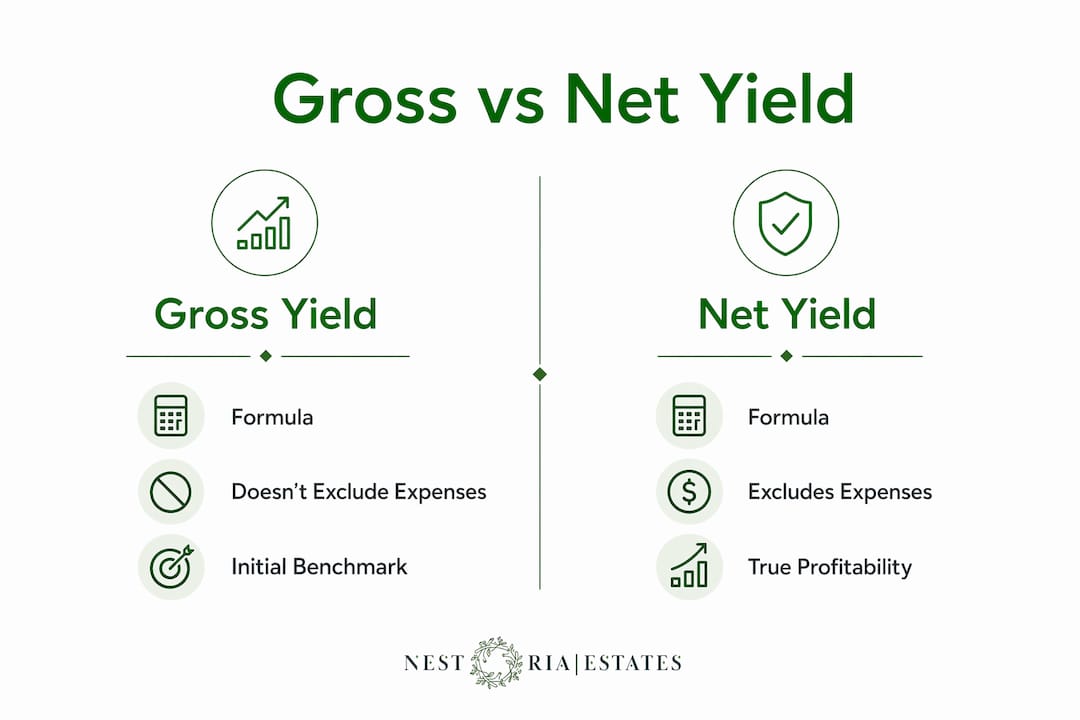
Pro Tip: The popular 50% rule assumes expenses eat half of gross rent. Actual expense ratios run 35%–45% in most U.S. markets, but short-term rentals with high turnover often push closer to 50%. Use 45% as your baseline when projecting Vancouver Airbnb yields.
What factors affect rental yield in short-term rental markets?
Location is the single largest driver of achievable rent and occupancy. A Vancouver property near Granville Island or the West End commands significantly higher nightly rates than one in a suburban neighborhood with limited transit access. Higher rates push gross yield up, but only if occupancy holds.
Location, property condition, and regulatory environment all substantially influence rental yield and income predictability. Turnkey-ready properties attract consistent bookings and justify premium pricing. A dated interior or deferred maintenance does the opposite. It lowers your average nightly rate and increases the maintenance budget that eats into net yield.
The factors affecting rental yield in Vancouver’s short-term rental market include:
Occupancy rate: A property sitting empty earns nothing. Seasonal demand in Vancouver peaks in summer and during major events. Vacancy risk is real and must be built into projections.
Management fees: Professional short-term rental management typically costs 8%–10% of gross rent. That fee reduces net yield but can increase gross income by improving pricing and occupancy.
Regulatory costs: Vancouver’s short-term rental licensing requirements add direct costs and restrict which properties qualify. Licensing laws and renter rights legislation affect cash flow stability and operating costs significantly.
Maintenance intensity: Short-term rentals face accelerated wear from frequent guest turnover. Higher maintenance reserves are not optional. Ignoring them produces a net yield figure that looks good on paper but fails in practice.
Property type and size: A two-bedroom unit in a walkable neighborhood will typically outperform a studio in a less desirable area, even at a lower nightly rate, because occupancy stays higher.
Understanding these factors is what separates a realistic yield projection from an optimistic one. Vancouver’s market is competitive and regulated. Owners who account for all costs from the start make better decisions.
How does rental yield compare to other investment metrics?
Rental yield measures return on the asset itself. It does not account for how the property was financed. That distinction matters enormously for investors who used a mortgage to buy.
Metric | Focus | Includes financing? | Best used for |
Gross rental yield | Top-line income potential | No | Quick property comparison |
Net rental yield | Income after expenses | No | Realistic profitability check |
Cash-on-cash return | Return on cash invested | Yes | Leveraged investment analysis |
Capital growth | Property value appreciation | No | Long-term wealth building |
Rental yield is a first-pass filter for income potential, not a comprehensive investment evaluation. Cash-on-cash return is the metric that reflects personal ROI on a financed property. It divides annual pre-tax cash flow by the actual cash invested (down payment plus closing costs). A property with a 5% net yield and a 20% down payment can produce a cash-on-cash return well above 5% if the mortgage rate is favorable.
Capital growth works differently. A Vancouver property might deliver a modest 4% net yield but appreciate 8% annually in value. Total return combines both. Experienced investors treat yield as one factor in a broader analysis that includes capital appreciation and risk profile.
The practical takeaway: use rental yield to filter properties quickly. Use net yield to stress-test profitability. Use cash-on-cash return to evaluate the deal given your actual financing. Use capital growth projections to assess long-term wealth potential. No single metric tells the whole story.
What are common mistakes Vancouver Airbnb owners make with rental yield?
The most common mistake is treating gross yield as a proxy for profitability. A property showing an 8% gross yield in Vancouver can easily deliver a 3% net yield after accounting for short-term rental management fees, cleaning between every guest, licensing costs, and a realistic vacancy allowance.
Overestimating nightly rates. Owners often project peak-season rates across the full year. Actual average daily rates reflect shoulder seasons and slow periods. Use annual averages, not summer peaks.
Underbudgeting maintenance. Short-term rental properties require higher maintenance reserves due to wear from frequent guest turnover. Budget at least 8%–10% of gross rent for maintenance, not the 5% that works for long-term rentals.
Ignoring vacancy. Even well-managed Vancouver Airbnb properties experience vacancy. A 10%–15% vacancy allowance is realistic for most markets.
Forgetting regulatory costs. Vancouver’s short-term rental licensing fees and compliance requirements are real line items. They belong in your expense calculation.
Skipping net yield entirely. A high gross yield does not guarantee profitability. Investors who skip the net yield calculation often discover the gap only after months of ownership.
Improving investment property yield requires monitoring real operating expenses monthly, not annually. Patterns emerge quickly. A property with rising cleaning costs or repeat maintenance calls signals a net yield problem before it becomes a cash flow crisis.
Professional property management can improve rental yield by reducing vacancy and controlling maintenance costs. Management fees of 8%–10% of gross rent are a real cost, but the operational efficiency they provide often more than compensates. For Vancouver Airbnb owners managing multiple properties or working full-time jobs, the math frequently favors professional management. Nestoriaestates provides detailed owner reporting so you can track net yield in real time, not just at tax season.
Pro Tip: Review your vacation rental yield mistakes annually. Costs shift, regulations change, and a yield calculation that was accurate in january may be outdated by july.
Key takeaways
Rental yield is a percentage that measures annual rental income relative to property value. Net yield, not gross yield, is the number that determines whether a Vancouver Airbnb property is genuinely profitable.
Point | Details |
Gross vs. net yield | Gross yield ignores expenses; net yield reflects what you actually earn after all costs. |
Expense range | Operating expenses consume 30%–50% of gross rent; short-term rentals sit at the higher end. |
Factors affecting yield | Location, occupancy, management fees, maintenance, and Vancouver regulations all shift net yield. |
Yield as a filter | Use rental yield to compare properties quickly, then stress-test with net yield and cash-on-cash return. |
Professional management | Management fees of 8%–10% reduce net yield but often improve gross income and reduce vacancy. |
Rental yield in Vancouver: what the numbers don’t tell you
I’ve worked with enough Vancouver property owners to know that the ones who get burned are almost never the ones who ignored yield entirely. They’re the ones who fell in love with a gross yield number and stopped there.
A property showing 9% gross yield in a high-demand Vancouver neighborhood sounds like a win. But once you factor in short-term rental licensing, a full-service management fee, cleaning between every two-night stay, and a realistic 12% vacancy rate, that number can compress to 4.5% net. That’s not a bad return. But it’s a very different decision than 9%.
What I’ve found is that the gap between gross and net yield is widest for short-term rentals. Long-term rentals have predictable expenses. Short-term rentals have variable ones. Guest turnover accelerates wear. Cleaning costs scale with booking frequency, not just property size. Regulatory changes in Vancouver can add costs overnight.
The investors I respect most treat rental yield as a starting filter, not a conclusion. They calculate net yield with conservative assumptions, then add a buffer. They also look at short-term rental ROI alongside yield, because a property that appreciates in value while delivering a 5% net yield often outperforms one with a 7% net yield in a flat market.
Vancouver’s short-term rental market rewards owners who understand their numbers deeply. The ones who succeed long-term are not chasing the highest gross yield. They’re managing the gap between gross and net with discipline and good data.
— Kamran
How Nestoriaestates helps Vancouver owners maximize rental yield
Vancouver Airbnb owners who want accurate yield data and hands-off management have a direct path forward with Nestoriaestates.

Nestoriaestates handles pricing optimization, guest communication, cleaning coordination, and maintenance for short-term rental properties across Vancouver. Every owner receives detailed reporting that shows actual income and expenses, so net yield is always visible, not estimated. The team uses real-time market data to adjust nightly rates, which directly improves gross income and occupancy. For owners who want to know exactly what their property earns and why, Nestoriaestates provides free revenue projections before any commitment. Explore the full range of property management services or reach out directly to discuss your property’s yield potential.
FAQ
What is rental yield in simple terms?
Rental yield is the annual rent a property earns expressed as a percentage of its value. A property worth $500,000 earning $25,000 per year has a 5% gross rental yield.
What is a good rental yield for a Vancouver Airbnb?
A gross yield above 6% is generally considered strong, but net yield after expenses is the more meaningful number. Vancouver short-term rentals with net yields of 4%–6% after all costs are performing well given the city’s property values.
How do I calculate net rental yield?
Subtract all annual operating expenses from annual rental income, divide by the property value, and multiply by 100. Operating expenses typically include taxes, insurance, management fees, maintenance, and vacancy allowances.
Why is net yield lower than gross yield for short-term rentals?
Short-term rentals carry higher operating costs than long-term rentals due to frequent guest turnover, cleaning between stays, and higher maintenance intensity. These costs reduce net yield significantly compared to the gross figure.
Should rental yield be the only metric I use to evaluate a property?
No. Rental yield is a first-pass filter, not a complete analysis. Combine it with cash-on-cash return, capital growth projections, and a realistic expense budget to make a fully informed investment decision.
Recommended
Comments