

How Vacation Rental Platforms Work: A Vancouver Host's Guide

TL;DR:
Vacation rental platforms in Vancouver handle listings, bookings, payments, and data sync, but require strict municipal licensing compliance. They earn mainly through host commissions, guest fees, and paid placements, with fees varying by platform and service model. Proper setup—including licensing, dynamic pricing, and real-time distribution—maximizes occupancy and income while avoiding costly operational and legal issues.
Vacation rental platforms are online marketplaces that list properties, handle search and booking flows, collect payments, and push reservation data to hosts and property-management systems. For a Vancouver property owner, that single sentence hides a lot of operational complexity. Here is what actually happens behind the scenes:
Listings and content: Your photos, description, pricing, and availability live on the platform’s servers and get indexed by its search algorithm.
Search and ranking signals: Platforms rank listings by response rate, review score, instant-book status, price competitiveness, and listing completeness.
Booking and payment flow: Guests pay the platform, not you. The platform holds funds, deducts fees, and releases the remainder to your payout account.
Host payout: Funds typically arrive 24 hours after check-in (Airbnb) or at intervals set by the platform, minus host-side commissions.
Distribution and sync: Reservation data flows outward to channel managers or property management systems (PMS) to block your calendar across other platforms.
One more thing before you go further: Vancouver has one of the strictest short-term rental (STR) regulatory environments in Canada. A valid municipal license and principal-residence compliance are prerequisites for listing, not afterthoughts. Every step in this guide factors that in.
Table of Contents
Which platforms should you list on, and who books through them?
Managing multiple platforms: channel managers, PMS tools, and why iCal falls short
Pricing, fees, and what Vancouver hosts can realistically earn
Canadian legal and compliance essentials for short-term rental hosts
Action checklist: how to list your property across multiple platforms
Nestoriaestates handles the operational load for Vancouver hosts
How vacation rental platforms work as businesses
Online travel agencies (OTAs) like Airbnb, Booking.com, and Vrbo are not just listing sites. They are two-sided marketplaces that earn money by connecting guests and hosts, then taking a cut of every transaction.
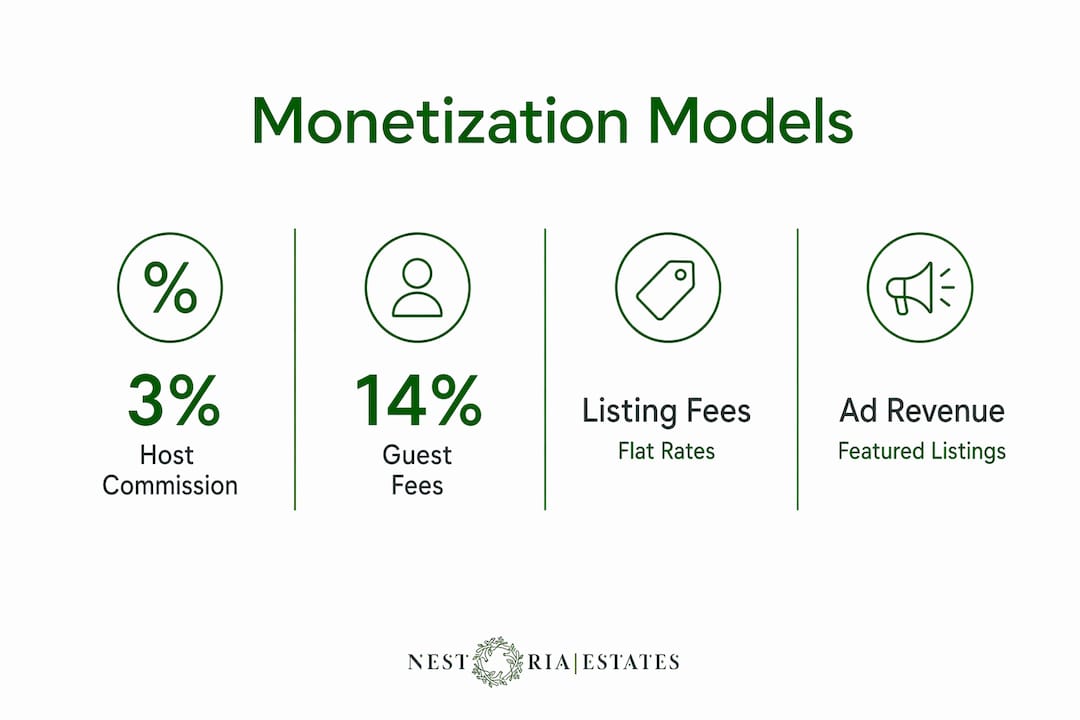
The three main monetization models
Commission per booking is the dominant model. The platform charges the host a percentage of the nightly rate, charges the guest a separate service fee, or splits the fee between both parties. Airbnb’s split-fee model charges hosts a host fee and guests a service fee on most bookings. Booking.com charges hosts a commission without a separate guest fee.

Subscription or listing fees are less common in the vacation rental space but do appear. Some platforms charge a flat annual fee to list, then take a lower per-booking commission. Vrbo historically offered a subscription option alongside its per-booking model, though availability of that option has changed over time.
Featured placement and advertising let hosts pay to appear higher in search results. This is a secondary revenue stream for most major OTAs, but it matters for hosts in competitive markets like Vancouver where organic ranking alone may not be enough during shoulder seasons.
Platform incentives are designed to push host behavior in directions that serve the platform’s conversion rate. Enabling instant-book, maintaining a fast response time, and offering flexible cancellation policies all improve your ranking. The catch is that those same policies can expose you to last-minute cancellations or guests who bypass your screening.
Monetization model | How the platform earns | Typical host cost (Canada) |
Split commission (Airbnb) | Host fee + guest service fee | ~3% host / 14%–16% guest |
Host-only commission (Booking.com) | Single host-side commission | 15%–17% |
Per-booking commission (Vrbo) | Host-side booking fee | ~8% per booking |
Subscription + commission | Annual listing fee + lower per-booking rate | Varies by plan |
Featured placement | Host pays for promoted position | Variable / auction-based |
Which platforms should you list on, and who books through them?
Not every platform attracts the same guest, and Vancouver’s mix of international tourism, business travel, and domestic leisure demand means platform choice directly affects your occupancy and average daily rate.
Platform profiles for Vancouver hosts
Airbnb remains the largest STR marketplace globally and the default starting point for most Vancouver hosts. It attracts a wide demographic: solo travelers, couples, families, and international visitors. Whole-home listings perform well, but Airbnb also supports private rooms and shared spaces. The platform’s review system and Superhost program create strong trust signals. Payout arrives roughly 24 hours after guest check-in.
Booking.com skews toward international travelers and hotel-comparison shoppers. Its guest base is more transactional and less community-oriented than Airbnb’s. For Vancouver hosts with well-appointed properties near downtown or the airport, Booking.com adds meaningful international demand, particularly from European and Asian markets. The platform charges a 15%–17% host commission with no guest-side fee, which can make your listed price look more competitive to guests.
Vrbo targets families and groups booking whole-home rentals, often for longer stays. It has less penetration in urban markets like Vancouver compared to resort or cottage destinations, but it is worth listing on if your property sleeps six or more. Vrbo charges a per-booking host fee.
Expedia Group (which owns Vrbo) also powers listings across Hotels.com and Expedia.com. Connecting through Vrbo often gives you partial exposure to those channels, depending on your property type.
AirHost and Lighthouse are not booking platforms in the OTA sense. AirHost is a property management software and channel manager used by hosts and managers to automate operations. Lighthouse is a revenue management and market intelligence tool that tracks competitor pricing, occupancy trends, and demand signals. Both are operational tools, not guest-facing marketplaces.
Platform | Guest type | Host fee model | Booking model | Geographic reach | API/channel manager support | Payout timing |
Airbnb | Broad: solo, couples, families, international | ~3% host + guest fee | Instant or request | Global | Yes, full API | ~24 hrs after check-in |
Booking.com | International, transactional, hotel-comparison shoppers | 15%–17% host-only | Instant (default) | Global, strong Europe/Asia | Yes, full API | Monthly or per-booking |
Vrbo | Families, groups, longer stays | ~8% per booking | Instant or request | Strong North America | Yes, full API | 1–5 days after booking confirmed |
Expedia/Hotels.com | Business and leisure, hotel-comparison | Varies | Instant | Global | Via Vrbo connection | Varies |
Airbnb’s instant-book toggle is almost mandatory in Vancouver’s competitive market. Listings without it rank lower and convert at a lower rate.
Booking.com’s payment model (platform collects from guest, remits to host) differs from its “pay at property” model for some property types. Confirm which applies to your listing.
Vrbo’s longer average booking window means you need a longer pricing horizon. Setting rates only 30 days out leaves money on the table.
How a listing becomes a booking: the step-by-step workflow
The path from “empty property” to “paid booking” has more steps than most first-time hosts expect. Missing one field can suppress your listing in search or delay your first payout.
The listing creation sequence
Create your account and property profile. Enter address, property type, number of bedrooms and bathrooms, and maximum occupancy.
Upload photos. Platforms prioritize listings with at least 20 high-quality images. Cover every room, outdoor space, and key amenity.
Write your title and description. Lead with what makes the property distinctive for Vancouver guests (mountain views, proximity to SkyTrain, parking).
Set house rules and a house manual. Specify check-in/check-out times, pet policy, smoking rules, and quiet hours. Vancouver’s noise bylaws make quiet-hours disclosure particularly important.
Configure your calendar and minimum-night requirements. Set minimum stays (typically 2–3 nights for urban Vancouver properties), advance notice requirements, and preparation time between bookings.
Set your nightly rate, cleaning fee, and additional guest fees. Connect a dynamic pricing tool if available.
Enter your municipal license number. Vancouver requires hosts to display their STR license number on the listing. Platforms will ask for it; some will hide or delist listings that omit it.
Add tax information. Enter your GST/HST registration number if applicable, and confirm how the platform handles Municipal Accommodation Tax (MAT) collection.
Publish and verify. Some platforms require identity verification (government ID, selfie) before your listing goes live.
Accept your first booking. Instant-book listings confirm automatically; request-to-book listings require you to approve within 24 hours or the request expires.
Manage guest communication and check-in. Send pre-arrival instructions, confirm check-in method (lockbox, smart lock, in-person), and respond to questions promptly.
Payout and reconciliation. After check-in, the platform releases funds minus its commission. Reconcile each payout against the reservation in your records.
Documents and fields to have ready before you list:
Vancouver STR license number (mandatory for all platforms)
Government-issued ID for host identity verification
GST/HST registration number (required once you exceed the $30,000 annual revenue threshold)
Proof of principal-residence status (may be requested by the City or by platforms)
STR-specific insurance certificate
Condo board permission letter (if applicable)
Managing multiple platforms: channel managers, PMS tools, and why iCal falls short
Once you list on more than one platform, calendar management becomes your biggest operational risk. A double-booking in Vancouver, where cleaning teams and guests are often traveling from a distance, is expensive and reputation-damaging.

Channel manager vs. PMS vs. CRM
A channel manager handles distribution: it pushes your inventory, rates, and availability to connected OTAs and pulls reservations back in real time. A vacation rental channel manager syncs calendar, rates, reservation details, and listing content across platforms from a single dashboard.
A PMS (property management system) runs the full booking lifecycle: reservations, guest communication, housekeeping schedules, owner statements, and financial reporting. Many PMS tools include a built-in channel manager, which simplifies the stack.
A CRM (customer relationship management tool) handles guest marketing, repeat-booking campaigns, and lifecycle communication. Most small-scale Vancouver hosts do not need a standalone CRM until they are managing direct bookings at volume.
Why iCal is not enough
iCal synchronization updates every 15–30 minutes and does not support rate sync or reliable two-way reservation detail transfer. That 15–30 minute window is long enough for a guest on one platform to book a night that is simultaneously being booked by a guest on another. iCal also cannot push rate changes, so you end up manually updating prices on each platform separately.
A real-time API-backed channel manager eliminates most double-booking risk and enables rate and availability sync across Airbnb, Vrbo, Booking.com, and direct booking engines simultaneously.
Feature | iCal sync | API channel manager | PMS with built-in channel manager |
Calendar sync speed | 15–30 min delay | Real-time | Real-time |
Rate sync | No | Yes | Yes |
Reservation detail transfer | Partial | Full two-way | Full two-way |
Unified inbox | No | Sometimes | Yes |
Direct booking integration | No | Sometimes | Yes |
Dynamic pricing integration | No | Yes (via tools like PriceLabs) | Yes |
Pro Tip: If you manage one or two properties and already use Airbnb as your primary channel, a standalone channel manager (Hostex, Lodgify, or Guesty) is usually sufficient. Once you hit three or more properties, or you want owner statements and housekeeping automation in the same system, move to a full PMS with a native channel manager. Mixing a standalone channel manager with a separate PMS introduces integration complexity that creates its own failure points.
Pricing, fees, and what Vancouver hosts can realistically earn
The gap between gross rental income and what actually lands in your bank account surprises most first-time hosts. Here is the full cost picture.
Platform fees
Airbnb host fee: approximately 3% of the booking subtotal
Booking.com commission: 15%–17% of the nightly rate
Vrbo per-booking fee: approximately 8%
Manager commissions
Full-service property management companies in Canada commonly charge 20%–40% of gross rental income. That range reflects the scope of services: at the lower end, you typically get listing management and guest communication. At the upper end, you get pricing optimization, cleaning coordination, maintenance dispatch, compliance monitoring, and detailed owner reporting.
Dynamic pricing and occupancy targets
Channel managers and PMS tools typically integrate with dynamic pricing tools like PriceLabs so rates can react to local events, competitor pricing, and seasonal demand. For Vancouver hosts, this matters most during peak summer months, major events at Rogers Arena or BC Place, and ski season for properties near transit to Whistler. Many hosts target 60%–80% occupancy as a baseline, though the right target depends on your average daily rate and cost structure.
Budget line items every Vancouver host should track:
Platform commissions vary depending on the channel.
Manager commission if applicable (20%–40% of gross)
Cleaning fees and laundry costs per turn
Utilities (electricity, internet, water)
Consumables (toiletries, coffee, paper goods)
STR-specific insurance premiums (standard homeowner policies often exclude STR liability)
Municipal STR license renewal fees
GST/HST remittances
Municipal Accommodation Tax remittances
Maintenance and emergency repair reserve
For data-driven pricing that accounts for Vancouver’s seasonal demand swings, a dedicated revenue management tool pays for itself quickly in most urban markets.
Canadian legal and compliance essentials for short-term rental hosts
This is where Vancouver hosts face their highest operational risk. Getting the compliance piece wrong does not just cost you a fine. It gets your listing removed.
Vancouver’s principal-residence rule
Vancouver’s short-term rental rules require that STR hosts operate only from their principal residence. You cannot list an investment property you do not live in as a short-term rental in Vancouver. The City also requires a valid STR license, which must be displayed on every OTA listing. Platforms are increasingly enforcing this: listings without a valid license number are hidden or removed.
Municipalities across Canada vary significantly. Ontario municipalities, for example, require principal-residence compliance and HST/MAT collection, with noncompliance triggering substantial fines and listing removal. Vancouver’s rules are among the strictest, but the direction of travel across Canadian cities is toward tighter enforcement, not looser.
Tax obligations
GST/HST: Once your STR revenue exceeds $30,000 in a 12-month period, you must register for GST/HST, collect it from guests, and remit it to the CRA.
Municipal Accommodation Tax (MAT): Vancouver levies a MAT on short-term accommodations. Some platforms collect and remit this on your behalf; confirm your platform’s current policy in writing.
Income tax: STR income is taxable. Keep records of all revenue and deductible expenses.
Condo and insurance considerations
If your property is in a strata (condo) building, your strata corporation’s bylaws may prohibit or restrict STR activity. Check the strata declaration before listing. Standard homeowner insurance policies typically exclude STR liability, so STR-specific coverage is not optional.
Compliance checklist before your first booking:
Valid Vancouver STR license obtained and displayed on listing
Principal-residence status confirmed
GST/HST registration completed if revenue threshold is met or expected
MAT collection confirmed with platform or set up manually
STR-specific insurance policy in place
Strata permission letter obtained (if applicable)
License number entered in OTA dashboard fields
Local managers note that license verification and principal-residence checks are a primary daily operational task. Platforms can and do delist listings when municipal authorities flag noncompliance.
Legal note: This article is general information, not legal or tax advice. Confirm your specific obligations with the City of Vancouver, the CRA, and a qualified professional before listing.
Common challenges hosts face and how to handle them
Even a well-set-up listing runs into friction. Knowing where the problems cluster helps you prepare.
The most common operational pain points:
Double-bookings: Almost always caused by iCal sync delays or manual calendar management. An API channel manager eliminates this.
Cancellations: Guest cancellations hurt your occupancy rate and can trigger platform penalties. A moderate cancellation policy with a clear minimum-stay requirement reduces last-minute cancellations.
Guest disputes: Platforms have resolution centers, but outcomes are inconsistent. Document property condition with timestamped photos before and after every stay.
Cleaning turnaround: In Vancouver, where same-day turnarounds are common in peak season, cleaning coordination is the most time-sensitive operational task. A missed clean means a bad review.
Review management: Respond to every review, including negative ones. Platforms weight recent review scores heavily in ranking.
Seasonal demand swings: Vancouver’s summer peak and ski-adjacent winter demand create wide occupancy variance. Dynamic pricing smooths revenue across the year.
Platform features like unified inboxes, message templates, damage deposits, and resolution centers help, but they do not replace good operational systems. A guest who cannot reach you within an hour during check-in will leave a three-star review regardless of how nice the property is.
Pro Tip: Three fixes with outsized impact: (1) Set up automated pre-arrival and check-out message templates so guests always get timely information even when you are unavailable. (2) Write house rules that are specific, not generic. “No parties” is unenforceable; “Maximum 4 guests at all times; no events or gatherings” is not. (3) Invest in professional photography once. Listings with professional photos consistently outperform those with phone photos, and you only need to do it once per property.
Should you self-manage or hire a property manager?
This is the question most Vancouver hosts eventually face. The honest answer depends on your time, your tolerance for operational complexity, and your comfort with local compliance.
Self-assessment checklist
Can you commit 10–20 hours per week to guest communication, cleaning coordination, and maintenance dispatch?
Are you comfortable monitoring and updating rates across multiple platforms daily?
Do you understand Vancouver’s STR licensing requirements and can you stay current as rules change?
Can you respond to a guest emergency at 2 AM on a Saturday?
Do you have reliable cleaners and maintenance contacts who can turn the property on short notice?
If you answered “no” to two or more of those, professional management is worth the commission.
Questions to ask a property manager before signing
What is your commission structure, and what exactly does it include?
How do you handle compliance monitoring and license renewals?
What insurance and liability coverage do you carry?
How long does onboarding take, and what documents do you need from me?
How do you report revenue and expenses to owners?
Do you support direct bookings, and how do you handle those commissions?
Can you provide local references from Vancouver hosts?
Red flags to watch for
No clear compliance process or vague answers about licensing
No transparent fee breakdown (hidden fees for maintenance calls, owner statements, or onboarding)
No local references or verifiable track record in Vancouver
One-size-fits-all contracts with no flexibility for your property type
No owner portal or regular reporting
The role of a property manager goes well beyond listing setup. Operators who move from DIY to professional management typically do so when multi-channel distribution and compliance become a full-time job, usually at the point of managing multiple units or when a regulatory change requires high-touch attention.
Decision flow for Vancouver hosts
One property, principal residence, comfortable with tech and guest communication: Self-manage with a channel manager and dynamic pricing tool.
One property, time-constrained, or compliance-uncertain: Consider full-service management.
Multiple properties or investment-focused: Full-service management almost always recovers its commission cost through better occupancy and fewer compliance errors.
Action checklist: how to list your property across multiple platforms
Follow this sequence to avoid double-bookings and compliance gaps from day one.
Pre-listing tasks
Confirm your property qualifies under Vancouver’s principal-residence STR rules.
Apply for and receive your Vancouver STR license.
Obtain STR-specific insurance and confirm coverage with your insurer in writing.
Get a strata permission letter if your property is in a condo building.
Hire a professional photographer and prepare an amenities list.
Register for GST/HST if your projected revenue exceeds $30,000 annually.
Listing and channel setup sequence
Create your primary listing on Airbnb first (largest demand pool; use it as your content master).
Select and set up your channel manager or PMS before publishing on additional platforms.
Connect Booking.com and Vrbo through the channel manager’s API integration.
Import your Airbnb calendar into the channel manager and verify two-way sync is active.
Enter your Vancouver STR license number in each platform’s host dashboard.
Confirm MAT and GST/HST collection settings on each platform.
Post-launch tasks (first 72 hours)
Monitor all three platforms for booking requests and calendar accuracy.
Enable instant-book on Airbnb once you are confident in your calendar sync.
Verify payout settings and confirm your bank account is linked correctly on each platform.
Set up automated messaging templates for booking confirmation, pre-arrival, and check-out.
Connect a dynamic pricing tool and set your minimum rate floor and occupancy targets.
Review your listing on each platform as a guest would see it; fix any missing fields.
Key Takeaways
Vancouver hosts who get compliance right first, then build a real-time multi-channel distribution stack, consistently outperform those who list first and figure out the rules later.
Point | Details |
Compliance before listing | Secure your Vancouver STR license and confirm principal-residence eligibility before publishing on any platform. |
Use API sync, not iCal | iCal updates every 15–30 minutes and cannot sync rates; an API channel manager eliminates double-booking risk. |
Budget the full cost stack | Platform fees (3%–17%), manager commissions (20%–40% if applicable), insurance, taxes, and cleaning all reduce gross income. |
Dynamic pricing lifts revenue | Integrating a tool like PriceLabs with your channel manager lets rates respond to Vancouver events and competitor moves automatically. |
Nestoriaestates for hands-off owners | Nestoriaestates offers full-service Vancouver Airbnb management covering compliance, pricing, guest communication, and reporting. |
What managing Vancouver Airbnb listings actually looks like
The part of this job that surprises most owners is how much of it is compliance, not hospitality. On any given day managing Vancouver listings, the priority is not finding guests. Airbnb handles that. The priority is making sure every active listing has a current license number displayed, that the principal-residence documentation is in order, and that any bylaw update from the City has been reviewed and acted on. That is the unglamorous daily work.
The guest experience side matters enormously too, but it runs on systems: automated messages go out at the right time, cleaners are dispatched and confirmed, and pricing adjusts based on what the market is doing that week. When a guest has a problem at 11 PM, someone answers. That response speed is what drives the review scores that keep listings ranked. The hosts who struggle are usually the ones who built a great listing but underestimated how much operational bandwidth the compliance and communication layers actually require. Vancouver’s regulatory environment makes that bandwidth requirement higher than almost any other Canadian city.
Nestoriaestates handles the operational load for Vancouver hosts
Managing a Vancouver Airbnb well means staying current on municipal licensing rules, running rates that respond to the market daily, coordinating cleaners between same-day turnarounds, and being available to guests around the clock. That is a full-time job for most owners with a single property.

Nestoriaestates is built specifically for Vancouver property owners who want the income without the operational overhead. The full-service management offering covers onboarding and listing setup, dynamic pricing calibrated to Vancouver’s demand patterns, guest communication from inquiry to checkout, cleaning and maintenance coordination, compliance monitoring (including license renewals and bylaw changes), and detailed owner reporting through a dedicated portal. Onboarding typically requires your STR license, insurance certificate, property access details, and a signed management agreement. From there, Nestoriaestates handles the rest.
For owners weighing whether professional management is worth the commission, the starting point is a free revenue projection. Get yours at nestoriaestates.com/services.
Useful sources and official links for Vancouver hosts
Regulatory and compliance:
City of Vancouver — Short-Term Rentals: Official licensing requirements, application portal, and principal-residence rules.
Vancouver Short-Term Rental Regulations: 2026 Impact: Plain-language breakdown of how current rules affect Vancouver hosts.
Short-Term Rental Rules in Ontario: Useful comparative context for hosts with properties in multiple provinces.
Channel manager and PMS resources:
Channel Manager Guide for Canadian Hosts (Vezpa): Explains API vs. iCal sync and how to connect Airbnb, Vrbo, and Booking.com.
What Is a Vacation Rental Channel Manager? (Hostex): Functional overview of channel manager capabilities and PMS integration.
Nestoriaestates resources:
Resource | What it covers |
Services — Nestoriaestates | Full-service management offerings, onboarding steps, and revenue projections |
Vancouver-specific compliance and operational setup guidance | |
Dynamic Pricing in Rentals: A Vancouver Host’s Guide | How data-driven pricing tools work and when to use them |
FAQ
How do vacation rental platforms make money from hosts?
Platforms earn through host-side commissions, guest service fees, or both. Airbnb charges hosts roughly 3% and guests 14%–16%; Booking.com charges hosts a commission without a separate guest fee.
How does the Vrbo algorithm work?
Vrbo ranks listings based on factors including booking acceptance rate, response time, review scores, listing completeness, and whether instant-book is enabled. Properties with consistent bookings and strong reviews rank higher in search results.
What is the difference between a channel manager and a PMS?
A channel manager distributes your inventory and rates across OTAs and pulls reservations in real time. A PMS manages the full booking lifecycle including housekeeping, owner statements, and guest communication. Many PMS tools include a built-in channel manager.
Do I need a license to list on Airbnb in Vancouver?
Yes. Vancouver requires all STR hosts to hold a valid municipal STR license and to display the license number on their listing. Listings without a valid license number can be hidden or removed by the platform.
What commission do property managers charge in Canada?
Full-service property management companies in Canada commonly charge 20%–40% of gross rental income, depending on the scope of services included.
Recommended
Comments