
City Tours and Rentals: What Vancouver Owners Need to Know
- info67421305
- 3 hours ago
- 8 min read

City tours are a marketing and experience multiplier for Vancouver short-term rentals, not a primary revenue driver. The highest-impact moves for property owners are proximity signals in listing copy, curated BIA event referrals, and virtual property tours — not running guided walks themselves.
Three things actually move the needle:
Proximity to tourist hotspots (Stanley Park, the PNE, Granville Island) signals desirability and commands a revenue premium, according to Airbtics’ Vancouver data
BIA-led city programming (Jane’s Walks, Doors Open) gives guests authentic local experiences your manager can promote at zero operational cost
Event-driven yield optimization is where the real money is: during FIFA 2026, Vancouver STRs saw a 33% year-over-year revenue increase, with most gains coming from rate increases, not occupancy
Table of Contents
What professional managers should actually do about city tours
Why virtual tours matter more than physical ones for most listings
Vancouver’s regulatory constraints change what’s actually possible
Checklist: questions to ask your manager about city-tour strategy
What owners consistently underestimate about city-tour strategy
Nestoriaestates puts these strategies to work for Vancouver owners
How city tours affect bookings, ADR, and guest satisfaction
The role of city tours in rentals splits cleanly into two tracks: direct and indirect. Direct means you or your manager actually host or package tours. Indirect means your listing, messaging, and pricing reflect the city’s attractions without you lifting a finger.
The indirect track is where Vancouver owners win. Mentioning Stanley Park proximity in listing copy, linking to BIA event calendars in your welcome book, and pricing aggressively around major events all lift revenue without adding operational complexity. Proximity to attractions is one of the strongest predictors of Airbnb revenue in Vancouver.
The FIFA 2026 data makes the yield story concrete. Supply growth before the tournament actually pushed occupancy down in some periods, yet revenue still climbed sharply because ADR rose faster than occupancy fell. That’s the pattern owners should internalize: during major events, pricing power matters more than filling every night.
Metrics worth tracking to connect tour-adjacent activity to performance:
ADR (average daily rate) around event windows vs. baseline
RevPAR (revenue per available room) to capture both rate and occupancy together
Review sentiment — guests who mention neighborhood walkability or nearby attractions in reviews tend to correlate with higher repeat-booking intent
Occupancy rate as a secondary check, since event periods can show rate gains alongside occupancy dips
What professional managers should actually do about city tours
The right manager model here is curator, not tour operator. Research from the Ted Rogers School of Hospitality and Tourism Management identifies Business Improvement Areas as the primary engines of city-tour programming in Canadian markets. Managers should plug into that infrastructure, not replicate it.
Practically, that means:
Maintaining a current list of BIA contacts and vetted local tour operators guests can book independently
Building templated welcome-book entries that highlight Jane’s Walks, Doors Open Vancouver, and seasonal neighborhood events
Embedding event calendar links in pre-arrival messaging so guests arrive with a plan
Using post-stay review prompts that reference neighborhood experiences to encourage specific, location-rich feedback
Managers who promote BIA programming in digital welcome books add perceived value with minimal effort — these are reusable, require no host infrastructure, and attract guests seeking authentic local experiences.
Pro Tip: Ask your manager to show you the welcome book template before you sign. If it’s a generic PDF with no Vancouver-specific event links or BIA references, that’s a gap worth flagging.
Red flags to watch for: any manager who promises to run large in-person tours, charges guests for excursions without clear insurance documentation, or uses unlicensed guides. Those activities create liability exposure that your STR licence does not cover.

Why virtual tours matter more than physical ones for most listings
For the majority of Vancouver STR owners, virtual property tours are now core listing infrastructure, not a nice extra. Out-of-town guests and international travelers booking premium units cannot physically inspect a property before committing. A 360° walkthrough closes that gap.
How to implement one:
Scope the shoot. Decide which rooms to feature (living area, primary bedroom, kitchen, any standout views). Skip storage rooms and utility spaces.
Choose production. A professional vendor using Matterport or a comparable platform runs CAD $200–$500 for a standard unit. In-house smartphone 360° apps cost less but show it.
Host and embed. Most platforms generate a shareable link. Embed it in your Airbnb listing description and link it from your direct-booking page if you have one.
Refresh annually. After a renovation or significant furniture update, reshoot. Outdated tours erode trust faster than no tour at all.
Virtual tours reduce cancellation risk by setting accurate expectations for space and layout. Guests who book after watching a walkthrough arrive knowing exactly what they’re getting, which means fewer disappointed check-ins and stronger reviews. Booking confidence for out-of-town travelers is one of the clearest conversion drivers in the short-term rental market today.
Vancouver’s regulatory constraints change what’s actually possible
Vancouver’s principal-residence requirement is the single biggest constraint on what city-tour-adjacent activities a host can offer. You can only legally operate a short-term rental in your primary residence, which rules out running a portfolio of “experience properties” or converting secondary suites into commercial tour venues.
Key constraints owners need to understand:
A city business licence is required for all STR operators
Hosting is restricted to the principal residence, limiting the ability to scale listing count
Offering paid experiences (guided tours, cooking classes, hosted events) from an STR unit raises separate licensing and insurance questions
This regulatory reality shifts the practical levers toward marketing and yield rather than volume. You can’t grow revenue by adding listings the way an unregulated market allows, so event-driven pricing and listing quality become the primary tools.
Vancouver’s STR market had roughly 8,615 active listings as of mid-2026, with an average annual revenue of approximately $20,400, 65% occupancy, and an ADR around $222, per AirDNA’s Vancouver overview. In that competitive field, a well-optimized listing with strong proximity signals and a virtual tour stands out.
Checklist: questions to ask your manager about city-tour strategy
Before signing with a manager or during a quarterly review, run through these:
Do you promote BIA events and local programming in the welcome book?
Can you show me the current virtual tour or listing media for comparable properties you manage?
How do you adjust pricing for major events like FIFA 2026 or Taylor Swift-scale concerts?
Do you have vetted local tour partners guests can book independently?
How do you handle insurance and liability if a guest asks about paid experiences?
Red flags:
Promises to run in-person tours without permits or insurance documentation
No dynamic pricing capability for event windows
Generic welcome books with no Vancouver-specific content
Low-cost investments that typically pay off: a professional virtual tour (CAD $200–$500), a curated BIA event calendar in the welcome book, and a manager with live event-pricing capability.
Vancouver examples and data that show what actually works
The FIFA 2026 case is the clearest local proof point. Vancouver STRs posted a 33% revenue increase year-over-year during the tournament, driven by ADR growth while occupancy dipped in some periods due to supply growth. Owners who had dynamic pricing in place captured that rate premium; those on flat pricing left money on the table.
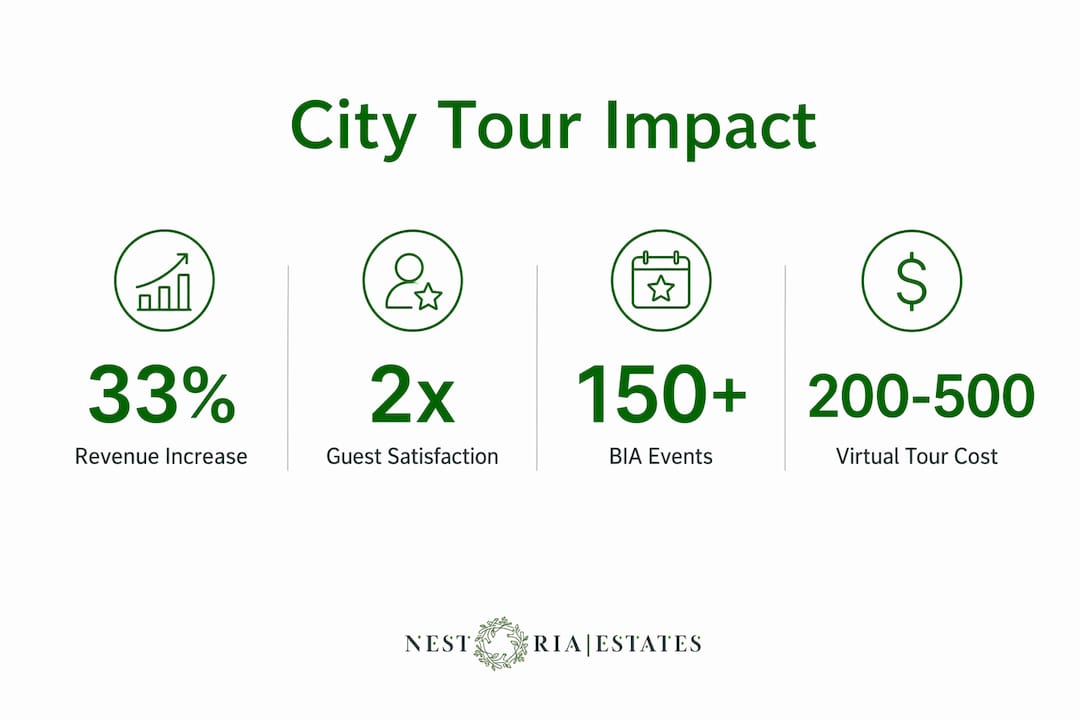
Metric | Vancouver STR Market (mid-2026) |
Active listings | ~8,615 |
Average annual revenue | ~$20,400 |
Average occupancy rate | 65% |
Average daily rate (ADR) | ~$222 |
FIFA 2026 revenue increase (YoY) | 33% |
Two owner scenarios that illustrate the pattern:
A Stanley Park-adjacent unit that leads its listing with “5-minute walk to Stanley Park seawall” and links to the Vancouver Park Board’s seasonal event calendar consistently outperforms comparable units that omit location context.
A unit in a BIA-active neighborhood (Commercial Drive, Main Street) that includes a monthly events digest in its welcome book generates more five-star reviews mentioning “neighborhood vibe” — a signal that correlates with higher repeat and referral bookings.
Key Takeaways
Proximity signals, BIA event curation, and event-driven yield optimization are the three levers that most reliably lift Vancouver STR revenue without adding operational or compliance risk.
Point | Details |
Proximity signals drive revenue | Mention specific hotspots (Stanley Park, PNE) in listing copy to capture the location premium. |
BIA curation beats hosting tours | Promote Jane’s Walks and Doors Open in your welcome book — zero infrastructure, real guest value. |
Event pricing is the biggest lever | Vancouver STRs gained 33% revenue YoY during FIFA 2026, mostly from ADR increases. |
Virtual tours reduce cancellation risk | A 360° walkthrough sets accurate expectations and supports premium ADR positioning. |
Nestoriaestates handles all of this | Nestoriaestates manages dynamic pricing, virtual tour coordination, BIA outreach, and Vancouver compliance for owners. |
What owners consistently underestimate about city-tour strategy
Most Vancouver owners I talk to are thinking about city tours the wrong way. They imagine hosting walks or partnering with a tour company, when the actual opportunity is much simpler and more scalable: make your listing feel like a gateway to the city without you doing any of the work.
The BIA infrastructure in Vancouver is genuinely underused by STR operators. These organizations run professionally produced programming, maintain event calendars, and actively want accommodation partners to promote their events. A manager who taps into that network adds real perceived value to a guest’s stay at essentially no cost. That’s a better return than any hosted experience.
The FIFA 2026 data also tells a story that owners should sit with: occupancy went down in some periods while revenue went up. That’s a counterintuitive result, and it means the instinct to fill every night at any price is exactly wrong during peak events. Pricing discipline, not occupancy chasing, is what separates high-performing Vancouver STRs from average ones.
Nestoriaestates puts these strategies to work for Vancouver owners
Vancouver owners who want proximity-led listing copy, virtual tour coordination, BIA event integration, and FIFA 2026-caliber yield optimization in one place have a clear option: Nestoriaestates handles all of it under a single management agreement, with no guesswork on Vancouver’s principal-residence rules or licensing requirements.
Nestoriaestates’s full management services cover dynamic pricing calibrated to Vancouver’s event calendar, listing media coordination (including virtual tours), welcome-book curation with BIA programming, and transparent owner reporting. The team also handles compliance with Vancouver’s STR licensing requirements, so owners stay on the right side of the principal-residence rules without tracking regulatory updates themselves.
To see what your property could realistically earn, request a free revenue projection directly through the Nestoriaestates website. It takes a few minutes and gives you a data-backed baseline before you commit to anything.
Useful sources
AirDNA — Vancouver STR overview: Active listings, ADR, occupancy, and revenue benchmarks for the Vancouver market.
Daily Hive — FIFA 2026 STR revenue analysis: Event-driven yield data showing the 33% revenue increase and ADR vs. occupancy dynamics.
Airbtics — Vancouver Airbnb data: Proximity-to-attractions revenue breakdowns and local market performance metrics.
Ted Rogers School of Hospitality and Tourism Management — BIAs report: Academic research on BIAs as the primary drivers of city-tour programming in Canadian markets.
RENX — Property marketing and virtual tours: Industry commentary on digital discovery tools and virtual tour adoption.
Nestoriaestates — Vancouver STR regulations guide: Plain-language breakdown of Vancouver’s principal-residence requirement and licensing obligations.
Nestoriaestates — Vancouver Airbnb management services: Service overview including pricing optimization, listing media, and owner reporting.
For owner reports, revenue projections, or a consultation on your specific property, contact Nestoriaestates directly through the services page.
FAQ
How do city tours affect Airbnb rental revenue in Vancouver?
City tours primarily affect revenue indirectly, through proximity signals in listing copy, curated BIA event referrals, and guest review sentiment. Direct tour hosting is rarely the revenue driver; event-driven pricing and location messaging are.
What is the principal-residence rule and how does it limit tour activities?
Vancouver requires STR operators to host only in their primary residence and hold a city business licence. This restricts using a property as a commercial venue for paid tours or large hosted experiences.
Are virtual tours worth the cost for a Vancouver STR?
A professional 360° walkthrough typically costs CAD $200–$500 and reduces cancellation risk by setting accurate guest expectations. For premium or out-of-town bookings, the conversion benefit generally justifies the investment.
What did FIFA 2026 show about event-driven STR pricing in Vancouver?
Vancouver STRs posted a 33% year-over-year revenue increase during the tournament, with most gains coming from ADR increases rather than higher occupancy, confirming that yield management outperforms occupancy chasing during major events.
How does Nestoriaestates handle city-tour strategy for owners?
Nestoriaestates manages listing optimization with proximity messaging, virtual tour coordination, BIA event integration in welcome books, and dynamic pricing calibrated to Vancouver’s event calendar, all within a single management agreement.
Recommended


Comments