

Short-term rentals in Vancouver: a guide for owners
- info67421305
- May 13
- 9 min read
TL;DR:
Vancouver’s short-term rental market is highly regulated, requiring owners to comply with city, provincial, and strata rules. Proper licensing, safety documentation, and proactive management are essential to remain legal and maximize profits. Professional management services handle compliance, dynamic pricing, and community relations, leading to higher earnings and reduced legal risks.
Vancouver’s short-term rental market looks attractive from the outside, but the reality is more complicated. Thousands of property owners have discovered, often the hard way, that short term rentals in Vancouver come with a web of rules that can ground a profitable listing before it ever earns its first dollar. The city enforces a strict principal residence requirement, layered licensing obligations, and strata bylaws that can override everything else. This guide cuts through the complexity so you know exactly what you’re dealing with, and how professional management can help you earn more while staying on the right side of the law.
Table of Contents
Key compliance challenges for Vancouver short-term rental owners
Maximizing rental income with professional short-term rental management
Navigating strata bylaws and community rules for Vancouver rentals
A fresh perspective on managing short-term rentals in Vancouver
How Nestoria Estates can simplify your Vancouver short-term rental journey
Key Takeaways
Point | Details |
Principal residence rule | Short-term rentals in Vancouver must be the host’s principal residence with proper city and provincial licenses. |
Strata restrictions | Strata bylaws can prohibit short-term rentals and impose fines, so owners should always review strata rules first. |
Compliance complexity | Multiple overlapping regulations require careful management to avoid costly fines and listing removals. |
Professional management value | Expert management optimizes revenue while handling complex compliance and operations for owners. |
Regulatory future-proofing | Owners should monitor upcoming regulatory changes and market trends to adapt rental strategies accordingly. |
Understanding Vancouver’s short-term rental regulations
British Columbia’s Short-Term Rental Accommodations Act (STRAA), which came into force in May 2024, fundamentally reshaped how short-term rentals operate across the province. The core rule is straightforward but consequential: you can only rent short-term in your principal residence. That means the home where you actually live, not an investment property you bought specifically to list on a platform.
Vancouver short term rental regulations go even further than the provincial baseline. Operating legally requires both a City of Vancouver short-term rental business licence and a BC provincial registration number, and the rental must be the host’s principal residence. You need both. Missing either one puts your listing in violation territory immediately.
Here’s what the licensing process actually involves:
Provincial registration: Apply through the BC Short-Term Rental Registry and pay the registration fee. Your registration number must appear on every listing.
City business licence: Apply through the City of Vancouver’s online portal. The city runs a pilot program that caps the number of licences issued in certain areas.
Proof of principal residence: You’ll need to provide documentation confirming the property is your primary home, such as a driver’s license, utility bills, or voter registration showing your address.
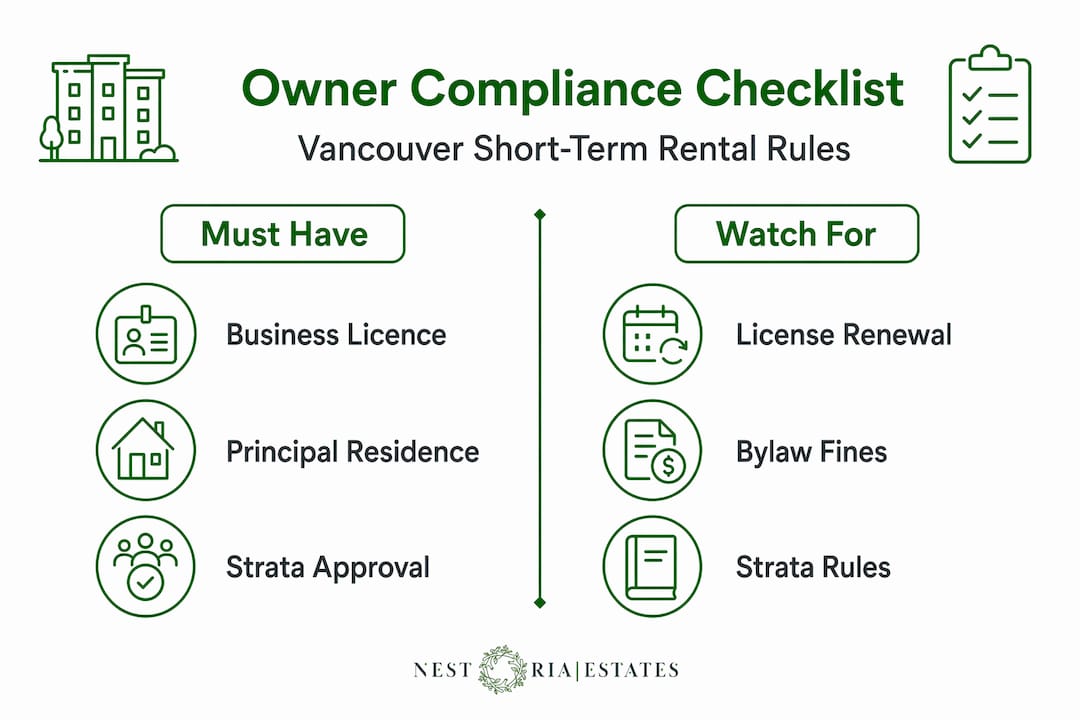
Strata approval (if applicable): If you own a condo or townhouse governed by a strata corporation, you need to verify that your strata bylaws permit short-term rentals before you apply for any licence.
The timing matters too. Licence renewals run on annual cycles, and missing a renewal deadline means your listing must come down until reinstatement is complete. Avoiding common Vancouver STR mistakes starts with treating these deadlines as non-negotiable.
Key compliance challenges for Vancouver short-term rental owners
Knowing the rules is one thing. Actually staying compliant month after month is where most owners run into trouble. The challenges stack on top of each other, and a gap in any one area can trigger consequences across the board.
Here are the four most common compliance hurdles, in order of how often they catch owners off guard:
Strata bylaw conflicts. Even if you hold a valid city licence and provincial registration, strata bylaws can block or restrict short-term rentals entirely. Many owners discover this only after they’ve already invested in furniture and photography.
Safety documentation gaps. The city requires working smoke alarms on every floor and in every bedroom, plus a posted fire exit plan visible to guests. Missing either during an inspection is a citable violation.
Licence renewal lapses. Both the provincial registration and the city business licence require annual renewal. The renewal windows don’t always align, which means owners need to track two separate deadlines.
Platform listing compliance. Your listing must display your provincial registration number. Platforms are now required to remove listings that don’t include it, and the city cross-references active listings against its licence database.
The financial stakes are real. Operating without proper licensing can result in fines reaching $3,000 per day from the city, and strata violations carry their own fines of up to $1,000 per day. These aren’t theoretical numbers. Enforcement has increased significantly since 2024.
Pro Tip: Before listing, request a copy of your strata’s current bylaws and the last 12 months of council minutes. Bylaws change, and a rental-friendly building from two years ago may have voted in restrictions since then.
For a deeper look at day-to-day hosting decisions, the Vancouver Airbnb host management tips guide covers the operational side in detail. It’s also worth understanding how short-term rentals compare to home swapping alternatives that some travelers are choosing instead, since that shift affects demand in certain neighborhoods.
Maximizing rental income with professional short-term rental management
Compliance keeps you legal. But it doesn’t automatically make your listing profitable. That’s where professional management earns its cost, often many times over.

The single biggest revenue lever is dynamic pricing. Most self-managing owners set a nightly rate and leave it. Professional managers adjust pricing daily based on local demand signals: events, seasonality, competing inventory, and booking pace. A well-priced listing during the Vancouver Folk Music Festival or Dine Out Vancouver can earn 40 to 60 percent more per night than a static rate would capture.
Proper revenue management requires balancing fee structures, occupancy, and average daily rate, and weak pricing strategies can cost owners more than higher commissions. That’s the counterintuitive truth most owners miss: paying a management fee often nets more income than managing yourself at zero cost.
Here’s what professional management typically handles that self-managing owners underestimate:
Guest communication: Response time directly affects search ranking on booking platforms. Managers respond within minutes, around the clock.
Cleaning coordination: Professional turnovers between guests, with quality checks that protect your review score.
Compliance documentation: Keeping licence numbers current on listings, tracking renewal deadlines, and maintaining safety records.
Maintenance response: Handling urgent repair requests without pulling you out of your day.
Service area | Self-management | Professional management |
Pricing | Fixed or manually adjusted | Daily dynamic adjustments |
Guest response time | Hours to days | Under 1 hour, 24/7 |
Cleaning oversight | Owner-coordinated | Managed with quality checks |
Licence tracking | Owner responsibility | Managed with renewal alerts |
Revenue reporting | None or basic | Detailed monthly statements |
Regulatory updates | Owner must monitor | Proactively communicated |
Pro Tip: When evaluating management companies, ask for a sample performance report and a breakdown of how they calculate your net income after fees. Vague answers about “maximizing revenue” without showing you actual data are a red flag.
The short term rental property management guide walks through exactly what to look for when choosing a manager, and top short term rental solutions Vancouver covers the local market context in more depth.
Navigating strata bylaws and community rules for Vancouver rentals
Strata governance is the layer of Vancouver’s rental landscape that surprises owners the most, and it operates almost entirely outside the city and provincial systems. A strata corporation is a legal entity that governs a multi-unit building or complex. It sets its own rules through bylaws, and those bylaws can be more restrictive than anything the city or province requires.
Strata corporations cannot ban long-term rentals but can regulate and fine for short-term rental violations, and some buildings prohibit Airbnb entirely with strict daily fines. This distinction matters enormously. If you want to rent your unit to a tenant on a 12-month lease, your strata cannot stop you. If you want to rent it nightly or weekly, they can, and often do.
Key points every condo owner needs to understand before listing short-term:
Review the current bylaws, not just the original disclosure statement. Bylaws are amended by majority vote and the version from when you bought may be outdated.
Check council meeting minutes for the past year. If short-term rentals have been discussed or fined recently, that signals active enforcement.
Understand the fine structure. Strata fines for short-term rental violations can reach $1,000 per day, and they accumulate quickly during a dispute.
Communicate proactively with your strata council. Owners who engage transparently before listing tend to face fewer conflicts than those who operate quietly and get reported by neighbors.
Rental type | Strata can ban? | Provincial protection | Typical fine for violation |
Long-term (12+ months) | No | Yes, protected by law | N/A |
Medium-term (1-11 months) | Partially | Limited | Varies |
Short-term (under 30 days) | Yes | No protection | Up to $1,000/day |
For owners thinking about the investment angle, profitable Vancouver rental investment tips covers how to evaluate a property’s short-term rental viability before you buy or commit to a strategy.
Preparing for future regulatory changes and market trends
The regulatory landscape for short-term rentals in BC is still moving. Owners who treat today’s rules as permanent are setting themselves up for a difficult surprise.
The most significant upcoming change involves opt-out provisions. BC’s STRAA allows municipalities to apply to opt out of the principal residence requirement if their local housing market meets specific vacancy and affordability criteria. Regulatory timelines and opt-out criteria depend on measurable housing market data with specific deadlines and effective dates, meaning ongoing changes require owners to plan ahead.
Kelowna’s opt-out, effective June 1, 2026, is the clearest example of how this plays out in practice. Kelowna met the vacancy rate threshold and successfully applied to allow non-principal-residence short-term rentals in certain zones. Vancouver, with its persistently low vacancy rates, remains under full restrictions and is unlikely to qualify for an opt-out in the near term.
What this means for your planning:
Vancouver will remain a principal-residence-only market for the foreseeable future. Don’t count on regulatory loosening as part of your investment thesis.
Vacancy rates in Vancouver directly affect your short-term rental viability. Tight long-term rental markets mean guests have fewer alternatives, which supports short-term demand.
Monitor provincial announcements annually. The opt-out framework is reviewed on a schedule tied to housing data releases, and the criteria could shift.
Build regulatory review into your annual planning cycle. Treat it the same way you treat licence renewal: a fixed date on the calendar, not something you get to when you have time.
“The owners who thrive in Vancouver’s short-term rental market aren’t the ones who found a loophole. They’re the ones who built compliance into their operations from day one and stayed ahead of every rule change.”
A fresh perspective on managing short-term rentals in Vancouver
Here’s what most owners get wrong: they think of compliance as a one-time checklist. Get the licence, post the registration number, done. What they underestimate is that compliance in Vancouver is an ongoing operational function, not a setup task.
The operational “hands-off” bundle often underestimated by owners includes compliance support like ensuring listing details and safety documents align with licensing requirements to prevent renewal issues. In practice, this means someone needs to be watching your listing, your strata notices, your city licence status, and the provincial registry simultaneously. That’s not a passive activity.
The gap we see most often isn’t between owners who know the rules and those who don’t. It’s between owners who have a system for staying compliant and those who rely on memory. Strata councils send notices that get buried in email. Renewal deadlines fall during busy seasons. A guest complaint triggers a strata inquiry that requires documentation you haven’t kept.
Professional managers who specialize in Vancouver’s market act as the connective tissue between you, your strata, the city, and the province. That liaison function is genuinely undervalued. When a strata council sends a notice about a guest complaint, a manager who knows the building’s bylaws and has the documentation ready can resolve it in hours. An owner handling it alone might take days, during which the strata is building a case.
The Vancouver Airbnb host management insights we’ve gathered from operating in this market consistently point to one conclusion: the owners who earn the most and face the fewest problems are not necessarily the ones with the best properties. They’re the ones with the best systems.
How Nestoria Estates can simplify your Vancouver short-term rental journey
Managing a short-term rental in Vancouver requires more than a great listing. It requires a team that understands the city’s licensing requirements, your strata’s specific bylaws, and how to price your property to earn its maximum potential every single night.

At Nestoria Estates, we handle every layer of that complexity for you. From obtaining and renewing your city business licence and provincial registration, to coordinating professional cleaning between every guest, to adjusting your nightly rate based on real-time market data, we manage the full operation so you don’t have to. Our Vancouver property management team monitors regulatory changes, communicates with strata councils on your behalf, and provides detailed monthly reporting so you always know exactly how your property is performing. If you’re ready to earn more with less involvement, explore our homeowner services and request a free revenue projection for your property.
Frequently asked questions
Can I rent out my Vancouver condo on Airbnb if I don’t live there?
No. Vancouver applies the provincial principal residence rule and requires both a short-term rental business licence and provincial registration, meaning investment properties not occupied by the owner cannot legally operate as short-term rentals.
What happens if I operate a short-term rental without a Vancouver city licence?
Operating without a city business licence can result in fines up to $3,000 per day, and your listing can be removed from booking platforms through the province’s enforcement mechanism.
Are strata bylaws able to prohibit me from renting my condo short-term in Vancouver?
Yes. Strata may pass bylaws banning or limiting short-term rentals with fines up to $1,000 per day for violations, even if you hold valid city and provincial licences.
How can professional management improve my Vancouver short-term rental’s profitability?
Professional managers provide pricing logic and performance reporting that balance commission fees with occupancy and average daily rate, typically increasing net income even after management costs are factored in.
Recommended
Comments