

Step by Step Rental Pricing for Vancouver Vacation Rentals

TL;DR:
Step by step rental pricing involves analyzing market data, property features, and seasonal demand to set competitive rates.
Vancouver Airbnb owners who use a structured approach outperform those who set flat rates by continuously testing and adjusting rates based on market feedback.
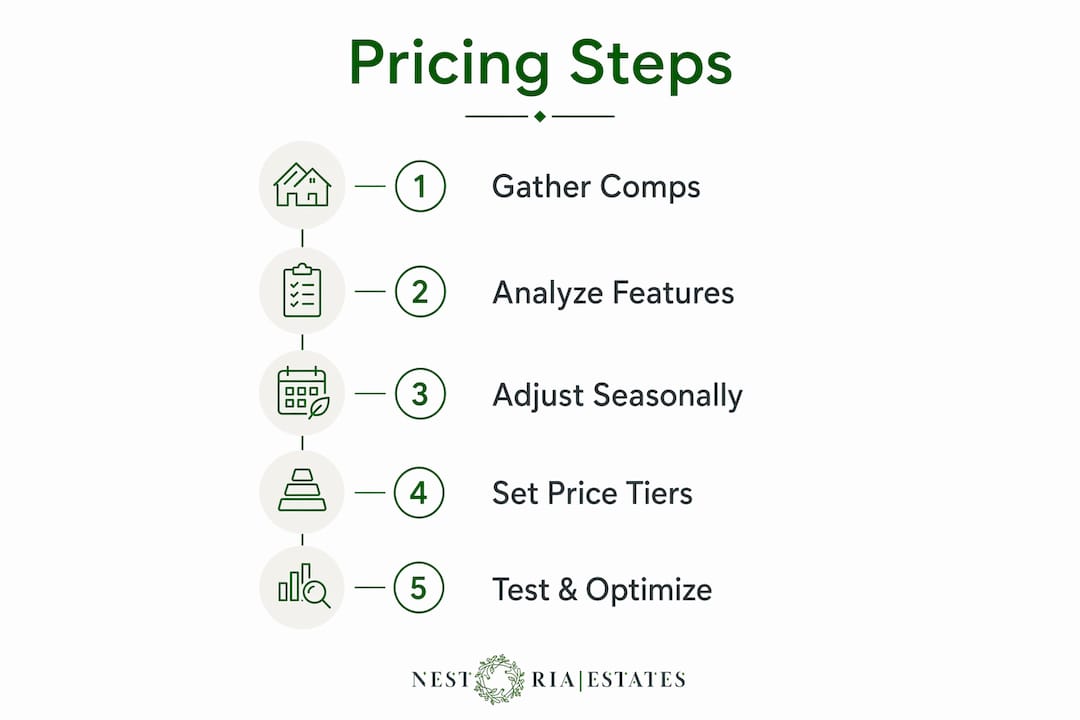
Step by step rental pricing is the process of methodically analyzing market data, property attributes, and seasonal demand to set competitive and profitable nightly rates for your vacation rental. Vancouver Airbnb owners who follow a structured approach, known in the industry as dynamic pricing methodology, consistently outperform those who set a flat rate and forget it. This guide walks you through every stage, from pulling comparable listings to building seasonal price tiers and testing your rates with real market feedback.
What market data and tools do you need to start pricing?
The foundation of any rental pricing guide is accurate, current market data. Without it, you are guessing. The most reliable starting point is pulling 5–10 comparable properties, covering both active listings and recently rented units in your area. Active listings show what landlords are asking. Recent rentals show what guests actually paid. The gap between those two numbers tells you how competitive your local market really is.

Comps are most effective when you combine actual rents tenants pay with landlords’ asking prices, avoiding reliance on outdated listing data. In Vancouver, this means checking Airbnb’s own search results filtered by your neighborhood, bedroom count, and amenity set. Look at properties in Kitsilano, Mount Pleasant, or the West End separately. Rates in these neighborhoods diverge significantly even within a few blocks.
For a pricing floor, the HUD Fair Market Rent benchmark defines a 40th percentile gross rent including utilities, updated annually. The FY 2026 figures became effective may 21, 2026. This number is not your target for short-term rentals. It is the minimum signal that tells you when a rate is dangerously below market.
Data source | What it tells you | Best use |
Airbnb active listings | Current asking rates by neighborhood | Competitive positioning |
Recently booked comps | What guests actually paid | True market rate |
HUD Fair Market Rent | Long-term rent floor by metro | Pricing floor check |
AirROI / PropMetrics | Occupancy and ADR trends | Seasonal benchmarking |
Local STR permit data | Supply volume in your area | Demand vs. supply read |
Pro Tip: Filter your Airbnb comps by “last 30 days booked” rather than just listed. A listing that has been sitting for 60 days with no bookings is not a reliable price signal.
How do you adjust pricing for your property’s features and local conditions?
Base market rates are a starting point, not a final answer. Your property’s specific attributes either justify a premium or require a discount relative to comps. The most common adjustments involve amenities, renovation quality, and guest policies.
A Vancouver condo with a rooftop deck, mountain view, and free parking commands a meaningfully higher rate than a comparable unit without those features. Conversely, a no-pets policy in a pet-friendly market reduces your eligible guest pool and may require a slight rate reduction to maintain occupancy. Comparing total guest cost for a typical stay, including cleaning fees and weekend premiums, gives you a cleaner competitive picture than comparing base nightly rates alone. Guests see the total checkout price, not just the nightly rate.
Seasonality is the single biggest pricing lever for Vancouver vacation rental owners. Disciplined seasonal pricing lifts revenue more than static flat rates by capturing demand swings effectively. Vancouver’s peak season runs from late june through early september, driven by tourism, film industry activity, and international visitors. A shoulder season covers april through may and october. The off-season spans november through march, with the exception of the holiday week between december 25 and january 1.
Identify your peak window. For most Vancouver properties, this is a 10–12 week stretch in summer.
Set a shoulder rate. Price shoulder months at roughly 80–90% of your peak rate to maintain occupancy.
Build an off-season floor. Your off-season rate should cover fixed costs and generate a modest margin, not maximize revenue.
Flag local events. Vancouver events like the Vancouver International Film Festival, Celebration of Light, and major conventions create short demand spikes that justify temporary rate increases.
Pro Tip: Check the Vancouver Convention Centre’s event calendar quarterly. A single large conference can fill the city for a week and support rates 20–40% above your normal shoulder pricing.
What are the best practices for building layered price tiers?
Layered pricing means you do not charge a single rate. You charge different rates based on day of week, season, and special events. This is the core of what separates high-performing Vancouver Airbnb owners from average ones.
Weekend premiums of 15–30% over weekday rates are standard practice in leisure markets. Vancouver’s short-term rental market qualifies as a leisure market for most neighborhoods. A property priced at $180 per night on weekdays should target $207–$234 on friday and saturday nights. That spread alone, applied consistently across 52 weekends, adds meaningful annual revenue.
Seasonal multipliers work on the same logic. Peak seasons typically last 2–4 months, and applying multipliers between 0.7x and 2x in pricing improves revenue capture across the full year. The table below shows how a $160 base weekday rate translates across tiers.
Pricing tier | Multiplier | Resulting nightly rate |
Off-season weekday | 0.7x | $112 |
Shoulder weekday | 0.9x | $144 |
Base weekday | 1.0x | $160 |
Shoulder weekend | 1.2x | $192 |
Peak weekday | 1.4x | $224 |
Peak weekend | 1.7x | $272 |
Event/holiday | 2.0x | $320 |
Review your tier structure quarterly. Vancouver’s rental supply and demand conditions shift with new STR regulations, new hotel inventory, and changes in tourism patterns. A quarterly review cadence keeps your tiers calibrated to current conditions rather than last year’s market.
Set calendar blocks for your quarterly reviews in advance: january, april, july, and october.
Pull fresh comps at each review, not just the ones you used at launch.
Adjust multipliers based on your actual occupancy data from the prior quarter.
How do you test and optimize your rental pricing step by step?
Your first published rate is a hypothesis, not a final answer. Treat initial pricing as a market velocity test, using inquiry volume as the primary signal. High inquiry volume with low conversion suggests your rate is competitive but your listing photos or description need work. Low inquiry volume with no bookings suggests your rate is too high for current demand.
The standard review window is 14 days. If a listing receives minimal interest after about 2 weeks, reduce the rate by 3–5% with a meaningful cut rather than a token $5 adjustment. A $5 drop on a $200 nightly rate is invisible to the algorithm and to guests. A $10–$15 drop signals a real change and can shift your position in Airbnb’s search results.
Set your opening rate at 5% above the median of your 10 best comps.
Monitor inquiry volume for the first 14 days after listing or after any rate change.
If inquiries are low, drop by 3–5% and reset the 14-day clock.
If you are booking out weeks in advance, your rate is likely too low. Raise it by 5–8% and monitor conversion.
Track booking velocity, meaning how far in advance guests are booking. Bookings coming in 60+ days out suggest strong demand and room to raise rates.
“Effective rental pricing uses feedback loops with short review windows of approximately 14 days to act proactively on market signals.”
Common pitfalls to avoid: do not lower your rate every time you have a vacant night. Vacancy is not always a pricing problem. It may be a listing quality problem, a seasonality issue, or a minimum stay requirement that is too long. Diagnose before you cut.
What financial goals should guide your long-term pricing decisions?
Pricing decisions must connect to your financial targets, not just to what the market will bear. The starting point is your break-even rent, which is the monthly revenue needed to cover your mortgage, strata fees, utilities, Airbnb host fees, and management costs. Any rate below break-even is a loss, regardless of occupancy.
Full-year revenue models should use month-by-month occupancy and ADR data to build operating reserves that cover off-season months reliably. A Vancouver property that earns strong revenue in july and august but sits at 40% occupancy from november through february needs a reserve strategy, not just a pricing strategy. Build your annual model before you set your rates, not after.
Calculate your break-even nightly rate at 60%, 70%, and 80% occupancy scenarios.
Set a revenue target that funds both operating costs and a capital reserve for maintenance.
Plan annual rate increases aligned with Vancouver’s CPI and STR market trends.
Use ROI analysis to decide whether to hold, reprice, or exit a property that is underperforming.
Pro Tip: Vancouver’s STR regulations have tightened in recent years. Factor potential regulatory changes into your 3-year revenue model. A property that only pencils out at peak-season rates is a high-risk investment.
For owners who want to understand how dynamic pricing for rentals connects to long-term yield targets, the methodology goes beyond seasonal tiers and into real-time demand signals.
Key Takeaways
Effective step by step rental pricing requires combining accurate market comps, layered seasonal tiers, and a disciplined 14-day feedback loop to maximize revenue across every season.
Point | Details |
Start with 5–10 comps | Pull both active listings and recently booked rentals to find the true market rate. |
Use seasonal multipliers | Apply 0.7x–2x multipliers across off-season, shoulder, and peak periods to capture demand swings. |
Apply weekend premiums | Price friday and saturday nights 15–30% above your weekday base rate. |
Test with 14-day windows | Review inquiry volume every 14 days and adjust by 3–5% when response is low. |
Anchor pricing to financials | Calculate break-even at multiple occupancy scenarios before setting any published rate. |
Pricing is a process, not a number
I have worked with Vancouver Airbnb owners who set their rates once at launch and never touched them again. Almost without exception, they left money on the table in summer and bled cash in winter. The owners who consistently outperform are the ones who treat pricing as a continuous process, not a one-time decision.
The most underrated skill in this market is knowing when to prioritize average daily rate versus occupancy. When Vancouver’s STR supply is tight, as it was through much of 2024 and into 2025, you push ADR hard. When new supply enters the market or regulations shift demand, you protect occupancy first and accept a lower nightly rate. Managing ADR and occupancy intelligently depending on local supply constraints is what separates profitable operators from frustrated ones.
Dynamic pricing tools are genuinely useful, but they are not a substitute for local knowledge. A tool does not know that the Vancouver International Film Festival fills Yaletown every september, or that a new hotel opening near your property changes your competitive set overnight. Use the tools for the baseline. Apply your local knowledge on top. That combination is what actually works.
— Kamran
How Nestoriaestates helps Vancouver owners price smarter
Pricing a Vancouver vacation rental correctly requires current market data, seasonal expertise, and the time to monitor and adjust rates continuously. Most property owners have the property but not the bandwidth.

Nestoriaestates specializes in short-term rental management for Vancouver Airbnb owners, with pricing optimization built into every management agreement. The team monitors market conditions, applies seasonal and event-based rate adjustments, and provides transparent monthly reporting so you always know how your property is performing. Owners receive a free revenue projection before signing anything. If you want to see what your property could realistically earn with a disciplined pricing strategy behind it, reach out to Nestoriaestates for a no-obligation conversation.
FAQ
What is step by step rental pricing for vacation rentals?
Step by step rental pricing is a structured method of setting nightly rates by analyzing market comps, adjusting for property features, building seasonal tiers, and testing rates with real booking data. It replaces flat-rate guessing with a repeatable, data-driven process.
How many comps do I need to price my Vancouver Airbnb?
Pull at least 5–10 comparable properties, mixing active listings with recently booked rentals. Active listings show asking prices; recent bookings show what guests actually paid.
How often should I adjust my vacation rental pricing?
Review your rates every 14 days when a listing is new or underperforming. Once stable, a quarterly review aligned with Vancouver’s seasonal shifts is the standard cadence.
What is a good weekend premium for a Vancouver short-term rental?
A weekend premium of 15–30% over your weekday base rate is standard in leisure markets like Vancouver. Apply it consistently to friday and saturday nights across all seasons.
How do seasonal multipliers work in short-term rental pricing?
Seasonal multipliers scale your base rate up or down depending on demand. Peak season rates typically use a 1.4x–2.0x multiplier, while off-season rates drop to 0.7x–0.9x of the base to maintain occupancy during slower months.
Recommended
Comments