

Strata Approval for Airbnb in Vancouver: 2026 Guide
- info67421305
- Jun 12
- 8 min read
TL;DR:
Strata approval is the essential legal step owners must secure before listing properties on Airbnb in Vancouver. It requires a 3/4 majority vote and proper filing at the BC Land Title Office; failure to comply leads to substantial fines and listing removal. Maintaining ongoing awareness of bylaws and regulations is crucial to ensure compliance and protect your investment.
Strata approval for Airbnb in Vancouver is a mandatory legal requirement that every condo or strata unit owner must secure before listing their property on any short-term rental platform. Strata corporations in British Columbia operate as independent legal entities under the Strata Property Act, meaning their bylaws can override both City of Vancouver licensing rules and provincial registry requirements. Skip this step and you face fines up to $1,000 per day from your strata alone, on top of city penalties reaching $3,000 per day. This guide walks you through exactly how strata bylaws work, how to get approval, and how all three layers of regulation fit together.
How strata approval for Airbnb in Vancouver actually works
Strata corporations hold real legal authority over how units in their buildings are used. Under the Strata Property Act, a strata council can pass bylaws that restrict or outright ban short-term rentals, and those bylaws carry independent legal weight separate from anything the City of Vancouver or the Province of BC permits.

STR bans require a 3/4 majority vote at a general meeting of strata owners. That threshold means a determined majority of your neighbors can shut down your Airbnb operation even if you hold a valid city license. Bylaws commonly impose minimum rental terms of 30, 60, or 90 days, which effectively eliminates nightly or weekly Airbnb stays.
One detail many owners miss: unfiled bylaw amendments are completely unenforceable. For a strata bylaw to carry legal weight, it must be filed and registered at the BC Land Title Office. This means checking the Land Title Office record, not just the document your strata manager hands you, is a non-negotiable due diligence step before you list.
Enforcement powers available to strata councils include written warnings, fines, formal hearings, and escalation to the Civil Resolution Tribunal. General strata fines are capped at $200 per contravention, but STR-specific fines can reach $1,000 per day under properly filed bylaws.
Key strata bylaw facts to know:
Bylaws restricting STRs must be filed at the BC Land Title Office to be enforceable
A 3/4 majority vote at a general meeting is required to pass or amend STR bylaws
Minimum stay requirements (30, 60, or 90 days) are the most common restriction type
Fines for STR violations can reach $1,000 per day under current rules
Bylaw changes have become increasingly common in Vancouver buildings over the past 24 months
Pro Tip: Before you do anything else, request a Form B Information Certificate from your strata. This document discloses all current bylaws and any outstanding fines. It is the single most reliable snapshot of your building’s rules.
Steps to get strata council approval for your Airbnb listing
Securing strata council approval is a process, not a single conversation. Treating it that way dramatically improves your odds of success.
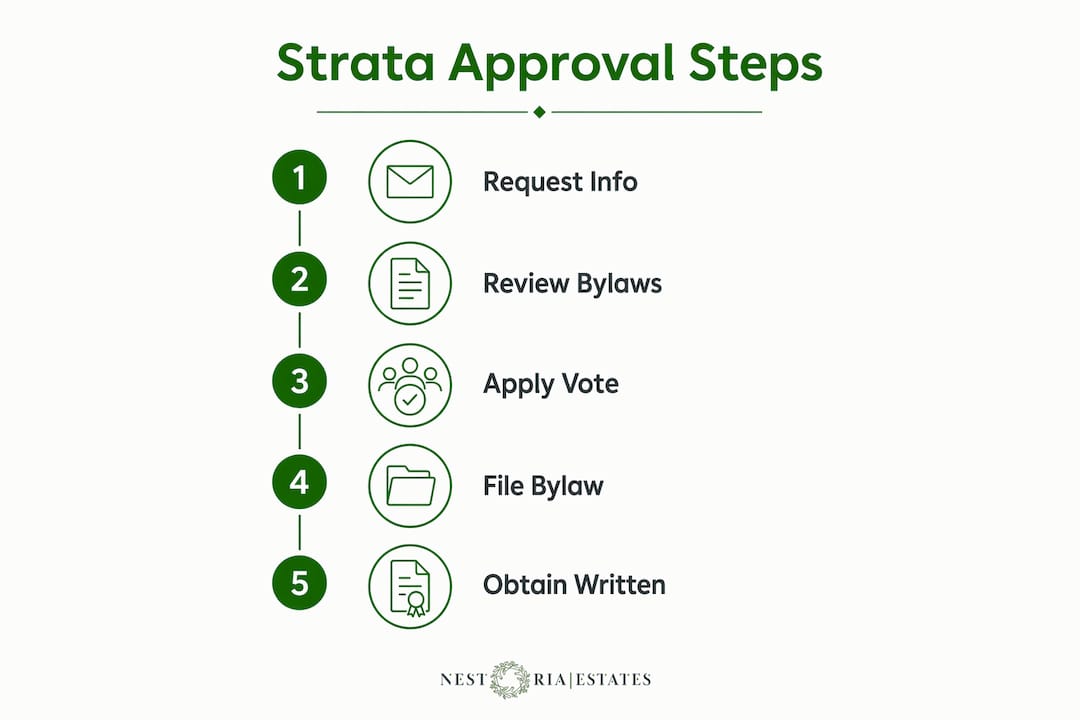
Request your current bylaws and Form B. Contact your strata manager or council and ask for the most recent filed bylaws and a Form B. Confirm the bylaws are registered at the BC Land Title Office. Any amendment that is not filed there has no legal force.
Review strata council meeting minutes. Bylaw changes can happen at any general meeting with a 3/4 majority vote. Reading the last 12 to 24 months of minutes tells you whether STR restrictions are being discussed, tightened, or challenged. This step takes 30 minutes and can save you thousands.
Submit a formal written request to the strata council. Verbal conversations carry no weight. Put your request in writing, describe your intended use (nightly rental, platform, estimated guest volume), and ask for a written response. This creates a paper trail that protects you later.
Address strata concerns directly. Councils most often worry about noise, security, and wear on common areas. Come prepared with a guest conduct policy, a contact number for complaints, and a willingness to discuss conditions such as guest registration or key fob protocols.
Get approval documented in writing. A verbal “yes” from a council member is not approval. You need written confirmation, ideally in the form of a council resolution or a signed letter on strata letterhead.
Monitor for bylaw changes after approval. Approval today does not guarantee approval next year. Attend or review AGM and SGM minutes regularly. If a new bylaw restricting STRs passes and is properly filed, your previous approval may no longer protect you.
Pro Tip: If your strata bylaws are silent on short-term rentals, that is not automatic permission. Ask the council for written clarification. Silence in a bylaw creates ambiguity, and ambiguity tends to resolve against the owner when enforcement begins.
How strata approval fits into Vancouver’s full regulatory framework
Strata approval is the foundation, but it is not the only requirement. Vancouver property owners must satisfy three separate regulatory layers before legally hosting on Airbnb.
Regulatory layer | Requirement | Cost (2026) |
Strata corporation | Written strata council approval or bylaw compliance | Varies by building |
City of Vancouver | Short-term rental business license | $1,185 annually ($77 application + $1,108 license fee) |
Province of BC | Short-term rental registry registration | Free to register |
The City of Vancouver requires written strata or landlord approval as part of the business license application. You cannot obtain the city license without it. The city license costs $1,185 annually as of 2026, and both the license number and the provincial registry number must appear on every listing across every platform.
The provincial short-term rental registry, administered under BC’s Short-Term Rental Accommodations Act, requires all operators to register and display their registration number on listings. Operating without a valid license and provincial registry number exposes you to city fines up to $3,000 per day and risks having your listing removed directly by platforms like Airbnb.
The critical hierarchy to understand: strata bylaws sit at the top. Even if you hold a valid city license and provincial registration, a strata bylaw banning short-term rentals makes your listing illegal within that building. Strata approval is a prerequisite, not an afterthought. Owners planning to buy a property specifically for Airbnb should review the legal realities of buying an Airbnb in Vancouver before committing to a purchase.
Common mistakes that lead to strata enforcement actions
Most enforcement problems are avoidable. They almost always trace back to one of a small number of predictable errors.
Assuming city or provincial approval is enough. Strata corporations are independent legal entities with authority that operates entirely separately from municipal rules. A city license does not override a strata bylaw.
Not verifying that bylaw amendments are filed. An unfiled amendment is legally meaningless. Always confirm registration at the BC Land Title Office before concluding that a restriction or permission is valid.
Ignoring Section 135 hearing rights. Under Section 135 of the Strata Property Act, owners have a right to a hearing before fines become enforceable. Strata councils that skip this notice step often find their fines thrown out at the Civil Resolution Tribunal.
Failing to document communications. Documented evidence including listing URLs, screenshots, and dated correspondence is critical in both enforcement hearings and Civil Resolution Tribunal proceedings.
Letting approval lapse. Bylaws can change at any general meeting. An owner who secured approval two years ago and stopped attending meetings may be operating illegally today without knowing it.
“The Civil Resolution Tribunal primarily examines whether procedural fairness was maintained by the strata council, not just whether an Airbnb rule was broken. Owners who know their procedural rights are in a far stronger position.” (Source)
If you receive a notice of violation, request a hearing in writing immediately. Do not pay the fine first. Paying a fine can be interpreted as admitting the violation, which weakens your position if you later want to dispute the underlying bylaw. For a broader look at common missteps, the guide on Vancouver STR law mistakes covers additional scenarios worth reviewing.
Key Takeaways
Strata approval is the legal prerequisite for every other step in the Vancouver Airbnb compliance process, and no city license or provincial registration can substitute for it.
Point | Details |
Strata approval comes first | No city license or provincial registration is valid without written strata council approval. |
Bylaws must be filed to be enforceable | Confirm registration at the BC Land Title Office before accepting any bylaw as legally binding. |
Three-layer compliance is required | Strata approval, a $1,185 city license, and a provincial registry number are all mandatory. |
Section 135 protects owners | Request a formal hearing before any fine becomes enforceable to preserve your rights. |
Bylaws change regularly | Monitor strata meeting minutes every 6 to 12 months to catch new restrictions before they affect your listing. |
Why I tell every Vancouver owner to treat strata approval as a living process
Most owners I work with come in thinking strata approval is a one-time checkbox. Get the letter, file the license, list the property. Done. That mindset is exactly what leads to enforcement problems 18 months later.
Strata bylaws are not static documents. They reflect the shifting opinions of your neighbors, and those opinions change. A building that was Airbnb-friendly in 2023 may have passed a 30-day minimum stay bylaw at its 2025 AGM. If you were not in the room or reading the minutes, you would not know until a fine notice arrived.
The owners who stay out of trouble are the ones who treat strata approval as an ongoing relationship, not a transaction. They show up to AGMs, or at minimum read the minutes. They keep a copy of their written approval on file. They respond to strata communications promptly and professionally. When a neighbor complains about a noisy guest, they address it before it becomes a formal complaint.
There is also a practical financial argument here. A $1,000 per day strata fine, stacked on top of a $3,000 per day city fine, can wipe out months of rental income in a single enforcement action. The cost of staying compliant, in time and attention, is a fraction of that exposure.
My honest advice: build a simple compliance calendar. Note your city license renewal date, your provincial registration renewal, and the dates of your strata’s AGM and SGM. Review the minutes within two weeks of each meeting. That 30-minute habit protects an asset worth hundreds of thousands of dollars.
— Kamran
How Nestoriaestates can help you stay compliant and profitable

Managing strata approval, city licensing, and provincial registration simultaneously is genuinely complex, and the rules keep changing. Nestoriaestates works with Vancouver property owners to handle exactly this kind of compliance work, from reviewing your strata bylaws and preparing council submissions to managing your city license renewal and provincial registry obligations. The team monitors regulatory changes so you do not have to, and keeps your listing protected year-round. If you want a clear picture of what your property could earn while staying fully compliant, explore the full management services Nestoriaestates offers, or reach out directly to discuss your specific building and situation.
FAQ
Does strata approval override my city Airbnb license in Vancouver?
Yes. Strata bylaws are independent legal instruments under the Strata Property Act and can ban short-term rentals even if you hold a valid City of Vancouver business license. Strata approval is a prerequisite for the city license, not a substitute for it.
How much does a Vancouver short-term rental business license cost?
The City of Vancouver short-term rental business license costs $1,185 annually as of 2026, broken down as a $77 application fee and a $1,108 license fee. Proof of strata or landlord approval is required to complete the application.
What happens if I list on Airbnb without strata permission?
Your strata can issue fines up to $1,000 per day under a properly filed bylaw, escalate to the Civil Resolution Tribunal, and file a complaint with the City of Vancouver. The city can add fines up to $3,000 per day, and platforms like Airbnb can remove listings that lack valid license numbers.
Can a strata bylaw banning Airbnb be reversed?
Yes, but it requires a 3/4 majority vote at a general meeting to amend the bylaw, and the amendment must be filed at the BC Land Title Office to take effect. Organizing enough owner support for that threshold is the primary challenge.
How do I know if my strata’s STR bylaw is legally enforceable?
Search the BC Land Title Office records for your strata plan and confirm that the specific bylaw amendment restricting short-term rentals has been filed. Any amendment that has not been registered there carries no legal weight and cannot be enforced.
Recommended

Comments