

The Role of Add-Ons in Vacation Rentals That Pay Off
- info67421305
- 2 hours ago
- 9 min read
TL;DR:
Offerings beyond the nightly rate enhance guest satisfaction and increase rental revenue in vacation rentals. Properly managed add-ons generate up to 30% more income without lowering prices, especially when timed and framed around guest needs.
Add-ons in vacation rentals are services and amenities offered beyond the nightly rate that directly increase both guest satisfaction and rental revenue. Property owners who treat these extras as a core part of their business, not an afterthought, consistently outperform those who rely on base rates alone. Ancillary revenue strategies can boost total property turnover by 15–30% without harming guest satisfaction or base rate competitiveness. That kind of lift, achieved without raising your nightly price, is the clearest argument for taking add-ons seriously. For Vancouver Airbnb owners managing properties in a competitive market, the importance of rental add-ons goes well beyond a few extra dollars per booking.
What is the role of add-ons in vacation rentals?
Add-ons, also called ancillary services or upsells in the short-term rental industry, are any paid offerings that sit outside the core booking fee. They range from time-based conveniences like early check-in and late checkout to physical extras like welcome packages, mid-stay cleaning, and equipment rentals. The industry term “ancillary revenue” captures all income generated this way.

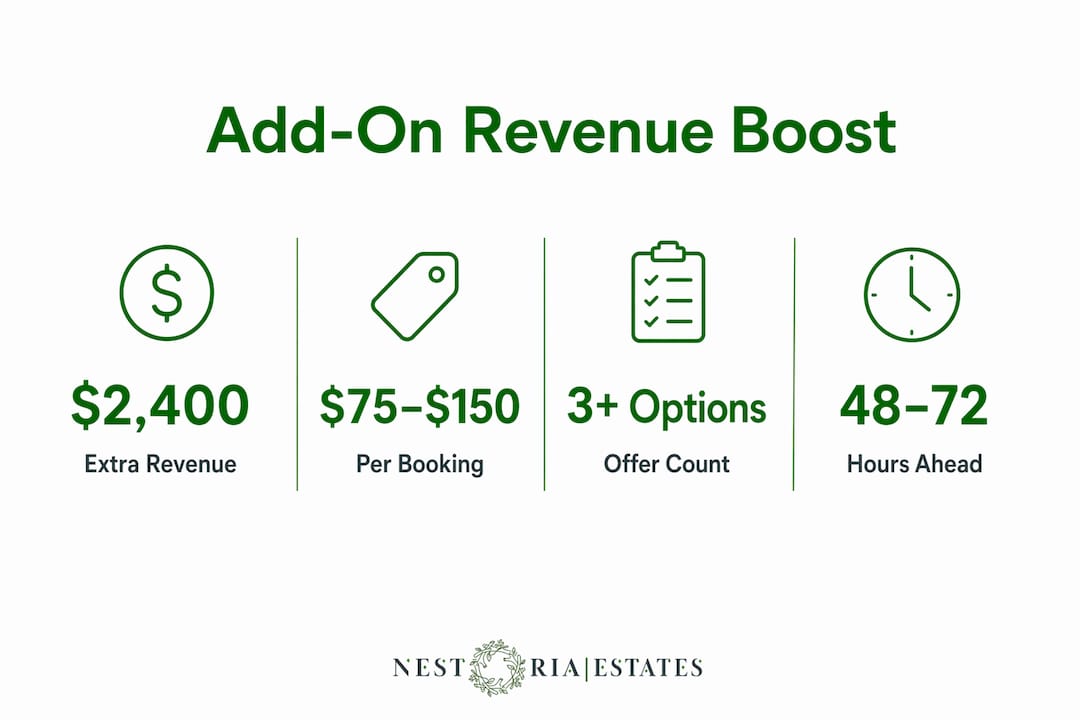
The financial case is concrete. Operators using three or more upselling strategies generate $2,400 to $4,800 in extra annual revenue per property with low incremental cost. That figure represents a 6–12% revenue increase over base booking income. For a Vancouver host with two or three active listings, that math adds up to a meaningful income stream.
Add-ons also serve a guest experience function that pure pricing cannot. Guests who feel their stay was personalized to their needs leave better reviews and rebook at higher rates. The benefits of vacation rental amenities extend beyond the transaction. They signal that a host pays attention, which builds the kind of trust that drives five-star ratings.
Which add-ons generate the most revenue?
Three categories consistently outperform all others: early check-in, late checkout, and welcome packages. These highest-converting upsell categories add $75–$150 per booking and generate over $2,000 in additional annual revenue per listing. Attachment rates run between 15–40%, meaning a meaningful share of guests accept these offers when presented correctly.
The reason these three convert so well is simple. They solve real problems. Guests arriving on a red-eye flight want to drop their bags and sleep. Guests leaving for a late afternoon flight do not want to spend three hours in a coffee shop. A welcome package with local snacks, a bottle of wine, and a handwritten note removes the “where do we start?” friction of arriving somewhere new.
Here is a breakdown of the most popular vacation rental services by category:
Add-On Category | Typical Price Range | Why Guests Buy It |
Early check-in | $25–$100 | Avoids waiting after long travel |
Late checkout | $25–$150 | Removes checkout-day stress |
Welcome package | $30–$80 | Creates a warm first impression |
Mid-stay cleaning | $50–$120 | Comfort on longer stays |
Bike or kayak rental | $40–$100/day | Convenience for local exploration |
Grocery delivery | $15–$30 service fee | Saves time on arrival day |
Time-based add-ons like early check-in and late checkout carry a particular financial advantage. These offers require no physical inventory and yield 100% margin when timed to avoid same-day turnovers. No supplies, no vendor coordination, no labor. You simply confirm availability and collect the fee.
Pro Tip: Check your cleaning schedule before offering early check-in or late checkout. If you have back-to-back bookings, block those dates from the offer automatically. Selling a time slot you cannot deliver destroys guest trust faster than any other mistake.
How to implement add-ons without operational chaos
The biggest mistake hosts make is launching too many add-ons at once. Limiting upsell offers to two or three options prevents choice overload and improves conversion rates. Guests who see a wall of extras feel sold to, not cared for. Start with the three highest-converting categories, master them operationally, then expand.
Timing is the second critical variable. The best window for upsell offers is 48–72 hours before check-in, when guests are actively planning their trip. Sending an offer at booking confirmation is too early. Guests are still in purchase mode and not thinking about logistics. Sending it the morning of arrival is too late to feel helpful.
A practical implementation sequence for Vancouver hosts:
Set up early check-in and late checkout first. These require no vendor relationships and generate immediate revenue. Block them automatically when same-day turnovers apply.
Add a welcome package in month two. Source locally. Vancouver has excellent options for artisan snacks, local coffee, and craft beverages. Keep the package consistent so it scales without extra decision-making.
Introduce mid-stay cleaning for stays of five nights or more. Coordinate with your existing cleaning team. This add-on practically sells itself on longer bookings.
Partner with local vendors for equipment rentals or experience bookings. Establish a referral or revenue-share arrangement with a bike rental shop or kayak outfitter. You offer the booking; they handle delivery and pickup.
Automate your messaging. Automated upsell messaging using property-specific data improves revenue while maintaining operational simplicity. Most property management systems support trigger-based messages tied to reservation details.
Pro Tip: Build a simple checklist for each add-on type. When a guest books, the checklist tells you exactly what to prepare and when to send the offer. This removes the mental load of remembering who gets what.
How should add-ons be framed to protect guest experience?
The framing of an add-on determines whether a guest feels helped or pressured. Guest-centric framing of add-ons as problem-solvers rather than sales pitches significantly increases acceptance and improves the guest experience. The language difference is subtle but powerful.
“Add late checkout for $50” reads as a fee. “Need a relaxed morning? Extend your checkout to 1:00 PM for $50 so you can enjoy your last day without rushing” reads as a favor. The offer is identical. The guest’s emotional response is not.
Personalization amplifies this effect. Add-ons personalized with guest name, property details, and stay length convert at 18–22%, compared to 4–6% for generic messages. That is roughly a threefold difference in revenue from the same number of guests. A message that references the guest’s name, their specific property, and the length of their stay signals that the offer was made for them, not blasted to a list.
A few principles that protect guest trust while maximizing conversions:
Offer only what you would genuinely recommend. Hosts should only offer add-ons they would recommend to a friend staying for free, ensuring genuine guest value.
Avoid pressure language. Phrases like “limited availability” or “act fast” erode trust when guests sense they are being pushed.
Stagger your offers. Guests prefer timely upsell offers aligned with trip stages rather than receiving everything at booking confirmation.
Keep the tone warm and specific. Reference the property, the season, or the guest’s trip context wherever possible.
“Upsells succeed when reframed as solutions that address guest problems, transforming offers into gestures of hospitality rather than sales pitches. The host who thinks like a concierge, not a cashier, wins both the conversion and the five-star review.”
Vancouver-specific add-ons that work in practice
Vancouver’s geography and tourism profile create a specific set of add-ons that perform well locally. Popular local add-ons in Vancouver include bike rentals, grocery delivery, mid-stay cleaning, and experience bookings with nearby providers. Each of these maps directly to what Vancouver guests actually do.
Guests staying near the Seawall, Stanley Park, or Granville Island frequently want bikes. A partnership with a local rental shop, where you handle the booking and they deliver to the property, removes all friction for the guest and generates a referral fee or margin for you. Kayak rentals work similarly for properties near False Creek or Deep Cove.
Grocery delivery partnerships with services that cover Vancouver neighborhoods solve the arrival-day problem. Guests flying in from Toronto or internationally do not want to navigate a grocery store before they have even unpacked. A pre-stocked fridge option, coordinated with a local delivery service, commands a meaningful service fee and earns immediate goodwill.
Mid-stay cleaning is particularly effective for Vancouver properties that attract longer bookings from remote workers or families. For stays of five nights or more, a mid-stay clean at a fixed add-on price keeps the property in good condition and reduces the post-checkout cleaning burden. Properties that offer this add-on also tend to see fewer complaints about cleanliness during the stay.
Add-On | Vancouver Context | Operational Requirement |
Bike rental | Seawall, Stanley Park access | Local vendor partnership |
Kayak rental | False Creek, Deep Cove proximity | Delivery and pickup coordination |
Grocery delivery | Airport arrivals, international guests | Service agreement with local provider |
Mid-stay cleaning | Stays of 5+ nights, remote workers | Existing cleaning team scheduling |
Experience bookings | Skiing, whale watching, city tours | Referral or affiliate arrangement |
For a real-world example of how optional services and upsells translate into higher revenue and guest satisfaction, Gulf Shores vacation rental properties demonstrate how well-curated add-ons become a defining feature of the guest experience rather than a secondary consideration.
Pro Tip: When building vendor partnerships, ask for a written agreement that covers delivery windows, cancellation policies, and guest communication protocols. Ambiguity in vendor relationships is the most common source of operational problems with service-based add-ons.
Key Takeaways
Add-ons in vacation rentals generate meaningful ancillary revenue and improve guest satisfaction when offered at the right time, in the right number, and with guest-centric framing.
Point | Details |
Start with three core add-ons | Early check-in, late checkout, and welcome packages convert best and require minimal setup. |
Time offers at 48–72 hours pre-arrival | Guests in active trip-planning mode convert at significantly higher rates than those at booking. |
Personalize every message | Named, property-specific offers convert at 18–22% versus 4–6% for generic messages. |
Limit choices to two or three options | Fewer offers reduce decision fatigue and improve overall conversion rates. |
Partner locally for service add-ons | Vancouver vendors for bikes, kayaks, and groceries extend your offer without adding operational load. |
What I’ve learned from add-ons in Vancouver rentals
The hosts I see struggle with add-ons share one trait: they try to build a full upsell menu before they have mastered a single offer. They sign vendor contracts, build out messaging sequences, and then wonder why nothing converts. The answer is almost always that they skipped the foundation.
Early check-in and late checkout are where every Vancouver host should start. They cost nothing to set up, require no vendor, and teach you the most important skill in add-on management: reading your own calendar. Once you know how to offer time-based add-ons without creating cleaning conflicts, everything else becomes easier.
The second thing I have seen consistently is that timing matters more than the offer itself. A welcome package offer sent at booking confirmation gets ignored. The same offer sent 48 hours before arrival, when the guest is already thinking about what to pack and where to eat, converts reliably. The offer did not change. The guest’s mental state did.
My honest advice for 2026: automate the timing, personalize the message, and keep the menu short. Property management workflow tools that support trigger-based messaging make this achievable without manual overhead. The hosts who treat add-ons as a system, not a series of one-off decisions, are the ones generating an extra $3,000 to $4,000 per listing annually.
— Kamran
How Nestoriaestates supports Vancouver hosts with add-ons
Nestoriaestates works with Vancouver property owners who want to grow rental income without managing every operational detail themselves. The team handles guest communication, pricing, and the kind of add-on coordination that takes time to get right.
If you want to know what your property could realistically earn with a structured add-on program, Nestoriaestates offers free revenue projections based on your specific listing. The full range of services covers everything from pricing strategy to guest experience management, including ancillary revenue support. Property owners who want a hands-off approach to maximizing income can also review the benefits of short-term rentals to understand the full financial picture before getting started.
FAQ
What are the most popular vacation rental add-ons?
Early check-in, late checkout, and welcome packages are the highest-converting add-ons, each generating $75–$150 per booking. Mid-stay cleaning and local equipment rentals like bikes or kayaks also perform well, particularly for longer stays.
How do add-ons impact rental income?
Operators using three or more upselling strategies generate $2,400 to $4,800 in extra annual revenue per property. That represents a 6–12% increase over base booking income with low incremental cost.
When is the best time to offer add-ons to guests?
The highest-converting window is 48–72 hours before check-in, when guests are actively planning their trip. Offers sent at booking confirmation convert at much lower rates because guests are not yet in logistics mode.
Do add-ons hurt guest satisfaction or reviews?
Add-ons framed as convenience solutions rather than fees improve guest satisfaction and review scores. Personalized offers that reference the guest’s name and stay details convert at 18–22%, far above the 4–6% rate for generic messages.
How many add-ons should a host offer at once?
Limiting offers to two or three options prevents choice overload and improves conversion rates. Start with time-based add-ons, master the operational side, then introduce service-based extras like grocery delivery or experience bookings.
Recommended