

The Role of Concierge in Hospitality: A Pro Guide
- info67421305
- Jun 2
- 8 min read
TL;DR:
A hotel concierge delivers personalized, proactive services that transform guest experiences and foster loyalty. They handle complex requests, coordinate vendors, and curate local experiences, acting as trusted advisors rather than simple information providers. Cloud-based tools and trained managers enable short-term rental operators to emulate concierge-level service, driving higher reviews and guest satisfaction.
A hotel concierge is defined as the dedicated hospitality professional who delivers personalized, anticipatory service that transforms a standard stay into a memorable experience. The role of concierge in hospitality extends far beyond answering questions at a desk. From securing last-minute restaurant reservations at a fully booked Vancouver hotspot to coordinating private tours and managing pre-arrival guest preferences, the concierge functions as a personal fixer, local expert, and service recovery specialist rolled into one. For hospitality professionals and luxury rental operators, understanding this role is the difference between average reviews and five-star loyalty.
What are the primary duties and responsibilities of a concierge?
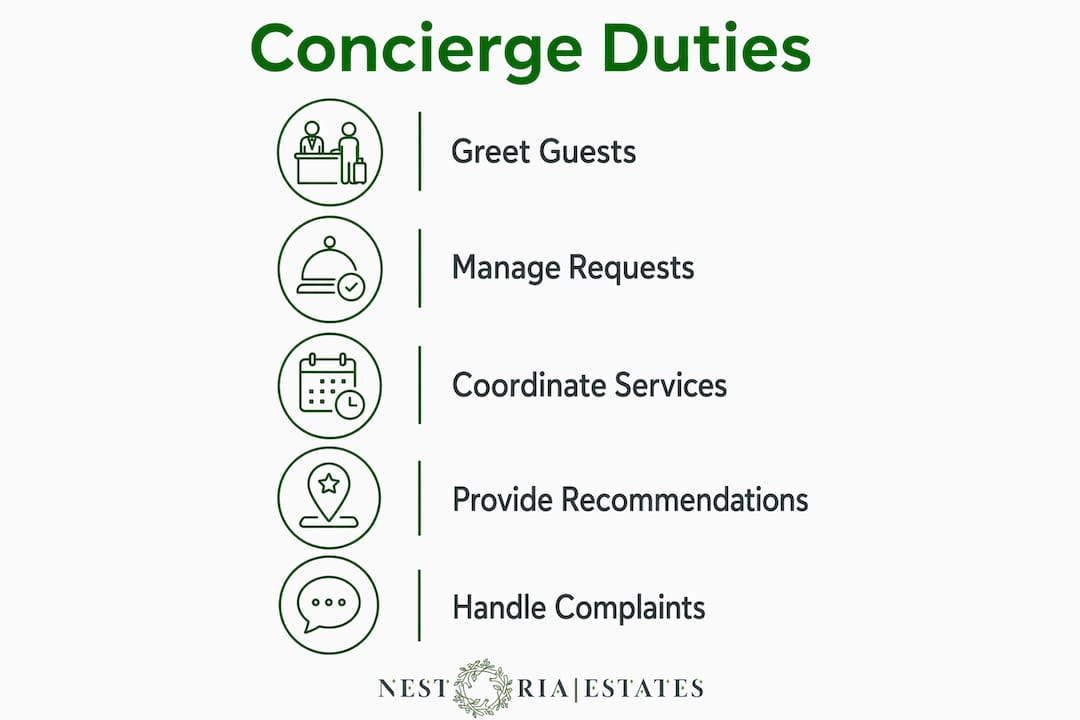
The concierge’s daily responsibilities span a wider range than most guests realize. Core concierge duties include making restaurant reservations, booking transportation, coordinating tours, managing guest errands, and handling special requests like late checkouts and wake-up calls. The concierge is the operational hub for itinerary logistics, not just an information desk.
Here is a breakdown of the most common concierge tasks in hospitality:
Securing restaurant reservations, including at exclusive or fully booked venues
Booking private transportation, airport transfers, and car rentals
Arranging tours, cultural events, theater tickets, and VIP experiences
Coordinating in-room amenities, floral arrangements, and occasion setups
Managing luggage handling, dry cleaning, and errand fulfillment
Providing hyper-local recommendations tailored to each guest’s interests
The distinction between a concierge and a front desk agent is significant and often misunderstood.
Function | Concierge | Front Desk |
Primary focus | Personalized guest experience | Administrative check-in/out |
Request type | Complex, bespoke, vendor-coordinated | Standard, transactional |
Guest interaction | Ongoing throughout the stay | Primarily at arrival and departure |
Local knowledge | Deep, relationship-based | General and informational |
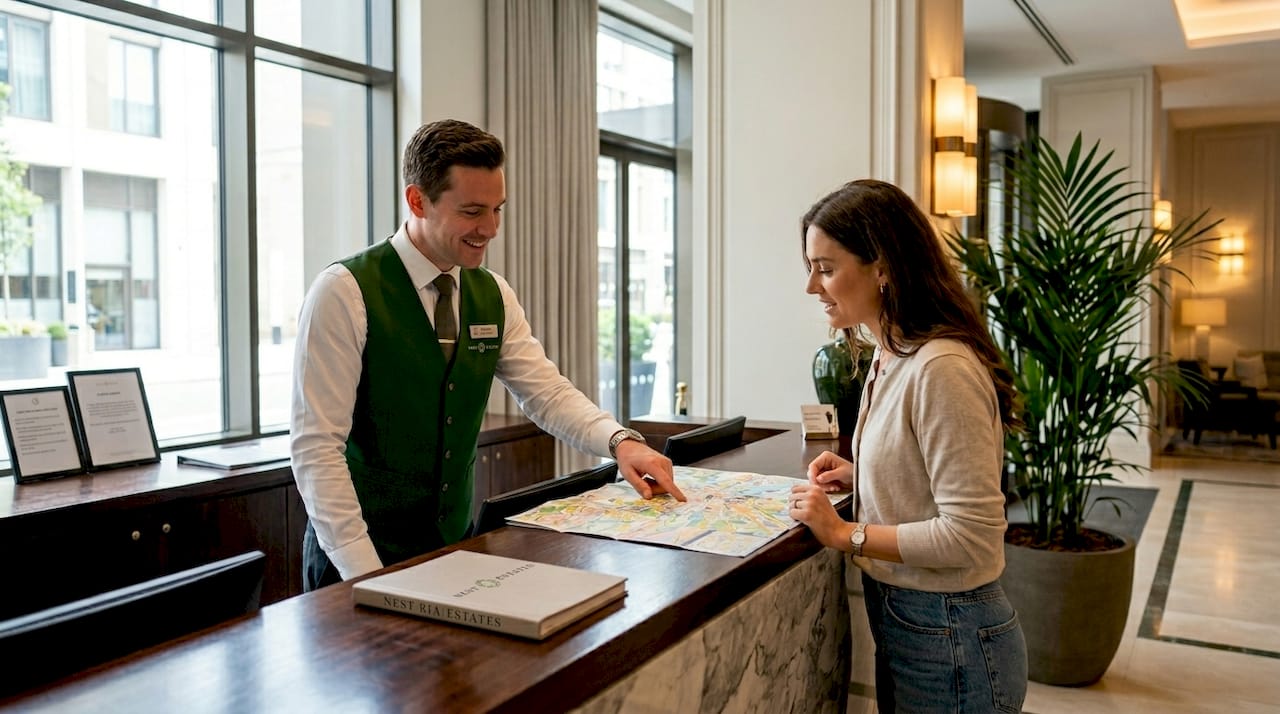
Concierge teams prevent negative reviews by handling guest requests continuously and freeing the front desk to focus on administrative operations. This division of labor is what keeps luxury properties running without friction.
Pro Tip: Train your concierge team to log every guest preference and special request in your property management system. That data becomes the foundation for personalized service on every future visit.
How do concierges enhance guest experience through proactive service?
The most effective concierges do not wait for guests to ask. Anticipatory service using prior visit notes, dining history, and occasion records allows a concierge to tailor a stay before the guest even arrives. This approach shifts the experience from reactive to genuinely personal.
Proactive service delivery includes several concrete behaviors:
Reviewing guest profiles before check-in to identify preferences and past complaints
Pre-arranging welcome amenities based on dietary restrictions or celebration occasions
Reaching out to guests 48 to 72 hours before arrival to confirm plans and offer suggestions
Monitoring in-stay requests in real time to catch dissatisfaction before it becomes a review
Service recovery is where concierge value becomes most measurable. When a restaurant reservation falls through or a tour gets canceled, the concierge who resolves the issue within minutes protects the property’s reputation. Concierge performance shapes guest reviews directly, making timely problem resolution a strategic priority, not just a courtesy.
The operational benefit extends to the entire property. Concierge operations reduce front-desk interruptions by absorbing complex, vendor-coordinated requests, which allows every department to function at a higher level.
Pro Tip: Create a shared digital log between your concierge and housekeeping teams. When a concierge notes a guest’s preference for extra pillows or a specific room temperature, housekeeping can act on it without a separate request.
What skills and qualities define an effective concierge?
The best concierges combine emotional intelligence with operational precision. National Geographic describes the concierge role as requiring part-time psychology, because guests frequently share personal context when making requests. Reading between the lines of what a guest says versus what they actually need is a skill that no software replicates.
The core competencies for a high-performing concierge can be organized into six categories:
Communication: Clear, warm, and adaptable across cultures and languages. Multilingual ability is a significant asset in markets like Vancouver, where international guests are common.
Curiosity: Genuine interest in each guest’s story, which drives better recommendations and more personalized service.
Creativity: The ability to solve unusual problems, like sourcing a specific ingredient for a guest’s dietary need or arranging a private museum visit after hours.
Confidence: Guests trust concierges who speak with authority about local options and who advocate effectively with vendors on the guest’s behalf.
Charisma: Relationship-building with local restaurants, venues, and service providers is what gives a concierge access to experiences guests cannot book themselves.
Competence: Organizational skills to manage multiple simultaneous requests without errors, combined with technology literacy for booking systems and property management platforms like Mews.
Human emotional intelligence remains irreplaceable in concierge roles, particularly in luxury hospitality where automation cannot replicate the nuance of a trusted personal relationship. This is the core reason why top-tier properties invest heavily in concierge training rather than replacing staff with chatbots.
How does the concierge role differ across hotel types and short-term rentals?
The scope of concierge service varies considerably depending on the property type, guest expectations, and available technology.
Property Type | Concierge Scope | Key Differentiator |
Luxury hotel | Full pre-arrival personalization, VIP vendor access, dedicated staff | Relationship-based, human-led service |
Mid-scale hotel | On-request assistance, standard local recommendations | Efficiency-focused, shared responsibilities |
Short-term luxury rental | Digital concierge tools, curated local guides, remote coordination | Scalable, tech-enabled personalization |
Vancouver Airbnb | Automated messaging, local experience curation, guest communication | Speed and local knowledge at scale |
In luxury hotels, the concierge functions as a visible brand ambassador. Concierge service is a defined competitive differentiator in luxury hospitality, where guests expect a blend of fixer, assistant, and trusted advisor. Properties like The Ritz-Carlton and Four Seasons have built brand identity partly around the depth of their concierge relationships.
In the short-term rental market, particularly in Vancouver’s competitive Airbnb sector, the concierge function is increasingly delivered through digital tools and curated guest guides. Digital concierge tools help scale personalized service without requiring a full-time on-site team. For Vancouver Airbnb owners, this means building a system that delivers local expertise, restaurant recommendations, and experience curation through automated but personalized communication.
The concierge role in short-term rentals is evolving rapidly. Guests booking a premium Airbnb in Vancouver’s West End or Yaletown now expect the same quality of local guidance they would receive at a boutique hotel. Operators who deliver that experience through well-designed guest communication systems consistently outperform those who treat it as optional.
Personalized travel experiences are no longer a luxury-only expectation. Guests across all price points respond to recommendations that feel tailored rather than generic, which is why even mid-market short-term rental operators benefit from building concierge-style communication into their guest journey.
What operational value do concierge managers add to hospitality properties?
A concierge manager is not simply a senior concierge. The role carries distinct operational responsibilities that directly affect service quality across the entire property.
Concierge managers oversee personalized service delivery, manage escalations, and hold the team accountable to quality standards including confirmation accuracy and response timeliness. This operational rigor is what separates properties with consistently excellent reviews from those with unpredictable guest experiences.
Key responsibilities of a concierge manager include:
Setting and enforcing response time standards for all guest requests
Reviewing confirmation accuracy for bookings, reservations, and vendor arrangements
Handling escalated guest concerns before they reach general management
Training new concierge staff on local knowledge, vendor relationships, and service protocols
Analyzing guest feedback to identify recurring service gaps and address them proactively
Concierge managers embed service quality through hard process controls, not just soft hospitality instincts. The combination of operational discipline and guest empathy is what makes this role strategically valuable to any property that competes on experience rather than price.
For Vancouver luxury rental operators managing multiple properties, the concierge manager function can be distributed across a property management team. The benefits of luxury property management include exactly this kind of structured service oversight, which protects both guest satisfaction and owner revenue.
Key takeaways
The role of concierge in hospitality is the single most direct lever a property has for converting a satisfactory stay into a memorable one that generates loyalty and five-star reviews.
Point | Details |
Concierge vs. front desk | Concierges handle complex, personalized requests while front desk manages administrative check-in and check-out. |
Proactive service wins | Using guest history and pre-arrival outreach prevents problems and drives stronger reviews. |
Six core skills | Communication, curiosity, creativity, confidence, charisma, and competence define top concierge performance. |
Short-term rental application | Vancouver Airbnb operators can deliver concierge-quality service through digital tools and curated local guides. |
Manager-level impact | Concierge managers enforce process controls that protect service quality and guest satisfaction at scale. |
Why the human concierge still outperforms every app I’ve seen
I’ve worked with enough luxury rental operators in Vancouver to know that the conversation about technology replacing the concierge is mostly theoretical. Every time a property leans too hard on automated messaging and pulls back on genuine local expertise, guest scores drop within two to three months. The pattern is consistent.
What I find most underrated is the concierge’s role in local experience curation. Guests do not want a list of the top ten restaurants in Gastown. They want to know which table to request at Ask for Luigi, which night the chef at Burdock and Co. is actually in the kitchen, and whether the seawall walk is better at sunrise or sunset. That level of specificity only comes from someone who has cultivated real relationships in the city.
The properties that win in Vancouver’s luxury short-term rental market are the ones that treat concierge service as a core product, not an add-on. Technology supports that product. It does not replace it.
— Kamran
How Nestoriaestates delivers concierge-level service for Vancouver rentals
Nestoriaestates brings the operational discipline of hotel-grade concierge service to Vancouver’s short-term rental market. If you own a luxury property in Vancouver and want guests to experience the kind of personalized attention that drives five-star reviews and repeat bookings, the answer is not hiring a full-time concierge. It is partnering with a management team that builds that experience into every guest interaction.

Nestoriaestates handles guest communication, local experience recommendations, and service coordination as part of its full property management services. From pre-arrival messaging to in-stay support, every touchpoint is designed to reflect the quality guests expect from a luxury stay. If you are ready to see what that looks like for your property, reach out directly to get a free revenue projection and service overview.
FAQ
What does a concierge do in a hotel?
A hotel concierge manages personalized guest requests including restaurant reservations, transportation, tours, and special arrangements. The role focuses on anticipating guest needs and resolving issues throughout the entire stay, not just at check-in.
How is a concierge different from the front desk?
The front desk handles administrative tasks like check-in, check-out, and billing. The concierge manages complex, personalized service requests and vendor coordination, operating as the guest’s personal point of contact for the duration of their stay.
Why are concierges important in luxury hospitality?
Concierge service is a competitive differentiator in luxury hospitality because guests expect experiences that go beyond standard amenities. A skilled concierge builds long-term guest loyalty through personal relationships and exclusive access that cannot be replicated by automation.
Can short-term rental operators offer concierge services?
Yes. Vancouver Airbnb operators can deliver concierge-quality service through digital tools, curated local guides, and proactive guest communication. The key is building a system that feels personal rather than automated, which directly improves review scores and repeat bookings.
What skills does a concierge need to succeed?
The most effective concierges combine emotional intelligence, deep local knowledge, multilingual communication, and organizational precision. Interpersonal skills and empathy are particularly critical because guests frequently share personal context when making requests, requiring a response that goes beyond the literal ask.
Recommended
Comments