

Top Property Management Tools 2026: Canada's Best Picks

TL;DR:
The top property management tools for Canadian landlords in 2026 vary by use case, with enterprise platforms suited for large portfolios and free tools for small landlords. Real-time API channel sync and AI messaging are essential automation features, especially for Vancouver Airbnb hosts managing multiple listings. Dedicated software automates compliance, financial tracking, and multi-channel management, offering advantages over spreadsheets and manual processes.
What are the top property management tools for Canadian landlords in 2026?
The strongest property management platforms for Canadian landlords and short-term rental hosts in 2026 are not a single category. They split by use case: enterprise multifamily operators prefer Yardi or MRI Software; growing residential portfolios often use Buildium, AppFolio, or DoorLoop; Vancouver Airbnb owners with multiple listings benefit from purpose-built short-term rental tools featuring real-time channel management and AI messaging.
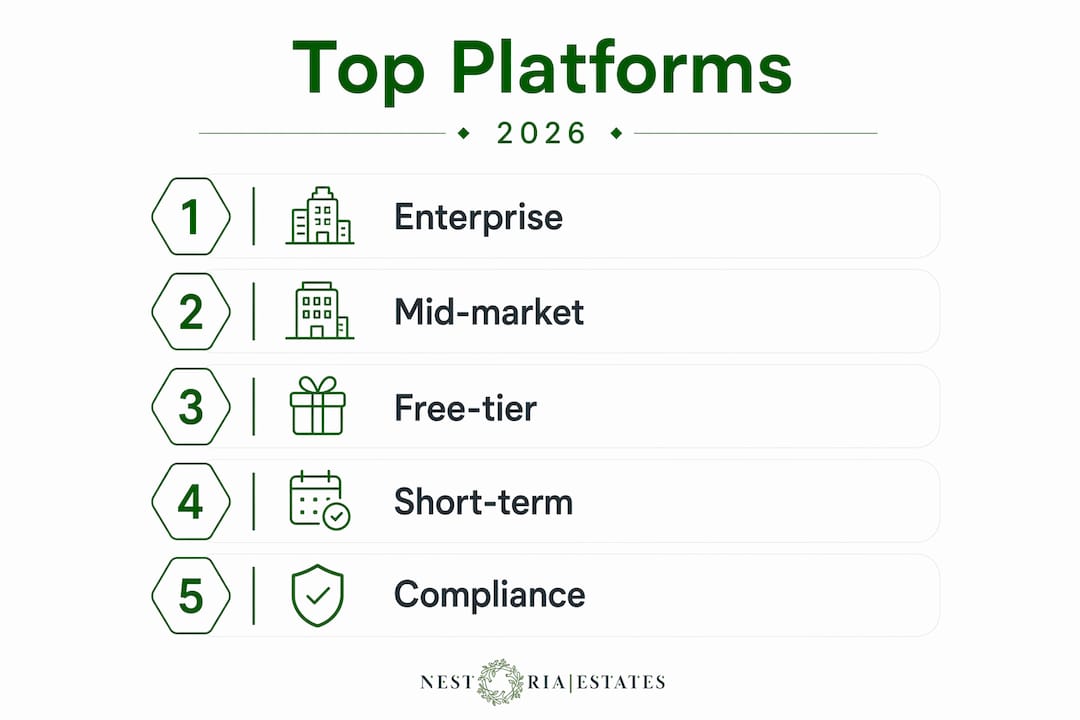
Here is the shortlist by use case:
Large multifamily and commercial portfolios: Yardi, MRI Software, RealPage, Entrata, Skyline, Property Matrix, Acumatica
Mid-sized residential portfolios: Buildium, AppFolio, Rent Manager, Hemlane, Propertyware, Clyr, DoorLoop
Small landlords and DIY managers: TenantCloud, Avail, Innago, Baselane, Rentec Direct, Landlord Studio, RentRedi, TurboTenant
Financial tracking and reporting: Stessa, DualEntry, Baselane
Leasing and showing automation: ShowingHero, Tenant Turner, Apartments.com Rental Manager, Zillow Rental Manager
Short-term rental and Airbnb management: PropUp, Bidrento, UpperBee (with Canadian compliance tools)
International and North American multifamily: UpperBee, Bidrento, Acumatica
For Vancouver Airbnb owners specifically, the non-negotiable features are real-time API channel sync (not iCal), AI-powered guest messaging, and built-in compliance tracking for the city’s short-term rental license requirements.
Pro Tip: If you manage more than two listings in Vancouver, iCal sync is not a viable option. The 15–30 minute update delay creates real double-booking exposure on Airbnb and VRBO simultaneously.
Side-by-side comparison of the top 2026 property management platforms
The platforms below cover the full spectrum from solo landlords to enterprise operators. One column you will not see here is a generic star rating: the table focuses on what each tool actually does and who it fits.
Platform | Best For | Key Features | Pricing |
Large multifamily and commercial | Full accounting, compliance, maintenance, reporting | Custom quote | |
Mid-to-large residential and commercial | Revenue optimization, analytics, leasing automation | Custom quote | |
Multifamily landlords | Integrated marketing, resident portal, mobile app | Custom quote | |
Small residential landlords | Bookkeeping, tax filing, rent collection | Free tier; paid plans available | |
Small to medium portfolios | Tenant portals, accounting, maintenance tracking | Tiered monthly plans | |
Residential and commercial managers | AI workflows, mobile access, leasing tools | Per-unit monthly | |
Large property firms | Configurable platform, open API, enterprise integrations | Custom quote | |
Single-family rental managers | Owner portals, custom reporting, maintenance | Per-unit monthly | |
Vacation rental operators | Channel management, real-time sync, guest messaging | Tiered plans | |
Mid-sized residential managers | Automation, owner reporting, expense tracking | Tiered plans | |
Leasing agents | Self-showing tech, lead management, scheduling | Subscription | |
Small to medium landlords | Screening, automated leasing workflows | Tiered plans | |
Small landlords and DIY managers | Tenant portals, accounting, online payments | Free tier; paid plans | |
Mid-market landlords | Local agent network, hybrid management | Tiered monthly | |
Small to medium managers | Accounting, tenant screening, reporting | Per-unit monthly | |
Real estate investors | Financial dashboards, portfolio tracking, tax prep | Free tier; paid plans | |
Individual landlords | Mobile expense tracking, tenant management | Tiered plans | |
DIY landlords | Lease agreements, rent collection, applications | Free tier; paid plans | |
Budget-conscious small landlords | Free lease management, tenant screening | Free | |
Landlords using Apartments.com | Listing integration, screening, rent collection | Free tier | |
Budget-conscious landlords | Free marketing, applicant tracking | Free tier; paid plans | |
Landlords marketing on Zillow | Listing sync, tenant screening, rent collection | Free tier | |
Growing property managers | Multi-channel sync, automation, user-friendly design | Tiered monthly | |
Small landlords needing mobile tools | Screening, rent collection, maintenance tracking | Annual subscription | |
Mid-to-large portfolios | Modular accounting, marketing, maintenance | Per-unit monthly | |
Enterprise with finance needs | ERP integration, financial operations, scalability | Custom quote | |
Large multifamily and commercial | Advanced workflow automation, custom reporting | Per-unit monthly | |
Managers needing accounting integration | Accounting workflows, data integration, reporting | Tiered plans | |
Vacation rental hosts | Channel syncing, tenant app, booking management | Tiered plans | |
Skyline | Large multifamily and commercial | Operational tools, maintenance management | Custom quote |
Multifamily with international reach | Cloud platform, compliance tools, North American focus | Tiered plans |
Enterprise platforms (Yardi, MRI Software, RealPage, Acumatica) are built for organizations managing hundreds or thousands of units. Their pricing reflects that: all four require a custom quote, and implementation typically involves dedicated onboarding teams. For a Vancouver condo investor with two or three properties, these are overkill.
Mid-market workhorses like Buildium, AppFolio, and DoorLoop hit the sweet spot for property managers handling 10–200 units. AppFolio’s AI-powered workflows stand out in this tier: the platform automates maintenance requests, lease renewals, and applicant screening in ways that genuinely reduce manual work. DoorLoop’s real-time sync and clean interface make it a strong pick for managers who want modern tooling without an enterprise price tag.
Free-tier tools including Innago, TurboTenant, Stessa, and Baselane serve landlords who are just getting started or managing a handful of units. Innago is genuinely free for core lease management and screening. Stessa’s financial dashboards are the best free option for investors who want portfolio-level reporting without paying for a full property management system.
Short-term rental specialists PropUp and Bidrento address the channel management and guest communication needs that long-term rental software ignores. For Vancouver Airbnb owners, Hemlane’s hybrid model (software plus local agent support) is worth a look if you want hands-on help without a full-service management company.
UpperBee’s explicit focus on North American compliance, including Canadian market requirements, gives it an edge for multifamily operators who need bilingual support and compliance export tools built in rather than bolted on.
How automation changes property management operations in 2026
Automation in property management has moved well past scheduled emails and auto-pay reminders. The platforms doing it right in 2026 handle the entire operational loop: booking intake, guest or tenant communication, payment collection, task dispatch to cleaners and maintenance crews, and financial reporting, all without manual intervention at each step.

For Vancouver Airbnb owners, the most consequential automation is multi-channel calendar sync. Hosts using iCal feeds accept a 15–30 minute update window between a booking on one platform and a block appearing on others. That gap is long enough for a simultaneous booking on a second channel. Real-time API connections close that window to seconds, which is why experienced Canadian hosts insist on native API integrations rather than iCal when evaluating any channel manager.
Hosts connecting to multiple booking channels report 42% more revenue than those listing on a single platform. The math is straightforward: more distribution means more visibility, and real-time sync means you can list on Airbnb, VRBO, Booking.com, and Expedia simultaneously without the operational risk that used to make multi-channel hosting impractical.
AI-powered guest messaging is the other automation category that has crossed from optional to expected. Automated AI replies draft responses to the most common guest questions and can send them automatically, saving hours of manual inbox management each week. For a host managing five or more Vancouver listings, that time saving is the difference between a sustainable operation and constant burnout.
Key automation features worth prioritizing in 2026:
Real-time API channel sync across Airbnb, VRBO, Booking.com, and Expedia (not iCal)
AI-powered messaging with automated replies and template libraries
Dynamic pricing integration that adjusts nightly rates based on demand, local events, and competitor data
Automated payment collection with direct deposit to owner accounts
Cleaning and maintenance task dispatch triggered by checkout events
Financial reporting with revenue breakdowns by channel and property
Compliance tracking for Vancouver’s short-term rental license requirements
Pro Tip: When evaluating any property management app, ask specifically whether the channel manager uses a direct API or iCal. Vendors sometimes list both as equivalent options. They are not.
Why landlord software beats spreadsheets for property management
Spreadsheets are not a property management system. They are a workaround that works until it doesn’t, and the failure mode is usually expensive: a missed rent payment, a double-booked unit, or a tax filing error that triggers an audit.
The core problem with spreadsheets is that they require manual updates at every step. A tenant pays late, and you have to remember to flag it. A maintenance request comes in by text, and you have to log it manually. A booking arrives on VRBO while you are updating your Airbnb calendar, and you have a conflict. Dedicated software handles all of these automatically, with audit trails and notifications built in.
For Vancouver Airbnb owners, the regulatory dimension makes spreadsheets especially risky. The city requires short-term rental operators to display valid license numbers on every listing. Tracking license renewal dates, compliance documentation, and tax reporting obligations across multiple properties in a spreadsheet is a manual process with no safety net. Software with built-in compliance workflows flags upcoming deadlines and keeps records in one place.
Specific advantages of dedicated landlord software over spreadsheets:
Automated rent collection with late fee calculation and payment history logs
Tenant screening integrated directly into the application workflow
Maintenance request tracking with vendor assignment and status updates
Lease management with e-signature and renewal reminders
Tax-ready financial reports exportable for Canadian accounting workflows
Multi-property visibility from a single dashboard without cross-referencing multiple files
Audit trails for every transaction, communication, and document
For a short-term rental operation in Vancouver, the switch from spreadsheets to dedicated software typically pays for itself within the first month through avoided errors and recovered time alone.
How to choose the right property management software in Canada for 2026
The right software depends on three variables: your portfolio type, your management style, and your budget. A solo landlord with two long-term rentals has completely different needs than a professional property manager running 50 short-term rentals across Vancouver.
Start with portfolio type. Long-term residential landlords need strong accounting, tenant screening, and lease management. Short-term rental hosts need channel management, guest communication tools, and dynamic pricing. Commercial property managers need customizable workflows and enterprise-grade reporting. Trying to use a tool built for one category in another usually means paying for features you don’t need while missing the ones you do.
Decision criteria chart:
Criteria | Small landlord (1–5 units) | Mid-market manager (10–50 units) | Enterprise / large portfolio (50+ units) |
Budget priority | Free or low-cost tier | Per-unit monthly pricing | Custom contract |
Must-have features | Rent collection, basic screening | Accounting, maintenance, tenant portal | Full ERP integration, compliance |
Channel management | Optional | Recommended | Required |
Mobile app | Nice to have | Required | Required |
Customer support | Email or chat | Phone and chat | Dedicated account manager |
Compliance tools | Basic | Canadian tax exports | Full regulatory workflow |
Additional factors that matter for Canadian operators:
Canadian tax compliance: Look for GST/HST tracking and CRA-compatible reporting exports. Not all US-built platforms handle Canadian tax structures correctly.
Bilingual support: If you manage properties in Quebec or serve French-speaking guests, bilingual platform support matters. UpperBee and some enterprise platforms offer this.
Data security: Confirm the platform stores data on Canadian or compliant servers. PIPEDA compliance is the relevant standard for Canadian property managers handling tenant personal information.
Trial periods: Most mid-market platforms offer 14–30 day free trials. Use them. A platform that looks good in a demo often reveals friction in daily use within the first week.
Integration depth: Check whether the platform connects to tools you already use, including QuickBooks, Xero, or your preferred dynamic pricing tool. A vacation rental booking workflow that requires manual data transfer between systems defeats the purpose of automation.
For Vancouver short-term rental hosts specifically, the short-term rental tools that matter most are those with direct API connections to Airbnb, VRBO, and Booking.com, plus built-in license number fields for Vancouver’s compliance requirements.
Canadian market insights: managing short-term rentals in Vancouver in 2026
Vancouver’s short-term rental market operates under some of the strictest municipal regulations in Canada. Every listing on Airbnb or VRBO must display a valid city-issued license number, and Airbnb enforces this as a listing requirement. Hosts who cannot produce the documentation before going live face immediate delisting, not a grace period.
The channel management picture in Vancouver reflects the broader Canadian OTA landscape. Airbnb dominates urban short-term rental volume, but real-time sync across 60+ channels including VRBO, Booking.com, and Expedia is what separates hosts who maximize occupancy from those who leave revenue on the table. Platforms that offer under-60-second sync times across all connected channels give Vancouver hosts a meaningful operational advantage during peak booking periods.
Direct bookings are the other revenue lever worth building toward. Processing payments through an integrated gateway like Stripe costs approximately 2.9% plus C$0.30 per transaction, compared to OTA commissions that run 5–20% depending on the platform. A property management system with a built-in direct booking engine lets you capture that margin on repeat guests without losing the discovery benefits of OTA listings.
Key considerations specific to Vancouver and Canadian short-term rental operators:
License compliance: Software must support storing and displaying Vancouver’s short-term rental license numbers on all connected listings.
Real-time API sync: iCal’s 15–30 minute delay creates unacceptable double-booking risk for multi-platform hosts. Native API connections are the only viable option.
GST/HST tracking: Canadian hosts collecting short-term rental income above the registration threshold must track and remit GST/HST. Software with built-in Canadian tax exports simplifies this considerably.
Regulatory documentation: Software can track compliance deadlines and store documents, but it cannot supply missing licenses. Getting the paperwork right before listing is a prerequisite no platform can bypass.
Bilingual capability: English/French bilingual support matters for operators serving guests from Quebec or managing properties in bilingual markets.
Statistic callout: Hosts listing on two or more booking channels report 42% more revenue than single-channel operators, a figure that underscores why real-time multi-channel management is the single highest-ROI investment for Vancouver Airbnb owners in 2026.
For a deeper look at how Vancouver Airbnb management strategy translates into higher yields, the combination of real-time channel sync, AI messaging, and dynamic pricing consistently outperforms any single-tool approach. Property managers who treat these three as a system rather than separate features tend to see the strongest occupancy and revenue results.
Nestoriaestates: full-service management for Vancouver Airbnb owners
The platforms compared above are tools. They require you to set them up, monitor them, respond to alerts, and make judgment calls when something goes wrong at 11 PM on a Friday. For Vancouver property owners who want the revenue without the operational load, Nestoriaestates offers a different path.

Nestoriaestates handles the entire short-term rental operation for Vancouver owners: pricing optimization using live market data, guest communication from inquiry to checkout, cleaning coordination, maintenance, and detailed owner reporting, complemented by professional property photo services that enhance listing attractiveness. You get a free revenue projection upfront, transparent reporting on every booking, and continuous pricing adjustments based on local demand. No platform subscriptions to manage, no guest messages to answer, no cleaning schedules to coordinate.
The contrast with self-managed software is concrete. A property manager using AppFolio or DoorLoop still makes the daily decisions. Nestoriaestates takes those decisions off your plate entirely, which is a different value proposition than any software tool can offer. For Vancouver Airbnb owners who want predictable income without active management, explore Nestoriaestates’ services to see what a fully managed approach looks like for your property.
FAQ
What is the best property management software for small Canadian landlords?
For small landlords managing 1–5 units in Canada, Innago, TenantCloud, and Baselane offer the strongest free or low-cost options, covering lease management, rent collection, and basic accounting without a monthly subscription.
Why is iCal sync a problem for Vancouver Airbnb hosts?
iCal sync updates calendars with a delay that creates a window where a booking on one platform may not block dates on others fast enough to prevent a simultaneous booking elsewhere. Real-time API connections eliminate this risk entirely.
How do Canadian short-term rental hosts handle GST/HST in their software?
Platforms like UpperBee and Nokumo offer Canadian tax reporting exports compatible with CRA requirements. US-built platforms often lack native GST/HST tracking, so Canadian hosts should confirm this feature before committing to any tool.
What does Nestoriaestates offer that property management software does not?
Nestoriaestates provides full-service Airbnb management for Vancouver owners, handling pricing, guest communication, cleaning, and reporting on the owner’s behalf. Software tools require the owner to operate them; Nestoriaestates removes that operational responsibility entirely.
How many booking channels should a Vancouver Airbnb host list on?
Hosts listing on two or more channels report 42% more revenue than single-channel operators. For Vancouver, Airbnb, VRBO, and Booking.com are the core channels, and adding a direct booking engine offers an extra opportunity to capture repeat guests at lower commission cost.
Key Takeaways
The single most impactful decision for Vancouver Airbnb owners in 2026 is choosing a property management system with real-time API channel sync, not iCal, combined with AI messaging and dynamic pricing as a unified operational system.
Point | Details |
Multi-channel revenue lift | Hosts listing on two or more channels report 42% more revenue than single-channel operators. |
iCal vs. API sync | iCal’s 15–30 minute delay creates double-booking risk; real-time API sync closes that window to seconds. |
Software vs. spreadsheets | Dedicated software automates rent collection, compliance tracking, and financial reporting that spreadsheets handle manually. |
Canadian compliance | Vancouver hosts must display valid short-term rental license numbers on every listing; software tracks deadlines but cannot supply missing paperwork. |
Nestoriaestates option | For Vancouver owners who want income without operations, Nestoriaestates provides full-service Airbnb management as an alternative to self-managed software tools. |
Recommended
rr88ca.com có đáng lướt qua không? Ừ, mình lướt thử cho biết thôi, kiểu vào xem họ trình bày có gọn gàng, có nói rõ thông tin cơ bản không, chứ không có ý đào sâu gì. Trên trang chủ có dòng “Trang Chủ Chính Thức 2026” nên mình dừng lại đọc vài đoạn giới thiệu, thấy họ ghi RR88 xuất hiện từ 2018 và đặt trụ sở ở Philippines, đọc vậy thì ít nhất cũng biết họ đang muốn nói rõ nguồn gốc. Kéo trang xuống khá mượt. Chữ dễ đọc, chia khối nội dung rõ nên không bị ngợp. Mình cũng thích cái cách họ gom mục thành từng cụm, nhìn lướt là thấy ngay mấy tiêu đề…
Mình cũng hay ngồi soi cầu cho vui thôi, chứ không dám đặt niềm tin 100%. Hồi trước toàn nhìn lô rơi với lô gan rồi chốt theo linh cảm, trượt vài lần là lại bực mình vì thấy mình nóng vội. Gần đây mình đọc thêm về Cầu về nhiều nháy nên bắt đầu quan sát kỹ hơn kiểu lặp nhịp, nhất là những con có dấu hiệu nháy qua mấy kỳ rồi im một đoạn lại quay lại. Có lần mình theo đúng cái nhịp đó, lúc đầu ra khá ổn nên cũng tự tin hơn, nhưng sau đó nó gãy cái rụp làm mình tỉnh ra. Từ đó mình coi mấy thứ này như gợi ý, kèm…