
Vacation Rental Setup Guide for Vancouver Airbnb Owners

TL;DR:
Most vacation rentals fail not due to location but because of poor systems, emphasizing setup over aesthetics.
Proper planning, legal compliance, and operational infrastructure, including technology and documentation, are crucial for success.
Most vacation rentals fail not because of bad locations, but because of bad systems. You can have a gorgeous condo steps from Stanley Park and still watch your calendar sit empty while your neighbor’s less impressive unit books solid. The difference almost always comes down to how the property was set up, not where it sits. This vacation rental setup guide walks Vancouver property owners through every layer of that process, from business planning and local permits to furnishing, technology, operations, and financial compliance. Get these foundations right, and the revenue follows.
Table of Contents
Key takeaways
Point | Details |
Plan before you furnish | Create a business plan and research Vancouver’s STR market before spending a dollar on furniture or decor. |
Permits come first | Vancouver’s short-term rental rules require licenses and registration before you can legally accept guests. |
Systems beat aesthetics | Repeatable cleaning, inspection, and inventory workflows drive guest satisfaction more than premium furniture alone. |
Tech pays for itself | Dynamic pricing tools, channel managers, and smart locks reduce manual work and increase nightly revenue. |
Accounting needs STR structure | A vacation rental optimized chart of accounts protects you from compliance risk and simplifies tax reporting. |
Vacation rental setup guide: planning and legal groundwork
Before you buy a single throw pillow, you need a business plan. That means running numbers: projected occupancy, average nightly rate for comparable Vancouver listings, startup costs, and your break-even timeline. Vancouver’s short-term rental market is competitive and geographically specific. A one-bedroom in Kitsilano performs very differently from one near Metrotown. Research both neighborhoods and booking windows before committing to a pricing strategy. The global STR market is projected at USD 149.20B in 2025 with 11.8% annual growth to 2033, which means more competition, not less.
Vancouver’s short-term rental rules
Vancouver requires hosts to obtain a short-term rental business license and list only their principal residence. That last part is the one that catches investors off guard. If you own a secondary investment property and plan to operate it as a full-time short-term rental, you need to understand exactly what the city permits before listing. Read the current regulations carefully at Vancouver STR regulations before you do anything else. Local regulatory compliance requires beginning permits early in your setup process to avoid fines and forced shutdowns.
Here is what your legal and planning checklist should cover:
Business plan with startup cost projections and 12-month revenue forecast
Market research specific to your neighborhood, unit type, and comparable listings
City of Vancouver STR business license application
Strata or condo bylaw review to confirm short-term rentals are permitted
Landlord insurance or short-term rental specific policy from a Canadian insurer
GST/HST registration if your gross rental revenue exceeds $30,000 annually
BC provincial rules reviewed alongside municipal requirements
Pro Tip: Get your insurance and licensing sorted before photographing the property. Lenders and platforms may ask for proof of coverage before your listing goes live.
Property preparation and furnishing
The goal of furnishing your rental is not to create your dream home. It is to build a space that photographs well, holds up to weekly turnover, and meets the expectations of Vancouver travelers, who tend to be savvy, design-aware, and quick to leave reviews. A comprehensive inventory checklist should guide every room, covering furniture, linens, kitchen gear, and safety equipment with documented purchase prices for insurance and tax purposes.

Must-have vs. premium amenities
Category | Must-Have | Premium Add-On |
Sleep | Quality mattress, pillows, blackout curtains | Weighted blankets, hotel-grade linens |
Kitchen | Full cookware set, coffee maker, knife block | Espresso machine, local pantry starter kit |
Connectivity | High-speed WiFi, clear network info | Smart TV with streaming, dedicated workspace |
Safety | Smoke detector, CO detector, fire extinguisher | Smart smoke sensor with app alerts |
Comfort | Heating and A/C, extra towels and blankets | In-unit washer/dryer, heated floors |
Safety setup is non-negotiable. Smoke detectors per floor and sleeping area, CO detectors near gas appliances, and fire extinguishers in key locations are required. Test all safety equipment at each turnover, not just when something seems wrong. Non-slip mats in the bathroom and night lights in hallways are small additions that prevent real problems.
When choosing furniture, prioritize durability and cleanability over visual complexity. Upholstered pieces should use performance fabric. Light-colored rugs and intricate wood finishes look great in photos but become liabilities after 20 guest stays. The luxury rental checklist from Nestoriaestates goes deeper on this for owners targeting the premium tier.
Pro Tip: Buy one extra set of every consumable, such as toilet paper, dish soap, and coffee pods, and store them on-site. Running out between restocks is one of the top complaints in reviews.
Setting up technology and your listing
A well-managed short-term rental in 2026 runs on software as much as it runs on good sheets. Setting up the right tech stack early saves you hours per week and prevents the costly double-bookings and pricing mistakes that sink newer hosts.
Here is the sequence to follow:
Choose a property management system (PMS) that syncs calendars across platforms. Tools like Hostaway, Guesty, or Lodgify give you a central dashboard for reservations, messaging, and reporting.
Integrate a dynamic pricing tool such as PriceLabs or Wheelhouse. These tools adjust your nightly rate based on local demand, events, and seasonal patterns. Static pricing leaves significant money on the table.
Install smart locks to automate check-in. Self-check-in consistently earns higher guest satisfaction scores and eliminates scheduling headaches around key handoffs.
Set up automated messaging sequences for booking confirmation, pre-arrival instructions, mid-stay check-in, and post-stay review requests. Guests respond well to timely, clear communication.
Take professional photos before listing. Listings with professional photography earn measurably more bookings at higher rates. Hire a real estate or hospitality photographer familiar with Airbnb composition.
Write your listing description to address the most common guest questions upfront: parking, transit access, WiFi quality, and house rules. A description that preemptively answers objections converts better.
The operational workflow for luxury rentals on the Nestoriaestates blog covers the tech selection process in more depth for owners managing premium properties.
Pro Tip: List on at least two platforms from day one. Relying on a single channel concentrates your risk. Even with a channel manager, maintaining two active listings increases your visibility and booking volume.
Operations: cleaning, inspections, and guest experience
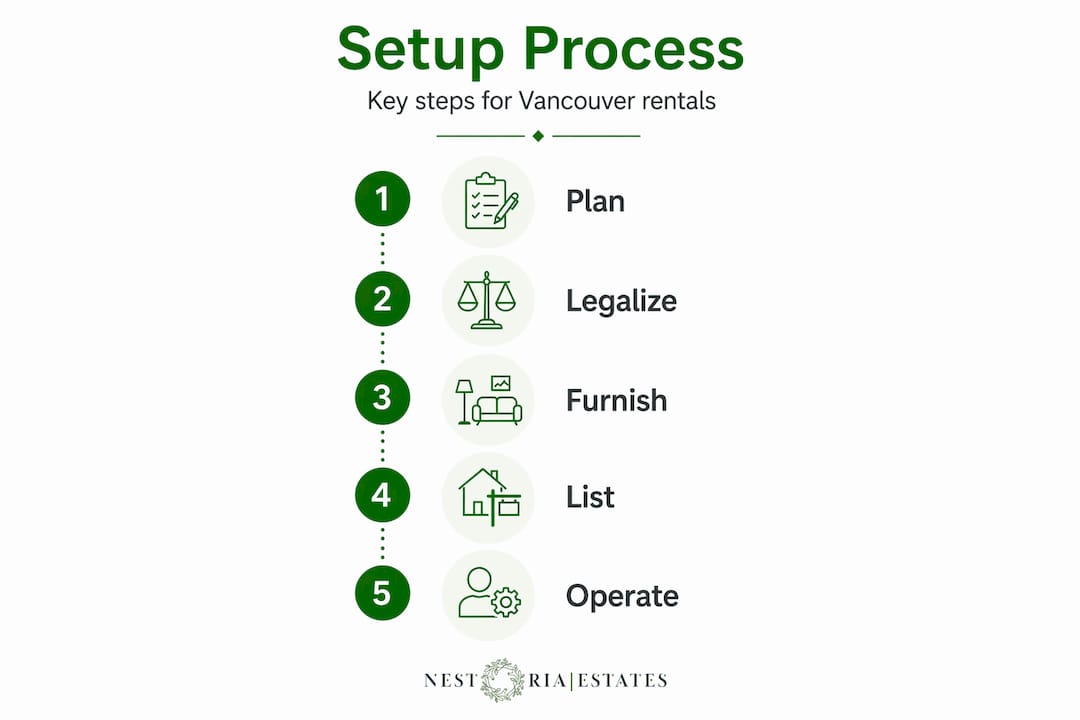
This is where most vacation rental owners discover that setting up a vacation rental is really about building a small service business. The five operational pillars of successful STR management are pricing, guest communication, cleaning and turnover, maintenance, and reviews. Neglect any one of them and your ratings drift. Let two slip and recovery is slow.
Turnover and inspection workflows
Most STR owners underestimate how much repeatable turnover inspections matter. A post-departure inspection should confirm the condition of every surface, appliance, and piece of furniture before the cleaner begins. A pre-arrival inspection confirms everything is guest-ready before check-in. Document both with photos. Over time, those records help you spot recurring issues, whether it is a door handle that keeps loosening or a cleaner who consistently misses the stovetop, and fix them before they become reviews.
Your cleaning checklist should be room-specific and printed or sent digitally to every cleaner before every turnover. Do not rely on memory or assumed standards.
House manual and guest communication
A house manual built from real guest questions performs far better than a generic welcome document. Pull the questions you have actually received or anticipate receiving, and organize them into clear sections: arrival and parking, WiFi, appliances, climate control, house rules, and local recommendations. Write it like you are texting a friend directions. Include photos of the thermostat, the garbage bins, the key lockbox. Keep it updated. Outdated information creates more friction than no information at all.
Operations area | What to track | Review frequency |
Consumables | Quantity on hand vs. par level | Every turnover |
Safety equipment | Functioning status, battery level | Monthly |
Inventory condition | Damage, wear, missing items | Quarterly |
Guest reviews | Rating trends, recurring themes | Weekly |
Pro Tip: Schedule a full inventory audit every quarter. Use the documented purchase prices from your initial setup to accurately value any replacements for tax purposes.
Financial setup and ongoing compliance
Vacation rental accounting is not the same as general rental accounting. A proper setup requires a specialized chart of accounts with 120 to 180 accounts covering revenue streams, cleaning and supply costs, owner liability accounts, trust clearing, and capital expenditures. This structure keeps your books clean and makes tax reporting far less painful.
Revenue tracking and tax compliance
Account category | Examples |
Revenue | Nightly rental income, cleaning fees collected, damage deposits |
Operating expenses | Cleaning, supplies, platform fees, utilities |
Owner liability | Funds held in trust pending owner disbursement |
Capital expenditures | Furniture purchases, appliances, renovation costs |
Using third-party booking platforms like Airbnb shifts some tax collection responsibilities. Intermediary platforms handle accommodation tax remittance in many jurisdictions, but you are still responsible for documenting which channels you use and confirming which taxes they cover versus which you owe directly. In Vancouver, you need to understand how the provincial municipal and regional district taxes interact with what Airbnb collects on your behalf.
Accurate STR accounting also simplifies owner statement generation and protects you if you are ever audited. The goal is for your books to clearly separate every revenue and expense category so your accountant can produce a compliant return without reconstruction.
Pro Tip: Set up a dedicated business bank account and credit card for your rental before your first booking. Mixing personal and rental finances creates reconciliation problems that compound over time.
My take on what actually determines success
I have worked with enough Vancouver short-term rental owners to say this with real confidence: the property rarely fails because of the property itself. It fails because the owner treated setup as a one-time event instead of a living system.
What I have seen repeatedly is that owners who invest heavily in design but skip the operational infrastructure hit a wall around month three. Reviews start drifting. A cleaning issue slips through. A guest can not figure out the thermostat, and no one responds fast enough. The gaps are almost always in process, not furniture.
The two things I would push every Vancouver host to prioritize are documentation and automation. Document your inspection process from day one, even if it feels excessive for a single unit. That documentation becomes your quality control system and your proof of condition when a damage dispute arises. Automate every guest message you possibly can. Not because you do not care, but because consistent, timely communication is what guests actually need, and manual responses at midnight are not sustainable.
Compliance is the other area that gets underestimated, particularly around Vancouver’s principal residence requirement and the tax interaction between Airbnb’s collection and provincial obligations. Stay current on local rules. They change. If you are not monitoring them actively, a regulation shift can put you offside without warning.
The hosts who perform well long term are not necessarily the ones with the nicest units. They are the ones who avoid common yield mistakes and treat their rental like the business it is from the very first day.
— Kamran
Let Nestoriaestates handle the complexity
Getting your vacation rental setup right across every dimension, legal compliance, pricing strategy, guest experience, and financial tracking, is genuinely demanding work. Most owners do not realize how much is involved until they are already operating.

Nestoriaestates specializes in full-service short-term rental management for Vancouver property owners. From professional management services including dynamic pricing, guest communication, and cleaning coordination, to hands-on support navigating local regulations, the team takes the operational weight off your plate entirely. Whether you are setting up your first rental or optimizing an existing one, Nestoriaestates offers free revenue projections and transparent reporting so you always know exactly how your property is performing. Contact Nestoriaestates to get a personalized assessment and a clear picture of what your property can realistically earn in today’s Vancouver market.
FAQ
What permits do you need for a Vancouver Airbnb?
Vancouver requires a short-term rental business license and mandates that hosts rent only their principal residence. Check current rules before listing, as enforcement has tightened significantly since 2023.
How much should I budget to set up a vacation rental?
Setup costs vary by property size and condition, but a thorough launch, covering furnishing, safety gear, photography, tech tools, and licensing fees, typically runs between $5,000 and $20,000 for a one-bedroom Vancouver unit.
What is a vacation rental chart of accounts?
A vacation rental chart of accounts is a specialized accounting structure with 120 to 180 accounts designed to track STR-specific revenue, expenses, owner liabilities, and capital items accurately for tax and compliance purposes.
How do I manage vacation rental cleaning at scale?
Create a written, room-specific cleaning checklist and send it to your cleaner before every turnover. Pair it with pre-arrival and post-departure inspections to catch issues before guests check in.
Does Airbnb collect taxes on my behalf in Vancouver?
Airbnb collects and remits certain accommodation taxes in British Columbia, but you are still responsible for confirming which taxes are covered and filing any remaining obligations directly with the provincial and municipal authorities.
Recommended
Comments