
Personalized Hospitality: A Practical Guide for Vancouver Hosts
Personalized hospitality means tailoring every guest interaction to that specific person’s preferences, context, and behavior rather than delivering a one-size-fits-all experience. For Vancouver Airbnb owners, it’s the difference between a guest who leaves a five-star review and books again versus one who had a perfectly fine stay and never returns.
A few things worth knowing upfront:
Personalization drives measurable revenue. Research cited by Jurny puts revenue uplifts from personalization in a moderate range, with ancillary revenue gains commonly reported for hosts using upsell systems.
Guest data is the engine. Without capturing stay purpose, arrival time, and repeat-guest flags, personalization stays superficial.
Quick wins cost almost nothing. A tailored pre-arrival message and a handwritten welcome note require zero tech investment.
Canadian law applies. Under CASL, sending marketing emails after a stay requires either express consent or documented implied consent, governed by CRTC guidance.
Key Takeaways
Personalized hospitality is the single most reliable lever Vancouver Airbnb hosts have to improve review scores, repeat bookings, and ancillary revenue, and the first stage requires no new software.
Point | Details |
Start with messaging, not tech | Segmented pre-arrival templates deliver immediate guest-perceived personalization at zero cost. |
Revenue uplift is measurable | Personalization programs are associated with revenue uplifts in the 10–30% range and ancillary gains around 15%. |
CASL consent must be documented | Implied consent from a stay applies for roughly two years; express consent is required for unrelated marketing beyond that. |
Maturity stages guide investment | Move from Basic to Established before spending on AI tools; clean guest data is the prerequisite. |
Track five KPIs | NPS trend, repeat booking rate, review score, ancillary revenue per stay, and offer conversion rate tell you whether personalization is working. |
Table of Contents
What does personalized hospitality actually mean?
TrustYou defines personalization in hospitality as customizing a guest’s experience based on their preferences, behavior, and interactions with the property. Operationally, that means anticipating what a guest needs before they ask, then delivering it in a way that feels human rather than automated.
For a Vancouver host, this looks like: knowing a guest is arriving on a red-eye from Toronto and leaving the blackout blinds down; recommending the Granville Island Public Market instead of a generic “local attractions” list; or placing a small bottle of BC wine in the kitchen for a couple celebrating an anniversary.
What personalized hospitality is not:
Inserting a guest’s first name into a template and calling it personalization
Equating personalization with luxury. A $150/night Kitsilano apartment can out-personalize a five-star hotel that runs scripted service. For a deeper look at where luxury and personalization diverge, see what luxury hospitality actually means.
Full automation with no human override. Automation handles delivery; judgment stays human.
A one-time gesture. Real personalization is a system, not a moment.
Mews frames it as tailoring services to each guest’s needs across every touchpoint, from pre-arrival messaging through checkout. The emotional component matters as much as the operational one: guests remember how a stay made them feel, not the thread count.
Why personalized hospitality matters for your bottom line
The business case is straightforward. Guests who feel recognized spend more, review better, and come back.
Guest-facing gains:
Higher satisfaction scores and more detailed positive reviews
Stronger emotional connection to the property, which drives repeat bookings
Reduced friction (guests who receive proactive information ask fewer questions)
Business gains:
Revenue uplift in the 10–30% range from personalization programs, per Jurny’s analysis of McKinsey-sourced data
Ancillary revenue gains around 15% for hosts who offer personalized upsells (late checkout, local experience add-ons)
Better review scores, which directly affect Airbnb search ranking in Vancouver’s competitive market
Operational efficiency through targeted automation that reduces repetitive guest questions
Statista’s data on accommodation booking factors shows personalization and convenience rank among the top influences on booking decisions, sitting alongside price and location. The global personalization software market reflects this demand, with investment momentum accelerating as properties of every size recognize the revenue case.
For short-term rental operators specifically, the compounding effect matters most. A guest who books twice generates roughly twice the lifetime revenue with zero acquisition cost.
What data and systems make personalization possible?
Personalization runs on data. The architecture is simpler than most hosts assume: guest data flows from your property management system (PMS) into a guest profile, then triggers messaging and on-property adjustments.
The data points that actually move the needle:
Stay purpose (business, leisure, special occasion)
Arrival and departure times
Language preference (critical in bilingual Canadian markets)
Repeat-guest flag and previous stay notes
Accessibility needs or dietary preferences captured at booking
Special occasions noted in the booking message
AltexSoft’s breakdown of personalization building blocks identifies guest profiles, segmentation logic, and automated triggers as the three technical foundations. Without a clean guest profile, every other system is guessing.
Practical integration priorities for a Vancouver host:
Two-way calendar sync between Airbnb and your PMS so guest data doesn’t live in silos
Guest notes field that carries forward across stays (repeat-guest recognition)
Automated pre-arrival trigger (24–48 hours out) pulling from the guest profile
Smart lock or keypad integration so check-in instructions personalize to arrival time
Post-stay trigger for review requests and, where consent allows, future offers
Industry platforms like TrustYou and Mews illustrate what full PMS-to-CRM integration looks like at scale. For a single Vancouver property, you don’t need enterprise software.
AI for Canadian Business notes that AI tools can draft bilingual pre-arrival messages and automate common touchpoints while preserving the moments that need a human response. That’s the practical split: automate the predictable, personalize the meaningful.
Pro Tip: Build a library of 20–30 brand-toned message templates covering pre-arrival, check-in, mid-stay, and post-stay moments. Automation delivers them; you override manually for exceptions. This single habit, recommended by Canadian practitioners, keeps personalization consistent without consuming your day.
How to implement personalized guest service step by step
Prioritize by effort-to-impact ratio. Most Vancouver hosts should spend the first month on quick wins before touching any new software.
Quick wins (same day to one week):
Add a guest notes field to your booking workflow. Record stay purpose, arrival time, and any detail from the booking message.
Write a personalized welcome note referencing something specific: the occasion, the neighborhood they mentioned, or their arrival city.
Build three pre-arrival message templates (leisure, business, special occasion) and send the right one 48 hours before check-in.
Create a local recommendations list segmented by guest type: families, couples, solo business travelers.
Mid-term (one to four weeks):
Set up a simple guest profile log (a shared Google Sheet works) capturing repeat-guest history, preferences, and special requests.
Segment your upsell offers. A couple celebrating an anniversary gets a different offer than a business traveler arriving Sunday night.
Add a mid-stay check-in message at the 24-hour mark asking if anything needs attention.
Advanced (one to three months):
Integrate a PMS with automated messaging triggers tied to guest profile fields.
Use hyper-personalization tactics that time offers and messages to behavioral signals: a guest who checked in late gets a different morning message than one who arrived at noon.
Build a post-stay sequence that requests a review, then (with proper consent) follows up with a return-booking offer.
Sample pre-arrival email structure:
Subject: Your Vancouver stay is [X days] away, [First Name] Opening line referencing their specific context (anniversary, first visit to Vancouver, business trip). Practical details: check-in time, access instructions, parking note. One personalized local recommendation tied to their stay purpose. Offer to answer questions before arrival. Warm sign-off with host name.
Hostfully’s guidance on short-term rental personalization and ManageYourProperty’s automation advice both emphasize the same principle: automation handles delivery, but the message content must feel written for that specific guest. For consistent delivery across every stay, the template library is what makes personalization repeatable rather than dependent on memory.
What stage of personalization maturity are you at?
Most Vancouver hosts sit at Stage 1 without realizing it. Here’s how the three stages break down:
Stage | Definition | Required data and systems | Typical complexity |
Basic | Manual, reactive personalization based on booking details | Booking platform data, manual notes, simple templates | Low; one person can manage |
Established | Proactive, segmented personalization with automated triggers | Guest profile log, PMS with messaging, segmentation rules | Medium; requires setup time upfront |
Hyper-personalized | Real-time, AI-driven personalization across all touchpoints | Integrated PMS + CRM, behavioral triggers, AI messaging | High; suits multi-property operators |
Signals you’re ready to move from Basic to Established:
You have at least 10% repeat guests and no system to recognize them
You’re sending the same pre-arrival message to every guest regardless of context
Guests are asking the same three questions repeatedly (a sign your proactive messaging isn’t targeted)
Signals you’re ready for hyper-personalization:
Your guest profile data is clean and consistent across 90%+ of bookings
Automation is running reliably with low error rates
You manage three or more properties and manual personalization is creating inconsistency
AltexSoft’s technical breakdown maps these stages to specific system requirements. The jump from Basic to Established is the highest-ROI move for most single-property Vancouver hosts.
How do you measure whether personalization is working?
Track these five KPIs. Each one has a measurement method a solo host can actually use.
Primary KPIs:
NPS/CSAT: Ask one question post-stay (“How likely are you to recommend this property?”). Track the trend monthly.
Repeat booking rate: Divide repeat bookings by total bookings over a rolling 90-day window.
Review score trend: Monitor your Airbnb star rating weekly. Personalization effects show up in written reviews within two to three booking cycles.
Ancillary revenue per stay: Track revenue from upsells (late checkout, add-ons) as a dollar amount per booking.
Conversion on personalized offers: Of guests who receive a segmented offer (return-booking discount, mid-stay upsell), what percentage converts?
Mini A/B experiment to prove impact:
For your next 20 bookings, send 10 guests a standard pre-arrival message and 10 a personalized version referencing their specific stay context. Compare review scores, question volume (fewer questions = better proactive information), and any upsell conversion between the two groups. Jurny’s revenue uplift data suggests even basic personalization moves the needle within a small sample.
What Canadian privacy rules apply to guest data?
Canadian hosts operate under two overlapping frameworks: CASL for marketing communications and PIPEDA for personal data handling.
The rules that matter most:
CASL (Canada’s Anti-Spam Legislation): Sending a commercial electronic message (a promotional email, a return-booking offer) requires either express or implied consent. Under CRTC guidance, implied consent from a transactional relationship (a completed stay) typically applies for two years. Express consent is required for unrelated marketing beyond that window.
PIPEDA: Governs how you collect, use, and store personal information. British Columbia has its own provincial privacy law (PIPA) that applies to BC-based operators and is broadly similar in principle.
Provincial note: Quebec’s Law 25 imposes stricter requirements than PIPEDA for Quebec-based operators. Vancouver hosts operating under BC’s PIPA should confirm their data practices with a privacy professional.
Privacy checklist for Vancouver hosts:
State in your booking flow what guest data you collect and why
Record the source and date of each consent (booking platform, direct inquiry, post-stay opt-in)
Retain guest data only as long as necessary (a two-year retention policy aligned with CASL’s implied consent window is a reasonable starting point)
Provide a clear opt-out mechanism in every marketing message
Never share guest data with third parties without explicit consent
Pro Tip: Collect express consent for post-stay marketing at the point of booking, not after the stay. A single checkbox in your direct booking flow (“I’d like to receive future offers from [property name]”) is far easier to document than trying to establish implied consent retroactively. For complex cases, consult a Canadian privacy lawyer.
Real-world examples: what personalized hospitality looks like in practice
Global chain example: Marriott and Hilton
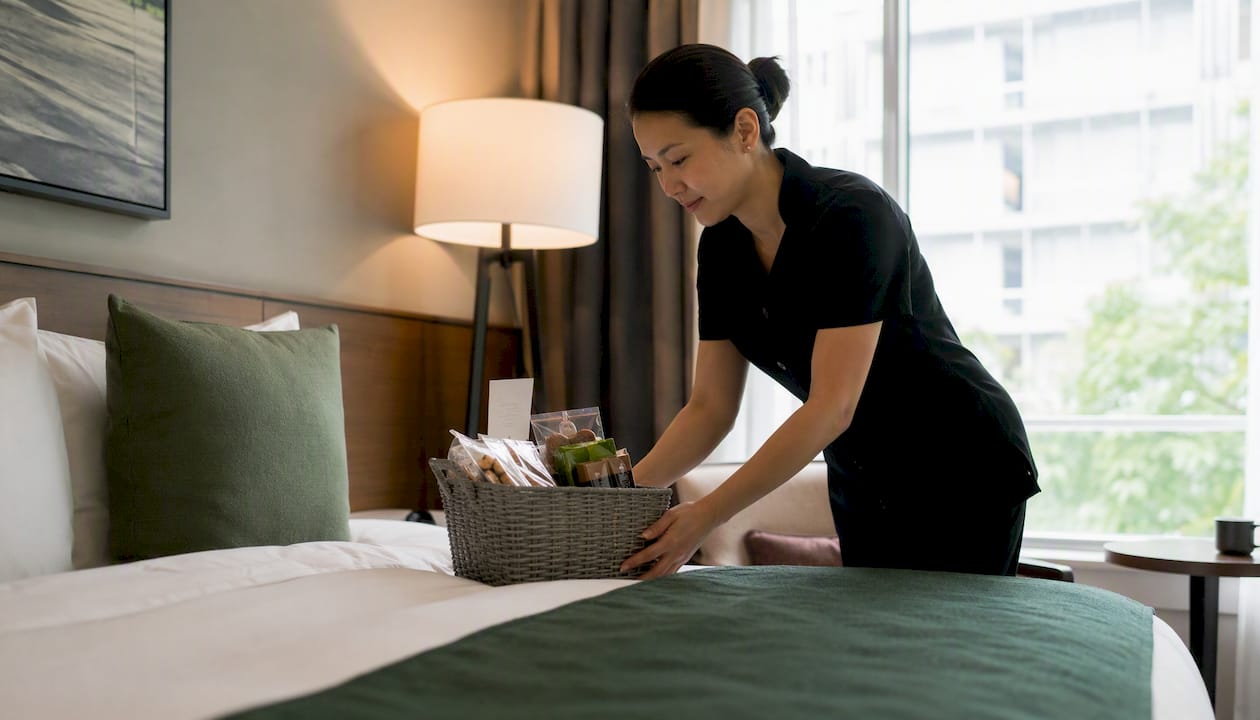
Marriott’s Bonvoy program and Hilton’s Honors platform both use stay history and preference data to pre-set room configurations, send targeted upgrade offers, and time loyalty communications to individual booking patterns. The measurable outcome is well-documented in loyalty program retention rates. For a Vancouver Airbnb host, the transferable lesson is simpler: a repeat-guest flag in your system should trigger a different welcome than a first-timer receives.
Boutique property example: Airbnb Superhosts
Airbnb’s Superhost data consistently shows that top-rated hosts share one habit: they respond to booking details in their communications. A guest who mentions a birthday in their booking message and receives a small acknowledgment on arrival generates the kind of review that mentions the host by name. The practical tactics for creating a stay guests remember follow the same logic: specificity beats generosity.

Vancouver short-term rental example: Nestoriaestates
A Vancouver property managed by Nestoriaestates illustrates how personalization scales across a portfolio. Guest communication templates are segmented by stay type, arrival time, and language preference. Repeat guests receive a recognition note and a tailored local recommendation updated for the season. The operational result is fewer mid-stay questions, higher review scores, and a measurable repeat-booking rate above the Vancouver market average.
Two takeaways for any Vancouver host:
Segment your welcome communication by at least three guest types (leisure, business, special occasion). The effort is 90 minutes upfront; the payoff compounds across every booking.
Track your repeat-guest rate quarterly. If it’s below 10%, your post-stay sequence needs work before you invest in any new technology.
Quick-win checklist for Canadian hosts
Immediate (one afternoon):
Write three pre-arrival message templates segmented by stay purpose
Add a guest notes field to your booking workflow
Create a local recommendations doc with 10–15 options segmented by guest type (families, couples, solo travelers)
Set a reminder to send a mid-stay check-in message 24 hours after check-in
Short-term (one to four weeks):
Build a simple guest profile log capturing repeat-guest history and preferences
Set up automated messaging triggers in your PMS or booking platform
Draft a post-stay sequence: review request at checkout, return-booking offer at day seven (with consent)
Segment your upsell offers by guest type and occasion
Medium-term (one to three months):
Integrate your PMS with a messaging tool that supports bilingual templates (relevant for Vancouver’s multilingual guest base)
Build a 20–30 template library covering every guest touchpoint
Run a 20-booking A/B test on personalized vs. standard pre-arrival messaging
Review your privacy checklist and confirm CASL consent documentation is in place
For understanding your target guest before building these segments, start with your last 20 reviews. The language guests use to describe what they valued tells you exactly what to personalize.
What does personalization actually cost?
The honest answer: the first stage costs almost nothing. The advanced stage requires real budget.
Stage 1 (Basic personalization): Zero software cost. The investment is time: roughly three to five hours upfront to build templates and a guest profile log, then 10–15 minutes per booking to apply them. For a Vancouver host managing one or two properties, this is the right starting point.
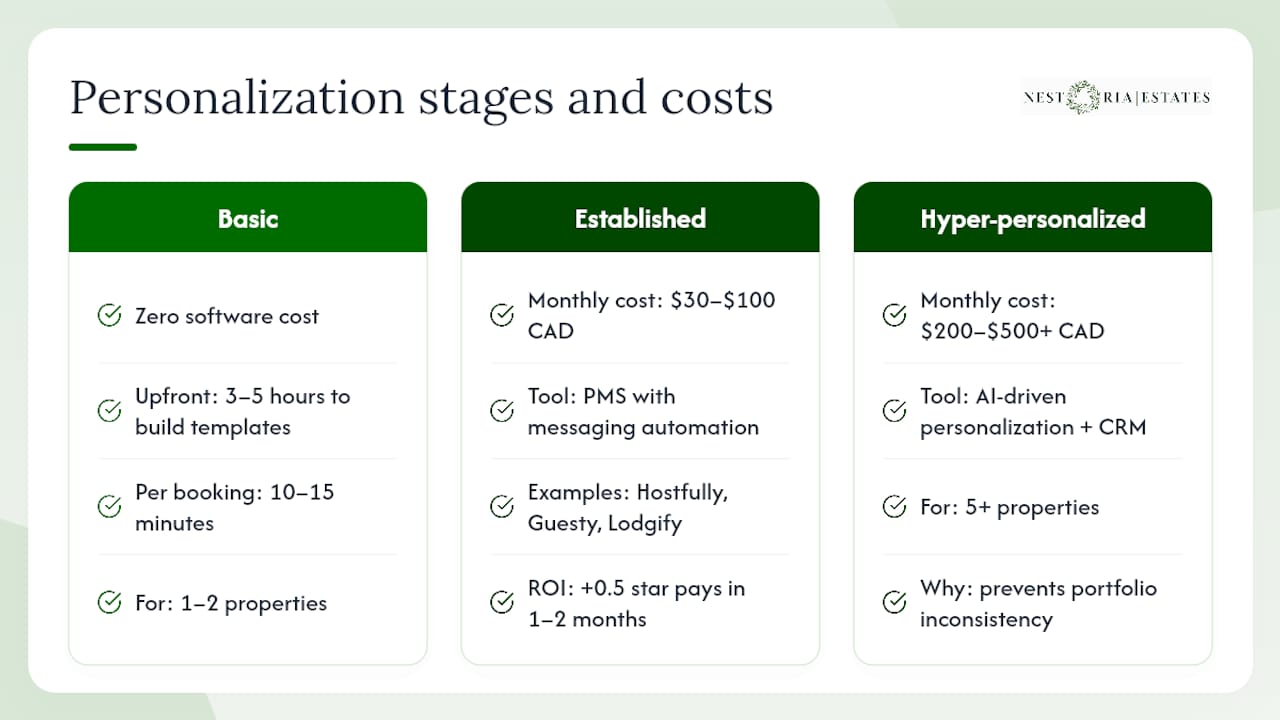
Stage 2 (Established): A PMS with built-in messaging automation runs roughly $30–$100 CAD per month for a single property, depending on the platform and feature set. Tools available in Canada include Hostfully, Guesty, and Lodgify, each with different pricing tiers. The ROI case is straightforward: if personalization lifts your average review score by half a star, the resulting improvement in Airbnb search ranking typically pays for the software within one to two months.
Stage 3 (Hyper-personalized): AI-driven personalization tools and full CRM integration add meaningful cost, typically $200–$500+ CAD per month for multi-property operators. This tier makes sense when you’re managing five or more properties and manual personalization is creating inconsistency across your portfolio.
Budget guidance for Vancouver hosts: Start with the free tier of whatever PMS you already use. Build the template library first. Only add paid automation tools once your guest profile data is clean enough to make automation accurate. Spending on software before your data hygiene is solid produces automated mediocrity, not personalization.
A perspective on what most Vancouver hosts get wrong
The most common mistake isn’t skipping personalization. It’s confusing activity with impact.
Hosts spend hours curating welcome baskets and local guides, then send the same generic pre-arrival message to every guest. The basket costs $40 and gets a passing mention in the review. A pre-arrival message that references the guest’s specific context, arrival time, and reason for visiting costs nothing and gets quoted verbatim in five-star reviews.
The data from Jurny’s hyper-personalization research supports this: timing and context matter more than the gesture itself. A bottle of wine left in the kitchen for an anniversary couple is memorable. The same bottle left for a solo business traveler arriving at 11 PM after a delayed flight is irrelevant.
Vancouver’s short-term rental market is competitive enough that the difference between a 4.7 and a 4.9 rating affects your search placement materially. Personalization is the most reliable lever to move that number, and the first stage costs an afternoon.
Nestoriaestates manages this across a Vancouver portfolio by treating personalization as an operational system, not a hospitality philosophy. Templates, triggers, guest profiles, and a clear consent framework. The services Nestoriaestates offers cover every layer of this for owners who want the outcome without the operational overhead.
Sources
Authoritative references used throughout this guide:
How personalization in hotels improves guest experience - Mews
Personalization in Hospitality: Stages, Key Elements, and In - AltexSoft
Hyper-Personalization: the Future of Hotel Marketing - Hospitality Net
Statista chart: influencing factors in accommodation booking online
Canadian Radio-television and Telecommunications Commission (CRTC) — CASL guidance
FAQ
What is personalized hospitality in simple terms?
Personalized hospitality means tailoring a guest’s experience to their specific preferences, context, and behavior rather than offering the same service to everyone. For a Vancouver Airbnb host, it starts with capturing stay purpose and arrival time, then using that information to shape every communication and in-property detail.
How does personalized hospitality differ from luxury service?
Luxury service delivers high-quality scripted gestures to every guest equally. Personalized hospitality delivers the right gesture to the right guest at the right moment, regardless of property price point. A $150/night apartment with a context-aware welcome note can outperform a five-star hotel running identical check-in scripts for every arrival.
What Canadian privacy rules apply when collecting guest data?
Vancouver hosts must comply with CASL for marketing communications and BC’s PIPA for personal data handling. Under CRTC guidance, implied consent from a completed stay typically covers transactional messages for two years; express consent is required for unrelated marketing. Document consent sources and dates for every guest.
What is the fastest way to start personalizing guest experiences?
Build three pre-arrival message templates segmented by stay purpose (leisure, business, special occasion) and send the appropriate one 48 hours before check-in. This single tactic requires no new software and typically shows up in review language within two to three booking cycles.
How do you measure whether personalization is working?
Track your NPS trend, repeat booking rate, and Airbnb review score on a rolling 90-day basis. For a direct test, run a 20-booking A/B experiment comparing a personalized pre-arrival message against your standard template and compare review scores and mid-stay question volume between the two groups.
Recommended
Comments