

Guest Experience: Why It Drives Loyalty, Rates, and Reviews
- info67421305
- 2 days ago
- 9 min read

Guest experience matters because it’s the single biggest lever hospitality owners have over repeat bookings, achievable rates, and online reputation, more than price ever will be. A large-scale review analysis found that experiential quality explains roughly 70 to 78% of the variance in guest satisfaction, while price barely moves the needle once experience and amenities enter the picture. If you manage even one listing, the verdict is simple: put your limited time into the guest moments that signal genuine care, not into shaving another few dollars off your nightly rate.
Experience, not price, predicts repeat bookings and rebooking intent
Higher review scores translate directly into better search placement on Airbnb and Vrbo
Small, consistent touches beat occasional grand gestures
Key Takeaways
Guest experience, not price, is the strongest lever hospitality owners have over repeat bookings, achievable rates, and online reputation.
Point | Details |
Experience beats price | Experiential quality explains 70 to 78% of variance in guest satisfaction; price contributes marginally. |
“Looked after” drives rebooking | Reassurance and clear expectations predict return bookings better than a lower nightly rate. |
Fix cleaning and messaging first | Cleanliness and pre-arrival communication are the highest-leverage, lowest-cost improvements available. |
Track repeat-guest leakage | Most repeat-guest revenue still flows through OTAs; capturing direct contact recovers commission dollars. |
Nestoria Estates operationalizes consistency | Full-service management applies pricing, messaging, and cleaning coordination continuously, not as one-time fixes. |
Table of Contents
Why Guest Experience Matters More Than Customer Service
Guest experience is the full arc of how someone feels about staying with you, from the moment they browse your listing photos to the follow-up message you send after checkout. Customer service, by contrast, is what happens when something goes wrong or a guest needs something specific. It’s a subset, not a synonym.
The distinction matters because owners who only think in terms of service tend to react. They fix problems well but never build the deeper sense of care that turns a one-time guest into a repeat one. Metrics like CSAT, NPS, and review-platform scores measure experience precisely because they capture the whole stay, not just the moments you had to intervene.
Scope: Customer service covers isolated interactions; guest experience covers the entire journey, including the physical space itself.
Timing: Service is reactive and often mid-stay; experience starts before arrival and continues after checkout.
Emotional outcome: Good service resolves friction; great experience creates anticipation and trust.
Measurement: Service is tracked by resolution time and complaint volume; experience is tracked by review scores, RevPAR, and repeat-booking rate.
How Guest Experience Impacts Loyalty, Revenue, and Reputation
Every dollar you spend improving a guest’s stay tends to show up somewhere on your books, usually in more than one place at once. Better experiences lift five things owners actually care about:
Repeat bookings. Research on Airbnb hosts found that creating a sense of being looked after predicts return bookings more reliably than a lower price point.
Achievable nightly rate. Guests who trust a listing based on strong reviews are less price-sensitive at the point of booking.
Occupancy and visibility. Airbnb and Vrbo both weight review scores and response rates in search ranking, so a stronger reputation compounds into more impressions.
Lower OTA dependency. HostAI’s analysis of over 231,000 confirmed bookings found that 77% of repeat-guest revenue still routes back through OTAs, meaning most owners are paying commission twice on the same guest relationship they should be able to capture directly.
Reputation as a moat. A property with a consistent 4.9 rating and detailed, positive reviews reads to future guests as low-risk, which shortens their decision time and increases conversion from view to booking.
The number that should reset your priorities: experiential quality accounts for 70 to 78% of the explained variance in guest satisfaction scores across a dataset of nearly 110,000 Airbnb reviews. Price, once amenities and experience are accounted for, barely registers. If you’re competing on nightly rate alone, you’re optimizing the variable that matters least.
For Vancouver hosts specifically, this plays out in a competitive downtown and False Creek market where reviews influence future bookings almost as much as location does. Two nearly identical condos a block apart can see very different occupancy simply because one has forty detailed five-star reviews and the other has twelve generic ones.

What Makes a Great Guest Experience?
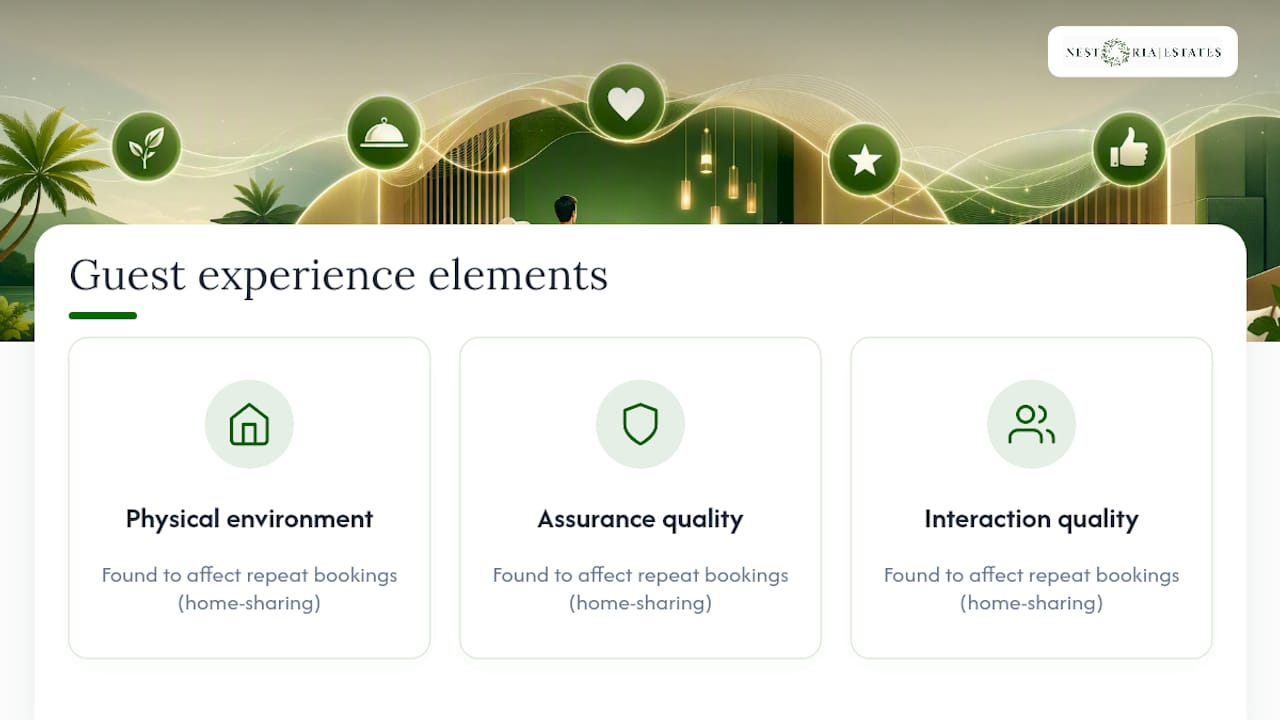
The drivers that move satisfaction scores aren’t exotic. They’re consistent execution on a short list of fundamentals, and research on home-sharing loyalty backs this up directly: physical environment quality, assurance quality, and interaction quality are the three dimensions that most reliably build loyalty in short-term rentals.
Listing accuracy. What guests see in your photos and description should match what they find, down to bed size and view.
Seamless arrival. Keyless entry, clear directions, and a check-in that takes under five minutes.
Cleanliness and comfort. This is the top driver of negative reviews when it fails, and it’s almost invisible when it succeeds.
Communication and responsiveness. Aim to answer pre-arrival questions within an hour during waking hours; guests read speed as care.
Personalization and local knowledge. A short list of nearby restaurants or a note about the best coffee shop costs nothing and reads as generous.
Reliable Wi-Fi. Industry research on short-term rental guest behavior names fast Wi-Fi among the top decision drivers guests use to compare rentals to hotels.
Staff and vendor professionalism. Cleaners, maintenance techs, and anyone who interacts with a guest represent your brand whether you’re on-site or not.
Pro Tip: Track cleanliness complaints and response time separately. If cleanliness issues dominate your negative reviews, fix your turnover checklist before touching anything else. It’s usually the highest-leverage repair available.
How Guest Experience Looks Different Across Hospitality Segments
The core principles hold everywhere, but the levers that matter most shift by segment.
Hotels live or die on consistency across dozens or hundreds of rooms; front-desk interaction quality and housekeeping standards dominate satisfaction scores.
Restaurants compress the whole experience into 60 to 90 minutes, so pacing, server attentiveness, and food timing carry outsized weight.
Short-term rentals depend heavily on pre-arrival communication and listing accuracy, since guests never meet a human before they walk in.
Events hinge on logistics and staff coordination, where one bottleneck (registration, parking, seating) can define the entire guest memory.
For a Vancouver Airbnb host managing a condo near Yaletown or Kitsilano, the practical takeaway is narrow but powerful: tighten your pre-arrival messaging sequence and your listing photos before you touch anything else. Those two levers do more for a self-managed rental than any amenity upgrade.
How to Improve Guest Experience in the Next 90 Days
Owners tend to overhaul everything at once and lose track of what actually moved the needle. A staged approach works better.
Audit listing accuracy first. Compare your current photos and description against the actual unit. Fix mismatches within a week; this is the fastest way to reduce negative surprises.
Rebuild your pre-arrival message sequence. One message at booking confirmation, one 48 hours out with check-in details, and one on arrival day with a personal touch.
Standardize your cleaning checklist. Give cleaners a written, room-by-room list rather than relying on memory. Cleaning is part of the guest experience in a way that shows up in reviews faster than almost anything else.
Upgrade Wi-Fi and one comfort item. New router or mesh system, plus one upgrade like better pillows or blackout curtains.
Run a 30-day pilot. Change one variable at a time (usually messaging or cleaning first), track review language before and after, and only scale what shows a measurable shift.
Automate the repetitive messages. Use scheduled or templated messaging for check-in instructions so your personal replies are reserved for the moments that actually need a human.
Add exactly one personalized touch. A local recommendation note or a small welcome item. More than one tends to feel performative rather than genuine.
Pro Tip: Guests want reassurance and easy access to help, not frequent unsolicited contact. Hosts’ research on “being looked after” consistently points to optional, concise responsiveness as the sweet spot. Message enough to prevent problems; don’t message so much you feel intrusive.
Resource allocation follows a simple rule: do the free things yourself (messaging templates, listing edits), and pay for the things that fail without professional consistency (cleaning, maintenance response, dynamic pricing).
How Do You Measure Guest Experience Impact?
You can’t improve what you don’t track, and most owners track far too little. A workable KPI set includes CSAT and NPS from post-stay surveys, average review score across platforms, repeat-booking rate, direct-booking share versus OTA share, average daily rate, occupancy, cost per turnover, and average resolution time for guest issues.
Review these weekly: response time, active issue resolution, and any new reviews.
Review these monthly: average review score trend, repeat-booking rate, direct-booking share, and occupancy against your market comp set.
Attribute revenue impact with simple before/after cohorts: compare ADR and occupancy for the 90 days before a change against the 90 days after, holding season constant where possible.
Pro Tip: Capture guest email at checkout, even informally, and tag which bookings originated from a repeat stay. That single habit is what lets you recover revenue currently leaking to OTA commissions on guests who would have booked directly if you’d asked.
The Research and ROI Case for Prioritizing Experience
The evidence converges on one point: experience beats price as the primary driver of both satisfaction and rebooking. The Airbnb host study found that guests who felt reassured and clearly informed were more forgiving of small issues and more likely to return, regardless of nightly rate. The 110,000-review analysis found experience explaining most of the variance in satisfaction, with price a minor factor. And repeat-booking research shows most owners are still losing that repeat revenue to OTA fees rather than capturing it directly.
Experience explains the bulk of satisfaction variance; price explains little
“Being looked after” beats low price as a rebooking predictor
Most repeat-guest revenue still routes through OTAs, an avoidable cost
Statistic to remember: experiential factors account for 70 to 78% of the variance in guest satisfaction in the largest available Airbnb review dataset. That’s the number to cite the next time someone suggests cutting your rate instead of fixing your check-in process.
Why This Should Change What You Prioritize This Quarter
That’s good news, because price is largely dictated by the market and experience is entirely within your control.
If you manage your own rental or a small portfolio, run one experiment this month: rewrite your pre-arrival message sequence and track your review language for 30 days. Nestoria Estates builds exactly this kind of guest communication and cleaning coordination into ongoing management because consistency, not one-time effort, is what actually protects a rating over a full year.
How a Full-Service Manager Turns This Into a System
Everything in this article works better when it’s not something you have to remember to do every week. Nestoria Estates is the alternative to piecing together your own listing edits, message templates, and cleaner check-ins: it operationalizes all of it, from pricing optimization and guest messaging to cleaning coordination and owner reporting, so the consistency that drives repeat bookings happens automatically instead of depending on your schedule.

For Vancouver Airbnb owners juggling a day job alongside a rental, that consistency is usually the difference between a listing that plateaus and one that climbs toward a stronger review average and higher occupancy quarter over quarter. Nestoria Estates handles the full range of management services so you get the revenue benefits of a well-run guest experience without doing the operational work yourself. If you want to see what that could mean for your specific property, request a free revenue projection and get a clear picture before you commit to anything.
Sources
FAQ
What are the three elements of guest experience?
Most frameworks reduce guest experience to physical environment quality, assurance quality (trust and reassurance), and interaction quality, the same three dimensions research on home-sharing loyalty found significantly affect repeat bookings.
What are the most essential elements of a positive guest experience?
Listing accuracy, cleanliness, fast communication, reliable Wi-Fi, and a sense that the host is genuinely looking after the guest consistently rank as the top drivers of satisfaction and rebooking intent.

What are the 5 C’s of hospitality?
Definitions vary across the industry, but a common version centers on cleanliness, communication, comfort, consistency, and care, all of which map directly onto the measurable drivers covered in this guide.
Why does guest experience matter more than price for Airbnb hosts?
Because experiential quality explains most of the variance in guest satisfaction once amenities are accounted for, while price contributes very little to how guests actually rate a stay.
How can a property manager improve guest experience for Vancouver hosts?
A full-service manager like Nestoria Estates standardizes pre-arrival messaging, cleaning checklists, and pricing so the consistency that drives repeat bookings happens without the owner managing every detail personally.
Recommended
Comments