
Why Luxury Rentals Stand Out for Travelers in 2026

TL;DR:
Luxury rentals offer more space, privacy, and amenities tailored for longer stays, surpassing standard hotels.
They attract discerning travelers seeking exclusive, home-like experiences with transparent pricing and personalized service.
Most travelers default to hotels out of habit. The booking is familiar, the loyalty points are stacking up, and at least you know what to expect. But that comfort comes at a cost. A 2025 survey of over 2,000 U.S. travelers found 62% still prefer hotels for holiday travel, largely citing amenities and pricing transparency. That gap is exactly why luxury rentals stand out. They are built to solve the specific complaints travelers have about standard rentals while delivering what hotels simply cannot: space, privacy, and a stay that feels designed for you.
Table of Contents
Key takeaways
Point | Details |
Space drives preference | Families and groups consistently choose luxury rentals for the extra square footage and shared living areas hotels cannot match. |
Amenities set the bar | Top-tier properties offer resort-level amenities including pools, fitness centers, and private access floors as standard features. |
Transparent pricing wins | Luxury rentals that bundle services and eliminate hidden fees convert skeptical hotel loyalists into repeat guests. |
Longer stays favor rentals | Serviced apartments and luxury rentals offer better value and comfort for stays beyond three nights compared to hotels. |
Vancouver market is growing | High-end renters in Vancouver actively seek privacy, exclusivity, and lifestyle flexibility that luxury short-term rentals deliver. |
Why luxury rentals stand out for modern travelers
The hospitality industry has a useful term for the high-end short-term rental category: “luxury serviced accommodations.” This covers everything from a curated penthouse on Airbnb to a fully staffed villa through a boutique rental agency. What makes this category distinct is not just the price tag. It is the philosophy behind the experience.
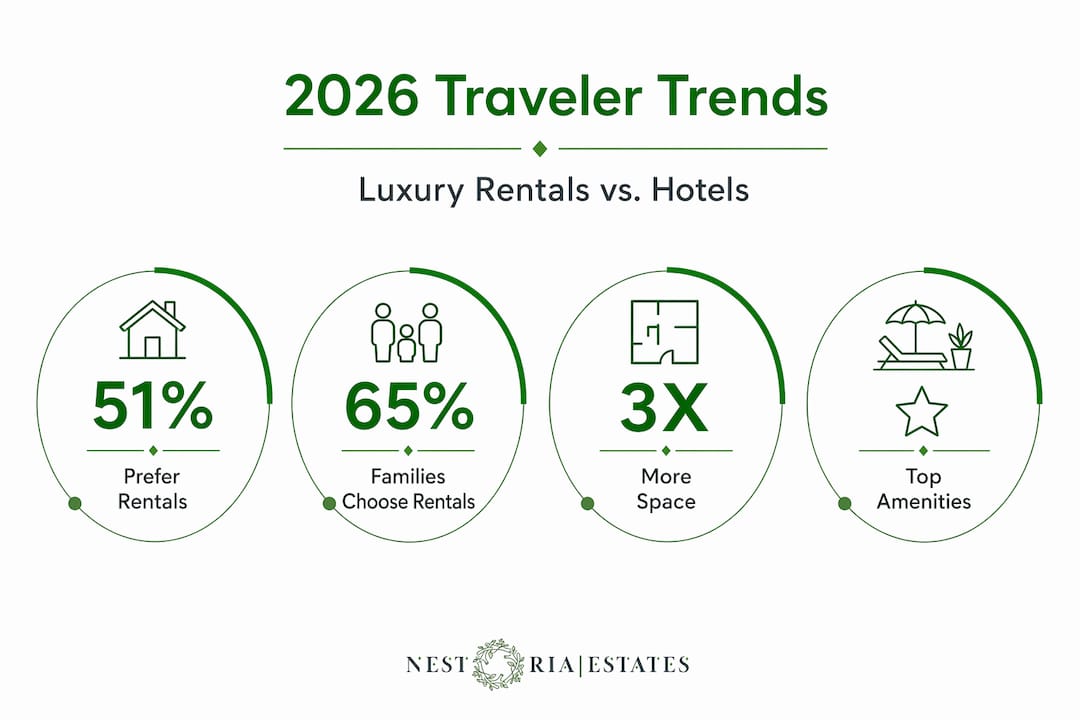
Traveler priorities have shifted significantly. According to a 2026 NerdWallet study, 51% of Americans now prefer vacation rentals over hotels, and that number jumps to 65% among parents traveling with children under 18. The reason is straightforward: hotel rooms are designed for one or two adults sleeping and checking email. Luxury rentals are designed for living.
Consider what a family of four actually needs during a week in Vancouver. They need a kitchen to avoid $200 restaurant bills every night. They need separate bedrooms so adults and kids can decompress separately. They need a living room that does not double as the only place to sit. A standard hotel room delivers none of that. A luxury rental delivers all of it.
Accommodation type | Average space | Private kitchen | Separate bedrooms | Living area |
Standard hotel room | 300 to 400 sq ft | No | No | No |
Luxury hotel suite | 700 to 1,200 sq ft | Sometimes | Rarely | Yes |
Luxury rental (2 bed) | 1,200 to 2,000 sq ft | Yes | Yes | Yes |
Groups traveling together feel this difference even more acutely. Shared spaces and full kitchens rank as top reasons why groups and families choose rentals for longer stays, particularly when practical value matters as much as the aesthetic.
Pro Tip: When evaluating a luxury rental for a group trip, calculate the total cost per person per night including meals you can cook in. A well-equipped rental kitchen often cuts total trip spending by 20 to 30 percent compared to hotel dining.
Amenities that go beyond the hotel standard
This is where understanding the unique features of luxury rentals really changes how you evaluate your options. Hotels offer amenities as shared resources for hundreds of guests. Luxury rentals, especially those in purpose-built residential towers, offer amenities that feel genuinely exclusive.
The Chicago luxury rental market offers a telling benchmark. A February 2026 analysis of the $20,000-plus monthly rental segment found properties offering 1.5 acres of amenity space across multiple floors, including pools, fitness centers, saunas, basketball courts, and golf simulators. These are not hotel add-ons. They are the baseline expectation.
Luxury rental properties in Vancouver’s premium towers operate the same way. Guests access rooftop terraces, concierge-level service floors, private wine rooms, and screening rooms that a hotel guest would pay significantly extra to access, if the hotel offered them at all.
What separates a luxury rental from an expensive Airbnb comes down to a few non-negotiables:
Curated furnishings and design: Not just “nice,” but intentionally sourced, cohesive, and photographically accurate
High-speed technology infrastructure: Gigabit internet, smart home controls, and premium entertainment systems
Private access floors and building security: Keycard-only floors, doormen, and concierge desks staffed around the clock
Resort-caliber wellness spaces: Pools, steam rooms, and fitness equipment that rival dedicated gym memberships
Outdoor and entertaining spaces: Private terraces, barbecue areas, and communal lounges that hotels cannot replicate at this scale
You can review the luxury rental checklist Nestoriaestates publishes for a practical breakdown of what guests at this tier actually expect.
Pro Tip: When listing or booking a luxury rental in a high-rise building, confirm whether amenity access is exclusive to rental guests or shared with all building residents. The distinction matters enormously for the privacy experience.
Service and convenience as a competitive advantage
One of the most underrated luxury rental advantages is what these properties eliminate. Hidden fees are the single biggest reason hotel-preferring travelers distrust short-term rentals. Cleaning fees that appear at checkout, mandatory insurance charges, and confusing cancellation windows all create friction. Luxury rentals that bundle services with transparent pricing directly address this, converting skeptics into loyal guests.

The service model has also evolved on the platform side. Airbnb’s shift from the “Superhost” badge to the “Guest Favorites” designation reflects this change precisely. Quality signals now center on the property itself, factoring in reviews, cleanliness scores, amenity ratings, and overall guest satisfaction rather than just how quickly a host replies to messages.
This matters for travelers because it means the marketplace is increasingly rewarding what luxury rentals were already built to deliver: consistent, property-level excellence.
Here is what the service model looks like at the top tier:
Flexible cancellation policies that match or exceed hotel standards
Dedicated guest support available before, during, and after the stay
Concierge services covering reservations, transportation, and local recommendations
Coordinated housekeeping mid-stay for longer bookings
Clear, all-inclusive pricing with no checkout surprises
The last point is not a minor detail. It is a conversion driver. Travelers who have been burned by unexpected fees on previous rentals will pay a premium for a booking process that resembles what they expect from a four-star hotel.
Operational strengths for longer stays
The industry term “serviced apartment” describes properties that sit between hotels and standard rentals. They are built for guests who need more than a few nights but want more comfort than a hotel provides. Serviced apartments typically cater to medium and long-term stays with home-like setups and more square footage, while hotels remain optimized for short, high-touch visits.
This distinction creates a specific kind of luxury rental advantage for certain traveler segments:
Digital nomads and remote workers who need a functional workspace, reliable internet, and enough room to maintain a routine for two to six weeks
Corporate executives on extended assignments who expect hotel-quality service but cannot live productively in a single hotel room for a month
Relocating families who need time to find permanent housing while maintaining comfort and routine for children
International travelers who prefer the privacy and cost efficiency of a full apartment over successive hotel nights during multi-week trips
The cost math strongly favors luxury rentals beyond the three-night mark. A luxury hotel suite at $500 per night for 21 nights totals $10,500. A comparable luxury rental with full kitchen access, larger space, and lower dining costs often runs 30 to 40 percent less for the same duration. The value compounds with every additional night.
Automation also plays a role. Smart locks, digital check-in, and automated communication allow luxury rental operators to run lean without sacrificing guest experience. Guests get the flexibility of self-directed check-in combined with the assurance of responsive human support when they need it.
The Vancouver luxury rental market
Vancouver occupies a specific and interesting position in the North American luxury rental market. The city attracts affluent transplants from across Canada, the U.S., and internationally, many of whom want to test city living before committing to ownership in one of the most expensive real estate markets on the continent.
High-end renters in Vancouver prioritize exclusivity, walkability to cultural hubs, and the kind of privacy that a detached property or top-floor unit delivers. The guests who book luxury short-term rentals here are rarely tourists on a budget. They are executives, international business travelers, film industry professionals during production season, and families exploring relocation.
For Vancouver Airbnb owners, this creates a genuine opportunity. The guest profile for a premium property in Yaletown, Coal Harbour, or the West End is not the same as a guest booking a budget unit anywhere in the city. What these guests want includes:
Stunning city or water views with floor-to-ceiling glass
Private parking and building security
Proximity to premium dining, fitness, and cultural venues
Fully equipped kitchens with high-end appliances
Fast, reliable fiber-optic internet for remote work
Owners who invest in these features and manage them to a consistent standard do not compete on price. They compete on experience, and that distinction is exactly what makes luxury rentals special as a category in this market.
My honest take on where luxury rentals actually win
I have spent years working with property owners across Vancouver, and the pattern I keep seeing is that the luxury rental advantages people talk about in theory are not always the ones that matter most in practice. Everyone mentions the pool and the views. What actually determines whether a guest rebooks or leaves a glowing review is far simpler.
It is the coffee machine that works. The blackout curtains that actually block light. The welcome guide that answers every question before the guest thinks to ask. These are the moments where a luxury rental either justifies its premium or exposes itself as a nicely photographed disappointment.
What I have learned is that why choose luxury accommodations comes down to this: guests at this tier have very high standards and very low tolerance for friction. They are not comparing you to the Airbnb down the street. They are comparing you to the Four Seasons they stayed at last month. Win on space, privacy, and property quality, then win again on execution. The two cannot be separated.
The future of luxury rentals in markets like Vancouver is property-centric. As Airbnb and similar platforms shift quality signals toward guest satisfaction rather than host metrics, properties that deliver a consistently exceptional physical experience will rise. Owners who understand this and invest accordingly will capture the guests who matter most: the ones who return.
— Kamran
How Nestoriaestates supports luxury rental owners in Vancouver
If you own a premium property in Vancouver and want guests to experience everything that makes luxury rentals special, the operational side matters as much as the physical space.
Nestoriaestates works specifically with luxury short-term rental owners across Vancouver and the rest of Canada, handling pricing optimization, guest communication, cleaning coordination, and detailed owner reporting. Every service is designed so your property performs at the level discerning guests expect, without requiring you to manage the details yourself. From dynamic pricing that reflects real market demand to concierge-grade guest support, the full suite of services is built to maximize both your revenue and your guest ratings. If you want to understand what your property could earn at the luxury tier, reach out to Nestoriaestates for a free revenue projection.
FAQ
Why do luxury rentals stand out compared to standard hotels?
Luxury rentals offer significantly more space, private amenities, and home-like functionality that hotels cannot match at the same price point. For families, groups, and longer stays, the combination of privacy, full kitchens, and resort-level property features creates an experience that consistently outperforms hotel alternatives.
What are the biggest benefits of luxury rentals for families?
According to a 2026 NerdWallet study, 65% of parents with children under 18 prefer vacation rentals over hotels, primarily because of shared living spaces, separate bedrooms, and kitchen access that make family travel more practical and affordable.
How do luxury rental amenities compare to hotel amenities?
Luxury residential rental properties now offer resort-scale amenity packages as a baseline, including pools, fitness centers, saunas, and private access floors. Unlike hotels where these facilities are shared with hundreds of guests, luxury rental buildings typically serve a much smaller, more exclusive resident and guest population.
Are luxury rentals a good option for longer stays?
Yes. Serviced apartments and luxury rentals are specifically designed for medium to long stays, offering more space and home-like setups that hotels are not built to provide. The cost per night also drops significantly relative to hotel suites for stays beyond three to four nights.
What makes Vancouver a strong market for luxury short-term rentals?
Vancouver attracts affluent transplants, executives, and international travelers who prioritize privacy, exclusivity, and lifestyle flexibility. Properties in neighborhoods like Coal Harbour and Yaletown with premium finishes, city or water views, and fast internet consistently attract high-quality guests who book at premium rates.
Recommended
Comments