

Vancouver Owners: 3 Questions to Choose a Cohost or Property Manager

If you own one property and live near it, a co-host usually gets you 80% of the benefit of full management for less money. If you own multiple units, live outside Vancouver, or want someone legally accountable for compliance and operations, a full-service property manager is the safer bet. The right call comes down to scope, fees, and who answers for the property when something goes wrong.
TL;DR:
Co-hosts usually handle only basic messaging and turnover tasks, charging between 10% and 25% of gross revenue, making them suitable for local owners with one property.
Full-service property managers operate more vendors, handle dynamic pricing, and charge 20% to 40%, often managing multiple units remotely and legally responsible for compliance.
Owners should verify who owns the registration and licensing, as outside help does not transfer legal responsibility, which remains with the property owner.
Transitioning from a co-host to full management requires careful coordination of calendars, contracts, finances, and insurance, typically taking two to four weeks.
Owners weighing the switch should request detailed fee structures, payment flow, and reporting options to avoid hidden costs and ensure clear accountability.
Table of Contents
Cohost vs Property Manager: A Quick Comparison
A co-host is someone who helps you run your listing while it stays under your Airbnb account, your reviews, and your name. A property manager typically operates the listing under their own business account, holds broader legal responsibility, and runs it as a standalone operation.
Here’s the fast version:
Co-host: Works inside your existing Airbnb account. You keep the reviews, the Superhost status, and the listing history.
Property manager: Often lists and operates under their own business account, building their own platform equity, not yours.
Fees: Co-hosts typically charge 10% to 25% of gross booking revenue depending on scope; full-service managers commonly run 20% to 40%.
The equity question matters more than most owners realize going in. If you ever sell the property or switch providers, keeping your own reviews and account history under a co-host arrangement means you’re not starting from zero.
What Does Each Role Actually Do Day to Day?
The scope gap between these two models is bigger than the fee gap. Here’s how the workload typically splits:
Guest messaging and booking questions. Both models usually handle this, but co-hosts often work reactively during set hours while managers run 24/7 coverage through dedicated software.
Check-in and check-out coordination. Co-hosts frequently handle this personally, especially for a single nearby property. Managers coordinate it through a vendor network or field staff.
Cleaning and turnover. Co-hosts often clean themselves or manage one cleaner directly. Managers run a rotating vendor pool with backup coverage for no-shows.
Maintenance and repairs. Co-hosts typically call you for anything beyond a light bulb. Managers usually have standing vendor relationships and can authorize repairs up to a set dollar threshold.
Pricing strategy. Co-hosts might adjust rates occasionally. Managers run dynamic pricing tools and adjust nightly based on demand data.
Guest disputes and refund requests. Co-hosts often escalate these to you. Managers generally handle them within a defined policy and only loop you in for high-value cases.
Taxes and lodging remittance stay your responsibility in either arrangement unless your contract explicitly states otherwise, so get that in writing. The technology gap widens the further you scale: a co-host can run one or two units with a shared calendar and a phone, but a property manager needs a proper property management system and a staffed vendor bench to handle more than about 15 to 30 properties without service quality slipping.
How Much Does a Cohost or Property Manager Cost?
Fee structure is where owners get surprised, usually because nobody asks how the percentage is calculated. Co-host fees generally land between 10% and 25% of gross booking revenue, scaling with how much you hand off. A co-host who just answers messages might charge closer to 10%; one who also manages cleaning and pricing pushes toward 25%.
Full-service property managers commonly charge 20% to 40%, covering pricing, guest communication, cleaning coordination, maintenance, and reporting under one fee. Payment flow differs too. With a co-host, Airbnb typically pays you directly and you pay the co-host separately, which keeps your bookkeeping simple but means you’re still the one filing lodging taxes. With a full-service manager, funds often flow through the manager’s custodial account first, then get remitted to you on a set schedule, which shifts some reporting weight but adds a step you need visibility into.
Watch for hidden costs on both sides:
Vendor pass-through charges for cleaning or repairs billed separately from the management fee
Supply restocking fees that aren’t included in the base percentage
Extra administrative charges for tax filing or licence renewal support
Pro Tip: Ask any candidate whether their fee is calculated on gross or net revenue before you sign anything. A 20% fee on gross revenue can end up costing more than a 25% fee on net, depending on how expenses get categorized.
Also ask about payout timing and whether you get audit access to booking-level statements, not just monthly summaries. If a provider hesitates on that question, treat it as a warning sign.
Who Has to Register: Host, Cohost, or Property Manager?
British Columbia’s short-term rental rules draw a sharp line between a “property host,” the person legally entitled to the unit, and a “property manager,” referred to as a supplier host in the province’s own guidance. Anyone handling day-to-day operations who isn’t the property host is generally expected to register as a property manager under provincial rules.
A co-host who only helps with messaging can often stay listed as a secondary contact. But if that co-host is effectively running the listing, the registry treats them as an operator, not a helper, and expects them to register accordingly.
The detail owners miss most often: hiring outside help doesn’t transfer your legal responsibility. BCHA’s compliance guidance makes clear that owners often remain on the hook even when someone else is running operations day to day.
Before signing with anyone, check these four things:
Confirm whose registration number actually appears on your live listing
Verify your provider displays a valid business licence where Vancouver’s municipal rules require it
Ask about strata restrictions if your property is in a multi-unit building
Get written confirmation of who tracks occupancy limits and recordkeeping requirements
How Do I Decide Between a Cohost and a Property Manager?
Start with three questions: How far do you live from the property? How many units do you own? How much operational risk are you willing to carry personally?
A local owner with one property who has time to field the occasional 11 PM message is a strong co-host candidate. An owner living three provinces away, or juggling four properties, generally can’t supervise operations closely enough to catch problems before they become bad reviews.
Once you’ve picked a direction, run this checklist with any candidate:
Get the scope of work in writing, including what’s explicitly excluded.
Confirm how payments flow and whether funds ever sit in a third-party account.
Ask for a sample owner report and how often you’ll receive one.
Nail down termination terms. Thirty days’ notice with no penalty is reasonable; a locked twelve-month term with an early-exit fee is not.
Request proof of insurance and ask directly what happens if a guest is injured on the property.
Ask for two references from current owners, not just testimonials off their website.
A resource like this guide on screening vacation rental management companies walks through more of these vetting questions in detail.
Pro Tip: If a contract describes services in vague terms like “handles guest needs as required,” push back. That phrasing gives a provider room to do the bare minimum while still technically fulfilling the agreement.
Vague language in the scope section is the single biggest red flag. If you can’t tell exactly what’s included just from reading the contract, assume it isn’t included.
When Should You Upgrade From Cohost to Full Management?
Most owners outgrow co-hosting for predictable reasons: repeat maintenance issues nobody’s tracking, a second or third property added to the portfolio, or simply running out of time to stay involved. A staged approach, co-host first, then upgrade, lets you test outsourcing without locking into a long contract before you know what you actually need.
Before handing off, work through this checklist:
Transfer or update calendar and lock access
Review and reassign any existing vendor contracts
Archive guest communication history for continuity
Reconcile finances up to the handover date
Update your insurance policy to reflect the new operator
Expect fee terms and fund custody arrangements to change at this stage. Budget two to four weeks for a clean transition.
What Nestoria Estates Sees Working for Vancouver Owners
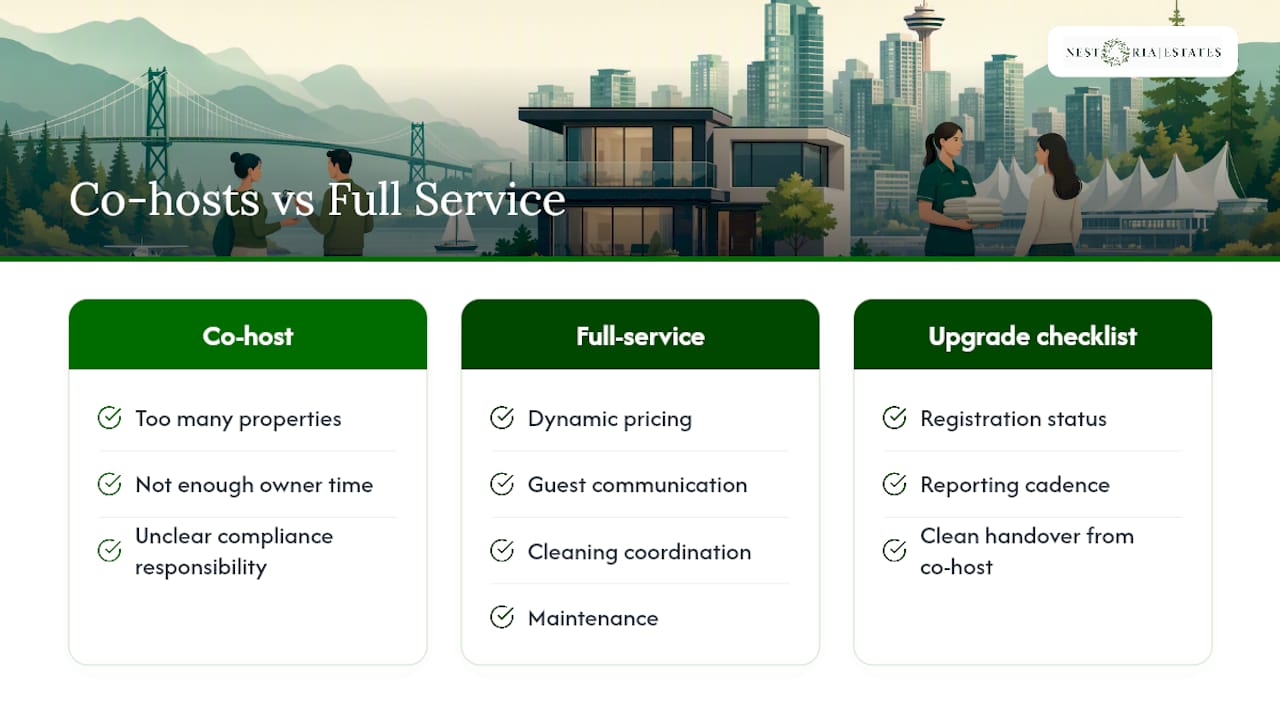
Most Vancouver owners who reach out to Nestoria Estates have already tried the co-host route and hit its ceiling: too many properties, not enough time, or too much uncertainty around who’s actually responsible for compliance. A full-service management provider offers dynamic pricing, guest communication, cleaning coordination, maintenance, and owner reporting, built for owners who want predictable income without operating the business themselves.
For owners still weighing what full-service host management actually involves, the upgrade path matters as much as the fee structure. Registration status, reporting cadence, and clean handover from a prior co-host arrangement all need attention before the switch pays off.
— Kamran
Get a Free Revenue Projection From Nestoria Estates
If you’re a Vancouver owner leaning toward full management after reading this, the next step is simple: get a real number before you commit to anything. Some property management companies offer a free revenue projection and initial consultation, no obligation attached.

Some management companies offer a single point of accountability for coordinating cleaning, pricing, messaging, and registration compliance under one agreement, as an alternative to piecing together a co-host and a handful of vendors yourself. To get your projection started, have your property address, current occupancy rate if you have one, and your desired level of involvement ready. That last part matters: some owners want zero contact, others want monthly check-ins, and a good property manager builds the reporting relationship around what owners actually want. Explore Nestoria Estates’ property management services and request your free projection to see what your property could realistically earn under full management.
Sources
Regulatory claims in this article draw from the BC Short-Term Rental Registry FAQ, Vancouver’s municipal short-term rental page, and BCHA’s compliance resources. Fee benchmarks come from industry analysis at PriceLabs.
FAQ
Is Co-Hosting on Airbnb Worth It?
For a local owner with one property who has time to stay involved, yes. It’s typically cheaper than full management and lets you keep your reviews and account history, though you still carry legal responsibility for compliance.
How Much Does a Cohost Get Paid on Airbnb?
Co-hosts typically earn 10% to 25% of gross booking revenue, with the exact percentage depending on how much of the operation they handle, from basic messaging up through full turnover coordination.
What Is the 80/20 Rule in Airbnb?
There’s no official Airbnb policy called the 80/20 rule. The phrase is sometimes used informally to describe how 20% of listing tasks, like pricing and guest communication, tend to drive 80% of guest satisfaction and repeat bookings, though this varies by owner and isn’t a documented Airbnb standard.
What Is Another Name for a Property Manager?
In British Columbia’s short-term rental registry, a property manager is officially referred to as a supplier host, distinct from the property host who legally owns or leases the unit.
Can Nestoria Estates Help Me Register My Property Correctly?
Some property management companies work with Vancouver owners to confirm registration status and licence display requirements as part of the transition into full-service management, removing the guesswork around who’s the operator of record.
Recommended
Comments