

Dynamic Pricing in Rentals: A Vancouver Host's Guide
TL;DR:
Dynamic pricing in Vancouver rentals adjusts nightly rates based on real-time demand, seasonality, and local events to maximize revenue. It involves setting guardrails, calculating cost floors, and regularly reviewing performance metrics like RevPAR to optimize profit. Implementing effective systems and discipline ensures hosts capitalize on market fluctuations while maintaining profitability.
If you’ve been setting your Vancouver Airbnb rate once a season and calling it done, you’re leaving real money on the table. To properly explain dynamic pricing in rentals, think of it this way: your nightly rate should move the way airline tickets do, rising when demand spikes and dropping strategically when it doesn’t. Vancouver’s short-term rental market has strong seasonal swings, local festivals, and ski season surges that create genuine pricing opportunities. This guide breaks down what dynamic pricing is, how it works in practice, and how you can apply it to your property today.
Table of Contents
Key takeaways
Point | Details |
Dynamic pricing adapts rates daily | Rates shift based on demand, seasonality, events, and competitor behavior to maximize revenue. |
Base price is the foundation | A well-calculated base price anchors all adjustments and protects your margin through price floors and ceilings. |
RevPAR beats occupancy as a metric | Maximizing revenue per available night outperforms chasing high occupancy at low rates. |
Guardrails prevent costly mistakes | Minimum and maximum price limits keep the algorithm from over-discounting or pricing out guests. |
Regular review keeps strategy sharp | Dynamic pricing systems drift without periodic checks; consistent oversight separates top performers from average hosts. |
Explaining dynamic pricing in rentals: the fundamentals
Most Vancouver hosts understand pricing in two modes: high season and low season. That’s not dynamic pricing. That’s calendar-based guessing. Understanding what dynamic pricing actually is changes how you think about rental income entirely.
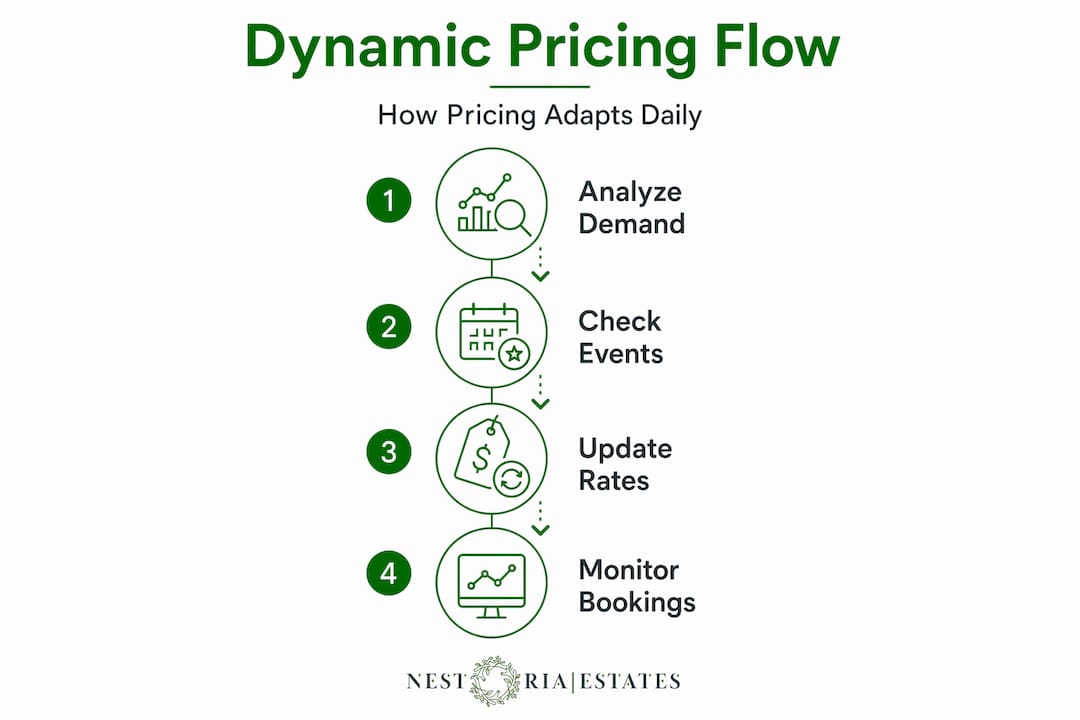
Dynamic pricing adjusts rates in real time based on demand signals, seasonality, competitor rates, and booking pace. Instead of you deciding what to charge for a Saturday in February, an algorithm analyzes what comparable properties are charging, how fast your calendar is filling, whether there’s a major event in town, and how far out the booking window is. Then it sets the price that will generate the most revenue for that specific night.
Static pricing, by contrast, sets a flat rate or a handful of seasonal rates that never respond to real-time conditions. The problem with static pricing isn’t that it’s always wrong. It’s that it’s almost never exactly right. You’re either undercharging during high-demand periods or overcharging during slow ones, and both outcomes cost you money.
Here are the core variables that feed into dynamic pricing decisions:
Demand signals: How many travelers are searching for stays in your area on specific dates
Booking pace: Whether your calendar is filling faster or slower than historical averages
Local events: Festivals, conferences, sports events, and holidays that temporarily spike demand
Competitor pricing: What similar listings are charging for the same dates
Lead time: How far in advance the booking is being made
The real goal of dynamic pricing isn’t to charge the highest possible rate. Dynamic pricing aims to maximize net margin per available rental unit, not occupancy alone. A night that books at $220 with a 70% monthly occupancy rate can outperform a night that books at $160 with 95% occupancy. That shift in thinking is where most hosts start improving their results.
Pro Tip: Before touching any pricing software, calculate your true cost per night, including mortgage, strata fees, utilities, cleaning, and platform fees. That number becomes your absolute price floor. Never let any algorithm price below it.
How dynamic pricing algorithms actually work
The technology behind dynamic pricing is sophisticated, but the logic is not complicated once you see it clearly. Pricing engines use machine learning to spot patterns in booking data and translate those patterns into daily rate recommendations.
Machine learning analyzes historical bookings, event calendars, and competitor rates to generate nightly price suggestions, usually updated once or twice a day. The algorithm is essentially asking: “Given everything happening in this market right now, what is the optimal price for this specific date?”
Vancouver gives these systems a lot to work with. Consider how pricing should behave across a few distinct scenarios:
Ski season weekends (December through March): Travelers booking Whistler-adjacent stays or looking for Vancouver base camp accommodations drive weekend rates sharply higher, often weeks in advance.
Summer festivals (July and August): Events like the Vancouver Folk Music Festival and Celebration of Light pull demand into specific weekends, creating short windows where rates can double.
Business travel midweeks: Corporate demand from the city’s tech and film sectors keeps weekday demand more stable than in purely leisure markets, giving you a stronger floor rate.
Last-minute bookings: As unbooked dates approach, the algorithm weighs the cost of vacancy against a discounted rate, applying tiered discounts rather than panic slashing.
Local events and booking lead time strongly influence rental demand, and Vancouver’s packed event calendar means there are few truly “dead” weekends if you’re priced correctly.
One often-overlooked mechanism is the balance between early-bird premiums and last-minute discounts. High-performing hosts use early bookings to lock in base revenue and then apply progressively steeper discounts as unbooked nights approach. Tiered last-minute discounts such as 10% off for 5 to 7 days out, 15% for 3 to 4 days, and 25% for 0 to 2 days tend to preserve both revenue and guest perception better than a single deep cut.
Setting up your dynamic pricing strategy
Understanding the theory is half the work. Building a system that runs reliably is the other half. Here’s a practical sequence for setting up dynamic pricing guardrails specific to Vancouver’s market.
Calculate your cost-based minimum price. Add up every fixed and variable cost tied to a guest stay: mortgage allocation, strata fees, utilities, cleaning fees, and platform commissions. Add your target margin. This is your floor. Setting cost-based minimum prices prevents the algorithm from discounting below profitability, even during slow periods.
Set a realistic maximum price. Your ceiling should reflect what the top-performing comparable listings in your neighborhood charge during peak demand. Going above that risks losing guests to better-valued alternatives and can hurt your listing’s search ranking.
Define your base price. The base price is the standard nightly rate for a typical low-demand date. It anchors every adjustment the algorithm makes. Set it too high and you’ll see chronic vacancies on slow dates; set it too low and your peak pricing won’t reach its potential.
Configure seasonal adjustments. Vancouver’s market has distinct cycles. Summer and ski season warrant higher base rates. January and November tend to be softer. Build these adjustments into your system rather than relying on the algorithm to catch everything.
Create minimum stay rules. Weekends during high-demand events often justify two or three night minimums. This prevents single-night bookings that block higher-value weekend stays.
Schedule regular reviews. Dynamic pricing systems require regular review to prevent price drift. Block time monthly to check your RevPAR trend, review competitor rates, and update your guardrail settings if costs have changed.
Here’s a quick comparison of the two main rental pricing models:
Feature | Static pricing | Dynamic pricing |
Rate changes | Manually, a few times per year | Automatically, daily |
Market responsiveness | Low | High |
Revenue potential | Limited by fixed assumptions | Higher across demand cycles |
Setup complexity | Simple | Moderate, requires guardrails |
Ongoing management | Minimal | Requires periodic review |
Pro Tip: Experienced operators often build hybrid models that blend dynamic nightly rates with discounted monthly rates, automatically selecting whichever option is more profitable for a given date range. If you’re seeing longer-stay inquiries, this is worth exploring.
Benefits and challenges of dynamic pricing
The benefits of dynamic pricing are real, but so are the pitfalls. Going in with a clear picture of both helps you avoid the mistakes that frustrate new adopters.
On the benefits side, the case is strong. Dynamic pricing is most beneficial in markets with uneven demand and strong seasonality, which describes Vancouver precisely. During peak periods, you capture rates that would be missed with a static approach. During slow periods, strategic discounting keeps occupancy from falling off a cliff.

You also gain a competitive edge. When your pricing reflects real market conditions, your listing appears more attractive at the right moments. A slightly lower rate on a Tuesday in November can move you up in search results and fill a night that would otherwise sit empty.
The challenges are mostly about discipline. Here’s where hosts tend to go wrong:
Panic pricing: Slashing rates aggressively when a date doesn’t book quickly. This trains repeat guests to wait for discounts and erodes your average daily rate over time.
Ignoring the cost floor: Letting the algorithm push rates below your actual cost per night, which boosts occupancy on paper while quietly destroying your profit margin.
Overreacting to short-term signals: One slow booking week in a typically strong month is not a trend. Adjusting your entire strategy based on it usually makes things worse.
Set-and-forget complacency: Most pricing issues arise from weak inputs or missing guardrails rather than algorithm failures. The algorithm is only as good as the rules you build around it.
“Dynamic pricing success depends more on well-defined rules and guardrails than on frequent price changes. A repeatable system outperforms constant manual tinkering.”
Communicating your pricing approach to guests also matters. You don’t need to explain the mechanics, but consistent responses to questions about rate changes build trust. Transparency around cleaning fees and total price visibility reduces booking friction and negative reviews tied to pricing surprises.
Practical tools and next steps
Once you understand how dynamic pricing works, the next question is which tool to use and how to measure whether it’s working. For Vancouver Airbnb optimization, the right tool depends on your portfolio size and how hands-on you want to be.
Popular dynamic pricing tools used by Vancouver hosts generally offer the following:
Automated daily rate updates based on local demand data
Integration with Airbnb, Vrbo, and direct booking platforms
Customizable floors, ceilings, and minimum stay rules
Market dashboards showing competitor rates and booking pace
Pricing software that integrates local data and competitor analysis to set optimal rates within your predefined limits
When choosing a tool, prioritize how well it understands your specific Vancouver submarkets, whether it factors in local event data, and how much control you retain over the guardrails. Automation level matters too. Some hosts prefer a tool that makes suggestions they approve; others want full automation with monthly reviews.
The metrics that tell you your strategy is working are RevPAR (revenue per available rental night), average daily rate (ADR), occupancy percentage, and net profit margin. RevPAR reflects pricing strategy success more accurately than occupancy alone because it accounts for both what you earned and what you could have earned on empty nights.
Pro Tip: Check your rental yield mistakes before adding a pricing tool. If your listing photos, description, or reviews are weak, better pricing will only partially offset the problem. Fix the conversion rate first.
My take on dynamic pricing after years in Vancouver rentals
I’ve worked with Vancouver property owners long enough to see the same pattern repeat: a host who was proud of their 95% occupancy rate discovers their net income is barely better than a host with 70% occupancy who used dynamic pricing properly. The number that felt like success was hiding a pricing problem.
What changed my own perspective was learning to focus entirely on margin per booking rather than nights booked. Maximizing profit sometimes means accepting lower occupancy to raise the average contribution per night. That’s not counterintuitive once you’ve seen the numbers, but it feels wrong the first time you deliberately price a night high enough to risk it going empty.
The discipline piece is what separates hosts who get lasting results. Setting your guardrails well and then trusting the system, rather than constantly second-guessing it, is genuinely harder than it sounds. I’ve watched hosts override their algorithm the night before a festival because they were nervous, only to miss the rate spike that would have paid for two months of mortgage.
Vancouver’s market has a rhythm. Learn it, build your pricing rules around it, and review quarterly. That’s the system. It’s not glamorous, but it works.
— Kamran
How Nestoria Estates can handle this for you
Managing dynamic pricing well takes time, local knowledge, and consistent oversight. Most Vancouver property owners have day jobs, families, and limited bandwidth for daily rate monitoring.

At Nestoriaestates, pricing optimization is built into every management engagement. The team monitors Vancouver’s market conditions continuously, adjusts rates based on real-time data, and applies guardrails that protect your income floor while capturing peak demand. You can see the full scope of what’s included by reviewing our property management services. For owners who want a clear picture of what their property could earn under professional management, Nestoriaestates also offers free revenue projections with no commitment. Learn more about Airbnb management solutions tailored to Vancouver’s unique market and find out what your property should actually be making.
FAQ
What is dynamic pricing for rentals?
Dynamic pricing for rentals is a strategy where nightly rates automatically adjust based on real-time demand, seasonality, local events, competitor pricing, and booking pace. The goal is to maximize revenue per available night rather than maintaining a fixed rate.
How does dynamic pricing work for Airbnb hosts?
Pricing software analyzes booking data, competitor rates, and local demand signals daily, then updates your nightly rate within the minimum and maximum limits you set. You retain control through your guardrail rules while the algorithm handles the daily adjustments.
What are the main benefits of dynamic pricing for Vancouver rentals?
The primary benefits include higher revenue during peak demand periods, reduced vacancy during slow periods through strategic discounting, and stronger competitiveness in Vancouver’s seasonal and event-driven market.
What is a base price in dynamic pricing?
The base price is your standard nightly rate for a typical low-demand date. It anchors all the algorithm’s adjustments upward or downward and should be set after calculating your true cost per night plus target margin.
How do I measure if dynamic pricing is working?
Track RevPAR (revenue per available rental night), average daily rate, occupancy percentage, and net profit margin together. RevPAR is the most telling single metric because it reflects both what you earned and the cost of empty nights.
Recommended
Comments