
Property Owner Workflow for Vancouver Airbnb Success

TL;DR:
Managing Vancouver short-term rentals requires a centralized, multi-stage workflow that ensures accountability and guest satisfaction. Implementing a single intake channel, clear documentation, proactive communication, and linking costs to owner reporting optimizes property management. Consistent routines for seasonal maintenance and precise owner fund reconciliation prevent costly errors and enhance operational efficiency.
Managing a short-term rental in Vancouver without a solid property owner workflow is like running a restaurant without a kitchen order system. Things fall through the cracks, guests notice, and your reviews pay the price. Most owners start out handling maintenance requests via text, tracking expenses in spreadsheets, and communicating with cleaners through group chats. It works until it doesn’t. This guide walks you through how to structure your rental management workflow from intake to owner reporting, so every part of your operation runs on purpose instead of on luck.
Table of Contents
Key takeaways
Point | Details |
Centralize request intake | Route all maintenance requests through one channel to eliminate lost tickets and confusion. |
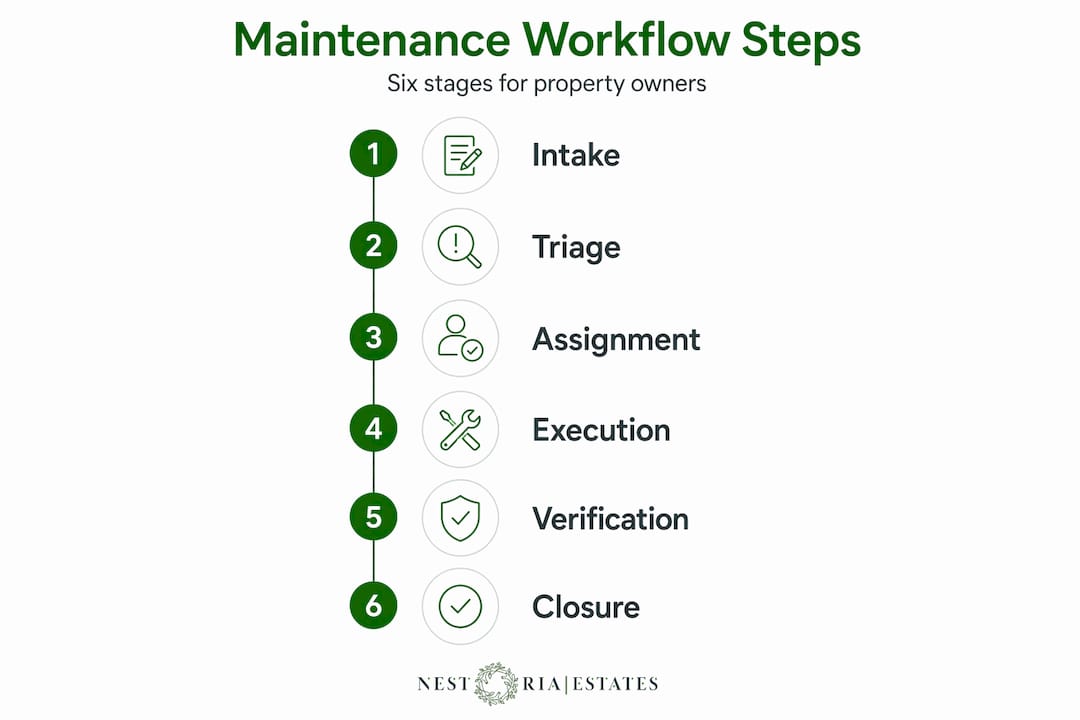
Use a six-stage workflow | Every maintenance request needs intake, triage, assignment, execution, verification, and documented closure. |
Communicate proactively | Immediate acknowledgment and status updates protect your review scores and guest trust. |
Link costs to reporting | Connect work orders to invoices and owner statements to avoid month-end reconciliation chaos. |
Schedule seasonal oversight | Automate preventive maintenance tasks and use digital checklists at every turnover to catch problems early. |
Building your property owner workflow foundation
Before you can execute any rental management workflow reliably, you need the right infrastructure. Most Vancouver Airbnb owners skip this stage and go straight to execution, which is exactly why their processes break down under pressure.
The single most important structural decision you will make is where maintenance requests come from. Accepting requests through multiple channels is the number one cause of workflow failures. Texts to your personal number, emails to your inbox, and verbal reports at checkout create a system where no one is accountable and nothing is tracked. Pick one channel, whether that is a tenant portal, a digital form, or a property management platform, and direct every request there without exception.
Once your intake channel is set, layer in the following:
Property management software with work order tracking, owner reporting, and vendor management (options like AppFolio, Buildium, or similar platforms handle these functions well)
A vendor roster with at least two contacts per trade, including 24/7 emergency availability for plumbing, electrical, and HVAC
Priority tiers for maintenance requests: P1 (life safety or habitability), P2 (affects guest experience), P3 (cosmetic or non-urgent)
Automation rules that trigger notifications and route requests based on priority without manual intervention
Automated routing and digital intake forms with validation rules prevent process stalls and keep all stakeholders aligned without you having to chase anyone down. That alone saves most owners several hours per week.
Pro Tip: Set up a dedicated email address or portal specifically for maintenance submissions, then create a filter or automation rule that categorizes and logs every submission the moment it arrives. Treat that inbox as a ticketing system, not a conversation.
The six-stage maintenance workflow, step by step
This is where the property management process gets specific. Here is how a well-built workflow moves from guest report to verified completion:
Intake. Guest or cleaner submits a request through your designated channel with a description and at least one photo. No photo, no ticket progression.
Triage. You or your manager reviews within a defined window (one hour for P1, four hours for P2, 24 hours for P3) and assigns a priority level.
Assignment. A work order is created with scope of work, property access instructions, and expected completion time. Vendor receives the work order digitally, not via text.
Execution. Vendor completes the work and uploads before and after photos directly to the work order. No verbal confirmation counts.
Verification. You or your property manager reviews the photos and confirms the work meets scope before closing the ticket.
Closure. The work order is closed with a documented audit trail including timestamps, vendor name, cost, and sign-off.
This six-stage approach with documentation at every stage creates accountability that protects you from vendor disputes, guest complaints, and cost allocation errors.
For urgent situations, the workflow accelerates. Urgent requests trigger immediate on-call vendor notification while simultaneously sending the guest an automated message confirming arrival time. The guest never sits in silence wondering if anyone is coming.

Pro Tip: Build a budget threshold into your workflow. For example, any repair under $300 gets approved and dispatched automatically. Anything above requires your explicit sign-off. This prevents delays on small fixes while keeping you in control of significant expenses.
Here is a quick reference for matching request types to response expectations:
Priority | Example | Response Time | Dispatch Method |
P1 Emergency | No heat, flooding, lock failure | Immediate | On-call vendor, auto-notify guest |
P2 High | Broken appliance, WiFi outage | 4 hours | Standard dispatch, status update |
P3 Routine | Cosmetic damage, minor fixture | 24 hours | Scheduled work order |
Guest communication inside your workflow
Here is the part most property owners underestimate. A well-run maintenance and communication process does not just fix the problem. It manages the guest’s perception of the problem from start to finish.
Guest satisfaction depends heavily on process: immediate acknowledgment, urgency assessment, fast dispatch, and proactive timeline updates reduce uncertainty and protect your reviews. A guest who waits 30 minutes for a reply but gets one is almost always more forgiving than a guest who gets a repair done in 20 minutes with no communication.
Structure your guest-facing communication workflow around four moments:
Acknowledgment. Sent within 15 minutes of request receipt, confirming you have received the issue and are assessing it.
Status update. Sent after triage, confirming priority level and estimated response time.
Dispatch confirmation. Sent when vendor is assigned, with vendor first name and arrival window.
Closure message. Sent after verified completion, confirming the issue is resolved and asking if anything else is needed.
Critically, all of this communication should flow through your central platform, not your personal phone. Centralized task tracking over fragmented texts and emails gives you a record of every interaction if a guest dispute arises later. It also means a team member can pick up any conversation without losing context.
“The goal isn’t just to fix problems fast. It’s to make guests feel confident that someone is always paying attention to their experience.”
For Vancouver Airbnb owners managing properties remotely, this communication layer is even more critical. You are not physically present to reassure anyone. Your workflow has to do that for you.
Owner financial workflows and reporting
This is where the real estate owner tasks that most people ignore end up costing the most money. The connection between your maintenance records and your owner statements is not automatic. You have to build it deliberately.
Maintenance ticketing workflows that link work orders to invoices and cost allocations prevent the fragmented month-end scramble that eats up hours of accounting time. Every work order should generate a corresponding invoice line that flows directly into your monthly statement.
Compare the two approaches side by side:
Workflow element | Ad hoc approach | Structured approach |
Work order records | Texts and emails | Digital tickets with timestamps |
Invoice matching | Manual, often delayed | Auto-linked to work order at upload |
Cost allocation | Guessed at month-end | Applied at work order closure |
Owner statement timing | Whenever it gets done | Fixed cadence within 10 business days |
Fund distribution | After owner asks | After full cleared reconciliation |
Monthly owner statements should be generated within 10 business days of month-end, after full reconciliation that includes all owner cost allocations and management fees. And critically, owner funds should never be distributed before that reconciliation is confirmed and cleared. Doing so creates audit problems that are painful to untangle later.
Digital owner portals give property owners real-time visibility into balances, invoices, and completed work without a single email to their property manager. That transparency alone reduces owner inquiry volume by a significant margin.
Routine and seasonal oversight for Vancouver properties
Vancouver’s climate creates specific maintenance rhythms that your efficiency for property owners depends on. Gutters fill fast in the fall. HVAC systems work hard in summer and winter. Pest pressure increases seasonally. If these tasks are not embedded in your workflow calendar, they get skipped until something breaks.
Here is how to structure ongoing oversight:
Turnover checklists. Every guest checkout triggers a digital checklist with mandatory photo documentation at each item. Treating turnover cleaning and maintenance discovery as one unified workflow means small issues get flagged and actioned before the next guest arrives, not after a bad review.
Seasonal preventive tasks. Program recurring work orders for HVAC servicing, gutter cleaning, exterior caulking checks, and smoke detector testing. Set escalation alerts if a recurring task is not completed within its scheduled window.
Vendor performance tracking. Log completion time, photo compliance, and guest feedback by vendor. Over time, this data tells you which vendors to prioritize and which to replace.
Pro Tip: Have your cleaner flag any maintenance issue they notice during turnover directly in your property management platform, not in a group chat. Attach a photo requirement to that flag. This turns your cleaning crew into your first line of property inspection at no extra cost.
A centralized dashboard that shows outstanding tasks, overdue items, and upcoming scheduled maintenance gives you the oversight you need without requiring you to be physically present at every property. For managing a portfolio of Vancouver rentals, this visibility is non-negotiable.
My take on building workflows that actually hold up
I’ve seen property owners invest in expensive software platforms and come away more confused than when they started. The technology is never the problem. The gap is always in documentation discipline and the willingness to enforce process consistently.
What I’ve learned from working with Vancouver Airbnb owners is that the two steps most people skip are verification and closure. They send the vendor, assume it’s done, and move on. Then a guest checks in to find the same dripping faucet because no one actually confirmed completion with photos. That single gap accounts for a disproportionate share of negative reviews and repeat repair costs.
My other observation: automation is a force multiplier for good processes, not a substitute for bad ones. If your intake is scattered or your vendor relationships are unclear, automating will just speed up the chaos. Get the fundamentals right first. Start with one channel, one priority system, and one documentation standard. Then layer automation on top of that solid base.
For owners scaling from two or three properties to five or more, the instinct is to add more tools. What actually works is adding more clarity. Clear escalation rules. Clear vendor scopes. Clear reporting timelines. That structure is what lets you manage multiple Airbnb bookings without your phone buzzing at midnight.
— Kamran
How Nestoriaestates handles this for Vancouver owners

Running a tight property owner workflow across maintenance, guest communication, and owner reporting is genuinely demanding work. Nestoriaestates was built specifically to take that operational weight off Vancouver Airbnb owners. Their team manages the full cycle: maintenance coordination with vetted local vendors, automated guest communication at every stage, monthly owner statements on a fixed reconciliation schedule, and a digital owner portal where you can see everything in real time. If you want to stop managing a process and start earning from a property, explore Nestoriaestates’ full management services or reach out directly to talk through your specific portfolio.
FAQ
What is a property owner workflow for short-term rentals?
A property owner workflow is a structured sequence of steps that routes maintenance requests, guest communication, and financial reporting through defined stages with documentation at each point. It replaces ad hoc management with a repeatable, accountable process.
How many stages should a maintenance workflow include?
A well-built maintenance workflow covers six stages: intake, triage, assignment, execution, verification, and closure. Each stage requires documentation to create an audit trail and confirm accountability.
When should owner funds be distributed?
Owner funds should only be distributed after full reconciliation is confirmed and cleared, typically within 10 business days of month-end. Distributing before reconciliation creates audit friction and accounting errors.
How does communication fit into a maintenance workflow?
Guest communication should be triggered automatically at four points: acknowledgment, status update, vendor dispatch, and closure. Centralizing this through one platform instead of personal texts preserves your records and protects you in any dispute.
What is the biggest workflow mistake Vancouver Airbnb owners make?
Accepting maintenance requests through multiple channels is the most common failure point. It fragments accountability, loses tickets, and makes it impossible to track resolution. One intake channel is the single highest-leverage fix most owners can make immediately.
Recommended
Comments