

What Is a Property Listing Service for Rentals?
- info67421305
- May 21
- 8 min read

TL;DR:
A property listing service manages a short-term rental’s presence across multiple booking platforms, optimizing occupancy and revenue. Using API integrations ensures real-time updates of availability, rates, and details, reducing double bookings and improving listing consistency. For Vancouver owners, adopting a coordinated, multi-channel management strategy significantly increases bookings and streamlines operations.
If you own a short-term rental in Vancouver and you’re not seeing the bookings you expected, the answer often comes down to one thing: your listing strategy. Understanding what is property listing service means understanding the entire system that gets your property in front of the right guests, at the right price, on the right platforms. It’s not just about posting photos on Airbnb. It’s a coordinated approach to property marketing, availability management, and multi-channel distribution that, when done right, directly affects how much you earn each month.
Table of Contents
Key takeaways
Point | Details |
Listing services go beyond Airbnb | A property listing service connects your rental to multiple booking channels and keeps all data synchronized. |
API sync beats iCal every time | Real-time API integrations prevent double bookings and keep calendars accurate across platforms instantly. |
Multi-channel distribution pays off | Hosts on 3 or more channels see 15-35% higher occupancy compared to single-platform listings. |
Your PMS may already include channel management | Many owners overpay for separate tools when their property management system already handles channel sync. |
Listings need depth to perform | Photos, amenities, descriptions, and guest messaging must all sync accurately to avoid suppressed listings. |
What is a property listing service
A property listing service is any system, platform, or professional service that creates, distributes, and manages a property’s presence across booking channels. For short-term rental owners in Vancouver, this means getting your unit visible on platforms like Airbnb, Vrbo, and Booking.com, while keeping all the details current and consistent.
Property listing explained in its simplest form: you have a property, and a listing service makes sure the right people can find it and book it. But the real complexity lives underneath that simplicity.
Here are the core components you need to know:
MLS (Multiple Listing Service): Originally a real estate database for agents and brokers, MLS is where properties are listed for sale or long-term rent. In Vancouver, the Real Estate Board of Greater Vancouver oversees the local MLS. For short-term rentals, MLS is typically not your primary channel, but understanding it matters if you’re managing a mix of long-term and short-term units.
IDX (Internet Data Exchange): IDX is the technology that lets real estate websites pull and display MLS listings. It’s significant for lead generation because IDX allows agents to capture leads on their own websites rather than handing traffic to third-party portals.
OTAs (Online Travel Agencies): These are your booking platforms. Airbnb, Vrbo, and Booking.com are all OTAs. They charge commission per booking in exchange for visibility.
Channel managers: Software that connects your property to multiple OTAs from a single dashboard. Changes you make in one place update everywhere automatically.
PMS (Property Management System): A broader tool that handles bookings, guest communications, pricing, cleaning schedules, and often includes channel management built in.
Pro Tip: Before paying for a standalone channel manager, check whether your PMS already includes this feature. Many owners pay twice unnecessarily because they don’t audit what their existing software covers.
How the technology actually works
The difference between a well-run listing and a chaotic one usually comes down to how the technology is connected. Two main methods exist for syncing your calendar and rates across platforms: iCal and API.

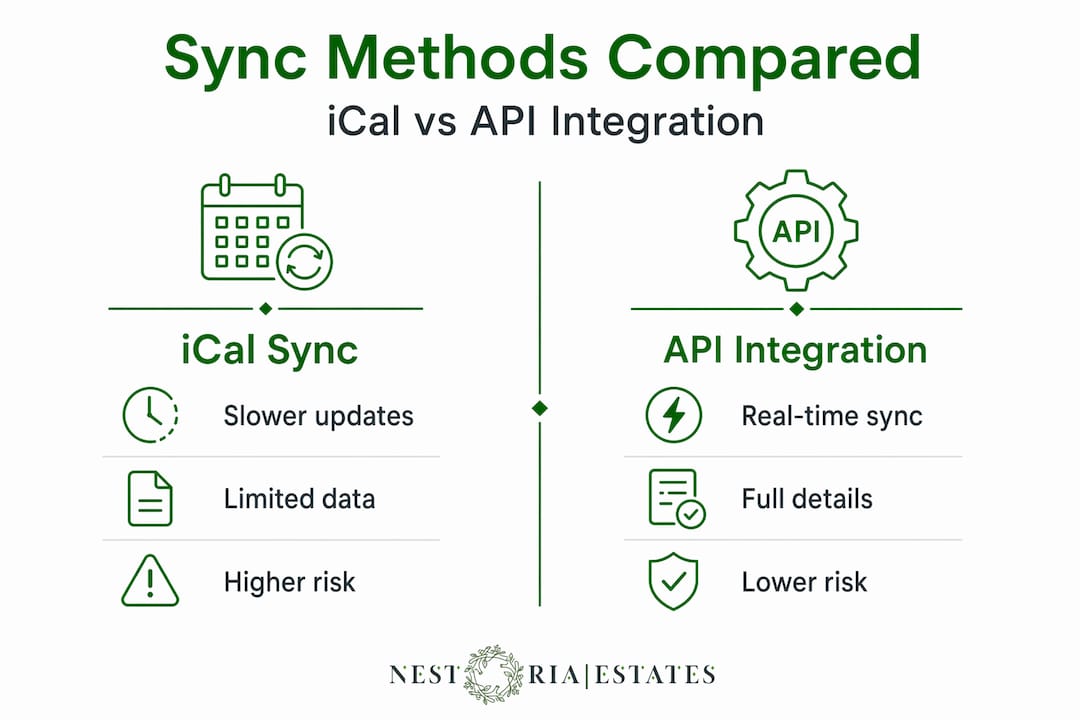
iCal sync works by sharing a calendar URL that platforms can check periodically. The problem is “periodically.” Depending on the platform, that refresh could take hours. In peak season, when your Kitsilano condo could book up in minutes, a two-hour sync delay between platforms is a genuine financial risk.
API sync works differently. Event-driven API triggers enable near-instantaneous updates that prevent double bookings far more reliably than scheduled polling from iCal syncs. When a guest books on Airbnb, the availability closes everywhere else in seconds.
Here’s what a fully integrated listing service should sync across all platforms in real time:
Calendar availability so no date gets double-booked across channels
Nightly rates including seasonal pricing and last-minute discounts
Property photos so your listing looks consistent on every platform
Amenity descriptions covering Wi-Fi, parking, kitchen, pet policies, and more
Guest messaging templates to trigger automated replies at the right stages of booking
Robust API integrations handle not just availability but photos, amenities, descriptions, and guest messaging, which is why incomplete syncing can get your listing suppressed by an OTA’s algorithm.
Sync Method | Speed | Double Booking Risk | Data Depth |
iCal | 1 to 24 hours | High during peak periods | Calendar only |
API | Near instant | Very low | Full property data |
Pro Tip: When evaluating a channel manager, ask specifically whether it uses a direct API connection with each OTA or relies on iCal as a fallback. The answer tells you more about the tool’s reliability than any marketing copy will.
Benefits and drawbacks of multi-channel listing
The case for using a property listing service across multiple channels is strong. Hosts distributing properties across 3 or more booking channels see 15-35% higher occupancy and save roughly 15 hours per week through automation. For a Vancouver property owner charging $200 per night, a 15% occupancy increase over a year translates into thousands of dollars in recovered revenue.
The benefits stack up clearly:
Greater exposure: Each platform has a different traveler base. Vrbo draws more family travelers. Booking.com pulls international guests. Airbnb attracts a broader mix. Being on all three means you’re not missing an entire guest segment.
Automated operations: Channel managers reduce management time by centralizing calendars, rates, and availability updates into one workflow.
Brand consistency: Guests who find you on one platform and cross-check on another see the same photos, the same description, and the same price range, which builds credibility.
Data leverage: Multi-platform distribution gives you performance data across channels, letting you spot which platform drives more bookings during specific seasons.
That said, multi-channel listing is not without friction. The costs of a quality channel manager or PMS add up, especially for single-property owners. The complexity increases when integrations are incomplete or when a platform updates its API and the sync temporarily breaks. And if you’re managing listings manually without proper tools, scaling without integrated PMS becomes an operational liability, not an advantage.
The most common pitfall in Vancouver’s short-term rental market is owners who list on multiple platforms but manage them manually. They log in to each platform separately, update pricing one by one, and chase calendar conflicts after the fact. That’s not a listing strategy. That’s a recipe for bad reviews and exhausted owners.
How to use property listing services effectively
Getting the most from a property listing service requires more than signing up and switching it on. Here’s the workflow that actually works for Vancouver short-term rental owners:
Audit your current setup. Know which platforms you’re on, how they’re connected, and whether that connection is API or iCal. This single step often reveals the source of booking conflicts or listing inconsistencies.
Choose a PMS or channel manager with direct API connections. Paying separately for channel management when your PMS already includes it wastes money and adds complexity. Consolidate where you can.
Build your master listing once, correctly. Professional-grade photos, a description that addresses what Vancouver guests actually search for (proximity to Granville Island, transit access, ski season availability), and a complete amenity list. Every platform pulls from this foundation.
Connect pricing tools. Static pricing leaves money on the table. Dynamic pricing software plugs into your PMS and adjusts nightly rates based on local demand, events, and competitor pricing in real time.
Integrate guest communication and operations. Your listing service should trigger automated messages at booking, check-in, and checkout. It should also connect to your cleaning schedule so turnovers are never missed after a late booking.
Pro Tip: For Vancouver specifically, seasonal demand shifts hard between summer tourism and winter ski traffic. Your listing descriptions, photos, and pricing rules should reflect both seasons. A property that mentions Whistler proximity in winter and Stanley Park in summer books more consistently year-round.
Review your listings every 90 days. OTA algorithms favor active, updated listings. Properties with stale photos or outdated descriptions get ranked lower, which means fewer eyeballs even if your price is competitive. The short-term rental management pitfalls most owners run into are nearly always connected to neglected listing fundamentals.
Understanding the role of property management in coordinating these layers is what separates owners who treat their rental like a business from those who treat it like a side project.
My honest take on integrated listing management
I’ve worked with enough Vancouver property owners to say this with confidence: most people who struggle with short-term rental income are not struggling because of their property. They’re struggling because their listing infrastructure is broken or nonexistent.
When I first started working with owners who had been managing listings manually across three or four platforms, the pattern was always the same. A double booking every couple of months. Pricing that never adjusted for events like the Vancouver Folk Music Festival or Dine Out Vancouver. Photos that looked different on each platform because someone had updated one and forgotten the rest. These aren’t bad owners. They’re owners using tools that weren’t built for multi-platform volume.
What changed for those owners was adopting a unified channel management setup. Not just picking any channel manager, but choosing one with genuine API-level integrations and a PMS that eliminated the need for three separate software subscriptions. The time savings alone, roughly 15 hours per week based on what I see in practice, freed owners up to focus on the things that actually require human judgment: property improvements, guest experience decisions, and investment strategy.
My honest advice: don’t over-engineer the technology stack, but don’t under-invest in it either. One solid PMS with API integrations to your top two or three OTAs will outperform a fragmented setup every time. And if you’re in the Vancouver market specifically, local expertise matters. Knowing when to drop minimum stay requirements ahead of a slow week, or when to hold firm on rates during a major convention, is not something generic software can always tell you.
— Kamran
How Nestoriaestates helps Vancouver owners maximize listings
Knowing what is property listing service is one thing. Executing it consistently across multiple platforms while managing guest communications, cleaning schedules, and pricing optimization is another challenge entirely. That’s exactly where Nestoriaestates steps in.
Nestoriaestates handles the full operational layer for Vancouver short-term rental owners: multi-platform listing setup and maintenance, real-time rate adjustments based on local market data, and coordinated guest communication from inquiry to checkout. Every property in the Nestoriaestates portfolio benefits from professional management services built around maximizing occupancy without putting that work on the owner. If you want to understand how your property could perform under a fully managed listing strategy, reach out to the team for a free revenue projection tailored to your Vancouver property.
FAQ
What does a property listing service include?
A property listing service includes creating and distributing your property across booking platforms, managing calendar availability, syncing rates and photos, and often coordinating guest communications. Professional services also handle pricing adjustments and operational coordination.
What is the difference between a channel manager and a PMS?
A channel manager connects your property to multiple OTAs and syncs availability and rates. A PMS is a broader system that manages the full operation including bookings, guest messaging, and cleaning schedules. Many PMS platforms include channel management, so you may not need both.
Why is API sync better than iCal for short-term rentals?
API sync updates your calendar and rates in near real time across all platforms, while iCal can take hours to refresh. During high-demand periods, that delay creates real double-booking risk. API integration is the professional standard for serious short-term rental operators.
How many platforms should I list my Vancouver rental on?
Most owners see the strongest returns from listing on two to four platforms. Airbnb covers the broadest audience, while Vrbo and Booking.com capture distinct traveler segments. Hosts on three or more channels consistently see higher occupancy than those relying on a single platform.
Can a property listing service really increase my rental income?
Yes, and the data backs it up. Hosts distributing across multiple channels with proper automation see occupancy gains of 15-35% compared to single-channel operators. For most Vancouver properties, that difference more than covers the cost of a quality management setup.
Recommended

Comments