
Luxury Property Listing Workflow for Vancouver Owners

TL;DR:
A luxury property listing workflow is a repeatable system handling pricing, communication, turnover, maintenance, and compliance, essential for maximizing revenue and guest experience. Automation and technology streamline operations by reducing errors through trigger-based sequences from booking to post-stay, especially as portfolio size grows. Proper pre-listing preparation and embedded regulatory checks ensure consistency, compliance, and sustained performance in Vancouver’s competitive short-term rental market.
A luxury property listing workflow is a repeatable, systematized series of operational processes that transforms a high-end short-term rental into a consistently revenue-generating asset with exceptional guest experiences. For Vancouver property owners managing Airbnb listings, the difference between a property earning $4,000 a month and one earning $7,000 often comes down to the quality of this workflow. The industry term for this approach is short-term rental operations management, and it covers everything from pre-listing preparation and dynamic pricing to automated guest communication and regulatory compliance. Tools like Hostaway, Operto, and PriceLabs are now standard components in any serious luxury rental operation. This article breaks down exactly how to build and run one.
What are the essential pillars of a luxury property listing workflow?
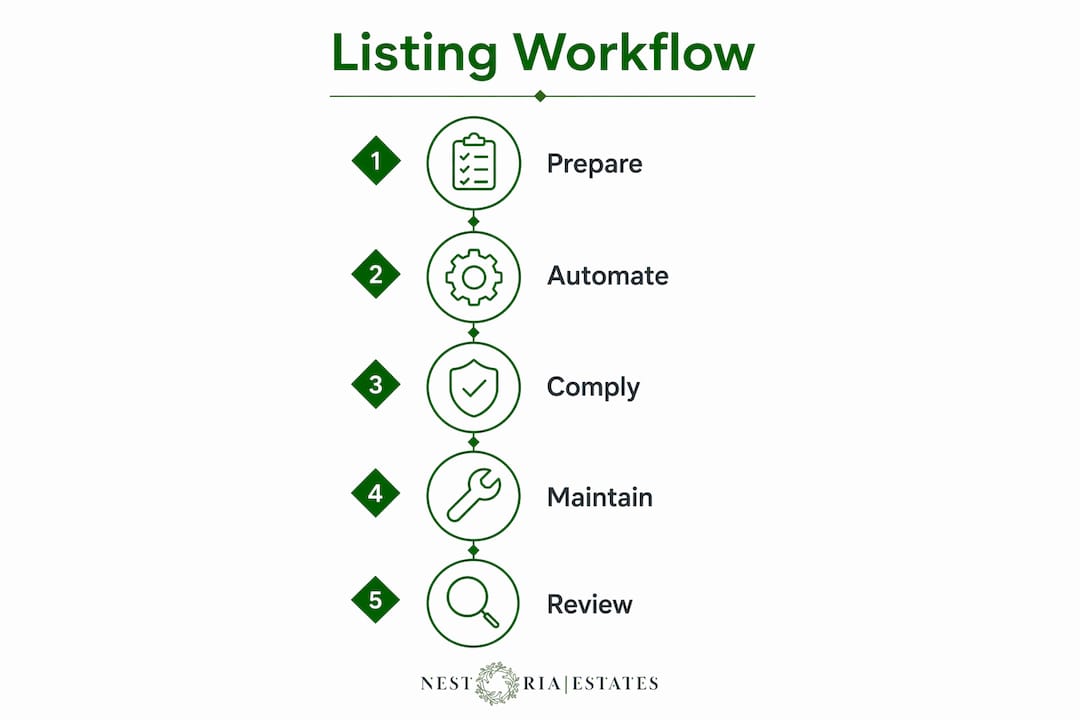
A luxury workflow rests on five pillars that, when neglected, directly cause revenue loss and negative reviews. These are not suggestions. They are the non-negotiable operational categories that every Vancouver owner managing a premium property must address before accepting a single booking.
Pricing. Dynamic pricing software like PriceLabs or Wheelhouse adjusts your nightly rate based on local demand, events, and competitor availability. Flat-rate pricing on a luxury Vancouver property is one of the fastest ways to leave money on the table.
Guest communication. A multi-stage automated messaging flow covers booking confirmation, pre-arrival instructions, mid-stay check-in, and a post-stay thank-you. Structured guest messaging flows reduce guest anxiety and preempt the most common support requests.
Turnover and cleaning. A written standard operating procedure (SOP) with a photo-proof step before every guest arrival is the minimum standard for luxury. Your cleaner’s checklist and your marketing photos must match what the guest actually walks into.
Maintenance and emergencies. A tiered escalation protocol separates minor issues (a burned-out bulb) from urgent ones (a broken boiler in January). Without this, every problem lands on your phone at midnight.
Reviews and reputation. A proactive review strategy means requesting feedback at the right moment in the post-stay sequence, then responding to every review within 24 hours. Consistent five-star reviews on Airbnb compound over time and directly affect search ranking.
Pro Tip: Build your guest communication flow as a template library first. Write every message once, then automate delivery. Editing one template takes five minutes; rewriting ad hoc messages for every booking takes hours per month.
Maintaining workflow integrity across all five pillars is what separates a professionally managed luxury listing from a well-decorated one that underperforms. Vancouver’s short-term rental market is competitive enough that gaps in any single pillar show up in your occupancy rate within 60 days.

How can technology and automation improve your listing operations?
Automation does not replace hospitality. It protects the parts of your operation that are most vulnerable to human error, specifically the handoffs between booking events and the tasks those events should trigger.
Here is how a trigger-based automation sequence works in practice for a luxury Vancouver property:
Booking confirmed. The property management system (PMS) automatically schedules a cleaning team for the checkout date and sends the guest a confirmation message with arrival instructions.
48 hours before check-in. The system sends a pre-arrival message with the smart lock access code, parking details, and house rules. The code is generated fresh for each guest.
Guest checks out. Trigger-based automation deactivates the access code immediately and sends the cleaning team a task notification with a checklist attached.
Cleaning complete. The cleaner submits photo proof through the PMS app. The system flags the property as ready and notifies the owner.
24 hours post-stay. An automated review request goes to the guest.
This sequence eliminates five separate manual coordination tasks per booking. Across 20 bookings a month, that is 100 tasks you no longer manage personally.
The tech stack that makes this possible has four layers:
Layer | Function | Example Tools |
PMS | Central operations hub | Hostaway, Guesty |
Channel manager | Multi-platform listing sync | Hostaway, Lodgify |
Dynamic pricing | Revenue optimization | PriceLabs, Wheelhouse |
AI guest messaging | Automated communication | Operto, Enso Connect |
A layered tech stack becomes genuinely necessary once you manage more than five properties. Below that threshold, a single PMS with built-in automation handles most needs. Above it, each layer pays for itself in time saved and errors prevented.
Pro Tip: Before buying any software, map your current workflow on paper first. Automation amplifies what you already do. If your process is broken, software makes the mess faster.
For a deeper look at how these tools fit into a broader operational strategy, the rental operations scaling process from Realtevo covers how operators are building these systems in 2026.
What does pre-listing preparation look like for a luxury rental?
Pre-listing preparation is the phase most Vancouver owners rush, and it is the phase that causes the most downstream problems. A standardized digital workflow from listing prep to lease signing reduces errors and accelerates the entire onboarding process.
The core pre-listing checklist for a luxury property covers four areas:
Core data set. Document the property address, all amenities, rental terms, house rules, and any restrictions (no pets, no events, maximum occupancy) in a single master file. This file feeds every platform listing and every guest communication template.
Photo standards. A luxury listing requires professional photography with a defined shot list: every room, all key amenities, outdoor spaces, and neighborhood context. Photo checklists before listing ensure your visual assets are consistent and scalable across multiple properties. For Vancouver-specific staging ideas, the Vancouver listing photo guide from Nestoriaestates covers 50 proven approaches.
Digital documentation. Organize all property documents in a named folder structure: lease templates, move-in checklists, maintenance records, and insurance certificates. Scan-ready files speed up any dispute resolution or platform verification request.
Listing copy. Write your title, description, and amenity list from the master data set. Consistency between your listing copy and the actual property is what prevents the gap between guest expectation and reality.
Pre-listing task | DIY approach | Managed approach |
Photography | Hire local photographer with shot list | Management company coordinates and quality-checks |
Listing copy | Write from master data set template | Professionally written and A/B tested |
Documentation | Self-organized digital folders | Centralized, compliance-ready file system |
Platform setup | Manual entry on each platform | Synced via channel manager |
The comparison above shows where the time cost concentrates when you manage this yourself. For a single property, DIY is viable. For a portfolio of three or more luxury units, the managed approach pays back in speed and consistency.
How to incorporate compliance into your listing workflow
Regulatory compliance is not a separate task. It belongs inside your workflow as a scheduled, recurring check, not a reaction to a problem.
Vancouver’s short-term rental regulations require hosts to hold a valid business license and list only their principal residence. The rules have tightened significantly since 2023, and enforcement has followed. Here is how compliance fits into an operational workflow:
Registration verification. Before any listing goes live, confirm your STR license number is current and displayed on the listing. Platforms now check this automatically in many jurisdictions.
Quarterly compliance review. Schedule a calendar reminder every 90 days to verify your license status, check for bylaw updates, and confirm your listing meets current platform requirements.
Deactivation protocol. If a compliance issue arises, your workflow needs a documented step for pausing the listing, notifying affected guests, and issuing refunds where required. Improvising this under pressure is expensive.
Platform reporting. In regulated markets like New York City, platforms must verify STR registrations and submit quarterly transaction reports to enforcement agencies. Vancouver is moving in the same direction. Building compliance verification into your workflow now protects your listing before enforcement catches up.
Workflow automation must include compliance verification and rapid deactivation mechanisms, especially in regulated markets. Owners who treat compliance as an afterthought are the ones who lose their listings without warning.
What mistakes do luxury property owners most often make?
The most costly mistakes in luxury rental operations are not dramatic failures. They are quiet, compounding errors that erode revenue and reputation over months.
Underpricing at launch. Setting a low rate to attract early reviews is a strategy that backfires on luxury properties. It attracts guests whose expectations do not match the property tier, generating reviews that hurt your positioning with the guests you actually want.
Skipping photo proof after turnover. Inspection and photo-proof steps before guest arrival are the quality gate that protects your luxury brand promise. Skipping this step means the first person to notice a problem is your arriving guest.
Neglecting channel management. Listing on Airbnb only limits your occupancy ceiling. VRBO and direct booking channels each serve different guest segments. A channel manager syncs availability and pricing across all platforms automatically.
Ignoring maintenance escalation. Without a tiered protocol, small issues become expensive emergencies. A leaking faucet reported in week one costs $150. The same faucet ignored for a month can cost $3,000 in water damage.
Avoiding automation. Manual coordination across cleaning teams, guests, and platforms is not a sign of personal attention. It is a source of errors that guests notice and review.
Pro Tip: Set your launch pricing at market rate or slightly above, then use dynamic pricing to adjust downward if occupancy lags. It is far easier to lower a rate than to rebuild a luxury brand reputation damaged by the wrong early guests.
For a structured look at property management best practices specific to luxury rentals, Nestoriaestates has published a practical guide covering the operational standards that consistently produce five-star results.
Key takeaways
A luxury property listing workflow succeeds when it combines five operational pillars, trigger-based automation, compliant pre-listing preparation, and a proactive maintenance protocol into one repeatable system.
Point | Details |
Five operational pillars | Pricing, communication, turnover, maintenance, and reviews must all function together to protect revenue. |
Automation triggers | Booking events should automatically assign cleaning tasks, generate access codes, and queue guest messages. |
Pre-listing documentation | A master data set and photo checklist prevent listing errors and speed up scaling to multiple properties. |
Compliance as workflow | Schedule quarterly license checks and build a deactivation protocol before you need it. |
Launch pricing discipline | Start at market rate and adjust dynamically rather than discounting early to attract reviews. |
What I’ve learned about building workflows that actually hold up
Most owners I speak with in Vancouver build their workflow backwards. They start with the guest-facing parts, the listing photos and the welcome message, and treat the operational infrastructure as something to figure out later. That approach works fine for the first few bookings. It falls apart the moment you have two properties, a double-booking scare, or a cleaner who cancels two hours before check-in.
The workflow has to come first. Not because it is more important than hospitality, but because it is what makes consistent hospitality possible at scale. I have seen beautifully designed properties in Vancouver’s West End and Coal Harbour consistently underperform because the owner was managing by text message and spreadsheet. The property was luxury. The operation was not.
The technology question is also more nuanced than most guides suggest. A PMS like Hostaway is not the right tool for every owner. If you have one property and you are actively involved, a lighter setup with Airbnb’s native tools and a scheduling app may serve you better. Choosing between self-management and full-service management depends on your portfolio size, your time, and the margin you need to make the numbers work. There is no universal answer, but there is a wrong answer: doing nothing and hoping the bookings keep coming.
The owners who build the strongest workflows treat them as living documents. They review their SOPs quarterly, update their pricing strategy seasonally, and test new automation tools against real operational problems. That discipline is what separates a property that performs well in year one from one that compounds its performance year over year.
— Kamran
How Nestoriaestates helps Vancouver owners build better listing workflows
Nestoriaestates works with Vancouver property owners who want the revenue of a professionally managed luxury rental without the operational weight of running one themselves. The team handles every layer of the luxury rental management process, from dynamic pricing and automated guest communication to cleaning coordination, compliance monitoring, and owner reporting. If you are building your first luxury listing or scaling an existing portfolio, Nestoriaestates provides the workflow infrastructure, the vendor relationships, and the market data to make your property perform at its ceiling. Free revenue projections are available for Vancouver properties, with no commitment required.
FAQ
What is a luxury property listing workflow?
A luxury property listing workflow is a standardized operational system covering pricing, guest communication, turnover, maintenance, and compliance for high-end short-term rentals. It replaces ad hoc management with repeatable processes that protect revenue and guest experience.
How does automation fit into a luxury rental workflow?
Trigger-based automation assigns cleaning tasks, generates smart lock codes, and sends guest messages automatically when booking events occur. This reduces manual coordination errors and scales across multiple properties without adding management hours.
What technology do luxury rental operators use?
Most operators use a layered tech stack including a property management system like Hostaway or Guesty, a dynamic pricing tool like PriceLabs, and AI guest messaging software like Operto. The right combination depends on portfolio size and owner involvement.
How do Vancouver STR regulations affect listing workflows?
Vancouver requires a valid business license and principal residence status for short-term rentals. Compliance checks, license verification, and a documented deactivation protocol must be built into your workflow as recurring scheduled tasks, not reactive responses.
When should a Vancouver owner hire a property management company?
Professional management makes financial sense when the time cost of self-management exceeds the management fee, typically around two or more properties, or when compliance complexity and guest volume require dedicated operational infrastructure.
Recommended
Comments