

Luxury Property Rental Trends 2026: Investor's Guide

TL;DR:
Luxury rental growth in 2026 is driven by increased ADR, not higher occupancy rates, especially in the luxury segment. Operational excellence, such as privacy, concierge services, and dynamic pricing, is crucial for maintaining premium rates and outperforming competitors. Regional markets like Vancouver benefit from regulatory advantages and event-driven demand, making localized intelligence essential for top-quartile returns.
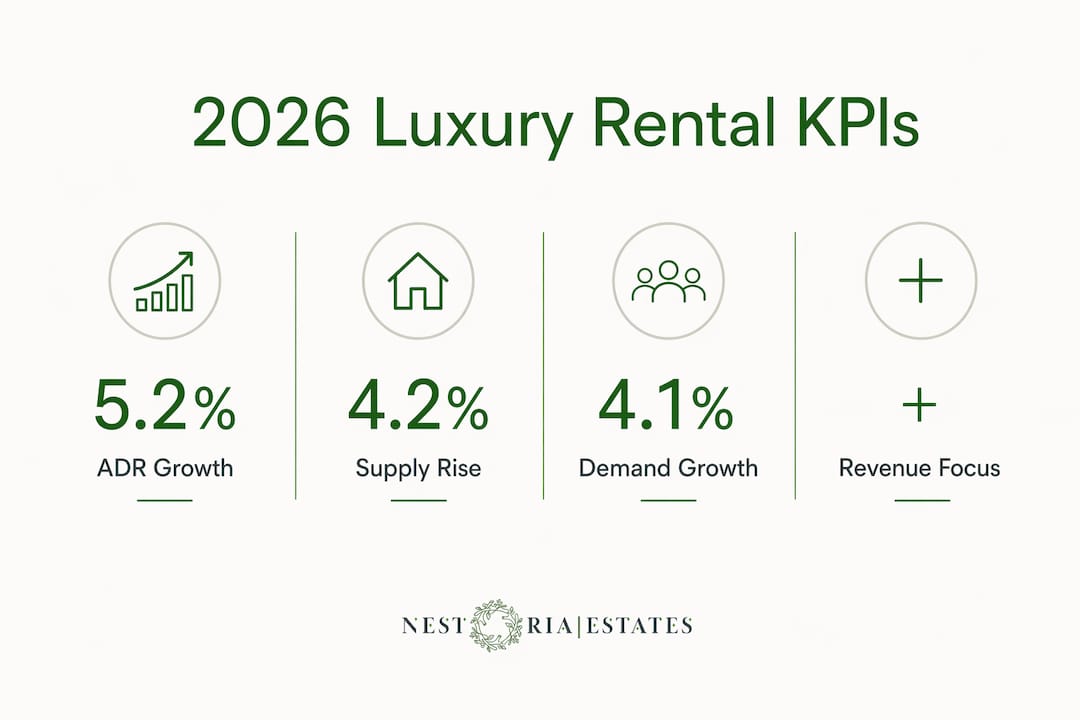
Luxury property rental trends in 2026 are defined by one clear shift: revenue growth is driven by pricing power, not occupancy volume. Across the short-term rental sector, national STR RevPAR grew 2.1% YoY in Q1 2026, with ADR climbing 3.6% to $246.62 even as occupancy slipped 1.5% to 48.4%. For luxury and super-prime properties, the divergence is sharper still. Luxury-tier ADR rose 5.2% while budget-tier rates actually declined. Vancouver Airbnb owners operating in the premium segment are positioned inside this exact dynamic, where scarcity, turnkey quality, and managed service determine who captures the premium and who competes on price.
How are pricing and occupancy trends shaping luxury short-term rentals in 2026?
The 2026 upscale rental market operates on a rate-first model. Luxury-tier ADR rose 5.2% in early 2026, while budget-tier rates fell 0.3%. That gap is not a coincidence. It reflects a structural split between guests who prioritize price and guests who prioritize experience. Investors who understand this distinction stop chasing occupancy and start protecting their rate.

Supply growth is the pressure point. Supply grew roughly 4.2% against demand growth of approximately 4.1% in early 2026. That near-parity sounds benign, but in practice it concentrates competition at the mid-tier. Luxury properties with genuine differentiators, meaning premium finishes, professional management, and privacy-forward design, face less direct competition because they occupy a narrower, harder-to-replicate segment.
The table below shows how the rate-versus-occupancy dynamic plays out across tiers in the current market:
Rental tier | ADR trend (2026) | Occupancy trend | Revenue implication |
Luxury / super-prime | +5.2% | Slight softness | Rate gains more than offset occupancy dip |
Mid-tier | +1.8% | Flat to declining | Margin pressure from supply growth |
Budget | -0.3% | Declining | Revenue contraction without differentiation |
Mountain and coastal markets outperform urban cores on both ADR and RevPAR. Markets like Vail and Steamboat Springs, along with coastal markets, show the highest luxury rental revenues in early 2026. Vancouver fits this coastal gateway profile, which means local owners benefit from the same structural tailwinds driving premium performance in comparable North American markets.
Pro Tip: Stop modeling your revenue around occupancy targets. Build your underwriting around ADR first, then calculate the occupancy floor you need to cover costs. This reframe changes which properties you buy and how you price them.
What operational and service factors differentiate successful luxury rentals in 2026?
The super-prime rental market in 2026 is not won on square footage or view alone. Operational service layers are the actual product. Ultra-high-net-worth guests expect privacy, security, concierge-level responsiveness, and a property that functions perfectly from the moment they arrive. When those elements are absent, even a stunning property underperforms on reviews, repeat bookings, and rate.
Knight Frank’s 2026 Wealth Report data makes the stakes concrete. Top-end rents in New York, London, and Singapore rose 63%, 53%, and 48% respectively over five years. That appreciation is not purely a real estate story. It reflects the compounding value of managed, turnkey properties that UHNW clients trust to deliver a consistent experience. Scarcity matters, but managed quality is what converts scarcity into sustained premium pricing.
For Vancouver Airbnb owners, this translates into specific operational investments:
Professional property management: Guests in the luxury segment expect 24/7 responsiveness, not a self-check-in kiosk and a FAQ document.
Turnkey presentation: Properties that are fully furnished, professionally staged, and maintained to hotel standards transact faster and command higher nightly rates.
Privacy and discretion: Separate entrances, keyless access with rotating codes, and no shared spaces are baseline expectations for UHNW guests, not premium add-ons.
Dedicated cleaning and maintenance protocols: A single negative review citing cleanliness or a broken fixture costs more in lost future revenue than the repair itself.
Concierge and local knowledge: Restaurant reservations, private transportation, and curated local recommendations convert one-time guests into repeat bookings.
Pro Tip: Treat operational service as a product feature in your listing copy, not as a footnote. Guests searching for luxury short-term rentals in Vancouver are comparing your service stack against boutique hotels. Make the comparison obvious and favorable.
Investors who prioritize operational excellence as a core investment pillar, rather than an afterthought, consistently outperform on both ADR and guest retention. This is the single most underpriced insight in the current luxury rental market.
How do regional market differences affect luxury rental performance in 2026?
Not all luxury markets behave the same way in 2026. Geography, regulation, and demand drivers create meaningful performance gaps that investors must account for before acquiring or repositioning a property.
Market type | ADR strength | Occupancy profile | Key demand driver | Risk factor |
Mountain resort (Vail, Steamboat) | Very high | Seasonal peaks, strong RevPAR | Ski and outdoor recreation | Short peak season |
Coastal gateway (Vancouver, Miami) | High | Year-round with event spikes | Tourism, business travel, events | Regulatory exposure |
Urban core (NYC, Chicago) | Moderate | Flat to declining | Business travel, events | Supply growth, STR restrictions |
International gateway (Singapore, London) | Very high | Consistent | UHNW relocation, finance sector | Currency and geopolitical risk |
Vancouver sits in the coastal gateway category, which carries a specific set of advantages and challenges. Demand is year-round rather than purely seasonal, and the city’s profile as a film industry hub, tech sector destination, and international tourism gateway creates multiple overlapping demand windows. Regulatory exposure is real, and local STR rules require active monitoring, but owners who operate within compliance benefit from a smaller licensed supply pool, which supports occupancy and rate.
Event-driven demand is a major revenue lever in markets like Vancouver. Dynamic pricing combined with event-driven demand windows can boost summer 2026 vacation rental revenue by 20 to 40%. Major sports events, film festivals, and holiday periods create distinct demand spikes that generic seasonal pricing completely misses. Owners using static monthly rates leave measurable revenue on the table during these windows.
Urban core markets face the toughest conditions in 2026. Supply growth and regulatory pressure combine to compress margins for properties that lack a clear differentiation story. The lesson for Vancouver owners is direct: a luxury property without a managed service layer and a dynamic pricing strategy is competing in the wrong tier.
What are the best investment and underwriting practices for luxury rental properties in 2026?
Underwriting a luxury rental property in 2026 requires a different framework than standard real estate analysis. Generic market labels like “luxury neighborhood” or “premium zip code” tell you almost nothing about actual revenue performance. The numbers that matter are ADR, occupancy interaction, and total gross revenue under stress scenarios.
Here is a practical underwriting sequence for luxury short-term rental acquisitions in 2026:
Pull actual gross revenue data, not asking-price projections. Use platforms like StaySTRA to access real ADR and occupancy data for comparable properties in the specific submarket. Actual gross revenue data and ADR/occupancy interaction should drive underwriting, not market labels.
Stress test occupancy while holding ADR. Luxury rental markets can support strong performance even when broad rent growth is mild, but occupancy dips are real. Model a scenario where occupancy drops 5 to 8 percentage points from your base case. If the deal still works, you have a margin of safety.
Quantify the amenity premium. A private pool, EV charging, a home theater, or a dedicated workspace each adds a measurable increment to ADR. Calculate the cost of adding or upgrading each amenity against the ADR lift it generates. Not every upgrade pays back equally.
Factor in managed service costs from day one. Professional management typically runs 20 to 30% of gross revenue for full-service luxury properties. Investors who model this from the start make better acquisition decisions than those who add it as an afterthought after the first bad review.
Analyze forward booking pace. Properties with strong forward booking windows, meaning reservations placed 60 to 90 days out, signal genuine demand rather than last-minute discount dependency. This is a quality signal that static revenue figures miss.
Account for Vancouver-specific regulatory costs. STR licensing fees, compliance requirements, and potential restrictions on non-primary residences affect net operating income. Build these into your model before closing, not after.
Pro Tip: Request a free revenue projection before acquiring any luxury rental property in Vancouver. Comparing a professional projection against your own model reveals assumptions you may have missed and prevents overpaying based on optimistic occupancy forecasts.
Key takeaways
Luxury property rental trends in 2026 reward investors who prioritize ADR discipline, managed service quality, and localized market intelligence over broad occupancy targets.
Point | Details |
Rate-first revenue model | Luxury ADR rose 5.2% in 2026 while occupancy softened; protect your rate, not your occupancy. |
Operational service as product | Privacy, concierge, and turnkey readiness are revenue drivers, not optional upgrades. |
Regional market selection | Coastal gateway markets like Vancouver outperform urban cores on RevPAR and demand diversity. |
Event-driven pricing | Dynamic pricing around demand windows can lift summer revenue by 20 to 40%. |
Stress-tested underwriting | Model occupancy dips of 5 to 8 points before acquisition to verify deal viability. |
What I’ve learned about the 2026 luxury rental market that most investors miss
Most investors I talk to still frame luxury rental performance as an occupancy problem. They see a vacancy week and immediately want to drop the rate. That instinct is exactly backwards in the current market.
The owners outperforming in 2026 are the ones who treat their property as a managed product, not a passive asset. They invest in the service layer, they price dynamically around real demand events, and they protect their ADR even when it means sitting on a vacancy for an extra night or two. Over a full year, that discipline compounds into materially better returns than the race-to-fill approach.
Vancouver is a particularly interesting market right now. The regulatory environment has thinned the licensed supply pool, which is actually a structural advantage for compliant owners. Fewer competing listings means your property gets more visibility, and if your service quality is strong, you capture a disproportionate share of the premium demand. I have seen Vancouver Airbnb owners with well-managed luxury properties achieve ADR premiums of 30% or more over comparable self-managed listings, purely because the guest experience is consistent and the reviews reflect it.
The one thing I would tell every investor entering this market: do not underestimate the value of localized market knowledge. Data from national platforms gives you the macro picture, but the micro-level intelligence, knowing which weeks spike in Vancouver, which guest segments pay the highest rates, and which amenities actually move the needle locally, is what separates average performance from top-quartile returns.
— Kamran
How Nestoria Estates helps you capture the 2026 luxury rental opportunity

Nestoria Estates specializes in full-service luxury property management for Vancouver Airbnb owners who want to capture the 2026 premium rental market without managing day-to-day operations themselves. The team handles dynamic pricing calibrated to local demand events, professional guest communication, cleaning coordination, and detailed owner reporting, all built around the rate-first model that defines the current high-end property market. If you are analyzing a potential acquisition or repositioning an existing property, Nestoria Estates offers free revenue projections grounded in real Vancouver market data. Explore the full range of luxury management services or reach out directly to discuss your property’s specific potential.
FAQ
What is driving luxury rental revenue growth in 2026?
Revenue growth in the 2026 luxury rental market is driven by ADR gains rather than occupancy increases. Luxury-tier ADR rose 5.2% while national occupancy fell 1.5%, meaning pricing power is the primary performance lever.
How does supply growth affect luxury short-term rentals in 2026?
Supply grew approximately 4.2% against demand growth of 4.1% in early 2026, creating competitive pressure at the mid-tier. Luxury properties with genuine service differentiation face less direct competition because they occupy a harder-to-replicate market segment.
Why does managed service matter so much for luxury rentals?
Operational service layers including privacy, security, and concierge responsiveness function as core product features for UHNW guests. Properties that deliver a consistent, fully managed experience command higher ADR and generate stronger repeat booking rates than self-managed alternatives.
How should investors underwrite luxury rental properties in 2026?
Use actual gross revenue data and ADR/occupancy interaction rather than market labels. Stress test cash flows assuming a 5 to 8 percentage point occupancy dip, and factor professional management costs of 20 to 30% of gross revenue into your model from the start.
Is Vancouver a strong market for luxury short-term rentals in 2026?
Vancouver fits the coastal gateway profile that outperforms urban cores on RevPAR and demand diversity in 2026. Regulatory compliance reduces competing supply, and event-driven demand from film, sports, and tourism creates multiple high-rate windows throughout the year.
Recommended
Comments