
Unique Vacation Rental Concepts Worth Booking in 2026
TL;DR:
Unique vacation rentals focus on extraordinary structures like treehouses, cave homes, and floating suites that turn the stay into the main experience. Location and authentic design significantly enhance their appeal, often commanding premium prices and fostering deep emotional connections. Travelers should verify utilities, access, and safety details before booking these distinctive, often remote, accommodations.
Unique vacation rental concepts are defined as lodging experiences that go beyond standard hotel rooms or conventional apartments, placing the stay itself at the center of the travel experience. Travel is shifting from “where to go” to “where to stay,” with the lodging becoming the primary reason for the trip rather than just a place to sleep. Platforms like Airbnb have responded directly to this shift, launching the OMG! category to spotlight the most extraordinary properties on the market. From floating tiki suites off the coast of Key West to converted jail cells in rural Manitoba, unconventional lodging ideas are no longer a niche curiosity. They are a fast-growing segment of the travel industry that rewards curious, well-prepared travelers.
What are the most popular unique vacation rental concepts?
The short-term rental industry now recognizes a formal category often called “experiential accommodations” or “alternative lodging.” These properties share one defining trait: the structure or setting is the experience. You are not just sleeping somewhere. You are sleeping inside the concept.
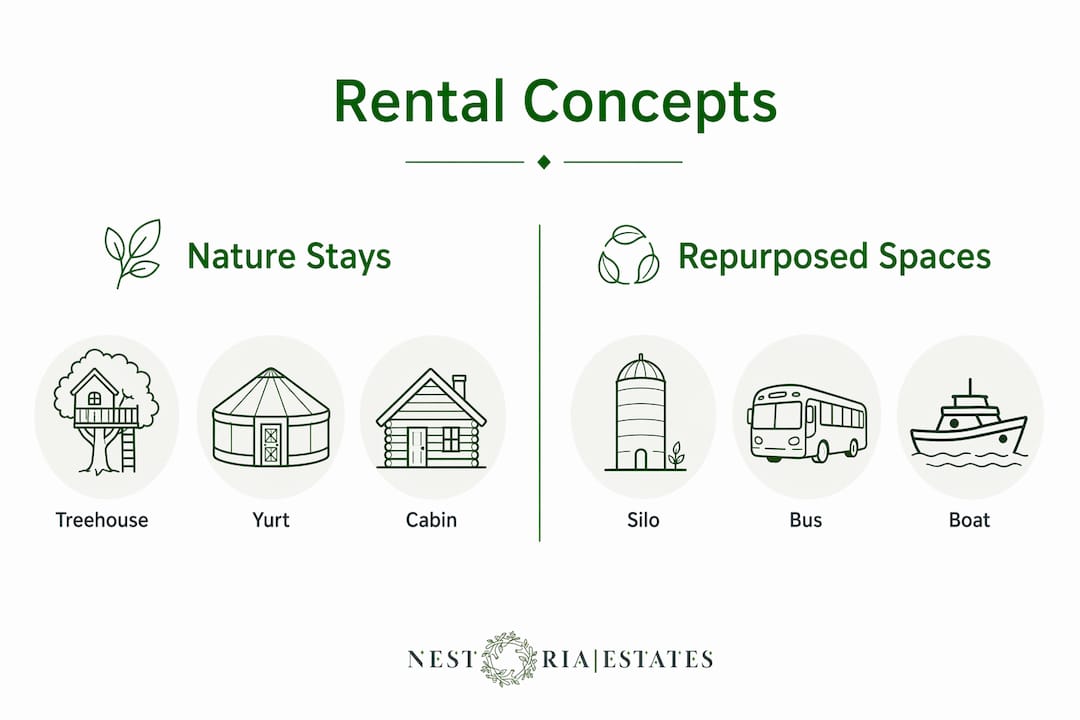
The most booked types of creative vacation rentals fall into a few clear categories:
Treehouses: Elevated structures built into or around mature trees, offering forest canopy views, birdsong, and a genuine sense of seclusion. Many feature full kitchens, hot tubs, and fiber-optic internet.
Caves and earth homes: Naturally temperature-regulated spaces carved into hillsides or built into rock formations. Cave stays in Cappadocia, Turkey, or Sedona, Arizona, maintain consistent interior temperatures regardless of outdoor conditions.
Floating properties: Off-grid suites on water, including houseboats, overwater bungalows, and tiki-style platforms. Floating tiki suites in Key West rent for $600 to $900 per night, require arrival by private boat, and offer limited utilities. That price point reflects how strongly travelers value genuine novelty.
Tiny houses: Compact, architect-designed structures that maximize space through clever engineering. These appeal to minimalist travelers and couples seeking a focused, distraction-free stay.
Yurts: Circular, fabric-walled structures rooted in Central Asian nomadic tradition. Modern yurts often include wood-burning stoves, Persian rugs, and skylights for stargazing.
Repurposed structures: Former jails, grain silos, churches, water towers, and lighthouses converted into rentable stays. Converted agricultural silos command up to $250 per night with occupancy rates around 60%, which is a strong performance for newly launched concept properties.
Here is a quick comparison of the most popular types by experience profile:
Concept type | Primary appeal | Typical price range | Best suited for |
Treehouse | Seclusion, nature immersion | $150–$400/night | Couples, families |
Cave or earth home | Temperature stability, history | $120–$350/night | Adventurous solo travelers |
Floating suite | Water access, off-grid novelty | $600–$900/night | Couples, luxury seekers |
Converted silo or jail | Local history, sustainability | $150–$250/night | Culture-focused travelers |
Yurt | Nomadic tradition, stargazing | $80–$200/night | Budget-conscious adventurers |
Tiny house | Minimalist design, efficiency | $100–$300/night | Design enthusiasts, couples |
Airbnb’s OMG! category, launched to spotlight the most extraordinary listings, reflects just how mainstream these quirky rental properties have become. Travelers searching for luxury vacation stays increasingly expect the property itself to deliver a story worth telling.
How do design and location shape a rental’s identity?
A distinctive rental concept fails without a cohesive design identity. The most successful unique rentals feel like lived-in homes rather than staged sets, and that authenticity creates a deeper emotional connection for guests. Terra Luz, a Latin-inspired desert sanctuary in the American Southwest, demonstrates this perfectly. Its design layers Frida Kahlo blue pools, wabi-sabi textures, hand-painted tiles, and desert-sourced materials into a single coherent aesthetic. Every object in the space reinforces the same story. Guests do not just stay there. They inhabit a world.
Location amplifies or undermines that identity. A treehouse in a suburban backyard delivers a fraction of the impact of the same structure perched above an old-growth forest in British Columbia or the Smoky Mountains. Remote and rural locations add scarcity value. Coastal settings add sensory richness. Urban repurposed structures, like a converted church in Northumberland, England, add historical weight that no new-build can replicate. Repurposed historic buildings blend modern comfort with authentic narratives, and that combination consistently attracts travelers who want more than a generic room.
The practical effect on pricing is direct. Remote properties with strong design identities and natural settings command premiums because they are genuinely irreplaceable. A guest cannot find the same experience two miles down the road.
Pro Tip: When evaluating a unique rental listing, look at the host’s photo selection. Hosts who photograph the surrounding landscape, the quality of light at different times of day, and the small design details are usually the ones who have thought carefully about the full guest experience.
Repurposing local infrastructure also adds a sustainability dimension that resonates with modern travelers. Converting existing structures like former RCMP detachments or grain silos avoids new construction, preserves local history, and gives travelers a connection to place that a purpose-built rental cannot offer. For travelers who care about their environmental footprint, this matters.
What should travelers verify before booking unconventional stays?
Booking a distinctive rental experience requires a different checklist than booking a hotel. The gap between expectation and reality is wider here, and the consequences of a mismatch are harder to fix once you have arrived at a remote property with no car access and no backup options.
Follow these steps before confirming any unconventional booking:
Confirm basic utilities. Verify toilet, shower, and power availability directly with the host before booking. Many unique rentals are experience-focused rather than hotel-luxury, and some genuinely do not include private bathrooms or reliable electricity.
Understand access requirements. Floating properties may require arrival by boat. Remote treehouses may involve a hike. Cave stays may have low ceilings or narrow passages. Read the listing’s access section carefully and ask the host to clarify anything ambiguous.
Check what is and is not provided. Open-air nests and adventure stays like the Human Nest at Big Sur’s Treebones Resort do not provide weather protection. Guests must bring their own bedding and prepare for outdoor sleeping conditions. These stays are closer to glamping than to hotel accommodation.
Review safety and permit documentation. Repurposed historical structures should have current safety certifications. Ask the host whether the property meets local short-term rental regulations and fire safety standards.
Read recent reviews with specific attention to surprises. Guests who mention unexpected conditions, noise, or missing amenities are giving you the most useful information in the listing.
Pro Tip: Message the host with one specific question before booking. A fast, detailed response signals a host who is engaged and prepared. A slow or vague response tells you something important about how they will handle issues during your stay.
You can find a deeper breakdown of what separates a well-managed unconventional property from a poorly run one in this guide to finding unique short-term rentals for luxury stays.
How is the market for unique vacation rentals growing in 2026?
The numbers behind this market are striking. Non-conventional listings on Airbnb grew by 123% between 2020 and 2024, reaching nearly 56,000 listings globally. That growth rate outpaced the overall Airbnb platform expansion by a wide margin, which means traveler demand for novel vacation stays is pulling supply forward rather than the other way around. Unique properties earned nearly $1 billion globally in 2021 alone, a figure that reflects genuine willingness to pay premium prices for genuinely different experiences.
“Guests are increasingly motivated by the uniqueness of the lodging itself rather than just the destination. The property is the destination.”
Rural and remote destinations have benefited most from this trend. Unique rentals give travelers a compelling reason to visit locations that lack traditional tourist infrastructure. A converted grain silo in rural Manitoba or a treehouse in the forests outside Vancouver creates a destination where none existed before. This has real economic consequences for small communities that would otherwise see little short-term rental activity.
Platform support has accelerated the trend further. Airbnb’s OMG! category, which awards grants to hosts building the most extraordinary properties, has directly incentivized the creation of new concept listings. Vrbo and other platforms have followed with their own curated collections of extraordinary travel accommodations. The competitive dynamic between platforms is pushing the category upward in quality and creativity.
Year | Unconventional Airbnb listings | Global revenue from unique properties |
2020 | ~25,000 (baseline) | Not publicly reported |
2021 | Growing | Nearly $1 billion |
2024 | ~56,000 | Significantly higher |
For travelers, this growth means more options, more competition among hosts, and better value at every price point. For property owners in markets like Vancouver, it signals that listing luxury rentals with a strong concept identity is one of the most effective ways to achieve premium pricing and strong occupancy simultaneously.
Key takeaways
The most successful unique vacation rental concepts combine authentic design identity, a location that reinforces the concept, and transparent communication about what guests should expect and prepare for.
Point | Details |
Lodging is the destination | Travelers increasingly book trips around the property itself, not just the location. |
Design identity drives value | Cohesive, authentic aesthetics like Terra Luz’s Latin desert theme command premium rates and stronger reviews. |
Verify before you book | Confirm utilities, access, and safety certifications directly with the host before paying. |
Market growth is accelerating | Unconventional Airbnb listings grew 123% from 2020 to 2024, signaling sustained traveler demand. |
Repurposed structures offer unique value | Converted jails, silos, and churches blend sustainability with authentic local history. |
Why unique rentals have changed how I think about travel
I have stayed in a converted RCMP jail cell in rural Manitoba, a treehouse outside Whistler, and a yurt on the edge of a working vineyard in the Okanagan. None of those trips were about the surrounding town or the regional attractions. The property was the entire point. That shift in travel motivation is not a trend that will reverse. It reflects something deeper about what people want from time off.
What I find underappreciated in most coverage of this category is the role of host preparation. The best unconventional stays I have experienced were run by hosts who anticipated every question I did not know to ask. They left laminated cards explaining the water pressure quirks, the best time to watch the sunrise from the deck, and which local farm sold eggs on Saturday mornings. That level of care cannot be faked, and it is the single biggest differentiator between a memorable stay and a frustrating one.
My honest advice: do not let the novelty of a concept override your judgment about the host. A beautifully photographed floating suite run by a disengaged host will disappoint. A modest treehouse run by someone who genuinely loves the property will exceed every expectation. Read the reviews for host responsiveness, not just property condition.
The market for types of luxury vacation rentals is maturing fast. The properties that will define this category in 2026 and beyond are the ones where design, location, and host quality align completely. Those are the stays worth planning a trip around.
— Kamran
How Nestoriaestates helps you find and book distinctive stays
Nestoriaestates works with property owners across Canada and the United States to manage short-term rentals that stand out in competitive markets. If you are a Vancouver property owner considering whether your space has the potential to become a sought-after concept rental, Nestoriaestates offers free revenue projections and data-driven pricing strategies that reflect current demand for unconventional properties. The team handles guest communication, cleaning coordination, and compliance so that your property performs at its peak without requiring your daily attention. Explore the full range of short-term rental services Nestoriaestates offers, or reach out directly to discuss your property’s potential.
FAQ
What are unique vacation rental concepts?
Unique vacation rental concepts are lodging properties where the structure or setting is the primary travel experience, including treehouses, cave homes, floating suites, converted silos, and yurts. They differ from standard rentals by placing the stay itself at the center of the trip rather than treating accommodation as secondary to a destination.
How much do unique vacation rentals typically cost?
Prices range widely by concept type. Converted silos and yurts typically run $80 to $250 per night, while floating off-grid suites in coastal locations like Key West can reach $600 to $900 per night depending on exclusivity and access requirements.
What should I check before booking an unconventional rental?
Confirm toilet, shower, power availability, and access requirements directly with the host before booking. Some open-air or off-grid properties do not include standard utilities and require guests to bring their own supplies.
Are unique Airbnb options growing in availability?
Non-conventional listings on Airbnb grew by 123% between 2020 and 2024, reaching nearly 56,000 listings globally. Airbnb’s OMG! category and host grant programs have directly accelerated this growth.
Why are repurposed buildings popular as vacation rentals?
Repurposed structures like former jails, churches, and grain silos offer a combination of local history, sustainable construction, and authentic character that purpose-built rentals cannot replicate. Travelers seeking cultural connection and distinctive narratives consistently favor these properties over generic alternatives.
Recommended
Comments