

Vacation Rental Pricing Guide for Vancouver Owners

TL;DR:
Effective vacation rental pricing combines a base rate based on market data with dynamic adjustments for demand and seasonality. Using weekly reviews and automated tools maximizes revenue by capturing demand spikes and protecting your profit margins. Setting a hard price floor ensures no booking results in a loss, even in slow periods.
Vacation rental pricing strategy is the methodical process of setting and adjusting nightly rates based on market data, demand trends, and operational costs to maximize your rental income and occupancy. This guide to pricing vacation rentals gives Vancouver property owners a practical framework built on Revenue Per Available Night (RevPAN), dynamic pricing, and seasonal adjustments. Properties using dynamic pricing earn up to 40% more annual revenue than those using static rates. That gap is the difference between a property that performs and one that just sits on the market.
How do you determine the right base rate for your vacation rental?
Your base rate is the foundation every other pricing decision rests on. Get it wrong and no amount of seasonal adjustment will fix your revenue.

Identifying your comp set
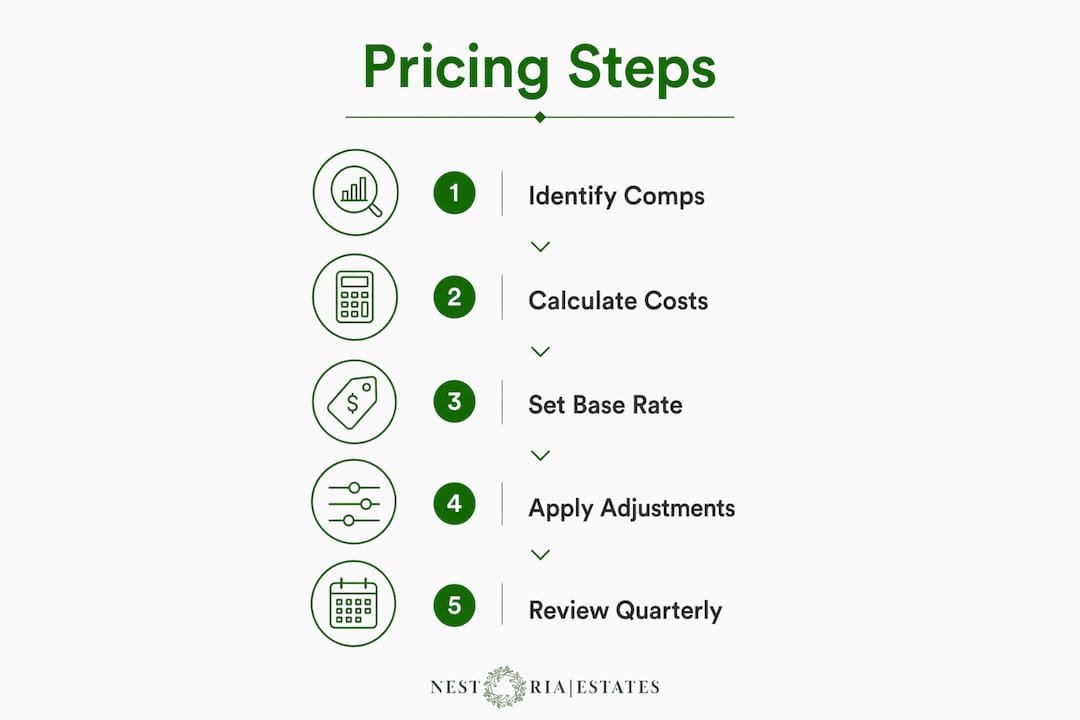
Start by finding 10–15 comparable listings in your Vancouver neighborhood. Match by bedroom count, guest capacity, key amenities like parking or laundry, and proximity to transit or attractions. Pull the median nightly rate from those comps over the last 90 days. That figure is your market baseline, not a ceiling.
New listings especially should start conservatively, within 10–15% of that median. Booking platforms reward new properties with visibility boosts, but only when the price signals competitiveness. A rate set too high early on suppresses bookings and tanks your ranking before you have any reviews to compensate.
Factoring in your true costs
Your base rate must cover cleaning fees, platform commissions, maintenance reserves, mortgage or carrying costs, and a target profit margin. List every recurring cost per stay. If your all-in cost per booking is $180 and your base rate is $150 per night for a two-night minimum, you are losing money on every reservation.
Pro Tip: Track how your base rate affects occupancy over 30-day rolling windows. If you fill up more than three weeks out consistently, your rate is likely too low. Many vacancies 30 days out signal the base rate is too high and needs recalibration.
Once your base rate is set, treat it as a living number. Review it quarterly against fresh comp data, and adjust when the market shifts, not when panic sets in.
What is dynamic pricing and how can it increase your rental income?
Dynamic pricing is the practice of adjusting your nightly rate in real time based on demand signals, booking pace, local events, and competitor behavior. It is the single most effective tool for closing the gap between what your property earns and what it could earn.
How dynamic pricing works in practice
Automated pricing tools pull data from platform search results, local event calendars, and historical booking patterns. They raise rates when demand spikes, such as during Vancouver’s peak summer season or major events like the Vancouver International Film Festival, and lower them when demand softens. The result is a rate that reflects actual market conditions rather than a guess made weeks in advance.
A manual approach, applying weekend premiums and seasonal tiers by hand, captures roughly 80% of the revenue efficiency of automated tools. That is a meaningful gap. Manual management also demands consistent weekly attention, which most property owners underestimate.
Structural vs. tactical pricing
Effective vacation rental pricing uses two layers. Structural pricing covers your seasonality tiers and length-of-stay rules. Tactical pricing covers event-based and last-minute adjustments. Both layers are required to maximize revenue. Relying on only one leaves money on the table.
Pricing layer | What it covers | Review frequency |
Structural | Base rate, seasonal tiers, stay rules | Quarterly |
Tactical | Events, last-minute gaps, booking pace | Weekly |
Automated tools | Real-time demand and comp adjustments | Continuous |
Manual overrides | Price floors, special circumstances | As needed |
Pro Tip: Always set a minimum price floor before activating any automated tool. Algorithms optimize for occupancy, not profitability. Without a floor, a slow week can push your rate below your actual cost per stay.
For a deeper look at how Vancouver owners are applying these methods, Nestoriaestates has published a practical breakdown of dynamic pricing for Vancouver hosts worth reading alongside this guide.
How should you adjust pricing for seasons, events, and occupancy trends?
Vancouver’s rental market has clear seasonal rhythms. Knowing them lets you price ahead of demand rather than reacting to it.
Defining Vancouver’s pricing seasons
Peak season runs from june through august, when tourism and outdoor activity drive strong demand. Shoulder seasons in may and september still command solid rates, especially for waterfront or mountain-adjacent properties. Off-peak months from november through february require a different approach, focused on longer stays and competitive rates rather than premium nightly prices.
Weekend premiums of 15–30% are standard practice for short-term rentals. Peak season premiums typically run 20–50% above your base rate. These are not arbitrary markups. They reflect real demand curves that the market has already priced in through your comp set.
Minimum stay rules and gap nights
Minimum stay rules protect your calendar from unprofitable configurations. A two-night minimum on weekends prevents single-night bookings that create unbookable gap nights on either side. Over peak holiday weekends, a three-night minimum is often the right call. Minimum stay rules over peak weekends prevent gap nights that reduce occupancy more than a rate increase ever would.
Key seasonal pricing guidelines for Vancouver owners:
Peak season (june–august): Apply 20–50% premium above base rate; enforce two to three night minimums
Shoulder season (may, september–october): Apply 10–20% premium; flexible minimums based on booking pace
Off-peak (november–april): Price at or near base rate; prioritize longer stays with weekly discounts
Event weekends: Apply tactical premiums of 25–40%; set minimums to span the event period
Last-minute gaps (within 7 days): Reduce rate modestly to fill, but never below your price floor
Avoid panic discounting when occupancy looks soft two weeks out. A discounted rate that fills a gap night at a loss is worse than leaving the night open and protecting your average daily rate.
What guest-focused pricing incentives help improve bookings and reduce turnover costs?
Length-of-stay discounting is one of the most underused tools in vacation rental pricing. Most owners focus entirely on nightly rate and ignore the operational math behind booking length.
A seven-night stay at a 10% discount generates more net revenue than seven separate one-night bookings. The reason is turnover cost. Each changeover requires cleaning, restocking, and key coordination. Longer stays cut those costs sharply. Length-of-stay discounting lowers turnover costs and operational friction while attracting guests who plan further ahead and tend to leave better reviews.
A practical discount structure for Vancouver rentals:
5 nights: 5% discount off the nightly rate
7 nights or more: 10% discount off the nightly rate
28 nights or more: Negotiate directly; monthly rates require separate cost analysis
Amenity premiums work in the opposite direction. A property with a private hot tub, dedicated workspace, or EV charging can justify rates 15–25% above comparable listings without those features. The premium must be visible in your listing and reflected in guest reviews to hold up over time.
Linking your pricing to guest experience also protects your long-term revenue. Higher-rated properties rank better on booking platforms, which means more visibility and more bookings at your target rate. Pricing and guest satisfaction are not separate decisions.
Pro Tip: Use length-of-stay discounts as a booking incentive, not as a default rate cut. Apply them selectively during shoulder and off-peak periods to attract longer stays without training guests to expect discounts year-round.
How often should you evaluate and update your vacation rental pricing?
Pricing is not a set-and-forget decision. The Vancouver short-term rental market shifts with tourism patterns, new supply, and platform algorithm changes.
A structured review cadence keeps your rates aligned with real conditions:
Weekly: Review bookings within the next 30–60 days. Weekly pricing review focused on near-term windows is the standard recommended by revenue management professionals. Adjust tactical pricing for events, gaps, or booking pace changes.
Monthly: Compare your occupancy rate and average daily rate against your comp set. If you are consistently outperforming on occupancy but underperforming on rate, your base rate is too low.
Quarterly: Recalibrate your base rate using fresh 90-day comp data. Update seasonal tiers if market conditions have shifted.
Annually: Review your full pricing structure, including minimum stays, discount thresholds, and price floors, against your actual cost per stay and profit targets.
The most common mistake owners make is reacting to a slow week by cutting rates across the board. One slow week is noise. Two or three consecutive weeks of low booking pace is a signal worth acting on. The distinction matters because reactive discounting erodes your average daily rate without solving the underlying issue, which is usually a listing quality or positioning problem, not a pricing one.
Tracking RevPAN rather than nightly rate alone gives you a cleaner picture of performance. RevPAN accounts for vacancy, so a $200 night with 60% occupancy outperforms a $250 night with 40% occupancy. Shifting to RevPAN as your primary metric is the mindset change that separates owners who manage pricing well from those who just react to it.
Key takeaways
Effective vacation rental pricing requires a base rate grounded in comp data, dynamic adjustments tied to real demand, and a weekly review habit that keeps rates ahead of the market.
Point | Details |
Base rate methodology | Use the median nightly rate of 10–15 comps over 90 days, starting within 10–15% of that figure. |
Dynamic pricing impact | Properties using dynamic pricing earn up to 40% more annual revenue than those on static rates. |
Seasonal premiums | Apply 15–30% weekend premiums and 20–50% peak season premiums above your base rate. |
Length-of-stay discounts | Offer 5% off for 5 nights and 10% off for 7+ nights to cut turnover costs and attract longer stays. |
Review cadence | Review near-term pricing weekly and recalibrate your base rate quarterly using fresh market data. |
What I’ve learned about pricing Vancouver rentals that most guides skip
Most pricing guides tell you to use dynamic pricing and leave it there. The real work is in the details that software cannot handle for you.
The biggest mistake I see Vancouver owners make is treating their price floor as a suggestion. When a slow november rolls around and the calendar looks empty, the temptation to drop below your cost per stay is real. But a booking that loses you money is worse than no booking at all. Your price floor is not a starting point for negotiation. It is a hard limit based on your actual cost per stay, including cleaning, platform fees, and maintenance.
The second thing most owners miss is the relationship between minimum stay rules and gap nights. A three-night minimum over a long weekend sounds restrictive, but a two-night gap on either side of a booked weekend is almost impossible to fill. The minimum stay rule protects your calendar from configurations that look occupied but actually cost you revenue.
Vancouver’s market also rewards patience more than most cities. The city draws consistent international tourism, conference traffic, and film industry demand that creates pricing opportunities well beyond the summer peak. Owners who track local event calendars and adjust tactical pricing two to three weeks ahead consistently outperform those who rely entirely on automated tools. Automation handles the baseline. Local knowledge handles the edge cases.
Finally, shift your focus from nightly rate to RevPAN. A property earning $180 per night at 85% occupancy outperforms one earning $220 per night at 60% occupancy. The math is simple, but the mindset shift takes time. Once you start measuring RevPAN, you stop chasing the highest rate and start building the most profitable calendar. For more on this approach, the Nestoriaestates guide on maximizing rental revenue in Vancouver covers the RevPAN framework in detail.
— Kamran
How Nestoriaestates helps Vancouver owners price smarter
Pricing a vacation rental well takes consistent market analysis, weekly adjustments, and a clear understanding of your property’s cost structure. Most owners do not have the time to do all three at once.

Nestoriaestates provides full-service property management in Vancouver that includes dynamic pricing setup, ongoing market analysis, and weekly rate adjustments based on real booking data. The team handles guest communication, cleaning coordination, and detailed owner reporting so you can see exactly how your property is performing. Nestoriaestates also offers free revenue projections before you commit, so you know what your property can realistically earn. If you want data-driven pricing without managing it yourself, reach out to the team to get started.
FAQ
What is RevPAN and why does it matter for vacation rentals?
RevPAN stands for Revenue Per Available Night. It measures actual revenue earned across all available nights, including vacancies, making it a more accurate performance metric than nightly rate alone.
How do I set a base rate for my Vancouver vacation rental?
Pull the median nightly rate from 10–15 comparable listings over the last 90 days and set your rate within 10–15% of that figure. Start conservatively to protect your listing’s visibility and ranking.
How much more can dynamic pricing earn compared to static rates?
Properties using dynamic pricing earn up to 40% more annual revenue than those using fixed rates. The gap comes from capturing demand spikes during events and peak periods that static pricing misses.
How often should I update my vacation rental pricing?
Review near-term pricing weekly, focusing on bookings within the next 30–60 days. Recalibrate your base rate quarterly using fresh comp data and updated cost figures.
What is a price floor and why should I set one?
A price floor is the minimum rate you will accept based on your true cost per stay, including cleaning, fees, and maintenance. Setting a hard floor prevents automated tools or slow periods from pushing your rate into unprofitable territory.
Recommended
Comments