

Why Use Dynamic Pricing for Rentals: 2026 Guide
TL;DR:
Using dynamic pricing allows Vancouver Airbnb hosts to respond automatically to demand and market trends, increasing revenue by up to 40%.
It helps maintain competitive rates, improve occupancy, and save time compared to manual pricing strategies.
If you’re still setting a flat nightly rate for your Vancouver Airbnb and adjusting it a few times a year, you’re almost certainly leaving money on the table every single week. Understanding why use dynamic pricing for rentals isn’t just a theoretical exercise. It’s the difference between running a reactive listing and running a property that actually competes. This guide breaks down what dynamic pricing is, how it works in practice, and why Vancouver hosts who ignore it are losing ground to those who don’t.
Table of Contents
Key takeaways
Point | Details |
Dynamic pricing reacts in real time | Rates adjust automatically based on demand, local events, and competitor activity rather than guesswork. |
Revenue gains are significant | Properties using dynamic pricing report 10% to 40% more revenue compared to static pricing models. |
Guardrails protect your floor | Setting minimum and maximum price limits prevents algorithms from pricing your property at harmful extremes. |
Occupancy gaps are measurable | Dynamic pricing users in the US outperform static operators by 13 occupancy points on average. |
Static pricing is increasingly obsolete | By 2026, dynamic pricing is becoming the industry standard, putting fixed-rate hosts at a structural disadvantage. |
Why use dynamic pricing for rentals
At its core, dynamic pricing for rentals means your nightly rate changes automatically based on real-time market conditions rather than staying fixed. According to AirDNA’s definition, dynamic pricing adjusts rental rates using live data inputs including demand signals, seasonality patterns, local events, and what competing properties are charging at any given moment.
The difference between dynamic and static pricing isn’t just about frequency of change. It’s about who or what is making the decision. A static rate is a human guess that ages poorly. A dynamic rate is a data-driven response that stays current.
Here’s what a well-configured dynamic pricing system monitors continuously:
Demand fluctuations. Search volume for Vancouver stays spikes around events like the Vancouver International Film Festival, Celebration of Light, or major sporting events at Rogers Arena. A good algorithm captures that spike and raises your rate before you even notice the trend.
Seasonality curves. Summer shoulder weeks and Christmas holiday windows behave very differently. Dynamic systems weight these patterns from historical data and apply them forward.
Competitor rates. If nearby listings drop their prices aggressively on a slow Tuesday, your system can respond without you logging in.
Booking pacing. How far in advance guests are booking tells you a lot about current demand. If your 30-day forward calendar fills faster than normal, that’s a signal to push rates up.
Lead time and last-minute windows. Early bird pricing for guests booking two months out differs from what a guest booking tonight should pay.
Best dynamic pricing systems refresh rates at least every 24 hours, and during high-demand windows they can update multiple times per day. That kind of responsiveness is simply not achievable manually, even if you’re checking your calendar daily.
Pro Tip: Don’t confuse dynamic pricing with discount pricing. The system raises rates when demand is high just as often as it lowers them when demand is soft. Over a full calendar year, the net effect is higher revenue, not lower.
Dynamic pricing advantages for Vancouver Airbnb hosts
The financial case for switching to a dynamic pricing strategy is not subtle. Revenue increases of 10% to 40% over static pricing are well-documented across vacation rental markets, and those gains come from two directions at once: extracting higher rates during peak demand and recovering occupancy during slow periods that would otherwise go unbooked.
Here’s how those advantages break down practically for Vancouver hosts:
Higher revenue during demand spikes. When a major conference books out downtown hotels, short-term rental guests flood Airbnb. A dynamic system recognizes the demand surge and adjusts your rate upward, sometimes significantly, without you doing anything.
Better occupancy in slow seasons. Rather than sitting empty during February shoulder weeks, a properly configured system softens your rate just enough to attract bookings that still cover costs and generate profit.
Time recovered from manual monitoring. Checking competitor rates, adjusting prices, and second-guessing every week is a real time drain. Automation returns those hours to you.
Competitive positioning against hotels. Vancouver hotels use sophisticated revenue management systems. Dynamic pricing gives individual hosts a comparable tool so they’re not permanently disadvantaged on price competitiveness.
Improved RevPAR metrics. Dynamic pricing enables property managers to demonstrate superior Revenue Per Available Rental compared to hosts on manual pricing. That matters if you’re managing multiple properties or planning to attract investors.
The occupancy data is particularly compelling. In the US market, properties using high-frequency dynamic pricing tools outperform static operators by 13 occupancy percentage points on average. That’s not a marginal edge. That’s a structural advantage that compounds over a full year of bookings.
Transitioning to dynamic pricing also signals a shift in how you operate. It marks the evolution from casual host to professional revenue manager, which matters more than ever in a saturated market like Vancouver’s. If you want to understand more about maximizing what your property earns, the benefits of short-term rentals article from Nestoriaestates covers the full picture.

Best practices when implementing dynamic pricing
Understanding the theory is one thing. Getting implementation right is where most hosts make costly mistakes. Here’s what separates effective dynamic pricing strategy from a misconfigured algorithm that causes problems.
Set price floors and ceilings first
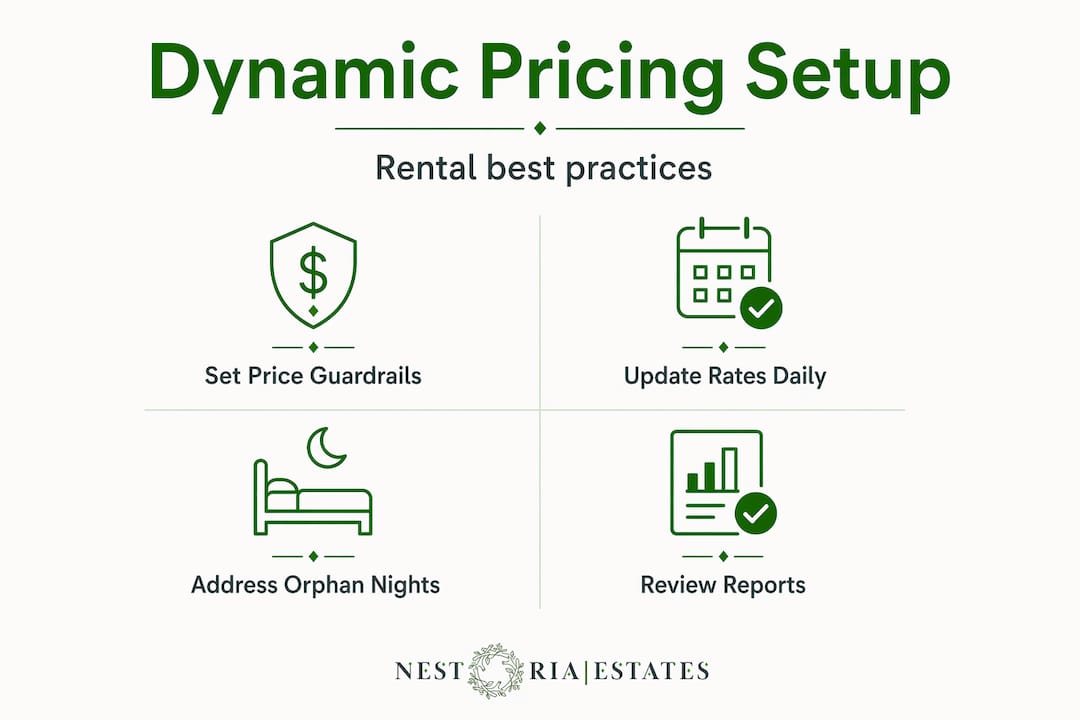
Before your algorithm touches a single rate, define your price guardrails. A floor prevents the system from dropping your rate below what covers your costs, cleaning fees, and minimum acceptable profit. A ceiling stops it from pricing you out of the market entirely during unusual data spikes. Without these limits, an algorithm can react to irrelevant anomalies in ways that damage your listing’s performance.
Address orphan nights proactively
One of the most underrated tactics in rental pricing optimization is dealing with orphan nights. These are single unbooked nights sitting between two existing reservations. Most static pricing hosts ignore them and lose the revenue entirely. Dynamic pricing systems apply rule-based logic to discount those nights just enough to make them attractive without undercutting your broader rate strategy.
Pricing approach | Orphan night handling | Typical outcome |
Static pricing | No adjustment, night stays vacant | Revenue lost entirely |
Manual dynamic pricing | Occasional ad hoc discount | Inconsistent, labor intensive |
Automated dynamic pricing | Rule-based auto-discount | Higher utilization, recovered revenue |
Don’t rely on the algorithm alone
Dynamic tools are powerful but not infallible. You still need to monitor performance weekly, check whether your floor and ceiling are calibrated correctly, and watch for local market changes the system may not weight appropriately. Vancouver’s short-term rental regulations have also shifted in recent years, and your pricing strategy needs to account for what your property is actually licensed to do.
Pro Tip: Review your dynamic pricing report at least once a month. Look specifically at nights that went unbooked at high rates and nights that booked at rates below your expected average. Those two data points tell you whether your floor, ceiling, or demand curve settings need adjustment.
The impact of dynamic pricing in Vancouver’s rental market
Vancouver is one of the most competitive short-term rental markets in North America. Hotel density is high, traveler expectations are sophisticated, and static pricing operators face increasing competitive pressure as dynamic pricing becomes the industry standard heading into 2026.
What makes this market particularly unforgiving for fixed-rate hosts:
Vancouver’s booking windows are short. Many guests book fewer than two weeks in advance, which means your rates need to respond to demand signals quickly.
The city has a dense calendar of demand-driving events: film festivals, tech conferences, NHL playoff runs, and major concerts regularly spike short-term rental demand in specific neighborhoods.
Competing properties managed by professional firms already use automated pricing. A host with a flat rate is essentially bidding blind against operators with real-time market intelligence.
The data from comparable markets reinforces this. In Italy, the occupancy gap between dynamic and static pricing operators reached 30 percentage points. While Vancouver’s gap is closer to the US average of 13 points, that still translates to weeks of additional bookings per year. For more on how to extract more from your Vancouver listing specifically, the Vancouver Airbnb optimization tips post from Nestoriaestates is worth reading alongside this one.
How to get started with dynamic pricing
Getting started doesn’t require a technical background. It requires making a few deliberate decisions before you turn anything on.
Calculate your break-even rate. Add up your mortgage (or carrying cost), strata fees, Airbnb service fees, cleaning, supplies, and a buffer for maintenance. Divide by your target occupied nights per month. That number is your absolute price floor.
Choose a pricing tool that fits your portfolio. Solo hosts with one or two properties have different needs than investors managing five or more. Look for tools with calendar integration, rule-based controls, and market data coverage for Vancouver specifically.
Connect your pricing tool to your property management system. Rates should flow automatically to your Airbnb calendar without manual exports. Any friction in that sync creates gaps.
Configure your rules before going live. Set your floor, your ceiling, your orphan night discount threshold, and your minimum stay rules. Don’t launch with defaults. Defaults are built for average markets, not yours.
Review performance monthly and adjust. Treat the first 90 days as a calibration period. Your goal is to learn how the algorithm responds to your specific property’s booking patterns and refine from there.
If you’d rather not manage this yourself, working with a professional property management service that has built-in dynamic pricing expertise removes the learning curve entirely. Nestoriaestates covers this in detail at professional rental management in 2026.
Pro Tip: Run a free revenue projection before committing to any tool or service. Most credible providers will model your property’s potential under dynamic pricing versus your current rates. That number usually makes the decision obvious.
My take on dynamic pricing after years in Vancouver rentals
I spent the early part of my career watching hosts in Vancouver leave serious money behind because they were emotionally attached to a number they’d set when they first listed. “My place is worth $200 a night” is not a pricing strategy. It’s a preference, and the market doesn’t care about your preferences.
When I shifted to fully automated dynamic pricing across the properties I work with, the first thing I noticed wasn’t the revenue increase. It was the relief of not second-guessing every rate adjustment by hand. The mental overhead of manual pricing is real, and it costs you accuracy too because humans are not good at tracking 12 variables simultaneously at 11pm on a Sunday.
What I’ve learned is that the hosts who resist dynamic pricing usually have one of two concerns. They either think it means constantly discounting, or they worry about losing control. Both concerns are valid if your system isn’t configured properly. But with the right floor, ceiling, and rules in place, you’re not handing over control. You’re delegating the repetitive parts to something that does them better than you can.
Vancouver’s rental market rewards precision. The hosts winning right now aren’t the ones with the nicest photos or the most amenities. They’re the ones whose rates are always in the right place at the right time.
— Kamran
Let Nestoriaestates handle your pricing strategy

At Nestoriaestates, we manage Vancouver Airbnb properties with built-in dynamic pricing as a core part of every engagement, not an add-on. Our team monitors market data, adjusts rate rules, and tracks performance across your calendar so your property stays competitive without requiring your daily attention. Whether you own one condo or a growing portfolio, our property management services are built around one goal: maximizing what your property earns while keeping your involvement minimal. Reach out for a free revenue projection and see exactly what data-driven pricing could mean for your specific Vancouver property.
FAQ
What is dynamic pricing for rentals?
Dynamic pricing for rentals is an automated strategy that adjusts your nightly rate in real time based on demand, seasonality, competitor rates, and local events. Unlike static pricing, it responds to market conditions continuously rather than relying on manually set rates.
How much can dynamic pricing increase my rental revenue?
Properties using dynamic pricing report revenue increases of 10% to 40% over static pricing, depending on market conditions and how well the system is configured.
Should I use dynamic pricing for my Vancouver Airbnb?
Yes, particularly in a competitive market like Vancouver where booking windows are short and demand spikes around local events. Static pricing leaves you permanently underpriced during peak periods and overpriced during slow ones.
How does dynamic pricing work without constant manual updates?
Dynamic pricing tools use algorithms that pull real-time data and update your rates automatically, often multiple times per day during high-demand windows. You set the rules and guardrails; the system executes.
What are price guardrails in dynamic pricing?
Price guardrails are minimum and maximum rate limits you set to prevent the algorithm from pricing your property below your cost floor or above a competitive ceiling. Setting these guardrails is one of the most critical steps in a safe dynamic pricing setup.
Recommended
Comments