

8% Often Becomes 18–22%: Airbnb Management Fees in Vancouver
The real risk isn’t the headline number. Add-on charges for placement, inspections, and maintenance markups routinely push a modest-looking 8% quote into an 18% to 22% effective annual cost once turnover season hits. Before signing anything, ask the manager, including full-service operators like Nestoria Estates, for a written fee schedule and a free revenue projection so you’re comparing real numbers, not marketing ones.
TL;DR:
Fee structures vary, with percentage-based fees aligning incentives but risking higher costs during turnover, while flat fees offer predictability but may be more expensive for high-revenue properties.
Common included services in base fees are rent collection, guest communication, routine reporting, and basic maintenance coordination, but extra charges for inspections, markups, and licensing often apply.
Comparing management quotes requires detailed, itemized fee schedules, explicit contract definitions, and calculations based on realistic turnover scenarios to reveal true effective annual costs.
Reducing costs involves operational control, such as negotiating caps on markups, requesting revenue projections, and improving onboarding and guest screening to limit extra charges.
Table of Contents
What Are the Typical Airbnb Property Management Fees?
Airbnb property management fees come in three basic shapes, and knowing which one you’re looking at matters more than the number itself.
Percentage-based pricing is the most common structure across Canada. Core management services, meaning rent collection, guest messaging, and basic coordination, typically run 6% to 12% of collected rent, with the national average landing near 8% to 10%, according to pricing guides that track fees across provinces. That range covers long-term rental management, though. Short-term rental and Airbnb-specific management, which involves far more guest turnover, cleaning coordination, and dynamic pricing work, usually sits higher. Full-service bundles for short-term rentals commonly run in a wide percentage range, with most Vancouver hosts landing in the lower portion of that range unless the property demands luxury-level, high-touch service, per Airbnb management cost breakdowns for 2026.
Flat-fee pricing works differently. Instead of a percentage, you pay a fixed dollar amount every month regardless of how much revenue the property generates. Flat management fees cluster around a few hundred dollars per month for basic oversight, while flat-fee revenue optimization services (pricing strategy alone, no guest management) generally cost somewhat more per listing per month, based on managed pricing cost comparisons for 2026.
Hybrid models split the difference: a lower flat base fee plus a smaller percentage cut, or a percentage fee with caps on certain services. Some operators also offer revenue-only management, where a specialist just handles pricing for a small percentage of gross revenue, while you or another company handles guest communication and cleaning.
Percentage models align the manager’s incentive with your revenue. They earn more when you earn more.
Flat fees give you cost predictability. You know your bill in January and December alike.
Hybrid structures try to balance both, often at the cost of added complexity in the contract.
The model you choose changes the manager’s motivation. A percentage-based operator has real skin in the game to push your nightly rate up. A flat-fee operator has less incentive to optimize aggressively since their paycheck doesn’t move either way.
What Do Base Management Fees Actually Include?
Base fees vary by operator, but most full-service contracts fall into a predictable pattern. Here’s what’s typically bundled into the headline percentage:
Booking and rent collection — processing guest payments and remitting your share.
Guest communication — messaging, check-in coordination, and basic issue resolution.
Routine reporting — monthly or on-demand statements showing occupancy, revenue, and expenses.
Basic maintenance coordination — scheduling a repair and following up, though not the repair cost itself.
Standard inspections — periodic walkthroughs to confirm the property is in good shape.
What’s usually not included is where hosts get surprised. Common add-ons include:
Placement or listing setup fees, often priced as a significant fraction to the full amount of one month’s projected rent, charged when a manager takes over a new property or, in long-term contexts, finds a new tenant. This is frequently the single largest line item in a turnover year, per the Canadian property management fee breakdown.
Detailed inspection reports, separate from routine walkthroughs, typically priced around $75 to $150 per report.
Maintenance markups, where the manager adds roughly 10% to 20% on top of any repair invoice they coordinate.
Cleaning and turnover fees, usually passed through to guests as a cleaning charge but sometimes marked up by the manager before it reaches the guest bill.
There’s also a category hosts often forget: regulatory and tax administration. Vancouver requires short-term rental operators to hold a business license and principal-residence documentation, and some managers charge a small administrative fee to handle renewals or municipal reporting on your behalf. Ask upfront whether that’s bundled or billed separately, since it’s easy to miss on a first read of the contract. For background on the local rules that shape these obligations, see this guide to short-term rentals in Vancouver.
How Do You Turn a Headline Fee Into an Effective Annual Rate?
The only honest way to compare two management quotes is to run the full math, not just glance at the percentage on the cover page. Here’s how that plays out with two realistic scenarios.
Scenario A: The deceptively cheap quote. A manager advertises a base percentage management fee on a property generating $60,000 in annual gross rent. Add typical placement fees, detailed inspection charges, and maintenance markups across the year. When summed, these can nearly double the effective annual cost compared to the advertised base percentage.
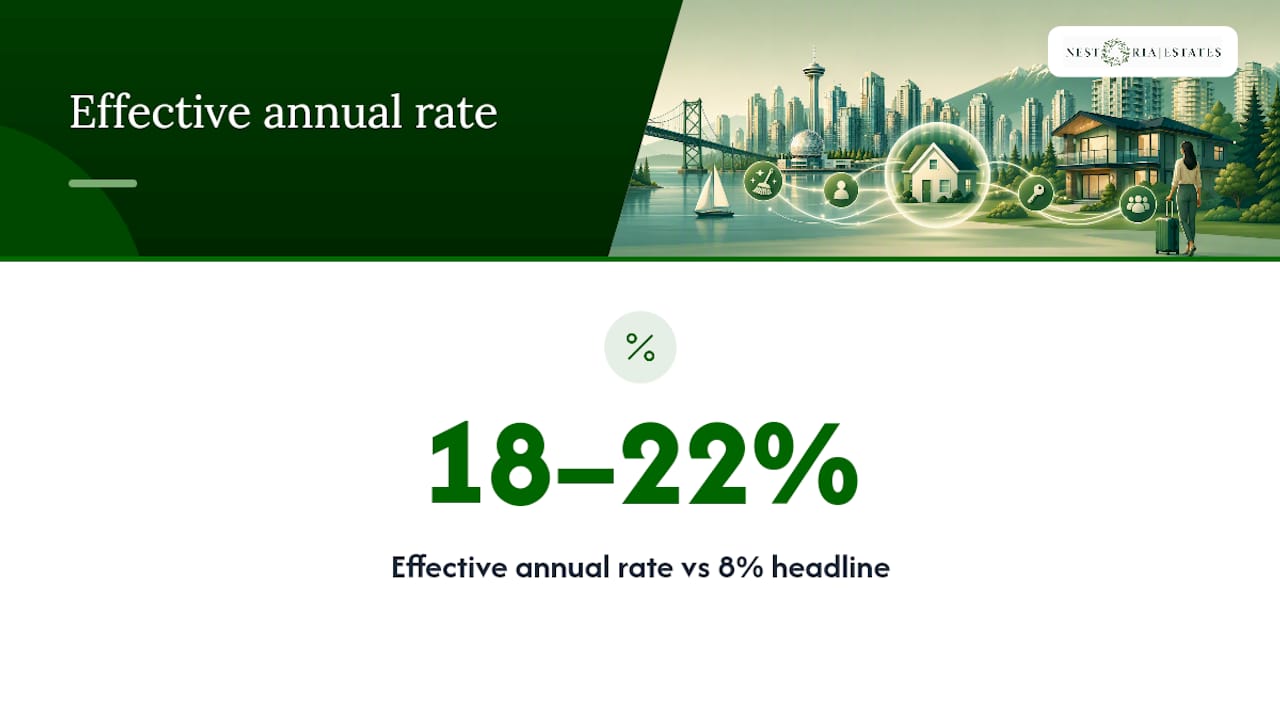
Barely higher than the headline, and in a turnover year, this quote could easily beat Scenario A.
The template is simple: sum every fee charged over twelve months and divide by annual rent collected. That single number is the only one worth comparing across operators.
Turnover math matters. Industry analysis of Canadian management contracts shows an advertised 8% fee can realistically land at an effective 18% to 22% annual rate in a year with a property changeover, largely driven by placement fees and inspection charges stacking on top of the base percentage.
Run this calculation on any quote before you sign, using your own property’s realistic turnover expectations, not the manager’s best-case pitch.
What Factors Push Airbnb Management Fees Higher or Lower?
Fee quotes for the same city can differ by 10 percentage points or more, and it rarely comes down to one manager just being greedier than another. A few concrete variables explain most of the spread.
Property complexity. A single studio condo costs less to manage than a large house with multiple bedrooms, a hot tub, or shared amenities that need separate upkeep.
Turnover frequency. A property booking mostly week-long stays needs far less cleaning coordination than one running a rotation of two-night bookings every few days.
Local ADR and seasonality. Higher average daily rates in strong markets, like downtown Vancouver during summer festival season, can justify a higher percentage fee because the dollar value being managed is larger, even if the workload is similar.
Regulatory load. Cities with stricter short-term rental licensing, reporting, or principal-residence verification requirements add administrative work that shows up somewhere in the fee stack.
Provider reputation and tech stack. Operators using dynamic pricing tools and revenue management software often charge more, but the pricing optimization can offset the higher fee through better occupancy and rate performance.
Service scope. A bare-bones booking and messaging service costs less than a bundle that includes professional photography, interior restyling, and proactive guest screening.
None of these factors are fixed. A host who reduces turnover friction, say, by requiring minimum two-night stays, can often negotiate a lower percentage simply because the workload drops.
How Do You Compare Quotes Without Getting Burned?
Every management quote should answer the same set of questions before you sign anything. Request these items in writing from any operator you’re evaluating, including a checklist of what to ask before hiring a management company:
A full, itemized fee schedule covering base management, placement, inspections, and maintenance markups, not just the headline percentage.
Exact contract wording on “collected” versus “charged.” Some contracts only bill the percentage fee on rent actually collected, pausing during vacancy. Others charge a flat rate regardless of occupancy, according to Canadian property management contract guidance. This single clause can swing your annual cost by thousands.
Placement fee terms, including whether it applies only on initial signup or every time the manager relists the property.
A cap on maintenance markups, ideally a flat percentage with a stated ceiling rather than an open-ended “cost plus” arrangement.
Inspection cadence and cost, so you know how many reports you’ll be billed for annually.
Termination and auto-renewal terms, since some contracts lock you in for 12 months with steep early-exit penalties.
Watch for vague language like “maintenance costs may apply” with no percentage attached, or vacancy billing terms buried in a separate clause than the fee schedule. Host forums are full of complaints about exactly this kind of ambiguity turning into a surprise invoice, a pattern echoed in host discussions about property management costs. A screening checklist for vacation rental managers covers similar ground and is worth a read alongside your own list.
Pro Tip: Run the effective-rate math twice for every quote: once assuming zero turnover for the year, and once assuming a realistic number of turnovers for your property. If the two numbers are wildly far apart, the contract’s vacancy and placement terms deserve a second look before you sign.
Which Fee Model Actually Fits Your Property?
Each pricing structure carries a real trade-off, and the right one depends on what you’re optimizing for.
Percentage models align your manager’s incentive with your revenue, which tends to work in your favor when occupancy and rates are climbing. The catch is variability: your monthly cost swings with performance, and you need to confirm whether fees pause during vacancy or keep charging regardless.
Flat-fee models offer budgeting simplicity. You always know the bill. But a flat fee on a high-ADR property can end up cheaper than a percentage model, while the same flat fee on a slow month becomes expensive relative to what you actually earned, an effect managed pricing comparisons flag as the core weakness of fixed pricing during occupancy dips.
Hybrid models try to soften both extremes with a lower base fee plus a smaller percentage cut, useful for hosts who want some predictability without giving up all revenue alignment.
Three questions settle most of the decision: How volatile is your occupancy likely to be? Do you want the manager financially motivated to push your rate higher? And can you tolerate a bill that changes month to month, or do you need a fixed number for budgeting?
How Can Hosts Lower the Real Cost of Management?
Reducing your effective rate isn’t about finding the lowest headline percentage. It’s about controlling the variables that generate add-on charges in the first place.
Start by asking for a sample revenue projection before signing anything. A credible operator should be able to show you expected occupancy, ADR, and net revenue based on comparable properties in your area, not just a promise that they’ll “optimize pricing.” If a manager can’t produce this, that’s worth noting. Demanding a projection and prior owner reports is a fast way to check whether the revenue optimization pitch is backed by anything measurable.
Beyond that, a few operational habits keep costs down on the ground:
Professional onboarding reduces early mistakes that trigger extra maintenance calls in the first few months, a topic covered in more depth in why professional short-term rental setup matters.
Guest screening cuts down on damage claims and the maintenance markups that follow them.
Local cleaning partners with fixed per-turn pricing avoid the markup creep that comes from ad-hoc contractor billing.
When negotiating, ask specifically to cap maintenance markups at a stated percentage with a dollar ceiling per incident, and to limit placement fees to genuine relisting events rather than routine contract renewals. Request owner-accessible reporting with an audit trail so every charge on your statement traces back to an actual invoice.
Pro Tip: Before signing, ask the operator to walk you through last month’s owner report for a comparable property. If they can’t produce one, or it’s vague on line items, that tells you more about how your own statements will look than anything in the sales pitch.
When Does Professional Management Actually Pay for Itself?
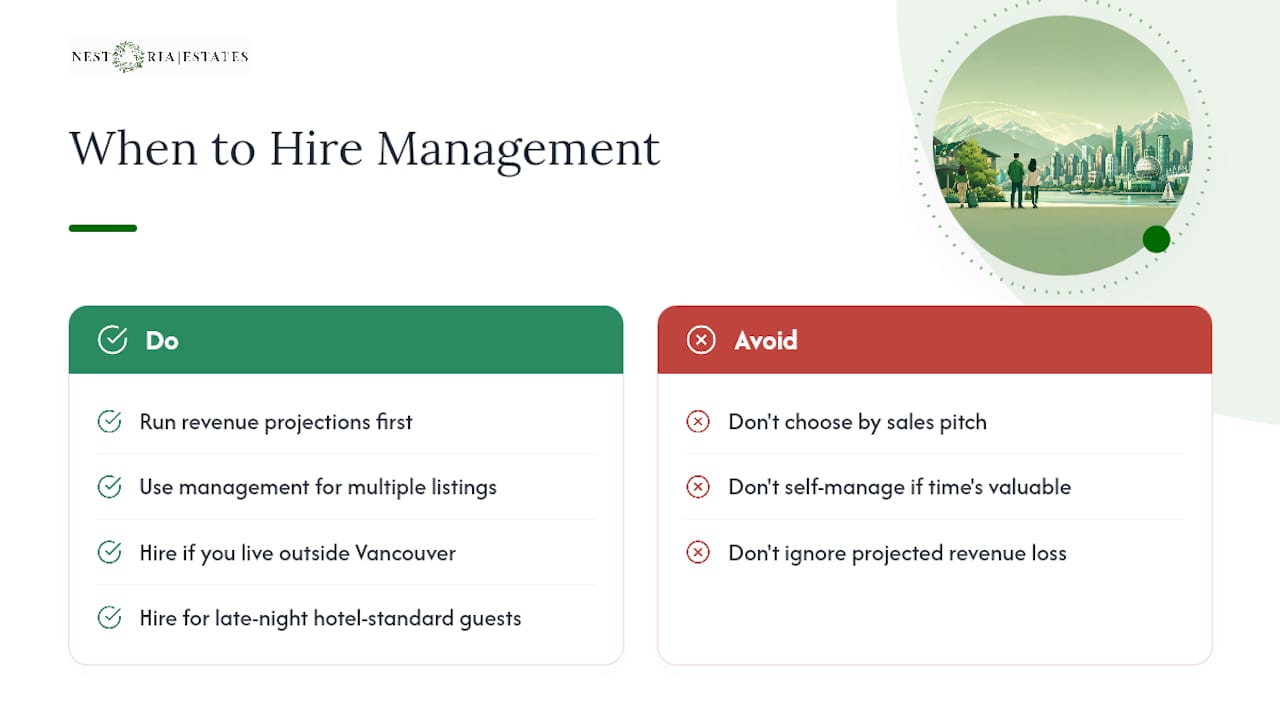
I’ll be direct about this: professional management earns its fee when the alternative cost, your time and the revenue you’d otherwise leave on the table, exceeds what you’re paying. That’s clearest for owners managing multiple properties, hosts who live outside Vancouver, or anyone renting to guests who expect hotel-level responsiveness at 11 p.m. on a Saturday.
But once you’re juggling more than one listing, or your time is worth more elsewhere, the math flips fast. This is exactly why Nestoria Estates offers free revenue projections before you commit. Run the numbers first. Let the data, not the sales pitch, make the call.
— Kamran
Get a Free Revenue Projection From Nestoria Estates
Nestoria Estates is the full-service alternative to piecing together a cleaner, a pricing tool, and a guest-messaging app on your own. Instead of stacking separate line items and hoping they add up to less than a management fee, you get one transparent contract covering pricing optimization, guest communication, cleaning coordination, maintenance, legal compliance, and owner reporting.

What’s typically included: dynamic pricing adjusted to real-time market demand, guest screening and communication handled around the clock, cleaning coordinated through vetted local partners, and monthly reporting you can actually audit line by line. Before you commit to any operator, and before you sign with Nestoria Estates or anyone else, request the same things: a written fee schedule, clear “collected versus charged” language, a maintenance markup cap, and a sample owner report.
Start by requesting a free revenue projection through Nestoria Estates’ services page to see what your Vancouver property could realistically generate under full-service management, no obligation attached.
Sources
FAQ
What Is the 15% Host Fee on Airbnb?
That’s Airbnb’s own host service fee, deducted from your payout before you ever see the money. It’s separate from any percentage you pay a property management company for running your listing.
Why Are Some Hosts Moving Away From Traditional Airbnb Management?
Frustration usually traces back to unclear billing, particularly vague maintenance markups and vacancy fees, rather than the concept of professional management itself. Operators like Nestoria Estates address this with transparent, itemized owner reporting so every charge is traceable.
Recommended
The Ultimate Guide to Vancouver Airbnb Management: Everything You Need to Succeed in 2026
Vancouver Airbnb Management Matters: Your 2026 Strategy Guide for High-Yield Results
Why Professional Airbnb Turnovers Matter for Short-Term Rentals in Vancouver
How to Choose the Best Airbnb Management Company in Vancouver (Compared)
Comments