

Vancouver Hosts: Calendar First Event Based Pricing to Protect Revenue
Event-based pricing means raising your nightly rate for a specific short-term rental when a confirmed local event will pull demand above normal levels, then bringing that rate back down once the event passes. The single most important move is tactical: find the next confirmed event within a reasonable drive of your listing, set a conservative rate override for those dates, attach a minimum-stay rule, and put a review date on your calendar.
TL;DR:
Premium rates for major events can reach over 150% above base rate if booked well in advance, especially for large festivals or conventions.
Hosts should start adjusting prices 2 to 8 weeks before events, depending on the event’s size, with price checks increasing in frequency as the date nears.
Pairing rate increases with minimum stay rules, such as two nights for single-day events or three nights for weekends, effectively protects overall revenue.
Monitoring booking pace, competitor availability, and search activity provides essential signals to adjust prices or lower rates if demand falters.
Managed, data-driven pricing approaches that include regular reviews and owner transparency can maximize event value without harming guest satisfaction.
Table of Contents
What Is Event-Based Pricing, Exactly?
Most Airbnb hosts already understand seasonal pricing: summer costs more than February, weekends beat weekdays. Event-based pricing is narrower and more aggressive. It targets specific calendar dates tied to a named, confirmed happening, a hockey playoff run, a music festival, a major conference, and price those dates as their own micro-market rather than an extension of the surrounding season.
The distinction matters because event demand behaves differently than seasonal demand. It gets announced late, it concentrates on a handful of nights, and it can vanish just as fast if the event gets postponed or a competing block of inventory opens up nearby. That volatility is exactly why event pricing needs live booking-pace monitoring rather than a rate you set once and forget. Hosts who treat every event the same way, whether it is a 500-person conference or a stadium concert, tend to either underprice the big ones or overprice the small ones. The fix is a system, not a hunch.

Quick Event-Pricing Checklist For Today
You do not need a revenue management degree to get most of the value here. Start with this sequence the next time you spot an event on the horizon.
Scan a realistic catchment. Anything within about 30 miles of your property, including convention centers, stadiums, and university campuses, counts as fair game.
Set a conservative opening premium. Start with a modest bump over your base rate for the event dates rather than guessing at a 3x number on day one.
Match the premium with a minimum stay. A one-night event booking that leaves you with an empty night on either side often costs more than it earns.
Build a review cadence into your calendar. Check weekly until you are 30 days out from the event, then switch to daily checks as the date approaches.
Write down your fallback triggers before you need them. Decide in advance what pickup pace would make you lower the rate, so you are not making that call in a panic three days out.
Pro Tip: Keep a simple spreadsheet or note with every event you have priced, what premium you set, and how it performed. Six months from now, that log becomes your best pricing tool for the next similar event.
When Should You Raise Rates for an Event?
Timing is where most hosts either leave money on the table or price themselves out of bookings entirely. The lead time you need depends heavily on the size of the event, and the premium you charge should scale with it too. Guidance on event pricing for concerts, festivals, and sports suggests hosts can see rate multiples of two to three times their base price during major events, but only when the timing and tier are right.
Here is a practical framework broken into three tiers:
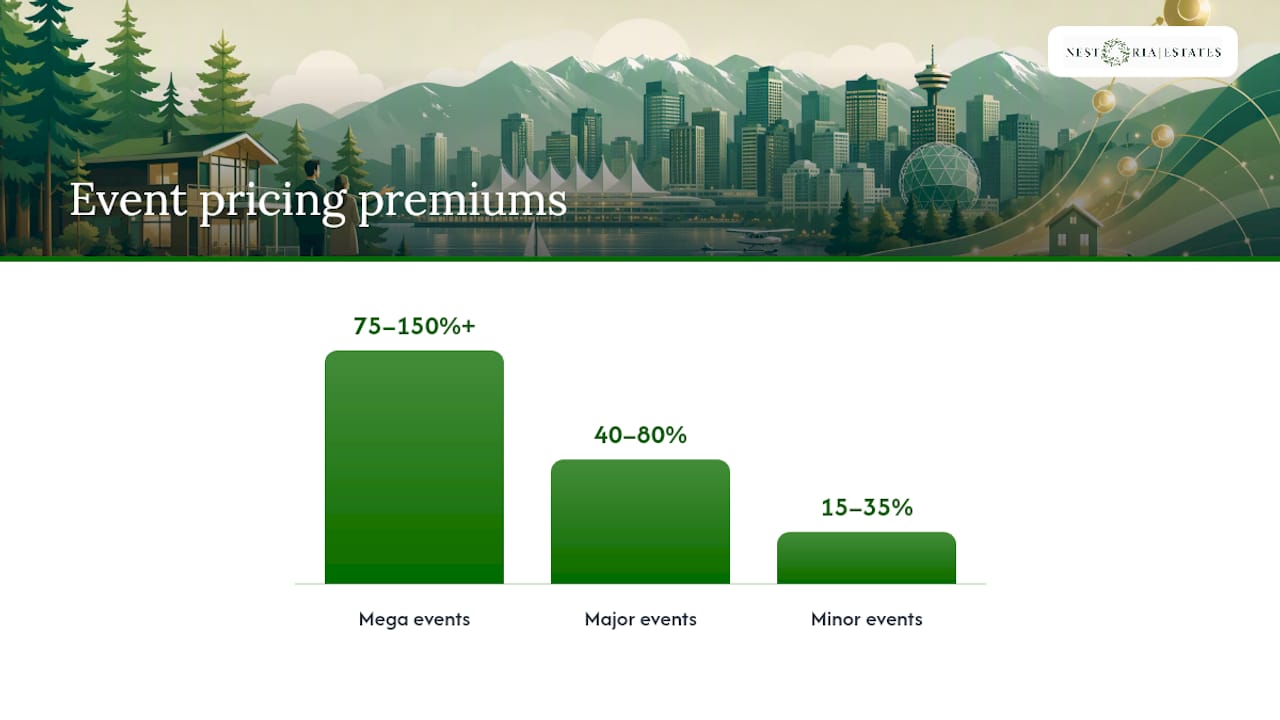
Mega events (major festivals, championship series, large conventions): Start adjusting rates as soon as the event is announced, sometimes months out. Premiums here can run from 75% to well over 150% above base rate depending on venue capacity and how limited nearby inventory is.
Major events (mid-size concerts, regional sports playoffs, multi-day conferences): Begin adjustments 4 to 8 weeks out. A premium in the 40% to 80% range is typically defensible once you confirm the event is drawing outside visitors, not just locals.
Minor events (single-day conferences, smaller festivals, weekend tournaments): A 2 to 4 week lead time is usually enough. Premiums of 15% to 35% tend to hold without killing your booking pace.
The cadence should tighten as the date nears: review monthly when the event is still far off, weekly once you are inside 30 days, and daily inside the final two weeks. That progressive approach, described in PriceLabs’ event pricing guidance, reduces the odds you get caught flat-footed by a sudden demand spike or stuck holding an overpriced calendar.
Booking Pace and Competitor Signals Worth Watching
Rate premiums are a guess until you have data confirming the market will bear them. The signals that matter most are booking pace, comp-set availability, and what competing listings are doing with their own minimum stays.
Watch for these specific signals:
Booking pace and pickup. How many nights are filling relative to a normal, non-event period for the same lead time.
Comp-set availability. If nearby listings similar to yours are selling out fast, that is your clearest signal the market will support a higher rate.
Competitor minimum-stay changes. When multiple listings near you suddenly require two or three nights, that is a sign hosts in your market already expect strong demand.
Search visibility and inquiry volume. A jump in views or messages without matching bookings often means your price is the sticking point, not demand itself.
If you have runway before the event, running a short price test is worth the effort. Raise your rate modestly for a two to four week window and watch what happens to pickup. Persistent bookings at the higher rate tell you the ceiling is higher than you assumed. A stall, meaning inquiries but no bookings for a week or more, tells you to pull back before you get stuck with empty nights. Standard tools like your Airbnb host dashboard or a market-level dynamic pricing platform can track this, but a manual calendar audit every few days catches nuances an algorithm misses. Smart pricing tools calibrated to average demand routinely undershoot the ceiling during genuinely high-impact events, which is exactly why manual overrides earn their keep here.
Minimum Stays and Payment Rules That Protect Your Revenue
Raising your rate alone leaves money on the table if you let a guest book a single event-adjacent night and leave you stuck with an unbookable gap the following evening. Pairing rate premiums with tighter stay rules is often more effective at protecting total event revenue than pushing your nightly rate alone, because it protects revenue per available night, not just the rate on paper.
Match your minimum-stay rule to the event’s shape:
Single-day events (a one-night concert or game): require a 2-night minimum so you are not left holding an orphan night before or after.
Weekend events (Friday through Sunday festivals or tournaments): push the minimum stay to 3 nights to capture the full weekend as one block.
Multi-day events (conferences or festivals running 4+ days): consider requiring the guest to book the full event window, or close to it.
On the payment side, tightening your cancellation policy and requiring prepayment for event-priced dates reduces the risk of a no-show eating into a night you could have sold at a premium to someone else.
What to Do When Event Demand Doesn’t Show Up
Not every event delivers. Sometimes a conference gets scaled back, a headliner cancels, or a competing property floods the market with cheaper inventory right before the date. Having a fallback plan set in advance keeps a disappointing event from turning into a panicked fire sale.
Set your trigger points now. A common rule: if booking pace sits meaningfully below normal at 14 days out, and still hasn’t recovered at 7 days out, that is your signal to act.
Lower the minimum stay first, not the rate. This often unlocks bookings from guests who wanted to come but couldn’t commit to your longer stay requirement.
If pace still doesn’t recover, step the rate down gradually. Cut it in stages over several days rather than crashing it in one move; a sudden drop can signal desperation and actually slow last-minute bookings further.
Log what happened. Record the trigger, the action, and the outcome so your next event forecast starts from real data instead of a guess.
Pro Tip: A gradual step-down after the event matters too. Cutting your rate to baseline the morning after a big event often leaves money on the table from guests still traveling in for a late arrival. Ease the rate down over three to five days instead.
Does Event Pricing Hurt Guest Satisfaction or Bookings?
The honest answer is: not when it is done with any discipline. Guests booking around a major concert, playoff game, or convention already expect to pay more, the same way they expect airfare and hotel rates to spike for the same dates. Review scores rarely suffer from a fair event premium; they suffer when a guest feels misled about what they are paying for, or when a host cancels a booking mid-stream to chase a higher rate elsewhere.
Booking volume during event windows typically holds up fine as long as the premium tracks reasonably with what comparable listings are charging. Where hosts get into trouble is either overshooting so far past the comp set that even event-motivated travelers balk, or under-communicating stay requirements, leaving a guest surprised by a 3-night minimum they did not expect. Clear listing descriptions during event windows, mentioning the nearby event explicitly, actually tend to improve conversion, since travelers searching those dates are often looking for exactly that proximity. The net effect of disciplined event pricing is usually more revenue per booked night, roughly stable occupancy, and no measurable hit to guest ratings.
Nestoria Estates’ Perspective: How Managed Pricing Captures Event Value
We apply a progressive, data-driven approach to event pricing across every portfolio we manage, adjusting rates in stages rather than guessing at a single number and hoping it holds. That means monthly reviews when an event is still distant, tightening to weekly and then daily as the date approaches, the same cadence outlined earlier in this guide.
Every Nestoria Estates owner gets a free revenue projection and transparent reporting that shows exactly how comp-set occupancy and pickup pace factored into a given rate decision. Owners consistently respond better to event premiums when they can see the market data behind the number, not just the number itself.
If you have an event coming up on your local calendar and want a second set of eyes on your pricing plan, we run calendar-level audits for exactly this situation.
— Kamran
Let Nestoria Estates Handle Your Event Calendar
Running the checklist above manually works, but it takes real time: tracking every event within your catchment, checking comp-set data daily as dates approach, and adjusting minimum stays without accidentally scaring off bookings. Nestoria Estates is built for hosts who want that upside without doing the daily calendar work themselves.

Our pricing optimization and continuous market-based adjustments cover exactly the cadence described in this guide, weekly reviews tightening to daily as events approach, paired with minimum-stay changes and cancellation settings that protect your revenue per night. Every owner gets transparent reporting showing the comp-set data behind each rate change, along with a free revenue projection before you sign anything. If you manage your property yourself and are unsure whether you are capturing full value from your local event calendar, request a free projection through our services page and we will show you what a data-driven approach to your next event window could look like.
Sources
FAQ
How far in advance should I raise rates for an event?
For mega events, start as soon as the event is announced, sometimes months ahead. For minor events, a 2 to 4 week lead time is usually sufficient.
What signals tell me to lower an event rate?
Watch booking pace at 14 and 7 days out; if pickup sits well below normal at both checkpoints, lower the minimum stay first, then step the rate down gradually rather than cutting it all at once.
Should I require a minimum stay during events?
Yes. Pairing a minimum-stay rule with your rate premium protects revenue per available night and prevents orphan nights before or after a one-night event booking.
Does event pricing lower my Airbnb review scores?
Not when the premium tracks reasonably with comparable listings and stay requirements are clearly stated upfront; guest dissatisfaction usually comes from feeling misled, not from paying a fair, event-driven rate.
Can a property manager handle event pricing for me?
Yes. Nestoria Estates runs calendar-level event audits and progressive rate adjustments across managed portfolios, backed by free revenue projections and transparent owner reporting.
Recommended
Comments