

Luxury Rental Industry Terms Every Investor Must Know
- info67421305
- 4 hours ago
- 9 min read

TL;DR:
Understanding the qualitative distinctions in luxury, ultra-luxury, and high-standard properties is essential for accurate classification and maximizing profitability.
Mastering operational and financial vocabulary, such as transient taxes, owner price protocols, and RevPAR, enables luxury rental owners to optimize management, compliance, and revenue.
If you own or manage high-end property in Vancouver and want to get more from your short-term rental, the vocabulary of the luxury rental market is not optional reading. Knowing the right luxury rental industry terms shapes how you price, market, negotiate, and manage. Mislabel a property as “luxury” when it does not meet qualitative thresholds, and you erode trust with exactly the guests who will pay top rates. Get the language right, and every decision you make, from listing copy to lease structure, becomes sharper and more profitable.
Key takeaways
Point | Details |
Luxury is qualitative, not just pricey | Location, privacy, architecture, and service define luxury far more than a high nightly rate alone. |
Misclassification costs real money | Labeling a high-standard property as ultra-luxury sets wrong expectations and drives negative reviews. |
Mid-term rentals hedge regulation risk | Properties rented for one to six months often bypass short-term permit requirements and transient taxes. |
Owner Price Protocol protects your brand | Per-property pricing removes per-person confusion and positions your asset correctly in the luxury tier. |
Operational control is the new differentiator | Frictionless privacy and embedded concierge services define what luxury guests expect and pay for. |
Luxury rental industry terms: definitions and classifications
The place to start is with a clear distinction that the industry itself sometimes blurs. “Luxury rental” is a widely used phrase, but the recognized standard vocabulary in the sector, as codified by agencies like Forbes & Partners, draws a hard line between three tiers.

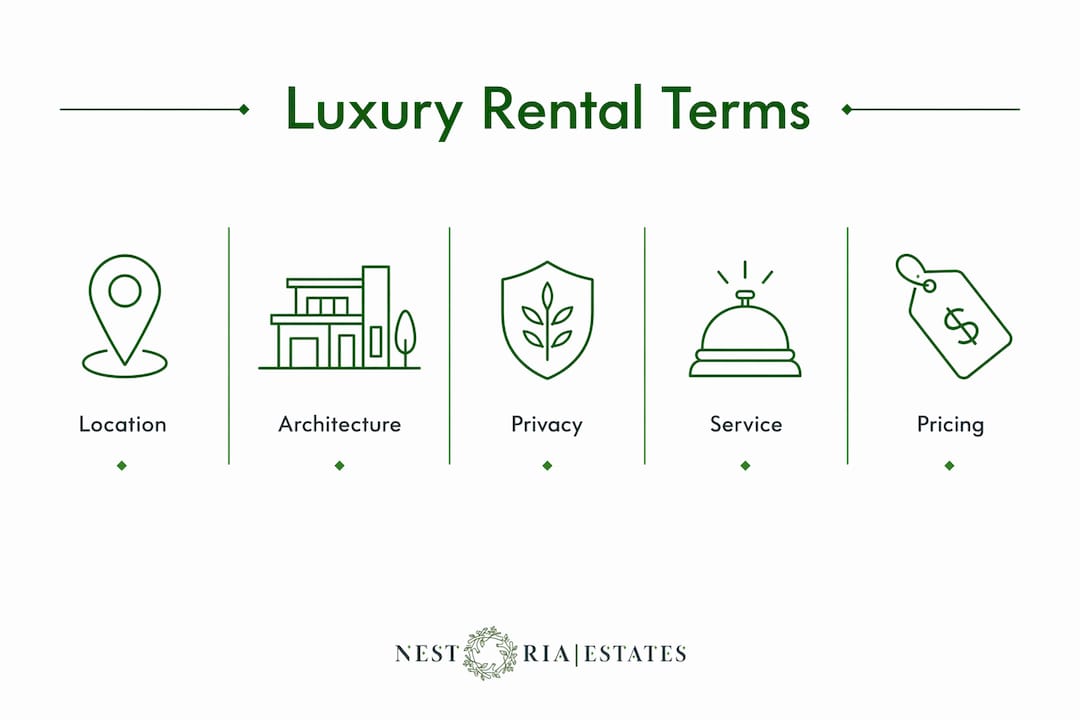
Luxury refers to properties where location, architecture, privacy, and embedded service quality exceed what money alone can replicate. Think a West Vancouver waterfront property with a dedicated concierge, private dock, and curated interiors. Ultra-luxury (sometimes called trophy property) is a step beyond: one-of-a-kind assets where exclusivity and bespoke lifestyle criteria drive demand completely outside the standard market. High-standard describes well-appointed properties, often newly renovated, that perform well but do not meet the qualitative bar for luxury classification.
Misclassifying a high-standard property as luxury does measurable damage to brand trust. Guests arrive expecting a standard the property cannot deliver. The resulting reviews cost far more in lost future bookings than the inflated nightly rate ever recovered.
Here are four foundational terms every investor should internalize:
Luxury classification framework. A structured scoring system, like the Forbes & Partners model, that evaluates properties across location, privacy, amenities, architecture, and service quality to assign an accurate market tier.
Suitability. A term describing the match between a property’s physical configuration and the profile of an expected guest group. A six-bedroom Vancouver home may be suitable for a corporate retreat but not for a multigenerational family with young children.
Group size and economy of scale. The per-person cost advantage that larger rental properties offer compared to booking multiple hotel rooms. This term appears in luxury sales conversations to justify premium per-night rates.
Owner Price Protocol. The industry practice of setting luxury villa or estate rates per property per night, not per person. This per-property pricing model eliminates confusing per-person markups and positions the asset cleanly against comparable properties.
Pro Tip: When you write a listing or present a property to a management agency, never use “luxury” as a descriptor without supporting evidence. Cite the specific qualitative factors: the privacy screen, the chef’s kitchen, the unobstructed mountain view. Evidence-backed claims convert; vague labels do not.
The global luxury travel market reached approximately $1.38 trillion in 2023 and is growing at a projected 7.9% annually. That growth is not spread evenly. Ultra-prime demand is consolidating around experience-driven, exclusive properties, while mid-tier listings face increasing price compression. Knowing where your Vancouver property fits in that spectrum is step one.
Operational vocabulary you need to manage effectively
Managing a luxury rental involves a set of terms that barely appear in residential landlord guides. Mastering this high-end rental vocabulary is what separates investors who react to problems from those who structure away from them.
Mid-term rentals cover stays of one to six months. This classification matters enormously for Vancouver owners because mid-term leases are often exempt from short-term rental permits and transient occupancy taxes, creating a regulatory hedge that standard nightly rentals cannot offer. The revenue per month tends to be lower than peak short-term nights, but the reduced vacancy risk and compliance cost often deliver better net returns.
Transient taxes are levies applied to short-term rentals below a threshold stay length, typically 30 days in most Canadian and American jurisdictions. Failing to collect and remit these is one of the most common compliance errors luxury property owners make. Nearly 47% of property managers report strict permitting or licensing requirements as a top operational challenge. Understanding where transient tax exposure begins and ends directly affects your net yield calculation.
Key operational terms worth knowing before your first management contract:
Rental concession. A landlord-provided incentive, such as one free week, reduced deposit, or complimentary service package, offered to secure a booking or lease. Rental concessions have more than doubled since pre-pandemic levels, with nearly 40% of listings now offering some form of incentive.
Grace period. A defined window after a payment due date during which a tenant can pay without penalty. Luxury lease agreements typically carry shorter grace periods than standard residential leases.
Sublease clause. Contract language governing whether and how a tenant may relist or sublet the property. For short-term luxury rentals, a poorly drafted sublease clause creates unauthorized platform exposure.
Frictionless experience. The operational standard in luxury hospitality where every guest touchpoint, from check-in to maintenance requests, is resolved before the guest feels it. This connects directly to embedded concierge services, which are now treated as table stakes in the luxury tier, not upgrades.
Embedded privacy. A design and operational principle where guest privacy is built into the property and service flow rather than offered as a feature. Gated entries, soundproofed walls, private pool areas, and non-disclosure agreements for staff all fall under this umbrella.
The operational control that luxury tenants now expect is total. They want every service anticipatory, not reactive. That shift in expectation has redefined what luxury leasing expressions mean in practice: “white-glove service” has moved from a marketing phrase to an operational benchmark.
Pro Tip: If your property management agreement does not define “frictionless experience” with specific service response times and guest touchpoint protocols, you have a gap that will show up in your reviews before you see it in your reporting.
Pricing, yield, and financial terminology
Numbers without vocabulary lead to bad decisions. The financial side of the luxury rental market has its own language, and getting it wrong means leaving revenue on the table or misreading your own returns.
Here are the most consequential financial terms explained:
Average Daily Rate (ADR). The mean revenue earned per occupied rental day. In luxury short-term rentals, ADR is the primary performance metric for comparing your property against comparable assets in the same market.
Occupancy rate. The percentage of available nights that are actually booked. A luxury Vancouver property with a high ADR but 45% occupancy may underperform a slightly lower-priced property at 70% occupancy. The relationship between these two figures defines your revenue ceiling.
Dynamic pricing. An algorithm-driven approach to adjusting nightly rates based on real-time demand signals: local events, competitor availability, seasonal patterns, and booking lead time. Properties using dynamic pricing consistently outperform static-rate listings on total revenue.
Orphan day pricing. A specific tactic within dynamic pricing where isolated unbooked nights between reservations are priced at a discount to improve fill rate. Ignoring orphan days is one of the most common yield leaks in high-end rental portfolios.
RevPAR (Revenue Per Available Room/Rental). A combined metric that captures both occupancy and rate performance. RevPAR = ADR multiplied by occupancy rate. This is the benchmark institutional investors use to evaluate luxury rental assets.
Off-market leasing. The practice of placing trophy properties with qualified tenants outside public listing platforms. Off-market trophy leases regularly achieve higher yields than publicly listed comparables because they meet bespoke lifestyle criteria that online platforms cannot communicate.
The 2% rule is a simplified benchmark suggesting monthly rental income should equal at least 2% of the purchase price. At the luxury tier, this rule rarely holds in high-cost markets like Vancouver, but it remains useful as a quick screening tool before deeper yield analysis.
Pro Tip: When benchmarking your luxury property, compare ADR and occupancy against properties in the same classification tier, not just the same neighborhood. A trophy waterfront estate is not comparable to a premium condo two blocks inland, even if they share a postal code.
Metric | What it measures | Why it matters for luxury |
ADR | Average revenue per booked night | Sets the baseline for revenue expectations |
RevPAR | Revenue per available night (booked and vacant) | Reveals true portfolio performance |
Occupancy rate | Percentage of nights booked | Balances rate strategy against fill risk |
Orphan day rate | Yield on isolated unbooked nights | Reduces revenue gaps between reservations |
Applying luxury terminology to listings and tenant relations
Knowing the right words is only half the job. The other half is deploying them where they create measurable results: in your listings, your lease agreements, and your tenant communications.
When you write a listing for a luxury rental property, the language you use signals tier before a prospective guest even reads the price. Use specific qualitative descriptors tied to your classification evidence. “Private infinity pool with unobstructed inlet views” outperforms “beautiful pool and great views” every time, not because it is longer, but because it is specific and verifiable.
Here is where premium rental terms do real work in marketing and operations:
Niche OTA channels. Beyond the major platforms, exclusive rental phrases like “ultra-luxury collection” or “curated private estates” are search terms associated with specialty booking platforms that cater to high-net-worth guests. Listing on the right alternative marketplaces alongside major platforms expands reach into the guest segment willing to pay top-tier rates.
Lease vocabulary. Luxury lease agreements incorporate terms like “quiet enjoyment clause,” “white-glove addendum,” and “damage waiver protocol.” Using recognized legal and industry vocabulary signals professionalism and reduces negotiation friction with sophisticated tenants.
Tenant qualification language. Terms like “guest profile requirements,” “principal traveler verification,” and “lifestyle alignment” are used in luxury rental communications to vet guests without running afoul of discrimination law.
Rental concession framing. When concessions are necessary to close a booking, framing them as “complimentary experience enhancements” rather than discounts protects your rate integrity and brand positioning.
For Vancouver owners specifically, the vacation rental industry language around STR licensing, principal residence requirements, and strata approval adds a local compliance layer to your listing and leasing vocabulary. Knowing these terms before you engage a management company tells them immediately that you are an informed operator.
My take on luxury vocabulary as a market signal
I have worked closely with enough property investors to say this with confidence: the owners who consistently outperform in the luxury market are almost always the ones who have internalized the vocabulary before they bought or listed. It is not coincidental.
Here is what I have seen repeatedly. When an investor misclassifies their property, usually calling it luxury when it belongs in the high-standard tier, they attract guests whose expectations exceed the delivery. The reviews that follow are not just a rating problem. They actually shift the property’s algorithmic positioning on major platforms downward, compressing future rate potential.
What has become clear to me watching the market split between commodity short-term rentals and genuine luxury assets is that the language reflects the strategy. Investors who talk about “operational control,” “embedded privacy,” and “Owner Price Protocol” are running a fundamentally different business than those describing the same assets as “nice place to stay.” The total control standard that now defines luxury tenant expectations is not a trend. It is a permanent recalibration.
Off-market leasing, in my view, is the most underutilized tool in the Vancouver luxury owner’s playbook. Most investors do not even know the term exists as a formal strategy. Trophy properties placed quietly with the right tenant consistently achieve better net yields with lower vacancy risk than anything you will find by maximizing your Airbnb listing.
The investors who treat terminology as a technicality are the same ones surprised when their “luxury” property underperforms. Language is not decoration here. It is infrastructure.
— Kamran
How Nestoriaestates helps luxury rental owners perform

At Nestoriaestates, we work specifically with property owners who want their high-end assets performing at the right tier, not just listed and forgotten. From dynamic pricing calibrated to your classification level, to guest communications that reflect the white-glove standard your property demands, every service is built around the vocabulary and standards covered in this article. If you are a Vancouver owner ready to stop guessing and start measuring, explore our full property management services to see how we handle pricing, marketing, compliance, and operational excellence for luxury rental investors.
FAQ
What makes a rental officially “luxury” vs. high-standard?
Luxury is a qualitative classification based on location, architecture, privacy, and embedded service quality. A property that is well-appointed but lacks those experiential thresholds is more accurately classified as high-standard, and misclassifying it damages booking trust.
What is Owner Price Protocol in luxury rentals?
Owner Price Protocol is the industry practice of pricing luxury villas and estates per property per night rather than per person. It eliminates per-person markup confusion and aligns the property with recognized luxury tier pricing conventions.
What are transient taxes and when do they apply?
Transient taxes are occupancy levies applied to short-term rentals, typically stays under 30 days. Most Canadian and American jurisdictions require landlords to collect and remit these separately from rental income.
How does mid-term rental status affect luxury property investors?
Mid-term rentals covering one to six months are often exempt from short-term rental permits and transient taxes, offering a lower-regulation revenue option for luxury property owners who want consistent occupancy with reduced compliance exposure.
What is RevPAR and why do luxury investors track it?
RevPAR, or Revenue Per Available Rental, is calculated by multiplying ADR by occupancy rate. It captures both rate and fill performance in a single metric, making it the standard benchmark institutional investors use to evaluate luxury rental asset performance.
Recommended
Comments