

Protect Your Listing: Short Term Rental Legal Forms for Canadian Hosts
Download an editable short-term rental agreement built for stays under the length your province treats as tenancy, add your provincial or municipal registration number before you publish a single listing, and require an e-signature before any guest books. That order matters. Skip the registration step and the strongest agreement in the world won’t stop a fine or a delisting if the local regulations are not followed.
TL;DR:
Ensuring your rental agreement includes a provincial or municipal registration number is essential, as failure to display it can lead to fines or delisting.
Agreements must specify a maximum stay length explicitly to comply with local laws, especially in jurisdictions like British Columbia or Toronto where limits are legally enforced.
Use legally focused templates that incorporate specific clauses about occupancy, cancellation, insurance, and liability, and avoid generic lease language that could imply tenant rights.
Keep detailed records of all bookings, registration proof, insurance, and tax remittance to facilitate inspections and audits; verify platform reports against actual collected taxes regularly.
Confirm all local registration and licensing requirements before listing, including renewal procedures and documentation, to prevent legal violations in rapidly evolving markets like Vancouver or Mississauga.
Table of Contents
What Are Short Term Rental Legal Forms, Exactly?
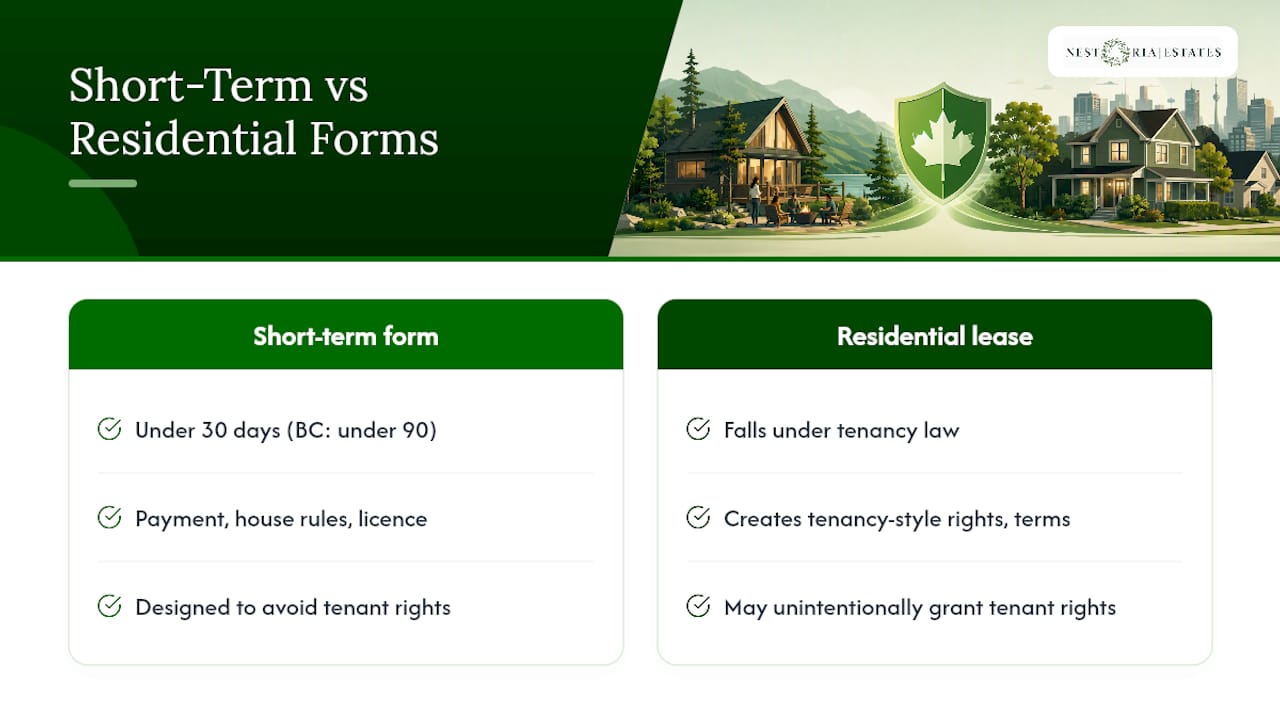
A short-term rental legal form is a written agreement between a property owner and a guest that governs a stay short enough to fall outside residential tenancy law, typically under 30 days, though British Columbia’s Short-Term Rental Accommodations Act extends the “short term” definition to stays under 90 days for registration purposes. The industry sometimes calls this a vacation rental contract, an Airbnb rental agreement, or a guest stay agreement. They’re all the same document doing the same job: setting payment terms, spelling out house rules, and proving the arrangement is a licence to occupy, not a lease.
The confusion trips up a lot of new hosts. A generic lease template from a landlord forms site can accidentally create tenant rights you never intended to grant. That’s the single biggest legal trap in this whole category, and it’s why a purpose-built short-term rental agreement (not a residential lease renamed) is worth getting right from day one.
Where To Get Editable Short-Term Rental Legal Forms
Three formats dominate this space, and each fits a different kind of host.
Fillable PDFs work well if you manage one or two properties and want something you can complete once per booking, save, and email. Word or Google Docs templates give you the most editing flexibility, which matters if your municipality requires specific bylaw language your generic template doesn’t include. Online form generators (the LawDepot and Jotform-style tools) auto-populate fields like dates and guest names and often bundle in e-signature capture, which speeds up high-turnover properties running back-to-back bookings.
Whichever format you pick, verify these before you trust it with a real booking:
A dedicated field for your provincial registration number or municipal licence number, not just a generic “permit number” line
Clear cancellation and refund terms tied to specific dates, not vague language like “reasonable notice”
A separate deposit clause distinguishing a security deposit from the nightly rate
An insurance and strata/condo disclosure section, even if it’s blank for properties without a strata board
Occupancy limits stated as a hard number, not “reasonable use”
Once the fields are filled in, route the document through an e-signature tool and attach the signed copy to your booking record. Most template providers, including Jotform’s fillable rental agreement templates, build e-signature capture directly into the form, which saves you from juggling a separate app. Store every signed agreement alongside the payment record for that stay. Provinces increasingly expect hosts to produce these on demand during inspections or audits, not reconstruct them after the fact.
What Clauses Actually Belong in Your Agreement?
Most template disputes come down to missing or vague clauses, not bad ones. Here’s what needs to be in the document, in roughly the order a guest will read it:
Parties and property — full legal names, the property address, and a statement identifying the host as owner or authorized manager.
Stay dates and check-in/check-out times — exact dates, not “approximately,” plus a late checkout fee if you charge one.
Payment terms — total cost, taxes included separately, and the payment schedule (deposit now, balance on arrival, or full payment up front).
Security deposit handling — the amount, how it’s collected (hold vs. charge), and the timeline for returning it after checkout.
Cancellation policy — a specific refund schedule tied to days before check-in, matching whatever policy you’ve set on the booking platform itself.
Maximum occupancy — a hard number of guests, with a clause stating unregistered guests or parties beyond that number violate the agreement.
House rules — noise cutoffs, smoking policy, pet policy, parking instructions.
Insurance and liability — a statement that guests assume risk for injury on the property except where caused by host negligence, plus a note on the host’s liability coverage.
Damage and incident process — what happens if something breaks, including whether you’ll charge the deposit or bill separately.
Emergency contact — a real phone number the guest can reach during the stay, not just a booking platform’s support line.
Registration/licence number — your provincial registry number or municipal permit number, displayed exactly as issued.
Not-a-tenancy statement — explicit language confirming the guest is a transient occupant, not a tenant, where your provincial Residential Tenancies Act allows that exclusion.
That last clause deserves its own paragraph, because it’s the one that actually protects you legally. Template guides that walk through BC’s clause requirements, including Lodgify’s breakdown of the province’s short-term rental template, consistently flag the registration number and occupancy limit as the two fields most often left blank, and both are the two a bylaw officer checks first.
If your property adds late checkout charges or other add-on fees, spell out exactly how they’re billed. Fee disputes are common enough that dedicated guidance exists just for handling them, like this explainer on late checkout fee structures, which is worth a read if you charge for flexible checkout times.
Pro Tip: Use the word “Guest” throughout the entire agreement, never “Tenant” or “Renter.” A single stray reference to a “tenant” in an otherwise solid short-term agreement has been enough in past disputes to shift how a tribunal interpreted the whole document.
How Do You Check Registration Rules by City and Province?
Registration requirements stack. You can owe a provincial registration, a municipal licence, or both, and missing either one is the fastest way to get a listing pulled or a fine issued.
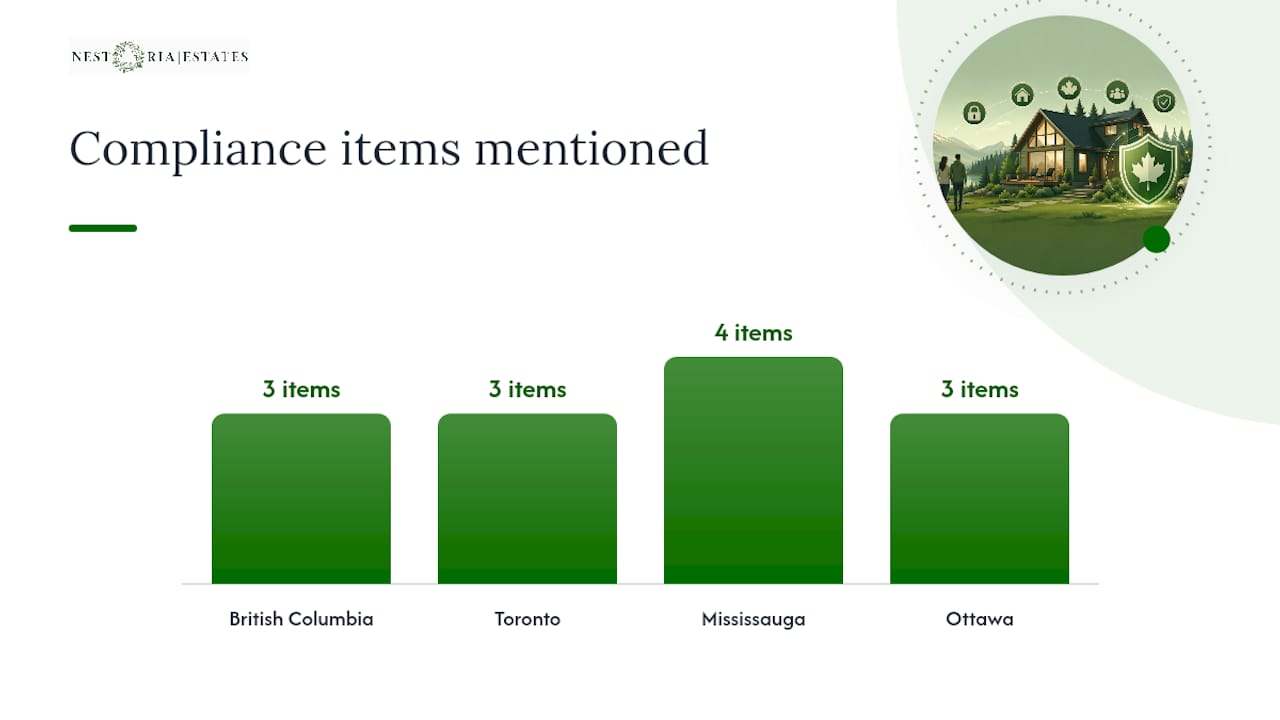
British Columbia requires most hosts in participating municipalities to register through the province’s short-term rental registry and display the resulting registration number on every listing and in every rental agreement. As of May 1, 2025, BC’s provincial registry validates listings directly against platform data, and platforms are required to remove listings that don’t show a valid number. Vancouver hosts also face principal-residence requirements in many zones, meaning the property you’re renting out short-term needs to be your primary home, with exemptions for secondary suites and laneway homes in specific cases.
Toronto requires operators to register with the city, post the city-issued registration number on every advertisement, and collect a 6% Municipal Accommodation Tax on any stay under 28 days, according to the city’s short-term rental operator page. Toronto also caps short-term rentals to a host’s principal residence plus one secondary suite.
Mississauga runs a licensing model rather than pure registration. The city’s short-term rental operator guide requires a licence, a property inspection, proof of liability insurance typically at or above $2 million, and the licence number displayed on every ad.
Ottawa operates a host permit scheme layered on top of Ontario’s provincial framework, with its own inspection and renewal cycle separate from Toronto’s rules just down the highway.
The scale of what’s changed since 2024 is worth sitting with: three major Canadian cities and one full province have all rolled out or tightened registration regimes inside about two years, which means a template you trusted in 2023 is very likely missing a required field today.
Use this checklist before you list a property or renew an existing one:
Confirm which registry applies: provincial, municipal, or both, based on your address
Gather proof of principal residence where required (utility bill, driver’s licence, property tax notice)
Apply for the registration or licence number and wait for issuance before listing
Add the exact registration/licence number to your agreement template and every listing platform
Note the renewal date and set a calendar reminder at least 30 days out
Confirm insurance coverage meets the minimum your municipality specifies
Photograph smoke detectors, fire extinguishers, and egress routes in case of inspection
How Do You Customize a Template Without Creating Legal Risk?
Editing a template feels safe until one wrong edit turns a licence-to-occupy into an accidental lease. A few rules keep customization from becoming a liability.
When you add a principal-residence declaration, collect the same documents your provincial registry accepts as proof, and keep copies in the same file as your signed agreement, not scattered across email threads. If your property sits inside a strata or condo building, don’t just mention “strata rules apply.” Name the specific bylaw, whether it’s a rental cap, a no-parties clause, or a minimum stay requirement, and include any disclosure language your strata board requires. Boards enforce against vague references far more aggressively than specific ones, since strata-specific short-term rental clauses need to point to the actual bylaw the property is governed by, according to guidance built into most current BC templates.
Keep your stay-length language airtight. If your province’s tenancy exclusion applies to stays under a certain number of days, state that maximum explicitly in the agreement rather than leaving it implied. And use “Guest” consistently, the same rule from the clauses section, but it matters twice as much once you start editing boilerplate language, since that’s exactly where old tenant terminology tends to survive an otherwise good edit.
Match your principal-residence proof to whatever your registry actually accepts
Cite the specific strata bylaw number, not a general “strata rules apply” line
State your jurisdiction’s maximum short-term stay length as a hard number
Replace every instance of “tenant” or “lease” left over from a generic template
Pro Tip: If your property crosses municipal boundaries in terms of ownership structure (a numbered company holding title, for example), get a lawyer to review the parties clause specifically. Everything else in a template is usually safe to adapt yourself.
What Records and Taxes Should Your Process Cover?
Registration gets a host through the front door. Recordkeeping is what gets you through an inspection or audit without a scramble.
Municipalities and provinces increasingly expect hosts, not just booking platforms, to retain transaction records and produce them on request, per BC’s short-term rental legislation overview. Keep a booking ledger with dates, nightly rates, and total charges. Keep receipts for every stay. Keep your registration or licence number documentation, proof of insurance, and, where applicable, proof of principal residence, all filed together rather than spread across different folders.
Tax obligations layer the same way registration does. Toronto’s 6% Municipal Accommodation Tax applies to stays under 28 days, and while many booking platforms collect and remit MAT automatically, hosts remain responsible for verifying that collection actually happened rather than assuming it did. The same verification habit applies to GST/PST and, in BC, the Municipal and Regional District Tax (MRDT): check your monthly platform statement against what you expected to owe, don’t just trust the dashboard.
Build recordkeeping into the agreement itself. A clause requiring guests to acknowledge receipt of a stay confirmation gives you a paper trail that matches your booking ledger line for line.
Keep a running booking ledger: dates, rate, total charged, taxes collected
File registration/licence documentation with your insurance proof, not separately
Retain principal-residence evidence for as long as your registry requires renewal proof
Reconcile platform tax remittance statements monthly, not annually
Set a retention timeline of at least the length your province’s audit window covers
Copy-Ready Clause Snippets For Your Template
A few short, labeled snippets save time when you’re adapting a generic template to your jurisdiction. Insert these directly, then localize the bracketed fields.
Registration number: “Host’s registration number is [PROVINCIAL/MUNICIPAL REGISTRATION NUMBER], issued by [ISSUING AUTHORITY], displayed here in compliance with local registration requirements.”
Principal residence: “Host declares this property is Host’s principal residence as of the date of this agreement, supported by [DOCUMENT TYPE] on file.”
Deposit handling: “A security deposit of [$AMOUNT] will be [held/charged] and returned within [X] days of checkout, less any deductions for damage documented under this agreement.”
Cancellation summary: “Cancellations made [X] days or more before check-in receive a [Y]% refund; cancellations after that window are non-refundable.”
Maximum occupancy: “This property permits a maximum of [NUMBER] overnight guests. Exceeding this number constitutes a breach of this agreement.”
Emergency contact: “In case of emergency during your stay, contact [NAME] at [PHONE NUMBER], available [HOURS/DAYS].”
Mark currency amounts, registration-number formats, and municipal licence numbers for localization every time you reuse a template across properties in different cities.
Any clause defining the relationship between host and guest, especially language touching occupancy rights or lease-like terms, should get a quick lawyer review before it goes live on a property you’re renting out for the first time. Templates get you 90% of the way there. That last 10% is where jurisdiction-specific risk hides.
Compliance Failures We See And Simple Fixes
Most compliance failures aren’t dramatic. A Vancouver host forgets to add a registration number to a listing after renewing it, and the platform flags the listing within days under BC’s registry validation rules. A Toronto operator collects MAT manually instead of confirming platform remittance, then owes back taxes months later. Neither mistake came from bad intentions. Both came from treating the legal form as paperwork instead of an active compliance tool.
Here’s the checklist we tell every new Vancouver owner to run before their first booking:
Registration or licence number confirmed and matched exactly across listing and agreement
Principal-residence documentation on file, not just assumed
Agreement uses “Guest” language throughout, zero tenancy terms
Insurance proof current and meeting your municipality’s minimum
Tax remittance verified against your last platform statement
Hosts who want the compliance tracking handled for them, alongside pricing and guest communication, can look at Nestoria Estates’ management services, which cover exactly this kind of ongoing registration and documentation work for Vancouver owners. For hosts managing it themselves, our Vancouver-specific regulation guide walks through the registry process step by step.
— Kamran
Sources
FAQ
What Are the Legal Requirements for Short-Term Rentals in Ontario?
Requirements vary by municipality on top of provincial rules.
What’s the Difference Between an Airbnb and a Short-Term Rental?
There’s no legal difference. Airbnb is a booking platform; a short-term rental is the legal category the stay falls into, typically under 30 days depending on jurisdiction, or under 90 days under BC’s provincial registration rules.
Can I Find a Free Template for a Rental Agreement in Canada?
Yes. Several providers, including LawDepot and Jotform, offer free fillable short-term rental agreement templates you can customize with your province’s registration number, cancellation terms, and occupancy limits.
How Do I Create a Short-Term Rental Agreement?
Start with an editable template built for short-term stays, not a residential lease, then add your registration or licence number, set clear payment and cancellation terms, define maximum occupancy, and collect an e-signature before the guest checks in.
Recommended
Comments