

Budget With CRA Tax Rules: Vancouver Short Term Rental Maintenance
Roughly a third of that spend hits as emergency repairs rather than planned work. The single biggest lever you control is preventive maintenance paired with cash reserves. Nestoria Estates uses these exact benchmarks with Vancouver owners to build defensible annual budgets instead of guesses.
TL;DR:
Property owners should set aside at least $1,000 annually for emergency repairs, which typically account for around 32% of total maintenance costs.
Maintenance costs per square foot range from $0.90 to $1.30 annually, with higher expenses linked to frequent turnovers, older buildings, and outdated systems.
Turnover-driven wear and recurring cleaning costs significantly increase short-term rental expenses compared to long-term rentals, often requiring shorter capital replacement cycles.
Building a segmented maintenance budget with separate reserves for routine, turnover, and capital expenses helps prevent surprise shortfalls, especially in high-turnover properties.
Canadian owners must carefully differentiate between deductible current expenses and capital expenses, properly classifying repairs versus renovations to optimize tax treatment.
Table of Contents
What Do Short Term Rental Maintenance Costs Actually Look Like?
Three heuristics dominate how property owners size up rental maintenance fees, and each tells you something different.
The per-square-foot method is the most granular. A dataset built from over 15,000 work orders puts median maintenance at $0.90 per square foot annually, with a typical range of $0.90 to $1.30 per square foot. That range covers routine repairs, appliance servicing, and minor fixes, but not major capital work like a roof or HVAC replacement.
It’s a rough proxy that works fine for quick sanity checks but ignores turnover intensity.
The percent-of-rent rule ties maintenance to income instead of value. Repairs typically run 5% to 8% of gross rent for active short-term rentals. This is the most useful heuristic for STRs specifically, because it scales with occupancy and guest volume rather than a static asset value.
What pushes a property toward the top of these ranges? Three factors: high turnover frequency, building age, and outdated mechanical systems. A 20-year-old condo with a 15-turnover month will sit closer to $1.30/ft² than a newly renovated house with monthly bookings.
Quick benchmark math: An 900-square-foot Vancouver condo at $1.10/ft² lands around $990 a year in routine maintenance, before turnover cleaning or emergency repairs.
How to Estimate Your Own Maintenance Budget
Building a workable number takes four steps:
Pick your base heuristic. Use per-square-foot for precision, percent-of-rent if you already track gross income closely.
Adjust for turnover and age. Add 15% to 25% if you run more than 10 turnovers a month or the property is over 15 years old.
Layer in contingency. Set aside at least $500 to $1,000 per year for surprises the base number doesn’t anticipate.
Convert to a monthly figure. Divide the annual total by 12 so it sits alongside your mortgage and utility payments.
Two worked examples:
800 ft² condo, moderate turnover (8/month): $0.95/ft² base = $760, plus 15% turnover adjustment ($114), plus $500 contingency = $1,374/year, or about $115/month.
2,000 ft² house, high turnover (16/month), older systems: $1.25/ft² base = $2,500, plus 25% adjustment ($625), plus $800 contingency = $3,925/year, or roughly $327/month.
Seasonal properties need a different lens. If you only operate six months a year, don’t divide the annual figure by 12. Divide by your actual operating months, then add winterization or storm-prep costs on top.
Line-Item Costs: What to Budget For, Item by Item
Routine and emergency items pull from very different budget lines, and mixing them up is where most owners underestimate their exposure.
Routine and mid-cycle items:
HVAC servicing: $150 to $400 per visit, once or twice yearly
Plumbing repairs (minor): $100 to $500 per incident
Appliance replacement: $400 to $1,800 depending on the unit
Interior painting (refresh): $500 to $2,500 depending on unit size
Flooring touch-ups or replacement: $3 to $12 per square foot
Turnover-specific costs:
Cleaning per turnover: $50 to $350 or more, depending on unit size and cleaning depth
Linen replacement: $150 to $400 per bedroom annually
Deep cleaning cadence: quarterly, on top of standard turnover cleans
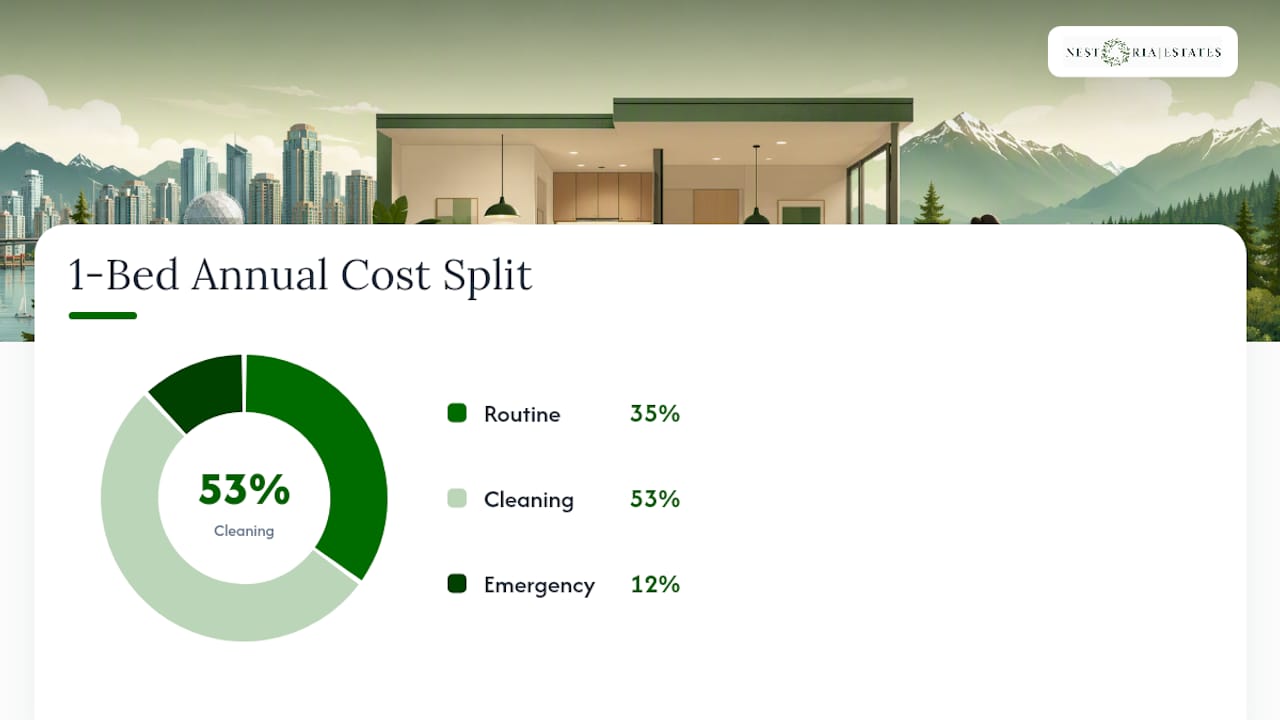
Emergency items (the unpredictable third): burst pipes, HVAC failures mid-stay, and appliance breakdowns during a booking. Emergency repairs make up roughly 32% of total repair spend across the industry dataset, and they cost more because they’re urgent, not planned.
A sample tally: a 1-bedroom unit might run $1,200 routine + $1,800 cleaning + $400 emergency reserve = $3,400/year. A 3-bedroom house scales to roughly $2,800 routine + $4,200 cleaning + $1,000 emergency reserve = $8,000/year.
Why Turnover Makes STRs Cost More Than Long-Term Rentals
A long-term tenant might trigger a maintenance call twice a year. A short-term rental with 15 turnovers a month generates 15 opportunities for wear, damage, and cleaning demand every single month. That difference compounds fast.
Here’s the mechanics in three steps:
Turnover accelerates wear. Furniture, linens, and flooring absorb far more foot traffic and handling than in a standard tenancy, shortening replacement cycles by roughly half.
Cleaning becomes a recurring line item, not an occasional one. At 15 turnovers a month and $125 per clean, that’s $1,875 in monthly cleaning spend alone, before any other maintenance category.
Furnishings need capital planning, not ad hoc replacement. A sofa that lasts eight years in a long-term rental might need swapping every three to four years in a high-turnover STR, which means your capital reserve has to account for shorter depreciation windows.
This is a structural cost difference, not a management failure. Owners who don’t plan for it end up funding replacements out of cash flow instead of a reserve, which is where budgets quietly fall apart.
Build a Maintenance Budget Map: Reserves, Buckets, and Sample Numbers
A maintenance budget map splits spending into three buckets, and treating them separately makes the numbers far easier to forecast. This approach mirrors how Ontario landlords structure annual cost forecasting to avoid surprise shortfalls.
Bucket 1: Routine maintenance. HVAC servicing, minor repairs, pest control. Predictable, scheduled, low variance.
Bucket 2: Turnover costs. Cleaning, linens, consumables. Scales directly with booking volume.
Bucket 3: Capital replacements. Furniture, appliances, flooring, systems. Irregular but large when they hit.
Keep a separate contingency fund of at least $500, sized larger for older buildings or properties with shared building systems like elevators or boilers.
Sample budget, moderate-turnover condo: $990 routine + $1,500 cleaning + $700 capital reserve = $3,190/year.
Sample budget, high-turnover vacation home: $2,500 routine + $4,800 cleaning/linens + $2,000 capital reserve = $9,300/year.
Pro Tip: Track actual spend against your budget every quarter, not just at year end. Costs drift, and a budget built once and never revisited stops reflecting reality within 18 months.
Current Expenses vs Capital Expenses: What Canadian Owners Need to Know
The Canada Revenue Agency draws a firm line between two categories of spending, and getting it wrong can cost you at tax time. A current expense restores a property to its original condition, like patching a roof leak or repainting a wall. It’s fully deductible in the year you pay it. A capital expense extends the useful life of the property or improves it beyond original condition, like replacing an entire roof or renovating a kitchen. It gets capitalized and depreciated over time through Capital Cost Allowance (CCA) rather than deducted all at once.
CCA rates vary by asset class:
Class 8 covers furniture and appliances, typically depreciated at 20% per year.
Class 1 covers most buildings, depreciated at 4% per year.
Class 3 applies to certain older buildings, at 5% per year.
Keep every invoice sorted by category from day one. Misclassifying a capital renovation as a current repair is one of the most common errors Canadian rental owners make on their returns, and it’s worth a conversation with an accountant before you file, not after. Nestoriaestates covers this in more depth in its guide to property owner tax tips for Vancouver Airbnb hosts.
Vendor Management: The Fastest Way to Cut Emergency Spend
Emergency repairs cost more because they’re reactive. The fix is building relationships before you need them, not after.
Pre-vet a contractor network for plumbing, electrical, HVAC, and appliance repair, plus a reliable housekeeping team, so you’re not searching mid-emergency.
Run a preventive schedule: annual HVAC servicing, seasonal checks before winter and summer, and a linen refresh every six to twelve months.
Use vendor agreements with response-time SLAs, especially for guest-facing issues like heating failures or plumbing leaks during a stay.
A pre-vetted vendor network shortens response times and locks in better rates than one-off emergency calls.
Pro Tip: Schedule your annual HVAC service in the shoulder season, right before your peak booking months. It’s cheaper, contractors have more availability, and you’re not risking a mid-summer breakdown during your busiest week.
A Vancouver Practitioner’s Take on Maintenance Reality
Every Vancouver owner Nestoria Estates works with underestimates one thing at first: how fast turnover-driven wear adds up compared to a standard tenancy. The surprises aren’t the big emergencies. They’re the accumulated small stuff.
Two things to do immediately: build a $500 to $1,000 contingency fund before your first booking, and schedule HVAC servicing before peak season, not after a failure. Full-service management earns its cost mainly when your portfolio grows past one or two units, or when you’d rather not field a 2 AM plumbing call yourself.
— Kamran
Predictable Maintenance Without the Guesswork
Nestoria Estates gives Vancouver owners something a spreadsheet can’t: a pre-vetted vendor network already in place, scheduled preventive checklists that catch problems before they become emergencies, and monthly reporting that shows exactly what maintenance cost you and why. Instead of chasing down a plumber at midnight or guessing at next year’s repair budget, you get a system already built around the benchmarks covered above.

This works best for Vancouver owners who want their short-term rental to run like a business, not a second job. If you’re weighing self-management against full-service support, request a free revenue and expense projection and see exactly where your property lands against these numbers. Explore the full scope of maintenance and management services Nestoria Estates provides for Vancouver hosts.
Sources
The figures throughout this guide draw from the RapidEye vacation rental maintenance dataset, built from over 15,000 work orders. Canadian tax specifics come from the CRA’s own pages on capital cost allowance classes and current versus capital expenses. Vendor-management guidance comes from Canadian Real Estate Magazine’s reporting on preventive maintenance practices.
Vacation Rental Maintenance Cost Statistics (2026) | RapidEye
FAQ
What expenses can be deducted from short-term rental income?
Current expenses that restore a property to its original condition, like minor repairs, cleaning, and routine servicing, are fully deductible the year you pay them. Capital expenses that improve or extend the property’s life must be depreciated through CCA instead.
What is the new tax rule for Airbnb owners in Canada?
The CRA continues to enforce the current-versus-capital expense distinction closely for short-term rental owners, so keeping invoices sorted by category from the start matters more than ever. Consult an accountant for changes specific to your filing year.
Is four months considered a short-term rental?
Definitions vary by province and municipality, but most short-term rental regulations in Canada apply to stays shorter than about a month, meaning a four-month booking would typically fall under long-term rental rules instead.
Recommended
Comments